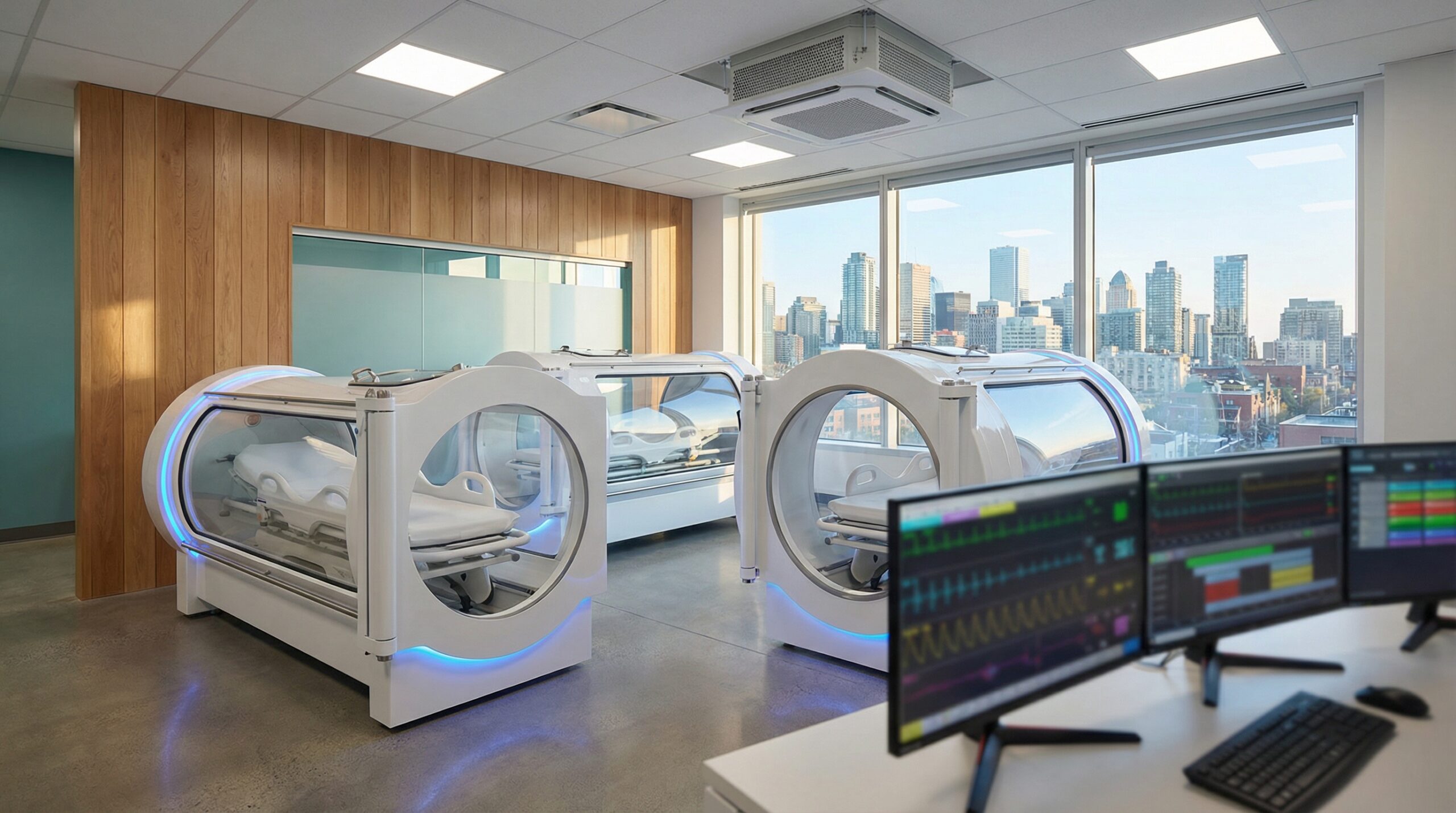
TL;DR: Canada’s hyperbaric oxygen therapy industry is projected to grow at a 5.2% CAGR through 2031, driven by expanding clinical indications, growing post-COVID demand, and advancing chamber technology. Clinic owners who invest in accreditation, embrace emerging indications backed by new research, and adopt modern monitoring systems are best positioned to capture this growth. Here is what you need to know to stay ahead in 2026.
Hyperbaric oxygen therapy (HBOT) is a growing medical sector in Canada, with increasing demand from patients, expanding private clinic networks, and evolving provincial coverage policies. Estimated reading time: 10 minutes
The Canadian hyperbaric oxygen therapy (HBOT) industry is entering a period of meaningful expansion. Hyperbaric oxygen therapy is a medical treatment in which patients breathe 100% oxygen inside a pressurized chamber, typically at 1.5 to 3.0 atmospheres absolute (ATA). As new research validates additional clinical applications and patient awareness continues to rise, clinic owners and operators across Canada face both significant opportunities and evolving regulatory expectations. At Canada Hyperbarics, we track these developments closely to help the industry stay informed and prepared.
This article examines the key trends shaping the Canadian HBOT landscape in 2026, from market growth data and emerging indications to insurance coverage shifts, technology advances, and accreditation standards that every clinic owner should understand.
How Is the Canadian HBOT Market Growing in 2026?
The numbers paint a clear picture of steady expansion. Canada’s HBOT market is projected to grow at a compound annual growth rate (CAGR) of 5.2% between 2025 and 2031, according to industry analysis by 6W Research. Globally, the HBOT devices market is forecast to reach USD $6.5 billion by 2033, with North America accounting for approximately 31.7% of that total.
Several factors are driving this growth in Canada specifically:
- An ageing population – Canada’s demographic shift is increasing demand for treatments addressing chronic wounds, diabetic complications, and age-related conditions that respond well to hyperbaric therapy.
- Rising chronic disease prevalence – Diabetes rates continue to climb across 10 provinces, and non-healing diabetic foot ulcers remain one of the most well-established indications for HBOT.
- Post-COVID awareness – The pandemic introduced millions of Canadians to the concept of HBOT through media coverage of its use in treating post-COVID fatigue and neurological symptoms, driving new patient inquiries.
- Increased healthcare spending – Provincial and federal healthcare budgets have expanded, with a growing focus on advanced medical therapies including hyperbaric medicine.
For clinic owners, this growth translates into a larger addressable patient population and greater referral volume – but only for facilities that maintain high clinical standards and stay current with evolving best practices.
What Emerging Indications Are Expanding Clinic Services?
Beyond the 14 indications currently approved by Health Canada and the Undersea and Hyperbaric Medical Society (UHMS), a wave of new research is broadening the therapeutic landscape for HBOT. These emerging indications represent potential growth areas for clinics that position themselves at the forefront of evidence-based practice.
Neurosurgical Applications
A 2024 review published in Medical Gas Research documented the expanding role of HBOT across multiple neurosurgical conditions. The authors noted that “hyperbaric oxygen has significant positive effects on the treatment of cerebral ischemia, intracranial tumors, and other neurosurgical conditions” and is “gradually gaining wide recognition by clinicians” (Chen et al., 2024; PMID: 40826939). For clinic owners, this signals growing referral potential from neurosurgery departments.
Aesthetic and Reconstructive Surgery
One of the most notable emerging market segments is aesthetic surgery recovery. A systematic review and meta-analysis published in Aesthetic Plastic Surgery evaluated HBOT as an adjunct in aesthetic procedures and found evidence supporting its use in improving healing outcomes and reducing complications following cosmetic surgery (2025; PMID: 40011247). This represents a largely self-pay patient population – an attractive revenue stream for private clinics.
Osteoporosis and Bone Health
A 2025 systematic review published in Bone examined preclinical evidence for HBOT as a direct anti-osteoporotic intervention, noting that it has been “proposed as a direct anti-osteoporotic intervention rather than solely an adjunctive therapy” (2025; PMID: 41483655). While clinical trials in humans are still needed, this research direction could eventually open an enormous patient population given that over 2 million Canadians live with osteoporosis.
Post-COVID Recovery
Research published in Scientific Reports in 2026 demonstrated that HBOT produces measurable metabolic reprogramming of endothelial-related pathways in COVID-19 patients, providing a biological basis for the clinical improvements observed in long COVID patients receiving hyperbaric treatment (2026; PMID: 41851311). Post-COVID clinics that offer HBOT are seeing sustained demand across Canada.
How Are Insurance and Coverage Trends Affecting HBOT Clinics?
Insurance coverage remains one of the most significant barriers – and opportunities – for HBOT clinic operators in Canada. The landscape is complex and varies considerably by province.
| Province | Public Coverage | Where Available | Private Clinic Coverage |
|---|---|---|---|
| Ontario | OHIP – 14 indications | Hospitals and eligible private clinics | Yes, some bill OHIP directly |
| British Columbia | MSP – limited | Vancouver General Hospital | Not covered by MSP (out-of-pocket) |
| Alberta | AHCIP – limited | AHS hospital clinics (Calgary, Edmonton) | Not covered by AHCIP |
| Quebec | RAMQ – limited | Hospital-based only | Not covered by RAMQ |
| Nova Scotia | MSI – limited | QEII Health Sciences Centre | Not covered by MSI |
| Other provinces | Varies | Limited or no public coverage | Typically out-of-pocket |
A cross-sectional analysis published in the Journal of Reconstructive Microsurgery found that physicians frequently report challenges obtaining insurance coverage for HBOT, even for approved indications such as acutely compromised grafts and flaps (2025; PMID: 40505695). This coverage gap creates both a challenge and a niche for well-documented clinics that can navigate the pre-authorisation process effectively.
Key trends clinic owners should watch:
- Private insurance expansion – Several major Canadian insurers have expanded their coverage of HBOT for approved indications, particularly diabetic wound care and radiation injury recovery.
- Documentation is critical – Clinics with robust documentation practices, including standardised outcome tracking and treatment protocols aligned with CUHMA and UHMS guidelines, are more successful in securing insurance approvals.
- Self-pay market growth – The growing interest in HBOT for emerging indications (post-COVID, concussion recovery, aesthetic surgery) is driving a robust self-pay segment that does not depend on provincial coverage.
What Technology Advances Should Clinic Owners Watch?
The hyperbaric chamber itself is evolving. Several technology trends are reshaping how clinics operate and deliver care:
1. Digital Monitoring and AI-Guided Dosing
Modern chamber manufacturers are integrating digital sensors, AI-guided oxygen dosing protocols, and remote monitoring software into new chamber models. These systems allow for more precise treatment delivery, real-time patient monitoring, and automated safety alerts. For clinic owners evaluating capital equipment purchases, chambers with integrated digital systems offer both clinical and operational advantages.
2. Improved Monoplace Chamber Designs
Monoplace chambers continue to dominate the Canadian private clinic market due to their lower capital cost, smaller footprint, and simpler staffing requirements. Newer models feature improved patient comfort, larger viewports, enhanced communication systems, and faster pressurisation cycles – all factors that improve patient throughput and satisfaction.
3. Telehealth Integration
Post-pandemic telehealth adoption is enabling hyperbaric clinics to conduct initial consultations, follow-up assessments, and wound progress monitoring remotely. This expands the geographic reach of clinics, particularly in a country as vast as Canada where patients in rural and northern communities often face significant travel barriers to access HBOT.
4. Data Analytics for Outcomes Tracking
Leading clinics are implementing electronic health record (EHR) systems specifically configured for hyperbaric medicine, enabling standardised outcome tracking, treatment protocol adherence monitoring, and data-driven quality improvement. This data is increasingly valuable for insurance negotiations and accreditation audits.
How Are Accreditation Standards Evolving in Canada?
Accreditation is becoming a key differentiator for Canadian HBOT clinics. The Canadian Undersea and Hyperbaric Medical Association (CUHMA) has established accreditation standards that evaluate facilities across four pillars: facility infrastructure, equipment compliance, staff qualifications, and training protocols.
Clinic owners should anticipate that accreditation will increasingly become a requirement – not just a differentiator – for insurance reimbursement and physician referrals. Key steps to prepare include:
- Review CUHMA Standards of Practice Guidelines – Ensure your facility meets or exceeds the current edition requirements.
- Staff certification – All clinical staff operating hyperbaric chambers should hold current certification from a recognised training programme (UHMS, NBDHMT, or equivalent).
- Equipment maintenance documentation – Maintain comprehensive logs of chamber inspections, maintenance, and safety testing per Health Canada medical device regulations.
- Emergency protocols – Written emergency procedures for fire, decompression emergencies, and medical emergencies must be current, practised regularly, and documented.
- Quality assurance programme – Implement a formal QA programme with regular chart audits, outcome tracking, and incident reporting.
For more detail on compliance requirements, see our comprehensive guide on Health Canada regulations for hyperbaric clinics.
What Does the Global HBOT Landscape Mean for Canadian Operators?
Canada does not operate in isolation. Global trends in hyperbaric medicine directly influence the Canadian market:
- Hospital versus private clinic dynamics – Globally, hospitals account for approximately 54.85% of HBOT delivery. However, the private and home-care segment is growing at a 9.42% CAGR, indicating a shift toward outpatient and community-based models that favour Canadian private clinic operators.
- Research investment – International investment in HBOT clinical trials is accelerating, particularly in neurology (TBI, stroke, Alzheimer’s), oncology support, and regenerative medicine. Canadian clinics can leverage this research to expand their referral networks and patient education efforts.
- Regulatory harmonisation – As Health Canada monitors international regulatory developments, Canadian clinic owners should expect evolving guidelines that align with global standards, particularly around chamber safety, staff qualifications, and approved indications.
At Canada Hyperbarics, we maintain an up-to-date research database of thousands of HBOT studies to help clinic owners and practitioners stay current with the evidence base.
Frequently Asked Questions
How fast is the Canadian HBOT market growing?
The Canadian hyperbaric oxygen therapy market is projected to grow at a compound annual growth rate of 5.2% between 2025 and 2031, driven by an ageing population, rising chronic disease rates, and expanding clinical evidence for new indications.
What new conditions are being treated with HBOT?
Emerging research areas include neurosurgical applications, post-COVID recovery, aesthetic surgery support, osteoporosis, and various neurological conditions such as traumatic brain injury and Alzheimer’s disease. These are in addition to the 14 indications already approved by Health Canada and UHMS.
Is HBOT accreditation mandatory in Canada?
CUHMA accreditation is not yet legally mandatory in all provinces, but it is increasingly expected by referring physicians and insurance providers. Clinic owners should pursue accreditation proactively as it is trending toward becoming a baseline requirement for reimbursement.
How can clinic owners improve insurance reimbursement rates?
Focus on thorough documentation, standardised treatment protocols aligned with UHMS and CUHMA guidelines, outcome tracking, and proactive communication with insurance providers. Research shows that physicians frequently face coverage challenges even for approved indications, making documentation quality essential.
What technology investments should HBOT clinics prioritise?
Digital monitoring systems, AI-assisted oxygen dosing, telehealth platforms for remote consultations, and electronic health record systems configured for hyperbaric medicine offer the highest return on investment for modern clinics.
Does provincial health insurance cover HBOT at private clinics?
Coverage varies significantly by province. Ontario (OHIP) covers 14 indications at both hospitals and eligible private clinics. Most other provinces limit public coverage to hospital-based programmes. Private insurance and self-pay options are available across Canada. See our conditions and coverage guide for province-specific details.
How many hyperbaric clinics are there in Canada?
Canada has a network of both hospital-based and private hyperbaric facilities spanning from British Columbia to Nova Scotia. CUHMA maintains a directory of accredited and recognised facilities. The number of private clinics continues to grow, particularly in Ontario, Alberta, and British Columbia. See our facility directory for current listings.
What role does CUHMA play in the Canadian HBOT industry?
The Canadian Undersea and Hyperbaric Medical Association (CUHMA) promotes excellence in hyperbaric and diving medicine through education, best practice guidelines, and facility accreditation. Established in 2015, CUHMA provides the primary framework for clinical standards in Canadian hyperbaric medicine.
Looking Ahead: Positioning Your Clinic for Growth
The Canadian HBOT industry in 2026 offers significant opportunities for clinic owners who approach growth strategically. The combination of expanding clinical evidence, increasing patient awareness, evolving technology, and a favourable market trajectory creates conditions for sustainable business development.
The clinic owners who will benefit most are those who invest in three areas: clinical excellence through accreditation and evidence-based protocols, operational efficiency through modern technology, and patient access through expanded service offerings and insurance navigation.
Stay informed on the latest developments in Canadian hyperbaric medicine by exploring our research database and frequently asked questions. For a comprehensive overview of HBOT conditions and treatment pathways, visit our conditions guide.
References
- Chen et al. (2024). Mechanism and application of hyperbaric oxygen therapy in neurosurgery. Medical Gas Research. DOI: 10.4103/mgr.MEDGASRES-D-24-00164. PMID: 40826939.
- Efficacy of Hyperbaric Oxygen Therapy as an Adjunct in Aesthetic Surgery: A Systematic Review and Meta-analysis (2025). Aesthetic Plastic Surgery. DOI: 10.1007/s00266-025-04728-9. PMID: 40011247.
- Hyperbaric oxygen therapy for osteoporosis: A systematic review of preclinical evidence and mechanisms (2025). Bone. DOI: 10.1016/j.bone.2025.117772. PMID: 41483655.
- Metabolic reprogramming of endothelial-related pathways in COVID-19 patients treated with hyperbaric oxygen therapy (2026). Scientific Reports. DOI: 10.1038/s41598-026-44520-6. PMID: 41851311.
- Insurance Coverage for Hyperbaric Oxygen Therapy in Acutely Compromised Tissues (2025). Journal of Reconstructive Microsurgery. DOI: 10.1055/a-2616-3981. PMID: 40505695.
This content is for informational purposes only and does not constitute medical advice. Hyperbaric oxygen therapy should only be administered by qualified healthcare professionals in accredited facilities. Consult your physician or a certified hyperbaric medicine specialist for treatment decisions. Canada Hyperbarics is an independent educational resource and is not affiliated with any specific clinic or manufacturer.