Conditions | Canada Hyperbarics Skip to main content

Clinical Evidence Database

Conditions & Clinical Evidence

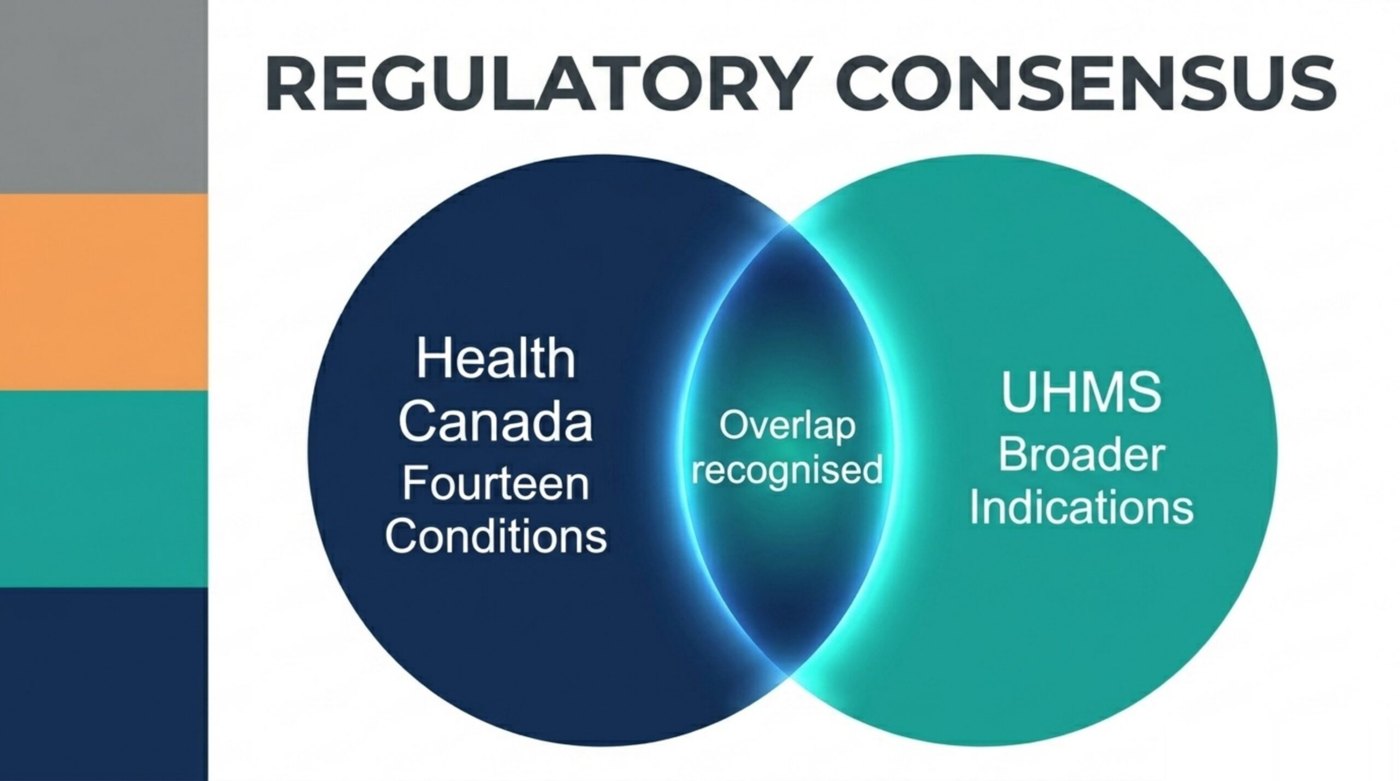
Hyperbaric oxygen therapy is recognised for 14 conditions by Health Canada. The UHMS Indications list partially overlaps and is broader. Evidence levels range from gold-standard RCTs to emerging pilot studies.

· Canada Hyperbarics Editorial Team · Sources

Evidence Levels: How to Read the Cards Below

Level A

Strong Evidence

High-quality randomised controlled trials and systematic reviews. Universally accepted as standard of care.

Level B

Moderate Evidence

Controlled studies and consistent clinical evidence. Adjunctive use is established practice.

Level C

Expert Consensus

Case series, mechanistic data, and expert opinion. Used in selected cases where higher-tier evidence is unavailable.

Cards in the Emerging Research tab use On UHMS list for indications recognised by the UHMS but not currently on Health Canada's 14-condition list, and Emerging for indications under active research with promising but not yet definitive evidence.

For Patients

Not sure if your condition is on this list?

Use our patient decision guide to assess whether HBOT may be right for you, plus questions to bring to your physician.

Read the guide
Level A Read more →

Decompression Sickness

The gold-standard treatment for decompression illness ("the bends") in divers. HBOT is the primary and universally accepted intervention.

Standard of care, UHMS, all diving medical authorities

Level A Read more →

Carbon Monoxide Poisoning

Strong RCT evidence demonstrates HBOT reduces cognitive sequelae. Standard of care in many emergency departments across Canada.

Weaver et al., NEJM 2002, Landmark RCT

Level A Read more →

Arterial Gas Embolism

Emergency indication for gas bubbles in arterial circulation. HBOT reduces bubble volume through Boyle's Law and accelerates gas reabsorption.

UHMS Emergency Indication, Universally accepted

Level A Read more →

Soft Tissue Radiation Necrosis

Strong evidence for radiation cystitis, radiation proctitis, and soft tissue necrosis after cancer radiotherapy. HBOT promotes angiogenesis in radiation-damaged tissue and is covered by OHIP at hospital programmes.

Marx 1983, Landmark study; UHMS & Health Canada Approved

Level A Read more →

Radiation Damage Affecting Bone

HBOT is the standard adjunctive treatment for osteoradionecrosis of the jaw and other bones. Used before and after dental procedures in irradiated fields to promote healing and prevent necrosis.

UHMS & Health Canada Approved, Dental/surgical adjunct in irradiated fields

Level B Read more →

Gas Gangrene

Adjunctive to surgery and antibiotics for clostridial myonecrosis. HBOT inhibits toxin production and enhances immune function against anaerobic bacteria.

UHMS Indication, Adjunctive therapy

Level B Read more →

Crush Injuries & Acute Ischaemia

Time-sensitive adjunctive therapy for crush injuries, compartment syndrome, and acute traumatic ischaemias. Reduces oedema and supports tissue viability.

UHMS Indication, Time-critical adjunct

Level B Read more →

Necrotizing Soft Tissue Infections

Adjunctive to surgical debridement. HBOT enhances leukocyte killing, inhibits anaerobic organisms, and improves antibiotic penetration into infected tissue.

UHMS Indication, Adjunctive to surgery

Level B Read more →

Compromised Grafts & Flaps

Supports viability of compromised skin grafts and tissue flaps through enhanced oxygenation, promoting neovascularization in ischaemic tissue beds.

UHMS Indication, Post-surgical adjunct

Level B Read more →

Refractory Osteomyelitis

Adjunctive to antibiotics and surgery for chronic bone infections that resist conventional treatment. Enhances oxygen-dependent leukocyte bactericidal activity.

UHMS Indication, Adjunctive therapy

Level B Read more →

Sudden Sensorineural Hearing Loss

Added to the UHMS Indications list in 2014. Growing evidence supports HBOT for idiopathic sudden hearing loss, particularly when combined with corticosteroids. Best outcomes when initiated within 14 days of onset.

UHMS Indication (added 2014), Best when initiated within 14 days of onset

Level B Read more →

Severe Anaemia (Exceptional Blood Loss)

When transfusion is impossible or blood loss is too great for the body to compensate, HBOT provides a bridge by dissolving oxygen directly into plasma, supporting tissue oxygenation until red blood cells can be restored.

UHMS Indication, Emergency/adjunctive therapy

Level B Read more →

Acute Thermal Burn Injury

Adjunctive therapy for severe burns. HBOT reduces oedema, supports tissue viability in the zone of stasis, enhances immune function, and may reduce the need for surgical intervention in selected cases.

UHMS Indication, Adjunctive to burn care
On UHMS list Read more →

Intracranial Abscess

Adjunctive to surgery and antibiotics for brain abscesses. HBOT enhances antibiotic penetration, supports leukocyte bactericidal activity, and reduces cerebral oedema in hypoxic brain tissue. On the UHMS Indications list, though not currently listed among Health Canada's 14 recognised conditions.

On UHMS Indications list, Not on Health Canada's 14-condition list

Emerging

Traumatic Brain Injury & Concussion

Active research area with mixed but promising RCT results. Particularly relevant to Canada's contact sports community. Studies suggest HBOT may promote neuroplasticity and reduce neuroinflammation.

Harch et al., J Neurotrauma 2012; Efrati et al., View studies · FAQ

Emerging

Stroke Recovery

Israeli RCTs demonstrated measurable neurological improvements in chronic stroke patients, with researchers investigating whether HBOT may support neurological recovery in chronic stroke patients.

Efrati et al., PLoS ONE 2013, View studies · FAQ

Emerging

Fibromyalgia

A prospective RCT demonstrated HBOT can diminish fibromyalgia syndrome with improvements in pain thresholds, quality of life, and brain function on SPECT imaging.

Efrati et al., PLoS ONE 2015, View studies · FAQ

Emerging

PTSD

Military-focused research ongoing with early evidence suggesting HBOT may help alleviate post-traumatic stress disorder symptoms through neuroplasticity mechanisms.

Active military research programs, Phase I/II trials

Emerging

Sports Recovery & Athletic Performance

Growing use among professional athletes for accelerated muscle recovery, soft-tissue injury healing, and post-concussion rehabilitation. Studies suggest HBOT reduces inflammation markers and accelerates return-to-play timelines.

Ishii et al., J Sports Med 2005; multiple case series, See FAQ

Emerging

Anxiety, Depression & Mental Health

Preliminary research suggests HBOT may improve symptoms of anxiety and depression through enhanced cerebral blood flow and neuroplasticity. Studies report improvements in cognitive function and mood regulation.

Hadanny et al., 2022, Neurocognitive RCT; See FAQ

Emerging

Anti-Aging & Longevity

A landmark Israeli RCT demonstrated HBOT can lengthen telomeres and clear senescent cells in aging adults, two key biological hallmarks of aging, though clinical significance and long-term implications require further study.

Hachmo et al., Aging 2020, Telomere RCT; See FAQ

Emerging

Inflammatory Bowel Disease (Crohn's & Colitis)

Growing evidence supports HBOT as adjunctive therapy for refractory Crohn's disease and ulcerative colitis, particularly for perianal fistulae. Studies report improved healing rates and symptom reduction.

Dulai et al., Aliment Pharmacol Ther 2014; See FAQ

Note: The following conditions are under investigation with limited or preliminary evidence. HBOT for these indications is not currently supported by robust clinical data and should not be considered standard of care. Research is ongoing.

Cerebral Palsy

Canadian multicentre RCT (Collet et al., Lancet 2001) found improvements in both HBOT and control groups, creating ongoing debate about pressurized air effects.

Autism Spectrum Disorder

Rossignol et al. (BMC Pediatrics 2009) showed modest improvements in some symptoms. Results remain debated and replication studies are needed.

Multiple Sclerosis

Early studies generated interest but have not been consistently replicated. Current evidence insufficient to recommend HBOT for MS treatment.

Lyme Disease

Largely anecdotal evidence with no strong clinical trial support. Not an approved indication; patients should discuss with their healthcare provider.

Alzheimer's Disease & Dementia

Animal models and small human studies suggest HBOT may improve cerebral blood flow and reduce amyloid plaque burden. Clinical evidence remains preliminary and larger trials are needed.

Shapira et al., Neurobiol Aging 2021, View studies

Chronic Fatigue Syndrome

Limited but intriguing evidence from small trials showing improvements in fatigue severity, cognitive function, and quality of life. Mechanism may involve improved mitochondrial function and reduced neuroinflammation.

Akarsu et al., UHM 2013, View studies

Spinal Cord Injury

Preclinical and small clinical studies suggest HBOT may reduce secondary injury and promote functional recovery when administered in the acute or subacute phase. Human data remains limited.

Huang et al., J Neurosurg 2014, View studies