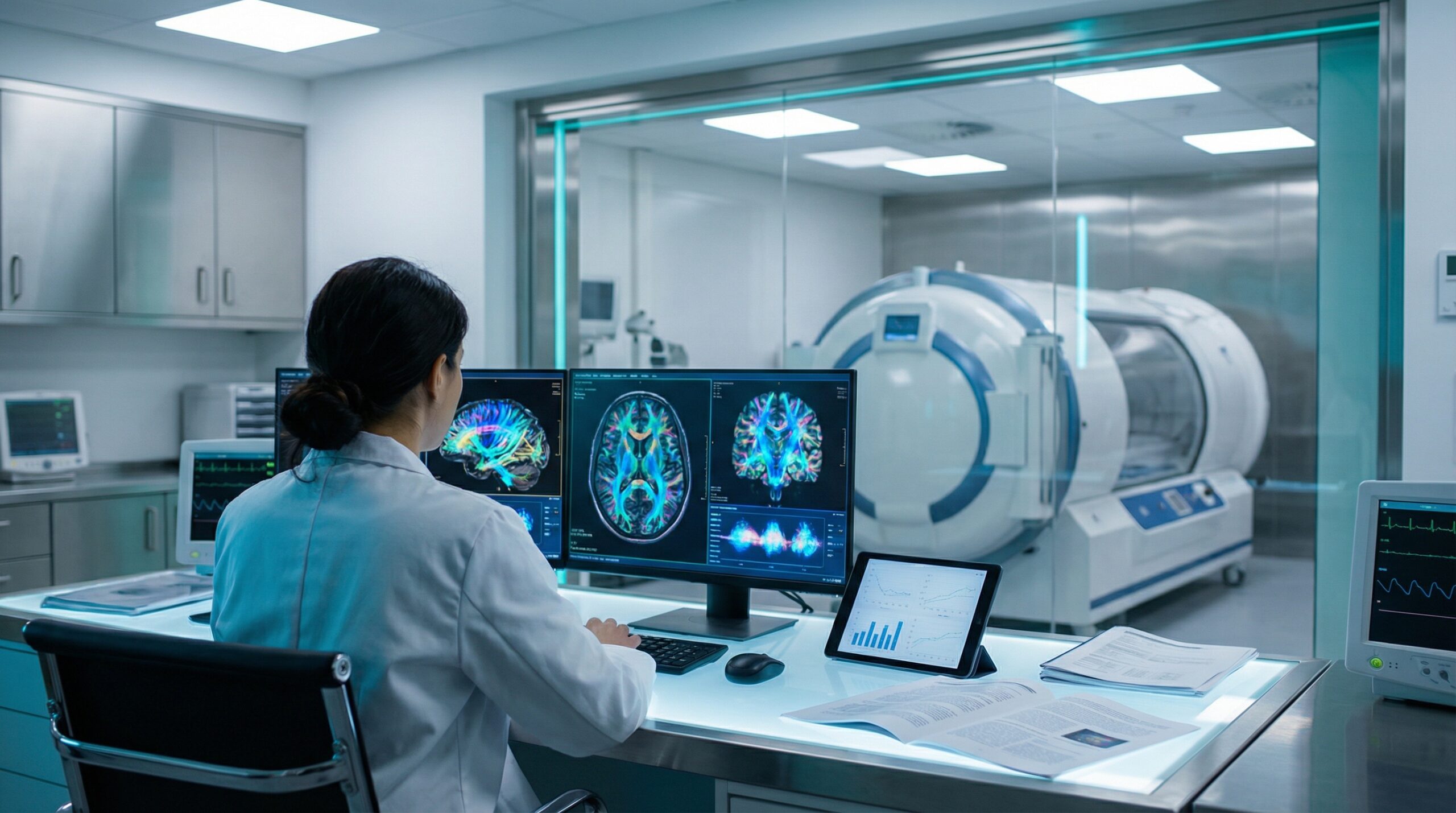
TL;DR: A 2025 systematic review and meta-analysis found that hyperbaric oxygen therapy (HBOT) significantly improves neurocognitive outcomes in traumatic brain injury (TBI) patients. Multiple randomised controlled trials now demonstrate benefits for cognitive function, memory, executive function, and post-concussion symptoms – though optimal protocols, patient selection criteria, and long-term durability remain active areas of investigation.
Hyperbaric oxygen therapy (HBOT) is an emerging adjunctive treatment for traumatic brain injury (TBI) that delivers 100% oxygen at pressures above 1 atmosphere absolute (ATA) to enhance cerebral oxygenation, reduce neuroinflammation, and promote neuroplasticity. With an estimated 69 million people sustaining TBIs globally each year and limited pharmacological options for long-term neurocognitive deficits, HBOT has become one of the most actively researched non-pharmacological interventions in neurorehabilitation. This evidence review examines the most significant recent publications – including a 2025 systematic review and meta-analysis, multiple randomised controlled trials, and emerging mechanistic studies – to assess where the evidence currently stands and where critical gaps remain for Canadian researchers.
What Does the 2025 Systematic Review and Meta-Analysis Show?
The most comprehensive recent synthesis of the literature is a 2025 systematic review and meta-analysis published in Annals of Medicine and Surgery, which evaluated HBOT specifically for neurocognitive deficits following TBI (DOI: 10.1097/MS9.0000000000003902). This meta-analysis is significant because it focused exclusively on cognitive outcomes, a critical and often underserved dimension of TBI recovery, rather than broader neurological endpoints.
The review included randomised controlled trials comparing HBOT to standard care or sham interventions in TBI populations. The authors concluded that HBOT demonstrates statistically significant improvements in neurocognitive function compared with control groups. However, they noted substantial heterogeneity across included trials in terms of:
- TBI severity classification (mild, moderate, severe)
- Time from injury to HBOT initiation (acute versus chronic phase)
- HBOT protocol parameters (pressure, session duration, total number of sessions)
- Cognitive outcome measures used across studies
This heterogeneity limits the strength of pooled effect estimates and underscores the need for standardised protocols in future trials. Nevertheless, the overall direction of evidence favours HBOT as a beneficial adjunctive intervention for TBI-related cognitive impairment.
How Does HBOT Compare to Normobaric Hyperoxia in Mild TBI?
A key question in the field has been whether the hyperbaric pressure component of HBOT provides additional benefit beyond supplemental oxygen alone. A 2023 randomised controlled trial published in Medicine directly addressed this question by comparing HBOT to normobaric hyperoxia (NBH) and standard care in patients with mild TBI (Glasgow Coma Scale 13–15) (DOI: 10.1097/MD.0000000000035215).
The trial, conducted at Cangzhou Central Hospital between 2017 and 2023, measured cognitive outcomes using the Montreal Cognitive Assessment (MoCA) and Mini-Mental State Examination (MMSE), alongside serum biomarkers of brain injury including S100β, neuron-specific enolase (NSE), glial fibrillary acidic protein (GFAP), hypoxia-inducible factor 1-alpha (HIF-1α), and malondialdehyde (MDA). Key findings included:
- Both HBOT and NBH improved MoCA and MMSE scores compared with standard care
- HBOT produced significantly greater cognitive improvement than NBH, with higher MoCA and MMSE scores at 30-day follow-up
- HBOT patients showed greater reductions in all five biomarkers (S100β, NSE, GFAP, HIF-1α, MDA), suggesting enhanced neuroprotection
- Regional cerebral oxygen saturation (rSO2) improved more with HBOT than NBH
These findings are mechanistically important: the superior biomarker response under hyperbaric conditions supports the hypothesis that increased partial pressure of oxygen – not simply supplemental oxygen – drives additional neuroprotective and anti-inflammatory effects. For researchers, this has implications for trial design, as sham protocols using normobaric air at slightly elevated pressures may not be truly inert controls.
What Are the Effects of HBOT on Paediatric Post-Concussion Syndrome?
One of the most rigorous trials to date is a randomised, sham-controlled, double-blind study published in Scientific Reports that evaluated HBOT in children aged 8–15 with persistent post-concussion syndrome (PPCS) from mild-to-moderate TBI (DOI: 10.1038/s41598-022-19395-y). Participants were 6 months to 10 years post-injury – making this a chronic-phase intervention study.
Twenty-five children were randomised to 60 daily HBOT sessions (n=15) or sham treatment (n=10). The results demonstrated significant improvements in the HBOT group across multiple domains:
| Outcome Measure | Effect Size (Cohen’s d) | p-value |
|---|---|---|
| General cognitive score | 0.598 | 0.01 |
| Memory | 0.480 | 0.02 |
| Executive function | 0.739 | 0.003 |
| Planning/organising | 1.09 | 0.007 |
| Global executive composite | 0.528 | 0.001 |
| Emotional symptoms | -0.676 | 0.04 |
| Hyperactivity symptoms | 0.244 | 0.03 |
Critically, clinical improvements correlated with microstructural changes on brain MRI in the insula, supramarginal gyrus, lingual gyrus, inferior frontal gyrus, and fusiform gyrus. This neuroimaging evidence provides an objective biological correlate for subjective symptom improvement – addressing a common criticism of HBOT trials that rely solely on patient-reported outcomes.
The study is particularly relevant because PPCS in children is a growing clinical concern with few evidence-based treatments. The large effect size for executive function (d=0.739) and planning/organising (d=1.09) suggests HBOT may target the frontal lobe dysfunction characteristic of post-concussion cognitive deficits.
What Does the 2024 RCT Show for Moderate TBI?
A 2024 randomised controlled trial published in the Asian Journal of Neurosurgery extended the evidence base to moderate TBI – a population that has been relatively understudied in HBOT research compared to mild TBI (DOI: 10.1055/s-0044-1791997). This trial evaluated whether HBOT, by increasing the partial pressure of inspired oxygen, could improve neurological outcomes in patients with GCS scores of 9–12.
The results supported the use of HBOT as an adjunctive therapy in moderate TBI, with treated patients demonstrating improved neurological outcomes compared with the control group. While the study had a relatively small sample size, it contributes to the growing body of evidence suggesting that HBOT’s benefits are not limited to mild TBI and may extend across the severity spectrum.
What Are the Emerging Findings on HBOT and TBI-Related Sleep Disorders?
A 2026 network meta-analysis in the Journal of Head Trauma Rehabilitation examined the comparative efficacy of interventions for TBI-related sleep disorders across 22 RCTs involving 1,299 patients (DOI: 10.1097/HTR.0000000000001155). Among the non-pharmacological treatments evaluated, HBOT significantly improved Pittsburgh Sleep Quality Index (PSQI) scores compared with control treatments.
This finding is clinically relevant because sleep disturbance is common after TBI and is independently associated with poorer cognitive recovery, mood disorders, and reduced quality of life. The fact that HBOT demonstrated sleep quality benefits adds a secondary outcome dimension that has been largely overlooked in HBOT-TBI research to date.
What Mechanisms Underlie HBOT’s Effects on the Injured Brain?
The proposed mechanisms by which HBOT benefits TBI patients operate across multiple pathophysiological pathways:
- Enhanced cerebral oxygenation: HBOT increases dissolved oxygen in plasma by 10–15 times compared with normobaric conditions, improving oxygen delivery to ischaemic penumbral tissue surrounding the primary injury
- Anti-inflammatory effects: Reductions in HIF-1α and pro-inflammatory cytokines suggest HBOT modulates the neuroinflammatory cascade that drives secondary injury after TBI
- Blood-brain barrier stabilisation: Decreased GFAP and S100β levels indicate reduced astrocytic damage and improved BBB integrity
- Neuroplasticity induction: The intermittent hyperoxic-normoxic cycles characteristic of HBOT protocols may trigger hypoxia-inducible factor pathways during the normoxic intervals, promoting angiogenesis, neurogenesis, and synaptic remodelling
- Oxidative stress reduction: Decreased MDA levels suggest HBOT, when appropriately dosed, does not exacerbate oxidative damage – a concern that has historically limited enthusiasm for the therapy
A 2025 review in Neural Regeneration Research further explored how blood-brain barrier disruption and neuroinflammatory responses influence TBI disease progression, providing additional theoretical grounding for HBOT’s multi-target mechanism of action (DOI: 10.4103/NRR.NRR-D-24-01398).
What Are the Key Research Gaps and Opportunities?
Despite the promising direction of evidence, several critical gaps limit the translation of HBOT-TBI research into clinical practice guidelines:
Protocol Standardisation
There is no consensus on optimal HBOT parameters for TBI. Published trials use pressures ranging from 1.3 ATA to 2.4 ATA, session durations of 60–90 minutes, and total sessions ranging from 20 to 80. The 2025 meta-analysis identified protocol heterogeneity as a primary source of between-study variance. Head-to-head dose-finding trials are urgently needed.
Timing of Intervention
Existing studies span acute (within 72 hours), subacute (weeks to months), and chronic (years post-injury) phases. Whether HBOT works through the same mechanisms at each stage – or whether there is an optimal therapeutic window – remains unresolved. The paediatric PPCS trial demonstrated efficacy even years after injury, suggesting potential for chronic-phase benefit, but this needs replication in larger cohorts.
Patient Selection Criteria
No validated biomarker or clinical criteria exist to predict which TBI patients will respond to HBOT. The 2026 veterans trial sub-study using EEG as a diagnostic and therapeutic monitoring tool (DOI: 10.1186/s13063-026-09531-8) represents an important step toward identifying electrophysiological predictors of treatment response.
Long-Term Durability
Most trials report outcomes at immediate post-treatment or short-term follow-up. Whether cognitive gains persist at 6 months, 12 months, or longer is largely unknown. Long-term follow-up studies are a critical priority.
Canadian Research Opportunities
Canada is well-positioned to contribute to this evidence base. With hyperbaric facilities across multiple provinces and growing clinical interest, there is an opportunity for Canadian researchers to design multi-centre trials that address the protocol standardisation gap. The Canadian Undersea and Hyperbaric Medical Association (CUHMA) and institutional networks through the Undersea and Hyperbaric Medical Society (UHMS) provide infrastructure for collaborative research. Canada’s publicly funded healthcare system also offers advantages for pragmatic trial designs that evaluate real-world effectiveness.
What Does This Mean for the Research Landscape?
The convergence of a positive systematic review and meta-analysis, multiple sham-controlled RCTs, and emerging mechanistic evidence has strengthened the evidence base for HBOT in TBI. The therapy has moved beyond the case-series and observational study phase into a body of randomised evidence that, while not yet definitive, consistently favours benefit.
For researchers, the most impactful next steps include:
- Multi-centre, adequately powered RCTs with standardised protocols and long-term follow-up
- Biomarker-guided patient selection studies to identify responders before treatment
- Mechanistic imaging studies (fMRI, DTI, PET) paired with clinical outcomes to map the biological basis of cognitive improvement
- Health economic analyses comparing HBOT’s cost-effectiveness against standard neurorehabilitation pathways
Canada Hyperbarics maintains a comprehensive research database with thousands of peer-reviewed studies on hyperbaric oxygen therapy, including condition-specific filtering for TBI and related conditions. Researchers can also consult the frequently asked questions section for foundational information on HBOT protocols and regulatory status in Canada.
Frequently Asked Questions
Is HBOT an approved treatment for TBI in Canada?
Traumatic brain injury is not currently among Health Canada‘s 14 recognised conditions for hyperbaric chamber licensing. Research use is permitted under appropriate institutional protocols. Some Canadian clinics offer HBOT for TBI on an off-label basis, and patients should discuss this with their treating physician.
What HBOT protocols have been used in TBI research?
Published trials have used pressures from 1.3 to 2.4 ATA, session durations of 60–90 minutes, and total treatment courses of 20–80 sessions. The most common protocol in recent RCTs is 1.5–2.0 ATA for 60 minutes, 5 days per week, for 40–60 sessions.
How strong is the current evidence for HBOT in TBI?
The evidence has reached the level of systematic reviews and meta-analyses of RCTs. While consistently positive, the body of evidence is limited by small sample sizes, protocol heterogeneity, and short follow-up periods. Larger, standardised trials are needed before clinical practice guidelines can be established.
Are there Canadian clinical trials investigating HBOT for TBI?
Canadian hyperbaric centres have participated in TBI-related research, though large-scale Canadian multicentre trials remain a gap. Researchers interested in collaboration should contact CUHMA or individual hyperbaric facilities for current study information.
What cognitive outcomes has HBOT been shown to improve?
Published RCTs report improvements in general cognitive function, memory, executive function, planning and organising ability, and sleep quality. Effect sizes range from small to large (Cohen’s d 0.24 to 1.09), with executive function showing the most consistent and robust improvements.
References
- Hyperbaric oxygen therapy (HBOT) for neurocognitive deficits following traumatic brain injury: a systematic review and meta-analysis. Annals of Medicine and Surgery. 2025. DOI: 10.1097/MS9.0000000000003902 (PMID: 41180753)
- Liu Z, et al. HBOT has a better cognitive outcome than NBH for patients with mild traumatic brain injury: A randomised controlled clinical trial. Medicine. 2023;102(37):e35215. DOI: 10.1097/MD.0000000000035215 (PMID: 37713814)
- Hadanny A, et al. Hyperbaric oxygen therapy in children with post-concussion syndrome improves cognitive and behavioural function: a randomised controlled trial. Scientific Reports. 2022;12:15233. DOI: 10.1038/s41598-022-19395-y (PMID: 36151105)
- Hyperbaric Oxygen Therapy (HBOT) in Moderate Traumatic Brain Injury (TBI): A Randomised Controlled Trial. Asian Journal of Neurosurgery. 2024. DOI: 10.1055/s-0044-1791997 (PMID: 40041595)
- Treatment of Sleep Disorders Following Traumatic Brain Injury: A Systematic Review and Network Meta-Analysis. Journal of Head Trauma Rehabilitation. 2026. DOI: 10.1097/HTR.0000000000001155 (PMID: 41851059)
- EEG as a diagnostic tool and therapeutic monitor in traumatic brain injury: a sub-study from the hyperbaric oxygen treatment for veterans with TBI randomised controlled trial. Trials. 2026. DOI: 10.1186/s13063-026-09531-8 (PMID: 41692764)
- Traumatic brain injury: Bridging pathophysiological insights and precision treatment strategies. Neural Regeneration Research. 2025. DOI: 10.4103/NRR.NRR-D-24-01398 (PMID: 40145994)
This content is for informational purposes only and does not constitute medical advice. Hyperbaric oxygen therapy for traumatic brain injury should only be pursued under the guidance of a qualified healthcare professional. Consult your physician before beginning any new treatment. Canada Hyperbarics provides this research summary as an educational resource and does not endorse off-label use of any medical therapy.