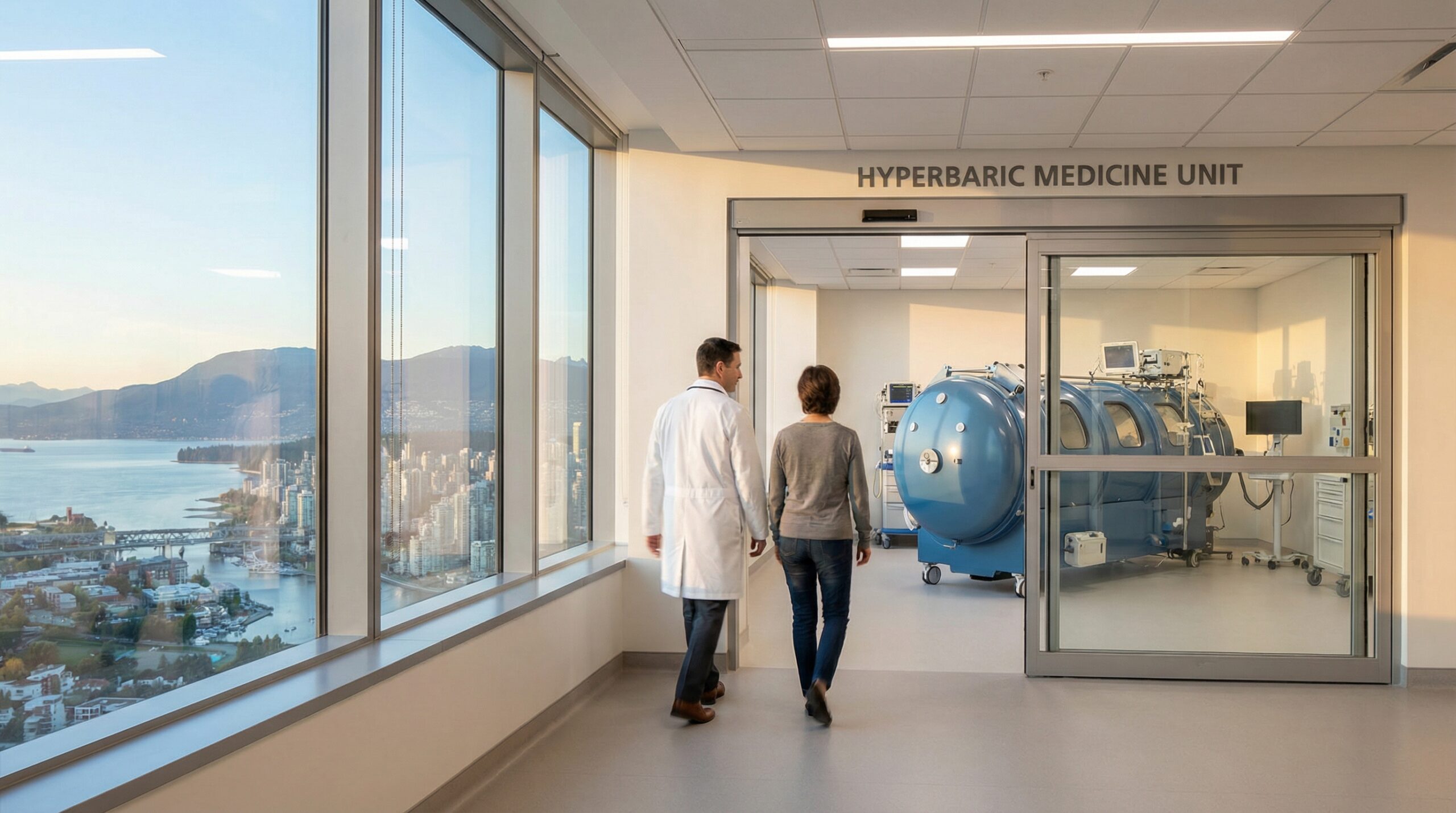
TL;DR: Vancouver General Hospital operates the only hospital-based, Health Canada–compliant hyperbaric oxygen therapy (HBOT) facility in British Columbia. MSP covers treatment at VGH for approved medical indications when referred by a physician. Several private clinics also operate across BC, but treatment at these facilities is not covered by MSP and must be paid out of pocket. This guide covers everything BC residents need to know about accessing HBOT – from MSP coverage and referral steps to private clinic options and costs.
Hyperbaric oxygen therapy (HBOT) is a medical treatment available in British Columbia through one hospital-based program and several private clinics. Hyperbaric oxygen therapy (HBOT) is a medical treatment in which a patient breathes 100% oxygen inside a pressurised chamber at pressures greater than normal atmospheric pressure. In British Columbia, access to this treatment is concentrated primarily at Vancouver General Hospital (VGH), the province’s only hospital-based hyperbaric unit that meets Health Canada licensing requirements and College of Physicians and Surgeons of BC accreditation standards. For BC residents considering HBOT, understanding how MSP coverage works, what conditions qualify, and how to navigate the referral process is essential. Canada Hyperbarics provides this guide to help you make informed decisions about your care.
Estimated reading time: 8 minutes
What Is Hyperbaric Oxygen Therapy and How Does It Work?
Hyperbaric oxygen therapy is a medical treatment that delivers pure oxygen at elevated pressures to promote healing. During a session, you sit or lie inside a sealed chamber while the pressure is gradually increased to between 1.5 and 3.0 atmospheres absolute (ATA). At these pressures, your lungs absorb significantly more oxygen than they would at normal atmospheric pressure, increasing oxygen concentration in your blood plasma by up to 10 to 15 times the normal level.
This oxygen-rich blood reaches tissues that may be damaged, infected, or oxygen-deprived – accelerating wound healing, fighting certain infections, and reducing inflammation. A typical session lasts 60 to 120 minutes, and most treatment protocols involve 20 to 40 sessions depending on the condition being treated. To learn more about how the treatment works, visit our frequently asked questions page.
Which Conditions Does MSP Cover for HBOT in British Columbia?
The Medical Services Plan (MSP) of British Columbia covers hyperbaric oxygen therapy only at Vancouver General Hospital and only for conditions approved by Health Canada. As of 2026, Health Canada recognises 15 approved indications for HBOT, which include:
- Acute carbon monoxide poisoning
- Decompression sickness (the bends)
- Arterial gas embolism
- Gas gangrene (clostridial myonecrosis)
- Crush injuries and acute traumatic ischaemia
- Non-healing wounds (including diabetic foot ulcers)
- Necrotising soft tissue infections
- Refractory osteomyelitis
- Delayed radiation injury (soft tissue and bone)
- Compromised skin grafts and flaps
- Exceptional blood loss anaemia
- Intracranial abscess
- Thermal burns
- Sudden sensorineural hearing loss
According to research retrieved from PubMed, a 2026 systematic review confirmed that HBOT demonstrates beneficial effects on angiogenesis and significantly reduces the rate of major amputations in patients with diabetic foot ulcers (Astasio-Picado et al., 2026). For patients with radiation injury to the jaw, an international clinical guideline co-authored by researchers at BC Cancer and the University of British Columbia reviewed the evidence for HBOT in managing osteoradionecrosis (Peterson et al., 2024).
Important: MSP does not cover HBOT at private clinics in British Columbia. Coverage is limited exclusively to hospital-based treatment at VGH. If you receive treatment at a private clinic, you will need to pay the full cost yourself or seek reimbursement through private insurance if your plan covers it.
For a complete list of conditions treated across Canada, visit our conditions directory.
Where Can You Receive HBOT in British Columbia?
Vancouver General Hospital – The Province’s Only Hospital-Based Facility
The Hyperbaric Unit at Vancouver General Hospital is located in the Leon Judah Blackmore Pavilion (Suite G700, Ground Floor, 855 West 12th Avenue, Vancouver). It is the only facility in British Columbia that meets Health Canada’s licensing requirements and holds accreditation from the College of Physicians and Surgeons of BC.
Key features of the VGH hyperbaric unit:
- Chamber type: Multiplace chamber capable of treating up to 8 patients simultaneously
- ICU capability: Ventilatory support, inotropic support, external pacing, and full physiological monitoring
- Emergency coverage: 24/7 availability for emergency cases (decompression sickness, carbon monoxide poisoning, arterial gas embolism)
- Accreditation: Compliant with CUHMA (Canadian Undersea and Hyperbaric Medical Association) standards
VGH treats only Health Canada–approved indications and requires a physician referral for all non-emergency cases.
Private Hyperbaric Clinics in British Columbia
Several private clinics across BC offer hyperbaric oxygen therapy for both approved and investigational conditions. These clinics are not covered by MSP, and patients pay out of pocket. Private clinics in BC include facilities in the Greater Vancouver area, Richmond, and on Vancouver Island.
When choosing a private clinic, look for:
- Medical-grade monoplace or multiplace chambers (not mild or soft-shell chambers)
- Treatment pressures of at least 1.5 ATA (medical-grade)
- A supervising physician with hyperbaric medicine training
- Emergency protocols and safety procedures in place
- Transparent pricing and treatment plans
For a directory of verified hyperbaric facilities across Canada, visit our clinics directory.
How Much Does HBOT Cost in British Columbia?
At Vancouver General Hospital, HBOT is covered by MSP at no direct cost to the patient for approved indications. You need a physician referral and must have an active MSP enrolment.
At private clinics in British Columbia, costs typically range from:
| Service | Estimated Cost Range |
|---|---|
| Initial consultation | $100–$250 |
| Single HBOT session (60–90 min) | $200–$400 |
| Full treatment course (20–40 sessions) | $4,000–$16,000 |
Costs vary by clinic, chamber type, treatment pressure, and session length. Some private clinics offer package pricing or payment plans. Check with your private health insurance provider – some extended health plans cover a portion of HBOT at private clinics, particularly for approved indications with a physician referral.
How Do You Get a Referral for HBOT in British Columbia?
Getting access to hyperbaric oxygen therapy in BC follows a clear pathway:
- See your family physician or specialist. Discuss your condition and whether HBOT may be appropriate. Your doctor will assess whether your condition matches one of the Health Canada–approved indications.
- Obtain a referral. For VGH, your physician sends a referral to the Hyperbaric Unit. For private clinics, some accept self-referrals, but a physician referral strengthens your case for any insurance claims.
- Assessment at the hyperbaric unit. If referred to VGH, the hyperbaric medicine team will review your medical history, confirm the indication, and assess whether you are a safe candidate for pressurised oxygen treatment.
- Begin treatment. Once approved, you will be scheduled for your treatment sessions. Emergency cases (carbon monoxide poisoning, decompression sickness) are treated on an urgent basis with 24/7 availability.
Wait times: Non-emergency referrals to VGH may involve wait times depending on the urgency and nature of the condition. Emergency indications are treated immediately. If wait times are a concern, some patients choose to begin treatment at a private clinic while awaiting their VGH appointment.
What Does the Research Say About HBOT for Common Conditions in BC?
Based on articles retrieved from PubMed, the evidence supporting HBOT continues to grow across multiple conditions relevant to BC patients:
Diabetic wound healing: A 2026 systematic review found that HBOT significantly reduces the rate of major amputations in patients with diabetic foot ulcers and promotes angiogenesis – the formation of new blood vessels essential for wound repair (Astasio-Picado et al., 2026).
Long COVID: A living systematic review led by researchers at McMaster University in Hamilton, Ontario, evaluated interventions for long COVID and found emerging evidence for HBOT as a treatment option, though the authors noted that larger studies are needed to confirm effectiveness (Zeraatkar et al., 2024). A separate 2026 review analysed 21 studies and concluded that HBOT is a safe treatment that has shown benefits for long COVID symptoms, including improvements in quality of life, fatigue, cognition, and cardiopulmonary function (Zoccali et al., 2026).
Radiation injury: An international clinical guideline for managing osteoradionecrosis – co-authored by clinicians at BC Cancer and the University of British Columbia in Vancouver – reviewed the available evidence for HBOT in preventing and managing radiation-related jaw damage in cancer patients (Peterson et al., 2024).
For the latest research on hyperbaric oxygen therapy, explore our research database with thousands of peer-reviewed studies.
Is HBOT Safe? What Are the Side Effects?
Hyperbaric oxygen therapy is generally considered safe when administered by trained professionals in medical-grade chambers. The most common side effects include:
- Ear and sinus pressure – similar to what you might feel during an aeroplane descent, caused by pressure changes. Equalisation techniques are taught before your first session.
- Temporary short-sightedness (myopia) – some patients experience mild vision changes during a treatment course, which typically resolve within weeks of completing therapy.
- Fatigue – feeling tired after a session is normal and usually mild.
Rare but serious risks include oxygen toxicity seizures and barotrauma to the ears, sinuses, or lungs. These risks are minimised through proper patient screening, controlled pressures, and trained hyperbaric staff – all standard at VGH’s hospital-based unit.
Contraindications include untreated pneumothorax, certain chemotherapy medications, and some ear conditions. Your physician and the hyperbaric medicine team will screen for these before treatment begins.
Can Private Insurance Help Cover HBOT Costs in BC?
While MSP does not cover private clinic HBOT, some extended health benefit plans offered by employers may partially reimburse hyperbaric oxygen therapy. Coverage varies widely by insurer and plan. To improve your chances of reimbursement:
- Obtain a physician referral and prescription for HBOT
- Ensure your condition is a Health Canada–approved indication
- Ask your clinic for itemised receipts with proper medical billing codes
- Contact your insurance provider before starting treatment to confirm coverage
Workers’ compensation claims through WorkSafeBC may also cover HBOT for workplace injuries that fall within approved indications. Veterans Affairs Canada (VAC) may cover treatment for eligible veterans.
Frequently Asked Questions About HBOT in British Columbia
Is hyperbaric oxygen therapy covered by MSP?
MSP covers HBOT only at Vancouver General Hospital for Health Canada–approved indications. Treatment at private clinics is not covered by MSP and must be paid out of pocket or through private insurance.
How many hyperbaric chambers are there in British Columbia?
VGH operates the only hospital-based hyperbaric chamber in BC. Several private clinics also operate chambers across the province, primarily in the Greater Vancouver area and on Vancouver Island.
Do I need a doctor’s referral for HBOT?
Yes, for VGH you must have a physician referral. Some private clinics accept self-referrals, but having a doctor’s referral is recommended for insurance purposes and to ensure HBOT is appropriate for your condition.
How long does a typical HBOT session last?
A standard session lasts between 60 and 120 minutes, depending on the condition being treated and the prescribed protocol. Most treatment courses involve 20 to 40 sessions over several weeks.
Can I get HBOT for long COVID in British Columbia?
Long COVID is not currently a Health Canada–approved indication for HBOT, so it would not be covered by MSP at VGH. Some private clinics in BC offer HBOT for long COVID on a self-pay basis. Research is ongoing – a 2026 review found that HBOT shows promise for improving fatigue, cognition, and quality of life in long COVID patients (Zoccali et al., 2026).
What is the difference between hospital and private HBOT?
Hospital-based HBOT (at VGH) uses medical-grade multiplace chambers, is staffed by specialised hyperbaric medicine physicians, and treats only approved indications. Private clinics vary in equipment quality and may offer treatment for investigational conditions. Always verify that a private clinic uses medical-grade equipment and has qualified medical oversight.
Are there HBOT facilities outside of Vancouver?
Currently, VGH is the only hospital-based facility. Private clinics operate in select communities including Richmond and Parksville (Vancouver Island). Patients in Northern BC, the Interior, or other rural areas may need to travel to the Lower Mainland for treatment. Canada Hyperbarics maintains a directory of verified facilities across the country.
How do I know if HBOT is right for my condition?
Speak with your family physician or specialist. They can assess whether your condition is an approved indication for HBOT and refer you to the appropriate facility. You can also review our conditions page for detailed information on each treated condition.
Next Steps for BC Residents
If you or a loved one is considering hyperbaric oxygen therapy in British Columbia, start by speaking with your physician about whether HBOT is appropriate for your condition. For approved indications, ask your doctor to submit a referral to the VGH Hyperbaric Unit. For more information about HBOT across Canada, explore the Canada Hyperbarics resource centre or browse our research database of thousands of peer-reviewed studies.
This content is for informational purposes only and does not constitute medical advice. Always consult a qualified healthcare provider before starting any new treatment. Hyperbaric oxygen therapy should only be administered under appropriate medical supervision.