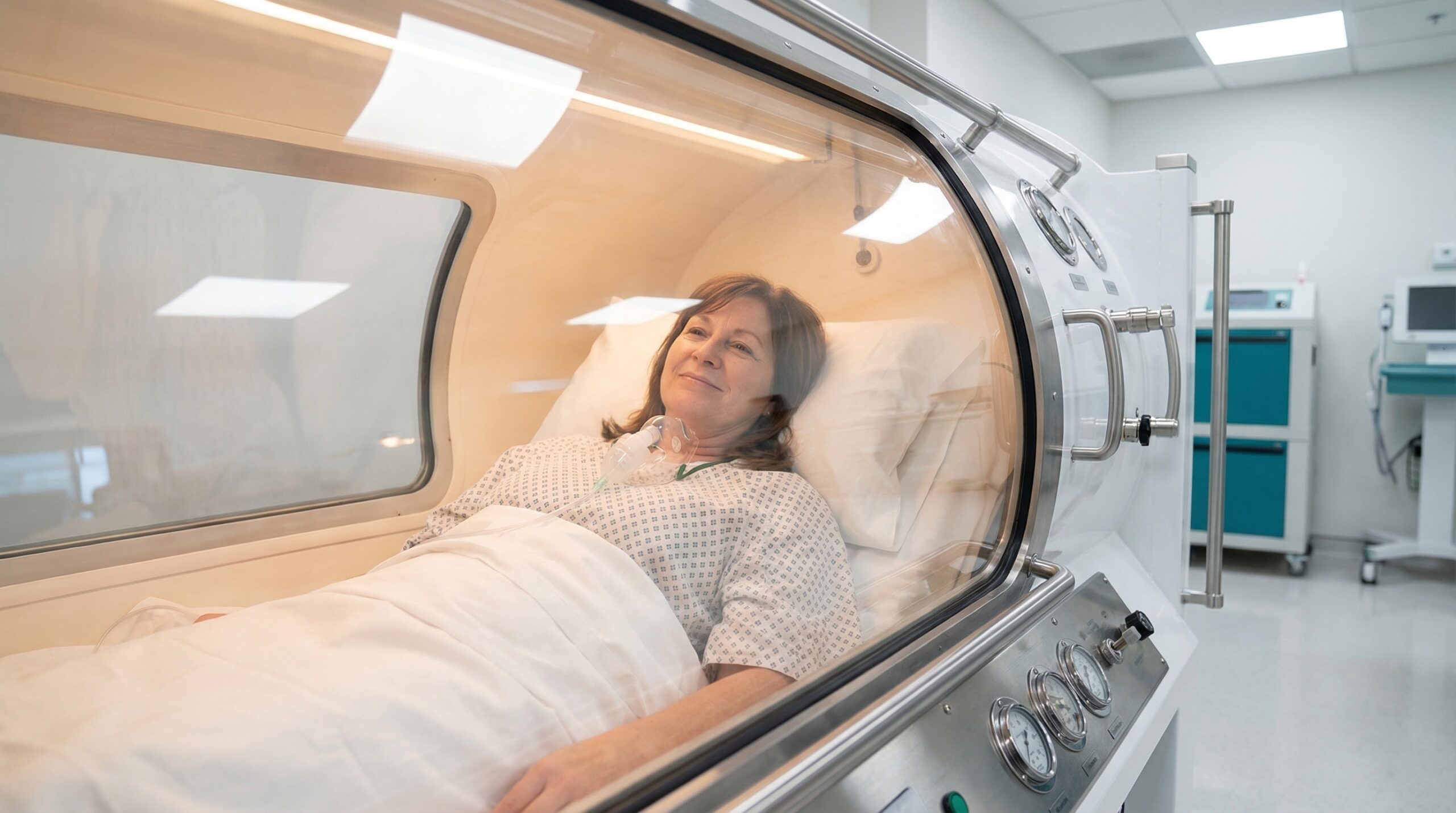
TL;DR: Emerging research suggests hyperbaric oxygen therapy (HBOT) may help relieve long COVID symptoms such as brain fog, chronic fatigue, and pain. A randomised controlled trial found significant improvements in cognitive function, energy, and sleep after 40 HBOT sessions. While promising, HBOT for long COVID is still considered investigational in Canada. This guide explains what patients need to know about the evidence, access, and safety.
Hyperbaric oxygen therapy (HBOT) is a medical treatment being studied as a potential intervention for long COVID, the persistent symptoms experienced by some patients months after SARS-CoV-2 infection. Estimated reading time: 10 minutes
Hyperbaric oxygen therapy for long COVID is an emerging treatment approach that has attracted growing attention from researchers and patients across Canada. Long COVID – also called post-COVID condition or post-acute sequelae of SARS-CoV-2 (PASC) – affects an estimated 6.2% of people who had symptomatic COVID-19, according to a 2022 study published in JAMA (Global Burden of Disease Long COVID Collaborators, 2022). For many Canadians, symptoms like brain fog, crushing fatigue, and persistent pain have lasted months or even years after the initial infection.
Canada Hyperbarics provides this research-backed guide to help patients understand what hyperbaric oxygen therapy is, what the current evidence shows, and how to access treatment across Canadian provinces.
What Is Long COVID and Why Is It So Difficult to Treat?
Long COVID is a condition in which symptoms persist for weeks, months, or years following a SARS-CoV-2 infection. The World Health Organization defines it as symptoms lasting at least three months after infection that cannot be explained by another diagnosis. Common symptoms include:
- Cognitive impairment (“brain fog”) – difficulty concentrating, memory problems, mental slowness
- Chronic fatigue – exhaustion that does not improve with rest
- Pain – headaches, muscle aches, joint pain
- Sleep disturbances – insomnia, unrefreshing sleep
- Psychiatric symptoms – anxiety, depression, mood changes
- Respiratory issues – shortness of breath, persistent cough
Researchers believe these symptoms may result from several mechanisms, including ongoing neuroinflammation, micro-blood clots, mitochondrial dysfunction, and damage to the lining of blood vessels. Because multiple systems are affected, finding a single effective treatment has been challenging. A 2024 living systematic review published in the BMJ examined the full range of interventions tested for long COVID and concluded that most treatments still require further high-quality evidence (Defined et al., BMJ, 2024).
How Does Hyperbaric Oxygen Therapy Work for Post-COVID Symptoms?
Hyperbaric oxygen therapy (HBOT) is a medical treatment in which a patient breathes 100% oxygen inside a pressurised chamber, typically at 1.5 to 2.4 atmospheres absolute (ATA). Under these conditions, blood oxygen levels rise dramatically – up to 10 to 15 times above normal – allowing oxygen to reach tissues that may have restricted blood flow.
Researchers have proposed several mechanisms by which HBOT may address long COVID symptoms:
- Reducing neuroinflammation – Elevated oxygen levels have been shown to decrease inflammatory markers in the brain and central nervous system
- Improving cerebral blood flow – HBOT may restore perfusion to brain regions affected by COVID-related micro-clots or vascular damage
- Promoting neuroplasticity – Repeated HBOT sessions can stimulate the growth of new blood vessels (angiogenesis) and support the repair of damaged neural pathways
- Enhancing mitochondrial function – Increased oxygen availability may help restore cellular energy production in fatigued tissues
- Modulating the immune response – HBOT has demonstrated effects on immune regulation, potentially calming the overactive immune response seen in some long COVID patients
These mechanisms address several of the root causes researchers have identified for long COVID, which is why HBOT has attracted significant research interest as a potential treatment option.
What Does the Research Say About HBOT for Long COVID?
The evidence base for hyperbaric oxygen therapy in long COVID is growing. While the research is still considered emerging, several important studies have been published:
The Landmark Randomised Controlled Trial (2022)
The most cited study in this area is a randomised, sham-controlled, double-blind trial published in Scientific Reports in 2022 (Zilberman-Itskovich et al., 2022; PMID: 35821512). The trial enrolled 73 patients with post-COVID condition symptoms lasting at least three months. Participants received either 40 daily sessions of HBOT at 2 ATA or sham treatments.
Key findings included:
| Outcome Measure | Effect Size (Cohen’s d) | Significance |
|---|---|---|
| Global cognitive function | 0.495 | p = 0.038 |
| Attention | 0.477 | p = 0.04 |
| Executive function | 0.463 | p = 0.05 |
| Energy | 0.522 | p = 0.029 |
| Pain interference | 0.737 | p = 0.001 |
| Psychiatric symptoms | 0.636 | p = 0.008 |
| Sleep quality | 0.480 | p = 0.042 |
Importantly, brain MRI scans showed measurable improvements in cerebral perfusion and microstructural integrity in several brain regions, providing objective evidence of the treatment’s effects beyond patient-reported outcomes.
Long-Term Follow-Up Results (2024)
A follow-up study published in Scientific Reports in 2024 tracked the same trial participants over a longer period (Catalogna et al., 2024; PMID: 38360929). The results showed that many of the cognitive and symptomatic improvements observed after HBOT were maintained over time, suggesting the treatment may produce lasting benefits rather than merely temporary relief.
Systematic Review of HBOT for Long COVID (2024)
A systematic review published in the journal Life in 2024 examined the collective evidence for HBOT in treating long COVID (Catalogna et al., 2024; PMID: 38672710). The review analysed multiple studies and found consistent positive signals for cognitive improvement, fatigue reduction, and quality of life enhancement. The authors noted that while results are encouraging, larger multi-centre trials are needed to establish HBOT as a standard treatment.
2025 Prospective Registry Data
The most recent evidence comes from a 2025 prospective registry study published in Scientific Reports (2025; PMID: 40759992). This real-world data further supports the findings from controlled trials, showing meaningful improvement in long COVID symptoms among patients who underwent HBOT in clinical settings.
Which Long COVID Symptoms Might HBOT Help With?
Based on the current research, HBOT has shown the most promise for the following long COVID symptoms:
- Brain fog and cognitive impairment – The strongest evidence supports improvement in attention, executive function, and overall cognitive performance
- Chronic fatigue – Multiple studies report significant energy improvements after HBOT treatment courses
- Pain – The RCT showed the largest effect size (d = 0.737) for reduced pain interference
- Sleep disturbances – Improved sleep quality was reported across several studies
- Psychiatric symptoms – Anxiety and depression symptoms showed significant improvement
It is important to understand that HBOT for long COVID is currently considered investigational. It is not yet an approved indication under Health Canada or the Undersea and Hyperbaric Medical Society (UHMS). Patients should discuss the evidence with their physician before pursuing treatment.
How Can Canadian Patients Access HBOT for Long COVID?
Accessing hyperbaric oxygen therapy in Canada varies by province and depends on whether treatment is sought through the public or private health system.
Public Health System Coverage
Because HBOT for long COVID is not yet an approved indication, provincial health plans do not currently cover HBOT specifically for post-COVID condition. Provincial plans like OHIP in Ontario, MSP in British Columbia, and AHCIP in Alberta cover HBOT only for the 14 indications approved by Health Canada – conditions such as carbon monoxide poisoning, decompression sickness, and non-healing wounds.
Private Clinic Access
Several private hyperbaric clinics across Canada offer HBOT for long COVID on an out-of-pocket basis. When choosing a clinic, patients should verify:
- The clinic uses medical-grade (not consumer/portable) chambers
- Treatment is supervised by a physician trained in hyperbaric medicine
- The facility holds appropriate accreditation
- The clinic follows CUHMA (Canadian Undersea and Hyperbaric Medical Association) standards
For help finding an accredited facility, visit the Canada Hyperbarics clinic directory, which lists verified hyperbaric centres across 10 provinces.
Private Insurance
Some private insurance plans may cover a portion of HBOT costs. Check with your insurer about coverage for “hyperbaric oxygen therapy” specifically. Many extended health benefit plans do not yet include HBOT for long COVID, but coverage policies are evolving as the evidence base grows.
Is Hyperbaric Oxygen Therapy Safe for Long COVID Patients?
HBOT is generally considered a safe treatment when administered in an accredited facility under medical supervision. The randomised controlled trials specifically studied safety in long COVID patients and reported no serious adverse events.
Common mild side effects may include:
- Ear pressure or discomfort – similar to the sensation during air travel, usually managed with equalisation techniques
- Temporary changes in vision – mild, reversible myopia (near-sightedness) that typically resolves within weeks of completing treatment
- Fatigue after sessions – some patients feel temporarily more tired after early sessions
- Sinus pressure – mild congestion or pressure, especially if there is an underlying sinus condition
Patients with certain conditions should not undergo HBOT, including those with an untreated pneumothorax (collapsed lung) or certain types of ear surgery. A thorough medical evaluation is always conducted before starting treatment. For a complete overview of safety considerations, visit our frequently asked questions page.
What Does a Typical HBOT Treatment Course Look Like?
Based on the protocols used in the published research, a typical HBOT treatment course for long COVID involves:
- Medical assessment – A physician evaluates your medical history, current symptoms, and suitability for treatment
- Treatment sessions – The research protocols typically used 40 sessions, each lasting approximately 90 minutes at 2 ATA
- Schedule – Sessions are usually conducted five days per week over approximately eight weeks
- Monitoring – Symptoms and progress are tracked throughout the treatment course
- Follow-up – Post-treatment assessments evaluate the degree of improvement
The total commitment is significant – typically eight weeks of near-daily visits. Patients should plan accordingly and discuss the expected time and financial commitment with their clinic before beginning treatment.
Frequently Asked Questions
Is HBOT a proven cure for long COVID?
No. HBOT is not a proven cure for long COVID. The current evidence is promising but still emerging. Randomised controlled trials have shown significant improvements in cognitive function, fatigue, and pain, but larger multi-centre studies are needed before HBOT can be considered a standard treatment for post-COVID condition.
How many HBOT sessions are needed for long COVID?
The published research protocols used 40 sessions, delivered five days per week over eight weeks. Your treating physician may adjust this based on your individual response and symptom severity.
Does provincial health insurance cover HBOT for long COVID in Canada?
Currently, no Canadian provincial health plan covers HBOT specifically for long COVID. Provincial plans like OHIP, MSP, and AHCIP only cover HBOT for the 14 Health Canada-approved indications. Treatment for long COVID is typically available at private clinics on an out-of-pocket basis.
How much does HBOT for long COVID cost in Canada?
Costs vary by clinic and province. A single HBOT session at a private clinic typically ranges from $200 to $400. A full 40-session treatment course may cost between $8,000 and $16,000. Some clinics offer package pricing or payment plans.
Can my family doctor refer me for HBOT?
Yes. Any licensed physician can provide a referral for HBOT. Speak with your family doctor about your long COVID symptoms and ask whether they believe HBOT may be appropriate based on the current evidence. Some hyperbaric clinics also accept self-referrals.
Are there any long-term risks of HBOT?
Long-term follow-up studies of HBOT for long COVID have not identified significant lasting side effects. The 2024 longitudinal follow-up of the RCT confirmed that benefits were maintained without new safety concerns. HBOT has decades of safety data for its approved indications.
Is a portable or home hyperbaric chamber effective for long COVID?
The research on HBOT for long COVID used medical-grade chambers operating at 2 ATA with 100% oxygen. Consumer-grade “mild” chambers typically operate at much lower pressures (1.3–1.5 ATA) with ambient air. There is no published evidence that low-pressure chambers are effective for long COVID. Patients should seek treatment at an accredited medical facility.
Where can I find a hyperbaric clinic in Canada?
Canada Hyperbarics maintains a comprehensive directory of hyperbaric facilities across 10 provinces. You can also check with CUHMA for a list of accredited centres. Visit our conditions page to learn more about all conditions treated with HBOT.
The Bottom Line for Canadian Patients
Hyperbaric oxygen therapy represents one of the more promising emerging treatments for long COVID based on the current research. The evidence – including a well-designed randomised controlled trial, long-term follow-up data, a systematic review, and real-world registry data – consistently shows improvements in cognitive function, fatigue, pain, and quality of life.
However, patients should understand that:
- HBOT for long COVID is investigational, not yet an approved indication in Canada
- Treatment is not covered by provincial health insurance for this condition
- The research is promising but still growing – larger trials are needed
- Treatment should only be pursued at accredited medical facilities under physician supervision
If you are living with long COVID symptoms, speak with your physician about whether HBOT may be an appropriate option for you. Visit the Canada Hyperbarics research database to explore the latest studies on hyperbaric oxygen therapy, or browse our about page to learn more about our mission to provide evidence-based information to Canadians.
This content is for informational purposes only and does not constitute medical advice. Always consult a qualified healthcare provider before beginning any new treatment. Canada Hyperbarics does not provide medical services and is not affiliated with any specific clinic or treatment provider.