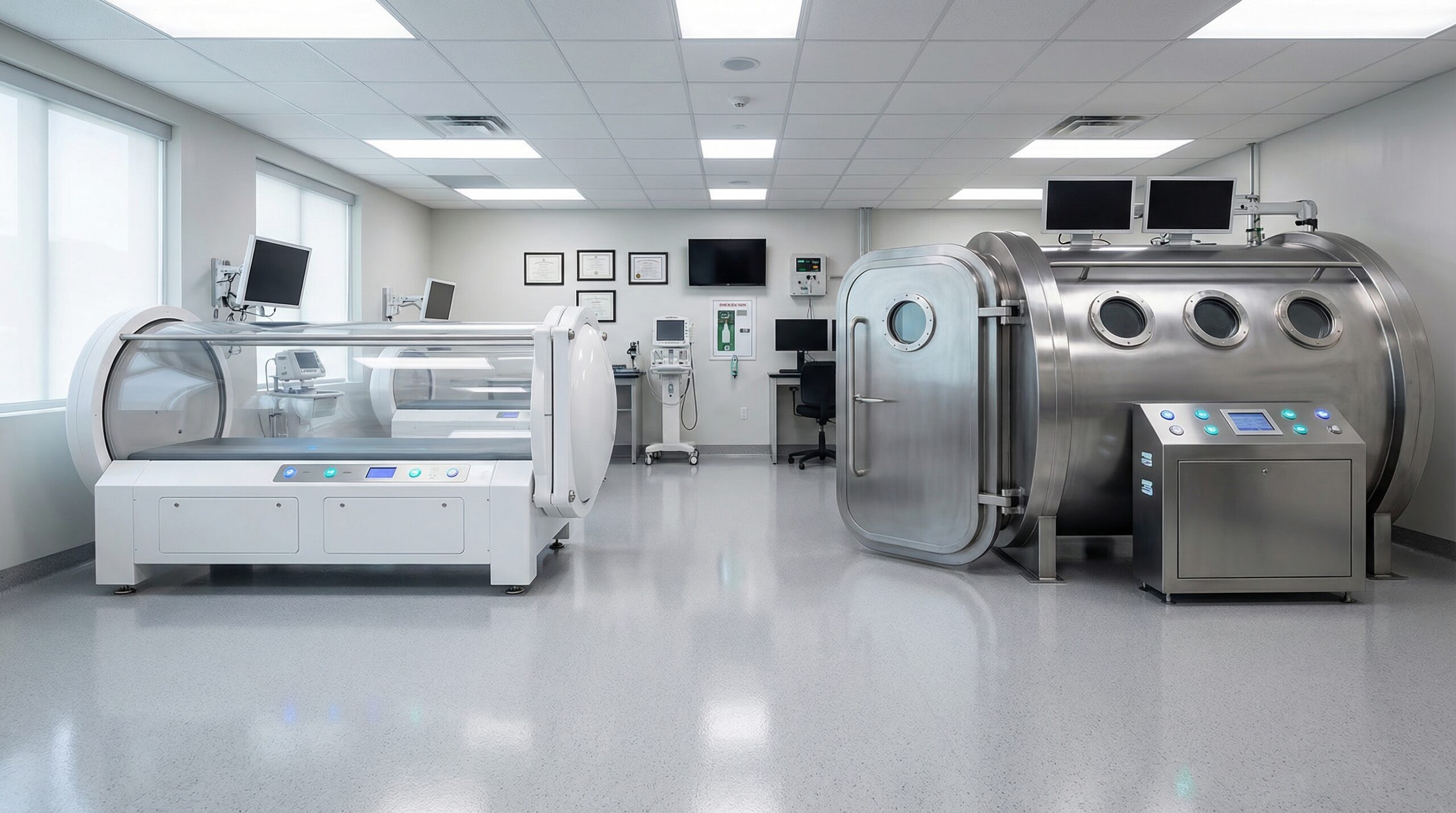
TL;DR: Monoplace hyperbaric chambers treat one patient at a time in a pure oxygen environment, while multiplace chambers treat multiple patients simultaneously using individual breathing masks. Both can deliver standard therapeutic pressures in the 2.0–3.0 ATA range, though multiplace chambers can reach up to 6.0 ATA for specialised protocols such as certain decompression sickness tables, but they differ significantly in cost, staffing, safety protocols, and patient monitoring capabilities. Your choice depends on patient volume, clinical complexity, budget, and regulatory requirements in your Canadian province.
Monoplace and multiplace hyperbaric chambers are the two primary types of clinical-grade chambers used in Canadian HBOT facilities, each with distinct operational and clinical characteristics. Choosing the right hyperbaric chamber is one of the most consequential capital decisions a clinic owner or operator will make. Monoplace and multiplace hyperbaric chambers are the two primary systems approved for clinical use in Canada, and each carries distinct advantages for different operational models. Whether you are launching a new hyperbaric facility or expanding an existing programme, understanding these differences is essential for regulatory compliance, patient safety, and long-term financial viability.
This comparison guide from Canada Hyperbarics breaks down the key differences between monoplace and multiplace chambers across clinical capability, safety, cost, staffing, and regulatory considerations – backed by peer-reviewed research from PubMed.
What Is a Monoplace Hyperbaric Chamber?
A monoplace hyperbaric chamber is a single-patient pressurised vessel typically constructed with a transparent acrylic hull that allows direct visual monitoring of the patient during treatment. The entire chamber is pressurised with 100% oxygen, eliminating the need for individual breathing masks or hoods.
According to a comprehensive review published in Diving and Hyperbaric Medicine, the 1960s saw multiplace hyperbaric chambers enter the hospital setting, and monoplace chambers later emerged as a more economical alternative, with acrylic-hulled designs accelerating adoption by enabling radiation therapy to be delivered simultaneously with hyperbaric oxygen (Clarke, 2020). Today, monoplace chambers are the most common chamber type in hospital-based and private hyperbaric programmes across North America.
Key characteristics of monoplace chambers include:
- Single-patient capacity
- 100% oxygen atmosphere inside the chamber
- Transparent acrylic hull for patient observation
- Typical operating pressures of 2.0–3.0 ATA (atmospheres absolute)
- Smaller physical footprint than multiplace systems
- Lower initial capital cost
What Is a Multiplace Hyperbaric Chamber?
A multiplace hyperbaric chamber is a walk-in pressurised vessel that can treat two or more patients simultaneously. The chamber is pressurised with compressed air, and patients breathe 100% oxygen through individual masks, hoods, or endotracheal tubes. An attendant – typically a nurse or hyperbaric technician – remains inside the chamber with patients throughout treatment.
The European Committee for Hyperbaric Medicine (ECHM) recommends multiplace chambers for critically ill patients, stating that “the hyperbaric chamber should be specifically designed for ICU patients and should be fully equipped to allow continuation of patient monitoring and treatment” (Mathieu et al., 2015).
Key characteristics of multiplace chambers include:
- Multiple-patient capacity (typically 2–14 patients)
- Compressed air atmosphere with individual oxygen delivery
- Inside attendant present during treatment
- Typical operating pressures of 2.0–6.0 ATA
- Larger physical footprint
- Higher initial capital cost but potentially lower per-treatment cost at volume
How Do Monoplace and Multiplace Chambers Compare on Clinical Capability?
| Feature | Monoplace | Multiplace |
|---|---|---|
| Maximum pressure | Typically 3.0 ATA | Up to 6.0 ATA |
| Oxygen delivery | 100% O₂ atmosphere | Individual masks/hoods in compressed air |
| Patient capacity | 1 patient per session | 2–14 patients per session |
| Inside attendant | No (external monitoring) | Yes (nurse or tech inside) |
| IV access during treatment | Limited (pass-through ports) | Full access |
| Ventilator compatibility | Specialised ventilators required | Standard ventilators with modifications |
| Patient monitoring | External via pass-through connections | Direct bedside monitoring inside chamber |
| Critically ill patients | Possible with modifications | Preferred for ICU-level patients |
| Air breaks | Provided via mask inside O₂ environment | Patient simply removes O₂ mask |
A 2020 review in Diving and Hyperbaric Medicine noted that modern monoplace chambers now support “complete pulmonary and arterial haemodynamic monitoring, transcutaneous and laser Doppler monitoring, as well as vasopressors, sedation, paralysis, and mechanical ventilation” through pass-through modifications, making them increasingly capable for complex patient management (Clarke, 2020).
What Are the Safety Differences Between Monoplace and Multiplace Chambers?
Fire risk is the most significant safety consideration distinguishing the two chamber types. Monoplace chambers operate in a 100% oxygen atmosphere, which creates an elevated fire hazard. All materials entering the chamber must be rigorously screened – no electronics, synthetic fabrics, or petroleum-based products are permitted inside.
Multiplace chambers, pressurised with compressed air, present a lower ambient fire risk. However, localised oxygen enrichment around patient breathing circuits still requires strict fire safety protocols.
A 2024 study published in Medical Devices investigated gas monitoring improvements in monoplace chambers, finding that the modified oxygen supply direction and temperature-control measures produced statistically significant changes in monitored chamber conditions (O2, CO2, humidity, temperature), though the authors note further research is needed to confirm resulting improvements in patient comfort and treatment effect (Lee et al., 2024). The researchers noted that continuous CO₂ and O₂ monitoring within the closed monoplace environment is critical because treatment occurs in a sealed volume where the patient both consumes oxygen and produces carbon dioxide.
Emergency Considerations
- Monoplace: In an emergency, the chamber must be depressurised before the patient can be accessed. Rapid decompression protocols are standard, but this introduces an inherent delay.
- Multiplace: The inside attendant can provide immediate hands-on care, including CPR, intubation, and medication administration, without depressurising the chamber.
Device Compatibility
A 2025 Canadian study from the Hyperbaric Medicine Unit at Toronto General Hospital examined the safety of continuous glucose monitoring (CGM) devices in hyperbaric conditions. The researchers concluded that CGMs “have not been validated for repeated exposure to hyperbaric conditions and should not be used in oxygen pressurised monoplace chambers until further safety data is available”, while providing practical recommendations for CGM use in multiplace chambers (Katsnelson et al., 2025). This distinction is particularly important for clinics treating diabetic patients with foot ulcers – one of the most common HBOT indications.
How Do Capital and Operating Costs Compare?
| Cost Factor | Monoplace | Multiplace |
|---|---|---|
| Chamber purchase price | $150,000–$400,000 CAD | $500,000–$2,000,000+ CAD |
| Facility modifications | Moderate (ventilation, O₂ supply) | Extensive (structural, air compressors, O₂ supply, fire suppression) |
| Oxygen consumption | Higher per session (entire chamber is O₂) | Lower per patient (masks in compressed air) |
| Staffing per session | 1 operator externally | 1 inside attendant + 1 external operator minimum |
| Per-treatment cost at volume | Higher (1 patient per session) | Lower (multiple patients per session) |
| Maintenance complexity | Lower | Higher (more systems to maintain) |
For clinics treating fewer than 8–10 patients per day, monoplace chambers typically offer a better return on investment. For higher-volume programmes or hospital-based facilities treating critically ill patients, multiplace chambers may achieve lower per-treatment costs through simultaneous patient treatment.
What Are the Staffing and Training Requirements?
Monoplace chambers require fewer staff per treatment session – typically one trained operator who monitors the patient externally through the transparent hull and manages chamber controls. This makes monoplace systems attractive for smaller clinics or programmes just beginning to offer HBOT.
Multiplace chambers require a minimum of two staff members: an inside attendant (who must be trained in hyperbaric nursing or technology and be medically cleared for pressure exposure) and an external operator. Larger multiplace programmes may require additional inside attendants based on patient acuity and the number of patients treated simultaneously.
Both chamber types require operators to hold certification through recognised programmes. In Canada, the Canadian Undersea and Hyperbaric Medical Association (CUHMA) and the Undersea and Hyperbaric Medical Society (UHMS) provide training standards and accreditation pathways.
What Does Health Canada Require for Chamber Approval?
In Canada, hyperbaric chambers are classified as Class III medical devices under Health Canada’s Medical Devices Regulations. Both monoplace and multiplace chambers must hold a valid Medical Device Licence (MDL) before they can be sold or used clinically in Canada.
Key regulatory considerations include:
- CSA Z275.1 – the Canadian Standards Association standard for hyperbaric facilities, covering chamber design, installation, operation, and maintenance
- Provincial workplace safety regulations – each province may impose additional requirements for pressurised vessels and operator certification
- Fire code compliance – especially stringent for monoplace chambers due to the 100% oxygen atmosphere
- Facility accreditation – UHMS facility accreditation is voluntary but increasingly expected by insurers and referring physicians
Clinic owners should verify that any chamber they purchase or lease holds current Health Canada licensing and meets CSA Z275.1 requirements. Importing chambers not licensed for the Canadian market can result in regulatory action.
Which Chamber Type Is Best for Your Canadian Clinic?
The right choice depends on your specific operational context:
Choose Monoplace If:
- You are starting a new hyperbaric programme with moderate patient volume
- Your patient population is primarily ambulatory outpatients (wound care, elective indications)
- You have limited facility space or budget for infrastructure modifications
- You want lower staffing requirements per treatment session
- You plan to treat fewer than 8–10 patients per day
Choose Multiplace If:
- You operate a hospital-based programme treating critically ill or ICU patients
- Your facility treats emergency indications (carbon monoxide poisoning, decompression sickness, arterial gas embolism)
- You need to treat high patient volumes efficiently
- Your clinical model requires hands-on patient access during treatment
- You have the budget and space for larger infrastructure and higher staffing levels
Many established Canadian programmes operate both chamber types – using monoplace chambers for routine outpatient treatments and multiplace chambers for emergencies and complex cases. This hybrid model optimises both cost efficiency and clinical capability.
Frequently Asked Questions
Can monoplace chambers treat all the same conditions as multiplace chambers?
For the 14 recognised conditions, both chamber types can deliver therapeutic pressures of 2.0–2.4 ATA. However, conditions requiring pressures above 3.0 ATA (such as certain decompression sickness treatment tables) require a multiplace chamber.
Are monoplace chambers safe for claustrophobic patients?
Modern monoplace chambers feature transparent acrylic hulls that provide an open visual field. Many patients tolerate treatment well, though some facilities offer mild anxiolytics for patients with significant claustrophobia. Multiplace chambers may feel less confining due to their walk-in design.
How long does a typical treatment session last in each chamber type?
Standard HBOT sessions run approximately 90–120 minutes in both chamber types, including compression and decompression phases. The treatment protocol is determined by the indication, not the chamber type.
Can I add more monoplace chambers later to increase capacity?
Yes. One advantage of monoplace systems is their modularity – clinics can start with one or two chambers and add units incrementally as patient volume grows, without major facility redesign.
Do provincial health plans cover treatment in both chamber types?
In provinces where public coverage is available (such as OHIP in Ontario for 14 recognised indications), coverage applies to the treatment itself regardless of chamber type, provided the facility meets regulatory standards. Visit our coverage guide for province-specific details.
What is the lifespan of each chamber type?
With proper maintenance, monoplace acrylic chambers typically have a service life of 15–20 years, while steel-hulled multiplace chambers can last 25–30+ years. Both require regular inspection, testing, and certification.
Are portable or soft-shell chambers a viable alternative?
No. Portable soft-shell chambers are not approved by Health Canada for clinical use. They typically operate at only 1.3 ATA – well below the therapeutic pressures of 2.0–3.0 ATA used in approved clinical protocols. Only Health Canada–licensed hard-shell monoplace and multiplace chambers should be used in clinical settings. Learn more about the differences on our FAQ page.
Where can I find accredited hyperbaric facilities in Canada?
Our clinic directory lists hyperbaric facilities across all Canadian provinces, including chamber types and accreditation status.
Making Your Decision
Both monoplace and multiplace hyperbaric chambers deliver effective hyperbaric oxygen therapy when operated according to established protocols. The optimal choice for your Canadian clinic depends on your patient population, treatment volume, budget, facility constraints, and clinical scope. Canada Hyperbarics recommends consulting with CUHMA, reviewing CSA Z275.1 requirements, and visiting established programmes operating each chamber type before making your capital investment decision.
For more information about approved HBOT indications, current research, or finding a facility near you, explore our comprehensive resource library.
This content is for informational purposes only and does not constitute medical advice. Decisions about hyperbaric chamber equipment should be made in consultation with qualified hyperbaric medicine professionals, regulatory authorities, and facility planning experts. Always verify current Health Canada regulations and provincial requirements before purchasing or operating hyperbaric equipment.
References:
- Clarke R. Monoplace chamber treatment of decompression illness: Review and commentary. Diving and Hyperbaric Medicine. 2020;50(3):264-272. doi:10.28920/dhm50.3.264-272
- Katsnelson G, Salvatori M, Djaiani G, et al. Safety and efficacy of continuous glucose monitoring devices in individuals with diabetes undergoing hyperbaric oxygen therapy: a scoping review. Diving and Hyperbaric Medicine. 2025;55(2):164-172. doi:10.28920/dhm55.2.164-172
- Lee HY, Lee Y, Kim H, Paik JH. Mechanical Improvement of Gas Monitoring System in Monoplace Hyperbaric Chamber to Advance the Safety and Efficacy. Medical Devices. 2024;17:217-227. doi:10.2147/MDER.S465022
- Mathieu D, Ratzenhofer-Komenda B, Kot J. Hyperbaric oxygen therapy for intensive care patients: position statement by the European Committee for Hyperbaric Medicine. Diving and Hyperbaric Medicine. 2015;45(1):42-46. PMID: 25964038