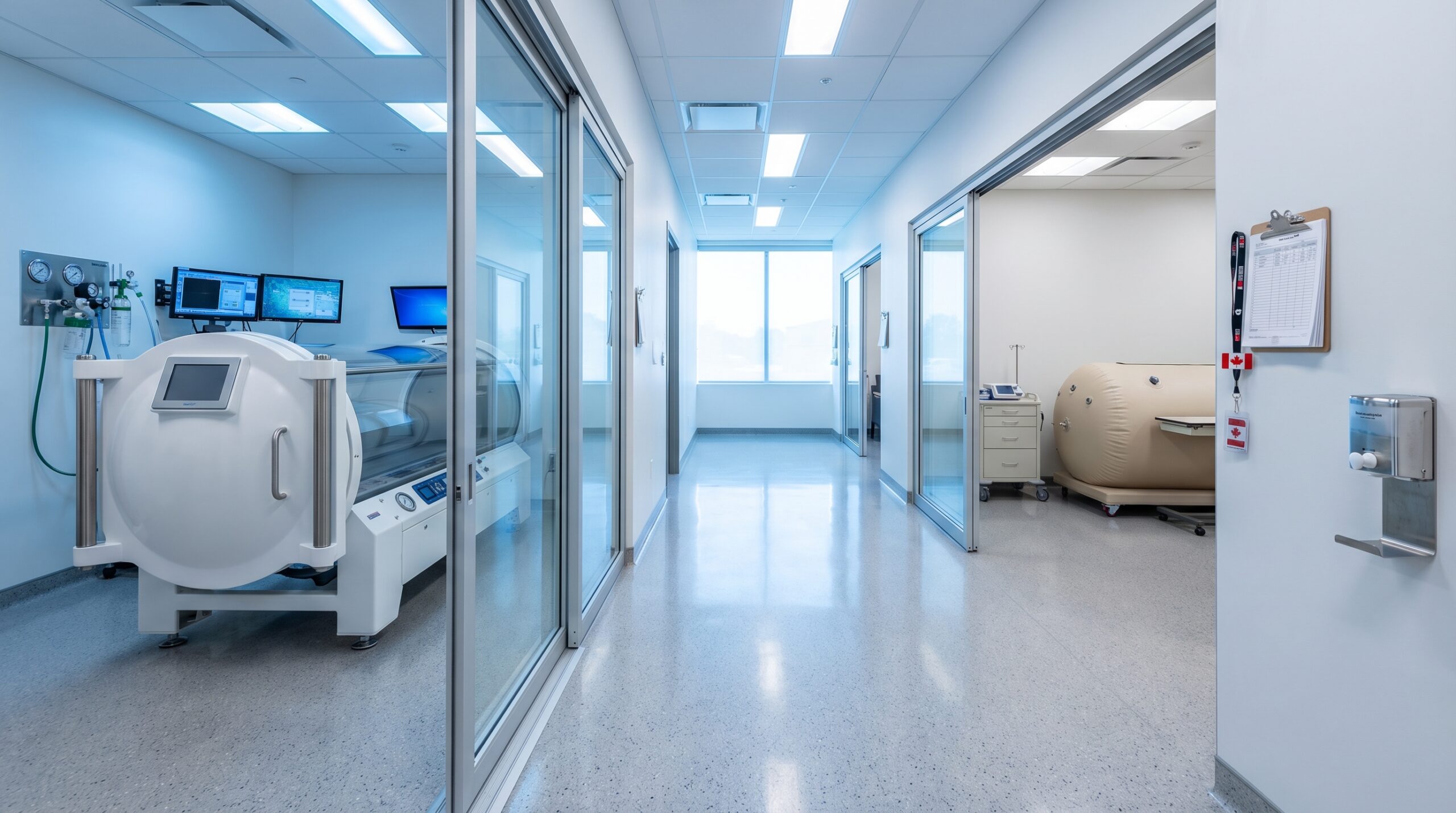
TL;DR: Mild hyperbaric oxygen therapy (mHBOT) uses pressures of 1.3 to 1.5 ATA, while standard-pressure HBOT operates at 2.0 to 2.5 ATA. According to PubMed research, standard-pressure chambers deliver significantly higher tissue oxygenation and are required for all Health Canada and UHMS-approved indications. Clinic owners considering equipment investments should understand the evidence, regulatory landscape, and business implications before choosing a system.
What Is the Difference Between Mild and Standard-Pressure Hyperbaric Oxygen Therapy?
Hyperbaric oxygen therapy (HBOT) is a medical treatment that involves breathing concentrated oxygen inside a pressurised chamber at pressures greater than normal atmospheric pressure (1.0 ATA). The therapy works by dramatically increasing the amount of dissolved oxygen in the blood and tissues, promoting healing through multiple physiological mechanisms.
For Canadian clinic owners and operators, one of the most critical equipment decisions is choosing between mild-pressure and standard-pressure hyperbaric systems. These two categories differ significantly in their operating pressures, evidence base, regulatory status, and clinical applications. Understanding these differences is essential for making informed capital equipment investments and delivering safe, effective patient care.
Mild hyperbaric oxygen therapy (mHBOT) refers to treatments delivered at pressures between 1.3 and 1.5 atmospheres absolute (ATA). These systems typically use inflatable, soft-sided chambers that can be pressurised with ambient air or oxygen concentrators. They are marketed for wellness, sports recovery, and general health optimization.
Standard-pressure HBOT operates at 2.0 to 2.5 ATA (and occasionally up to 3.0 ATA for specific indications). These are rigid-walled, medical-grade chambers – either monoplace (single patient) or multiplace (multiple patients) – that deliver 100% oxygen under higher pressure. Standard-pressure systems are the basis for all Health Canada and Undersea and Hyperbaric Medical Society (UHMS) approved indications.
How Does Tissue Oxygenation Compare at Different Pressures?
The fundamental question for clinic owners is whether lower-pressure systems deliver clinically meaningful oxygen levels. According to PubMed research, the answer is clear: standard-pressure HBOT produces significantly higher tissue oxygenation than mild-pressure systems.
A 2024 study published in Undersea & Hyperbaric Medicine by Sack et al. measured transcutaneous oxygen pressure (TcPO2) in 130 consecutive patients with chronic ulcers at both 1.4 ATA and 2.0 ATA. The results were striking: average TcPO2 at 1.4 ATA after 10 minutes of oxygen breathing was 161 mmHg, compared to 333 mmHg at 2.0 ATA (p < 0.001). The researchers concluded they found no evidence supporting the claim that 1.4 ATA treatment can benefit chronic ulcer patients (PMID: 38615347).
Further research by Leveque et al. (2023), published in the International Journal of Molecular Sciences, compared oxidative stress responses at 1.4 ATA and 2.5 ATA. While both pressures triggered similar reactive oxygen species (ROS) production and antioxidant responses, the immunomodulatory and inflammatory responses were dose-dependent, meaning they increased proportionally with higher pressure. This suggests that the therapeutic mechanisms most relevant to treating approved medical conditions require standard pressures (DOI: 10.3390/ijms241512361).
What Does the Clinical Evidence Say About Each Pressure Range?
The evidence base differs dramatically between mild and standard-pressure HBOT. Here is a side-by-side comparison of what the published literature supports:
| Parameter | Mild Pressure (1.3-1.5 ATA) | Standard Pressure (2.0-2.5 ATA) |
|---|---|---|
| Operating pressure | 1.3-1.5 ATA | 2.0-2.5 ATA (up to 3.0 for select conditions) |
| Chamber type | Typically soft-sided, inflatable | Rigid-walled monoplace or multiplace |
| Oxygen delivery | Air or oxygen concentrator (24-40% O2) | 100% medical-grade oxygen |
| Tissue oxygenation (TcPO2) | ~161 mmHg at 1.4 ATA | ~333 mmHg at 2.0 ATA |
| UHMS-approved indications | None | 14 approved indications |
| Health Canada status | Not approved for medical indications | Approved as Class III medical device |
| Evidence quality | Limited: mostly sports recovery and animal studies | Extensive: RCTs, systematic reviews, meta-analyses |
| Provincial coverage eligibility | Not eligible for public health coverage | Eligible in Ontario (OHIP), BC (MSP), Alberta (AHCIP), and other provinces |
| Estimated cost per unit | $5,000-$30,000 CAD | $100,000-$500,000+ CAD |
Notably, a major multicentre RCT protocol published in BMJ Open (Stirnemann et al., 2024) for sickle cell disease treatment uses 1.3 ATA as the sham (placebo) control group, while the therapeutic intervention group receives 2.0 ATA. This design decision by leading researchers underscores the medical community’s view that 1.3 ATA is not considered a therapeutic dose for approved medical conditions (DOI: 10.1136/bmjopen-2024-084825).
What Are the Health Canada Regulatory Requirements for Hyperbaric Chambers?
For Canadian clinic owners, the regulatory landscape is a critical factor. Health Canada classifies medical-grade hyperbaric chambers as Class III medical devices, which require licensing and compliance with the Medical Devices Regulations (SOR/98-282). Key regulatory considerations include:
- Medical device licensing: Standard-pressure chambers used for approved medical indications must hold a valid Health Canada medical device licence.
- CSA Z275.1 compliance: The Canadian Standards Association standard Z275.1 (Hyperbaric Facilities) sets requirements for the design, construction, installation, operation, and maintenance of hyperbaric facilities operating above 1.5 ATA.
- Facility accreditation: Clinics operating standard-pressure chambers may pursue accreditation through the Canadian Undersea and Hyperbaric Medical Association (CUHMA) or UHMS, which strengthens credibility and may be required for provincial health insurance billing.
- Soft-sided chamber classification: Mild-pressure chambers operating below 1.5 ATA may fall outside the CSA Z275.1 scope, but clinic owners must still comply with provincial health and safety regulations, fire codes, and any applicable municipal bylaws.
If your clinic intends to treat any of the 14 UHMS-approved indications or bill provincial health insurance plans, a standard-pressure, Health Canada-licensed chamber is required. You can find accredited hospitals and regulated facilities across Canada on the Canada Hyperbarics directory.
Is There Any Legitimate Clinical Role for Mild-Pressure HBOT?
While mild-pressure systems lack regulatory approval for medical indications, emerging research does suggest some physiological effects at lower pressures. According to PubMed, a 2024 study by Gutierrez et al. found that mild hyperbaric oxygen exposure (below 1.5 ATA with 100% O2) provided measurable cardioprotection during ischemia/reperfusion in animal models and affected vascular relaxation. The authors noted that mHBOT is “cheaper, easier to implement, and equally effective” for certain wellness applications (DOI: 10.1007/s00424-024-02992-3).
Research in sports recovery has shown modest benefits from mild-pressure exposure. Multiple studies on athletes have demonstrated improvements in subjective fatigue scores and some recovery biomarkers at 1.25 to 1.3 ATA. However, these studies typically involve small sample sizes and do not address approved medical conditions. A randomised crossover trial by Yagishita et al. (2025) found that standard-pressure HBO at 2.5 ATA produced significant improvements in perceived fatigue compared to a mild hyperbaric air control at 1.3 ATA (DOI: 10.3389/fspor.2025.1690794).
Clinic owners should understand that marketing mild-pressure systems for medical conditions without adequate evidence may raise concerns under Health Canada’s advertising guidelines and could expose operators to liability. Any claims about treating specific medical conditions must be supported by robust clinical evidence.
What Are the Business Implications for Canadian Clinic Owners?
The choice between mild and standard-pressure systems has significant financial and operational implications. Here is a practical comparison for clinic operators evaluating their options:
| Business Factor | Mild Pressure (1.3-1.5 ATA) | Standard Pressure (2.0-2.5 ATA) |
|---|---|---|
| Capital investment | Lower ($5,000-$30,000 CAD) | Higher ($100,000-$500,000+ CAD) |
| Installation requirements | Minimal – can operate in standard rooms | Significant – fire suppression, ventilation, dedicated space |
| Staff training | Basic operational training | CHT/CHRN certification recommended or required |
| Provincial health billing | Not eligible | Eligible where covered (OHIP, MSP, AHCIP, RAMQ) |
| Private insurance coverage | Rarely covered | Often covered for approved indications |
| Revenue per session | Lower (wellness pricing, $75-$200) | Higher (medical pricing, $200-$500+) |
| Patient referral pipeline | Self-referral, wellness market | Physician referrals, hospital partnerships |
| Liability exposure | Risk if medical claims are made | Lower with proper protocols and accreditation |
| Market positioning | Wellness, sports recovery, anti-ageing | Medical, evidence-based treatment |
For clinics focused on treating approved medical conditions and billing provincial health plans, standard-pressure chambers are the only viable option. The higher capital investment is typically offset by higher per-session revenue, physician referral networks, and insurance reimbursement. Canada Hyperbarics maintains a directory of hospitals and regulated facilities offering standard-pressure HBOT across all provinces.
How Should Clinic Owners Evaluate Dose-Dependent Outcomes?
An important consideration for clinic owners is that HBOT outcomes are often dose-dependent. Research published on our research database includes a 2026 study comparing outcomes of HBOT at 2.0 versus 2.5 ATA for haemorrhagic radiation cystitis, demonstrating that even within the standard-pressure range, pressure differences can affect clinical outcomes (view study).
The dose-response relationship in HBOT means that:
- Higher pressures deliver more dissolved oxygen. At 2.0 ATA with 100% O2, arterial oxygen tension reaches approximately 1,400 mmHg, compared to roughly 100 mmHg under normal conditions.
- Therapeutic mechanisms are pressure-dependent. Angiogenesis, stem cell mobilisation, anti-inflammatory effects, and antimicrobial activity all require adequate oxygen partial pressures to activate.
- Protocol selection matters. The optimal pressure and number of sessions varies by condition. UHMS treatment protocols specify pressure ranges for each approved indication.
- Emerging research may expand the role of lower pressures. While current evidence strongly favours standard pressures for approved conditions, ongoing research into sports recovery, wellness, and mild cognitive applications may establish clearer roles for lower-pressure systems in the future.
What Equipment Standards Should Canadian Clinics Follow?
Regardless of which pressure system a clinic chooses, safety and compliance standards are non-negotiable. For standard-pressure operations in Canada, the following apply:
- CSA Z275.1: The Canadian standard for hyperbaric facilities, covering design, construction, installation, operation, and maintenance
- NFPA 99: The National Fire Protection Association’s Health Care Facilities Code, Chapter 14 covers hyperbaric facilities
- Provincial fire codes: Most provinces adopt NFPA standards or have equivalent provincial requirements for hyperbaric facility fire safety
- UHMS or CUHMA accreditation: Voluntary but strongly recommended for credibility, physician referrals, and insurance billing
- Staff certification: Certified Hyperbaric Technologist (CHT) or Certified Hyperbaric Registered Nurse (CHRN) credentials through the National Board of Diving and Hyperbaric Medical Technology
Mild-pressure operators should be aware that even though CSA Z275.1 may not apply below 1.5 ATA, provincial occupational health and safety regulations, electrical codes, and fire safety requirements still apply. Operators should consult with their provincial regulatory bodies before establishing any hyperbaric facility.
For a detailed overview of Health Canada regulations governing hyperbaric facilities, visit the Canada Hyperbarics regulatory information page.
Frequently Asked Questions
Can mild-pressure HBOT chambers treat approved medical conditions?
No. None of the 14 UHMS-approved indications can be treated with mild-pressure (1.3-1.5 ATA) systems. All approved treatment protocols require standard pressures of 2.0 ATA or higher with 100% oxygen. Clinic owners offering mild-pressure systems should not market them for treating approved medical conditions.
Are soft-sided hyperbaric chambers legal in Canada?
Soft-sided chambers are available for purchase in Canada, but their use for medical treatment is not supported by Health Canada-approved indications. They may be used for wellness purposes, but operators must avoid making unsupported medical claims and should comply with all applicable provincial regulations.
What is the return on investment for a standard-pressure chamber?
Standard-pressure chambers have higher upfront costs ($100,000-$500,000+ CAD) but generate higher per-session revenue ($200-$500+), benefit from physician referral networks, and are eligible for provincial health insurance billing in several provinces. Many established clinics report reaching profitability within 2-4 years, depending on patient volume and payer mix.
Do any provincial health plans cover mild-pressure HBOT?
No. Provincial health plans (OHIP, MSP, AHCIP, RAMQ, and others) only cover HBOT delivered at standard pressures for approved medical indications. Mild-pressure treatments are considered out-of-pocket expenses. For a comprehensive overview of provincial HBOT coverage across Canada, visit our coverage guide.
Can a clinic offer both mild and standard-pressure HBOT?
Yes, some clinics operate both types of systems. Standard-pressure chambers are used for medically indicated treatments, while mild-pressure systems serve the wellness and sports recovery market. This dual approach can diversify revenue streams, but clinic owners must clearly distinguish between medical treatments and wellness services in their marketing and patient communications.
What training is required to operate each type of chamber?
Standard-pressure chambers require staff with CHT or CHRN certification, and facilities should ideally have a hyperbaric-trained physician as medical director. Mild-pressure chambers have less formal training requirements, but operators should still complete manufacturer training and understand basic hyperbaric safety principles, including barotrauma recognition and emergency procedures.
Where can I find accredited hyperbaric clinics in Canada?
Canada Hyperbarics maintains a directory of hospitals and regulated facilities offering standard-pressure HBOT across all Canadian provinces. This directory includes both hospital-based programs and accredited private clinics.
The Bottom Line for Clinic Owners
The evidence is clear: standard-pressure HBOT at 2.0-2.5 ATA delivers significantly greater tissue oxygenation, supports all approved medical indications, and qualifies for provincial health insurance billing. For clinic owners committed to evidence-based medicine and long-term business viability, investing in a Health Canada-licensed, standard-pressure chamber is the foundation of a credible hyperbaric program.
Mild-pressure systems may serve a niche role in wellness and sports recovery, but they should not be positioned as substitutes for medical-grade HBOT. As research continues to explore optimal dosing protocols, the distinction between wellness and medical applications will likely become even more important for regulatory compliance and patient safety.
Canada Hyperbarics provides comprehensive resources for clinic owners evaluating hyperbaric equipment options. Explore our research database for the latest evidence, our facility directory to connect with established programs, and our conditions guide for detailed information on approved indications.
This content is for informational purposes only and does not constitute medical advice. Clinic owners should consult with regulatory authorities, legal counsel, and qualified hyperbaric medicine professionals before making equipment purchasing or operational decisions. Canada Hyperbarics does not endorse any specific chamber manufacturer or equipment supplier.