For referring and emergency physicians in Canada. Severe thermal burn injury is one of the 14 conditions publicly funded in Canada for hyperbaric oxygen therapy (HBOT), and where it is used it is an adjunct to specialised burn-centre care, not a substitute for resuscitation, surgery, or wound management. Because the burn evidence base is limited and largely observational, this guide is deliberately conservative. It summarises when to consider referral, how to assess and stabilise the patient first, what the evidence does and does not support, the Canadian referral pathway, and contraindications. It closes with the complete list of open-access research published since 2020, each linked to its free full text.
When to refer
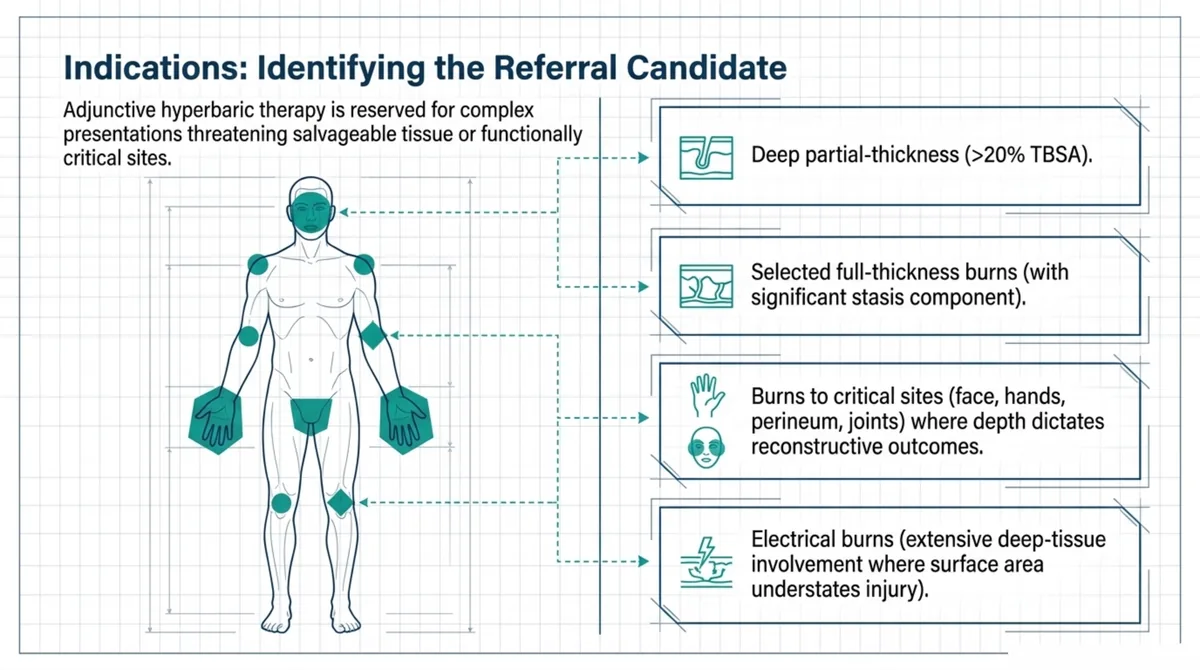
HBOT for burns is time-sensitive, so any consideration of adjunctive hyperbaric treatment should happen in parallel with definitive burn-centre referral, not after it. The first priority is always transfer to a burn centre for resuscitation and surgical assessment. Where a hospital-based hyperbaric programme is co-located with or accessible to that burn centre, consider raising HBOT for a patient with:
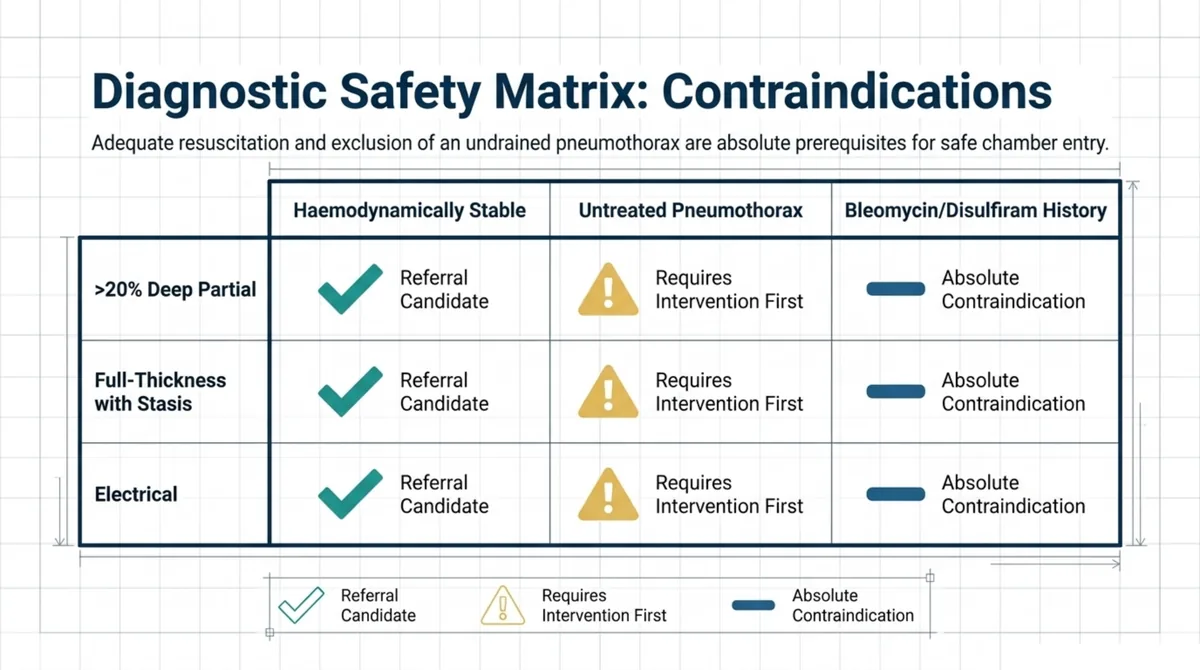
- Deep partial-thickness (deep second-degree) burns exceeding roughly 20 percent total body surface area (TBSA), where progression of the zone of stasis threatens otherwise salvageable tissue.
- Selected full-thickness (third-degree) burns with a significant viable zone-of-stasis component that may benefit from improved tissue oxygenation.
- Burns to functionally critical sites such as the hands, face, perineum, or major joints, where preserving depth-dependent function changes the reconstructive outcome.
- Electrical burns with extensive deep-tissue involvement, where surface area understates the true tissue injury.
The biological window matters. Where benefit has been reported, HBOT was generally started within the first 24 hours of injury, and the rationale for benefit is concentrated in the first 24 to 48 hours, when the zone of stasis is most vulnerable to progression. Refer early and let the burn centre and hyperbaric team decide together, rather than waiting to see whether the wound declares itself.
Assessing the patient before referral
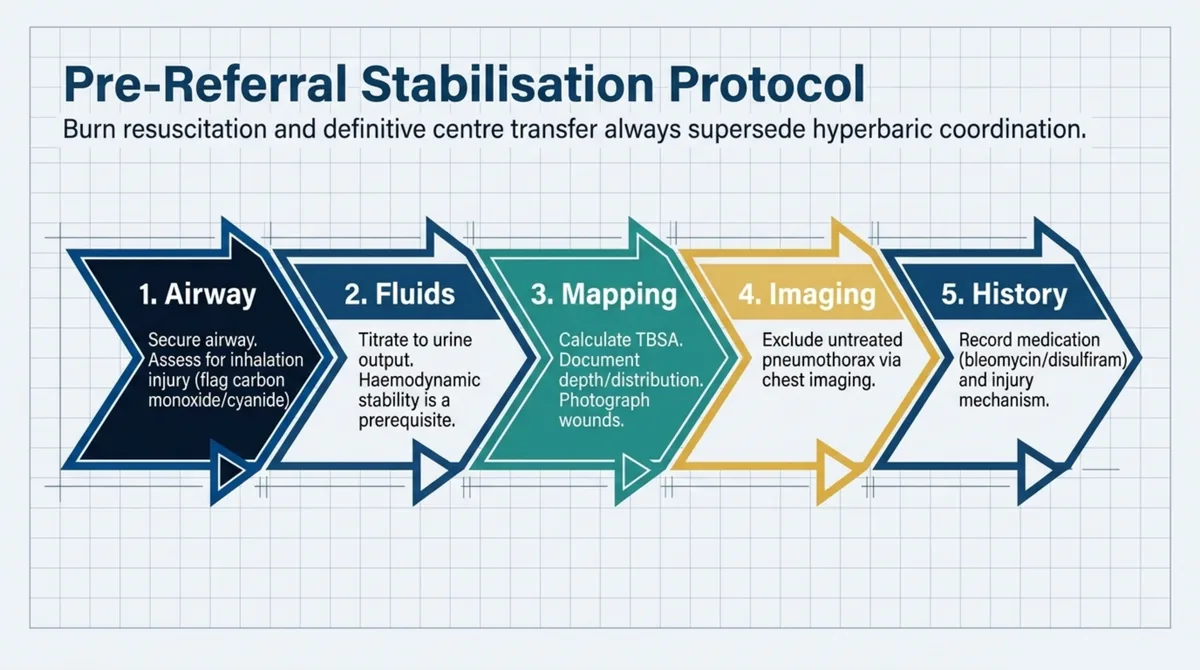
Burn resuscitation and stabilisation come first. While arranging burn-centre transfer and any hyperbaric discussion, the receiving department should:
- Secure the airway and assess for inhalation injury. Facial burns, singed nasal hair, carbonaceous sputum, or stridor warrant early airway evaluation. Suspected concurrent carbon monoxide or cyanide exposure changes the urgency and the oxygen strategy and should be flagged explicitly to the hyperbaric team.
- Begin fluid resuscitation using a recognised formula and titrate to urine output. Haemodynamic stability is a prerequisite for safe chamber entry.
- Calculate TBSA and document burn depth and distribution with a standard chart, and photograph the wounds where possible.
- Exclude an untreated pneumothorax on examination and chest imaging, particularly after blast, electrical, or high-energy mechanisms, because it is an absolute contraindication to chamber entry until drained.
- Record the medication and exposure history, specifically any concurrent bleomycin or disulfiram, and the mechanism, timing, and any associated trauma.
What the evidence supports
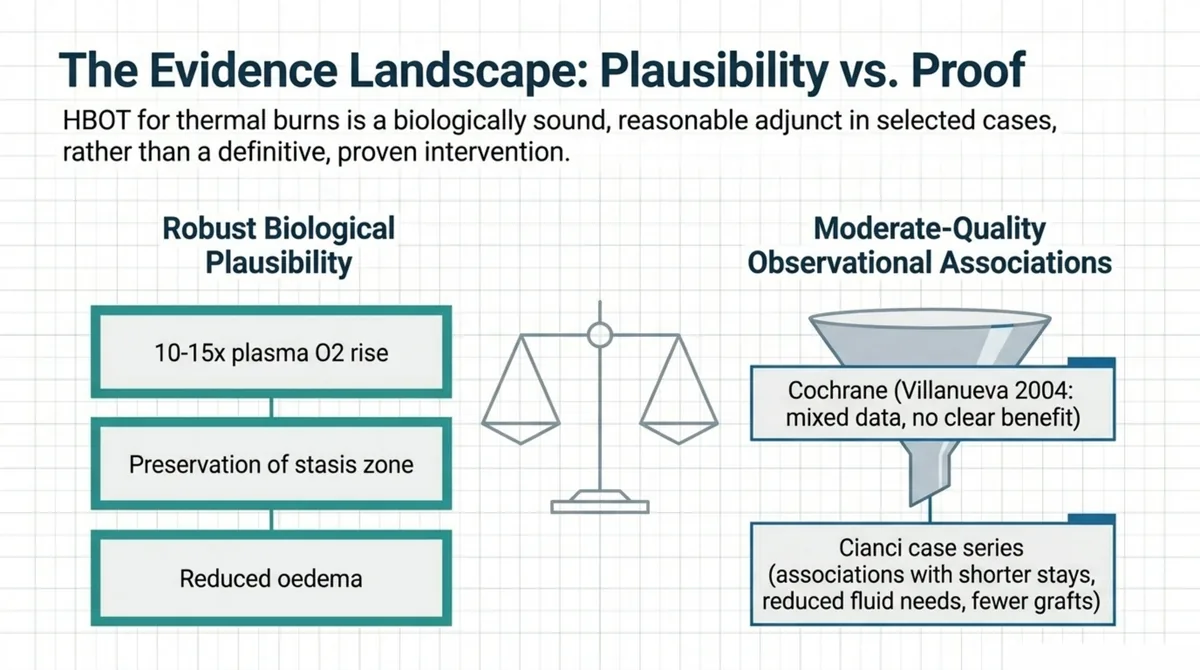
The evidence for HBOT in thermal burns is limited and should be presented to patients and colleagues as such. The condition is graded as moderate-quality evidence drawn predominantly from controlled and observational studies rather than from large, definitive randomised trials.
The most cited synthesis is the Cochrane review (Villanueva et al. 2004), which found the evidence mixed and predominantly observational and did not establish a clear benefit. Observational work, most notably the Cianci case series, has reported associations with reduced oedema, shorter hospital length of stay, fewer skin-grafting procedures, and reduced mortality in patients with moderate-to-severe burns. These are associations from non-randomised data, not proof of benefit, and they should not be framed as established outcomes.
The mechanistic rationale is more secure than the clinical outcome data. At treatment pressure, plasma oxygen content rises roughly 10- to 15-fold and tissue oxygen tension in the peri-burn zone can reach several hundred mmHg, which supports the threatened zone of stasis. Hyperoxic vasoconstriction reduces oedema without compromising oxygen delivery, neutrophil bactericidal activity and antibiotic efficacy are enhanced, and angiogenesis and fibroblast function are supported for wound healing and graft take. Taken together, the biological plausibility is reasonable while the outcome evidence remains modest, so HBOT in burns is best understood as a reasonable adjunct in selected cases rather than a proven intervention.
Clinical translation
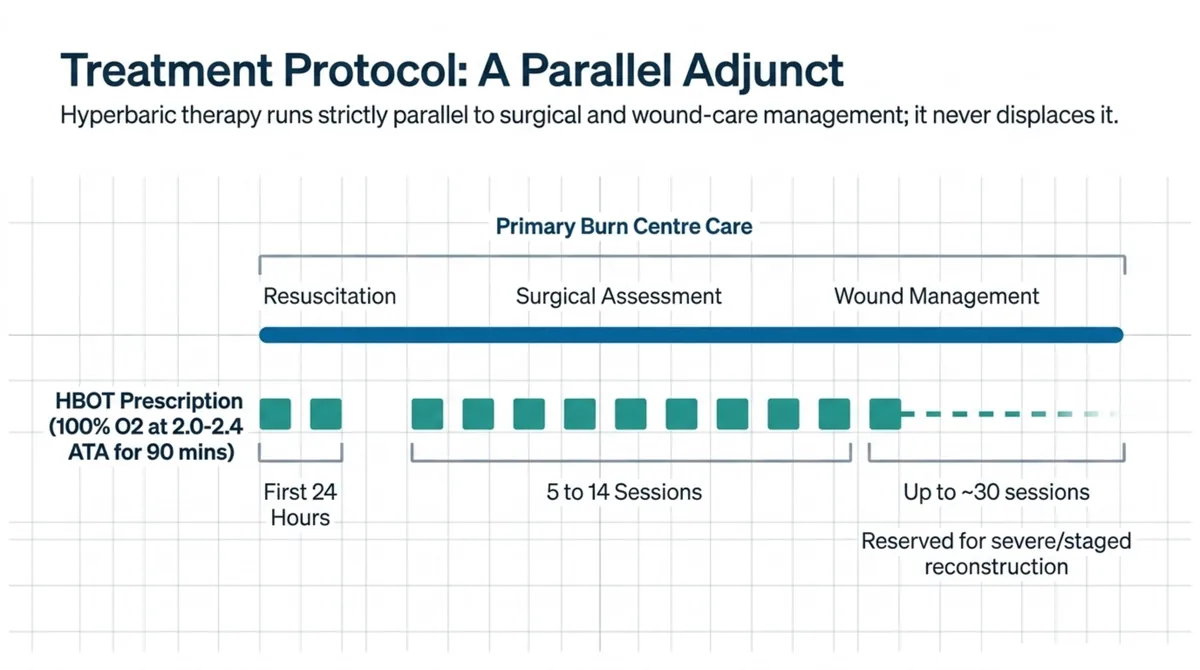
Consider it early, position it correctly, and do not oversell it. The rationale for benefit is concentrated in the first 24 to 48 hours, so any decision to involve the hyperbaric team should be made alongside the burn-centre referral, not days later. Where it is offered, a typical course is 100 percent oxygen at 2.0 to 2.4 ATA for 90-minute sessions, often two sessions in the first 24 hours and then once daily for roughly 5 to 14 sessions, with extended courses of up to about 30 sessions reserved for severe burns or staged reconstruction. Throughout, HBOT runs in parallel with surgical and wound-care management and never displaces it. You can read the full clinical background on the acute thermal burns condition page.
The Canadian referral pathway
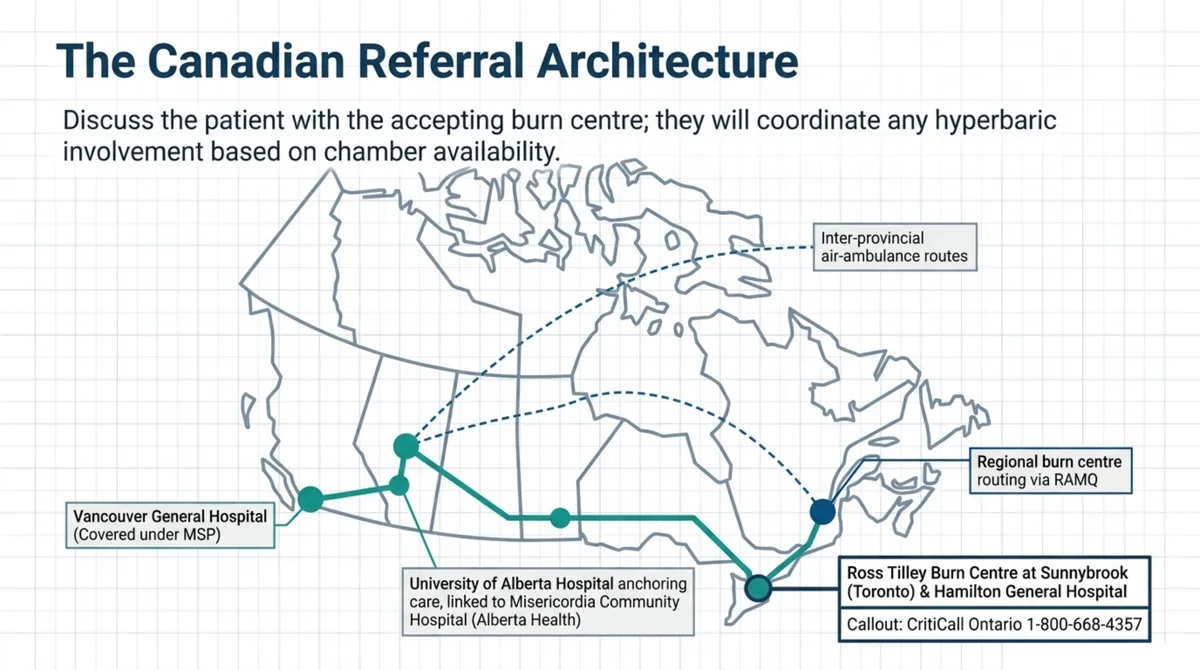
Severe thermal burn injury is publicly funded in Canada as one of the 14 conditions for which provincial health insurance covers HBOT at hospital-based programmes. In practice, adjunctive HBOT for burns is only available where a hyperbaric programme is co-located with or accessible to a burn centre, so the referral pathway runs through burn-centre transfer first.
- Ontario: burn referrals route to the Ross Tilley Burn Centre at Sunnybrook (Toronto); Hamilton General Hospital also operates a hospital-based hyperbaric programme. CritiCall Ontario at 1-800-668-4357 coordinates emergency inter-hospital transfer and can arrange Ornge transport when needed.
- British Columbia: route to Vancouver General Hospital, which has a hospital-based hyperbaric chamber; covered under MSP.
- Alberta: burn care is anchored by the University of Alberta Hospital in Edmonton, with hospital-based hyperbaric treatment available at the Misericordia Community Hospital hyperbaric programme; covered by Alberta Health.
- Quebec: RAMQ covers hospital-based hyperbaric programmes for recognised indications; coordinate burn transfer through the regional burn centre.
- Provinces and territories without combined burn-and-HBOT capability: inter-provincial referral routes exist, with air-ambulance transfer to the nearest centre that can provide both burn care and hyperbaric treatment.
Because eligibility for adjunctive HBOT depends on the burn centre's assessment and on chamber availability, the practical step for a referring physician is to discuss the patient with the accepting burn centre and let that team coordinate any hyperbaric involvement.
Contraindications and cautions
The absolute contraindications relevant to the acute setting are an untreated pneumothorax, which must be drained before chamber entry, and concurrent bleomycin or concurrent disulfiram therapy. Relative cautions include severe haemodynamic instability requiring continuous high-dose vasopressor titration, an uncontrolled seizure disorder, and severe chronic obstructive pulmonary disease with bullous lung disease. In the burn patient specifically, adequate resuscitation, a secured airway, and exclusion of an undrained pneumothorax are practical prerequisites for safe treatment, and the burn centre and hyperbaric team should weigh these together before any session.
How to use the research list below
The list contains every thermal burn study in the Canada Hyperbarics database that was published in 2020 or later and has a freely available full-text version, each linked directly to that full text. Paywalled and abstract-only studies are excluded, and retracted studies are removed. This is a reference list, not a set of summaries. Because the open-access burn literature since 2020 is small, the list is short by design. Counts and the open-access set refresh each quarter.
Open-access research, 2020 to present
3 studies with a free full-text version, grouped by year, newest first. Each entry links to the full text. The set refreshes each quarter; retracted and paywalled studies are excluded.
20261 study
- Sah R et al. Role of hyperbaric oxygen therapy in oral submucous fibrosis: a randomized comparative study from India. Arch Craniofac Surg. Full text (Unpaywall) ›
20251 study
- Chu XL et al. Research progress in different physical therapies for treating peripheral nerve injuries. Frontiers in neurology. Full text (Unpaywall) ›
20211 study
- Alyafi T et al. Therapeutic Outcome of Burn Patients Treated With Hyperbaric Oxygen. Cureus. Full text (Unpaywall) ›