Complete Guide
Hyperbaric Oxygen Therapy Cost & Coverage in Canada
How HBOT works, the 14 recognised conditions it treats, what it costs at hospital programmes (covered) and private clinics (self-pay), and how to access care across 9 provinces.
$0 at hospital programmes with a physician referral · $150 to $400 per session at private clinics
Definition
What is hyperbaric oxygen therapy?
Hyperbaric oxygen therapy (HBOT) is a medical treatment in which a patient breathes 100 per cent oxygen while inside a pressurised chamber at 2.0 to 2.8 atmospheres absolute (ATA). The increased pressure dissolves 15 to 20 times more oxygen directly into blood plasma than is possible at sea level, allowing oxygen to reach tissues with compromised circulation, drive angiogenesis (new capillary growth), accelerate wound healing, and clear carbon monoxide from haemoglobin roughly six times faster than ordinary oxygen. In Canada, HBOT is recognised by Health Canada for 14 specific conditions and is delivered at 11 hospital-based programmes across 7 provinces plus 22 private clinics across 9 provinces. A standard course is 20 to 40 sessions of 90 to 120 minutes each, daily or near-daily for 4 to 8 weeks; emergency indications (carbon monoxide poisoning, decompression sickness, gas gangrene, air embolism) use shorter, time-critical protocols.
Cost
How much does hyperbaric oxygen therapy cost in Canada?
Hyperbaric oxygen therapy costs $150 to $400 per session at private clinics in Canada, or about $3,000 to $16,000 for a full 20 to 40 session course. At hospital-based programmes it is free for the 14 recognised conditions with a physician referral, covered by provincial health insurance. Where a private clinic sits in that range depends on facility, chamber type, and location, with introductory single sessions sometimes available at lower rates and premium multiplace chambers in major-city clinics at the upper end. Coverage details and facility availability vary by province.
What you actually pay
What does HBOT cost at hospital programmes vs private clinics in Canada?
The single biggest cost variable in Canada is whether you are treated at a hospital programme (covered by provincial insurance for recognised conditions) or at a private clinic (self-pay).
Full comparison: is HBOT cheaper at a hospital or a private clinic?
Hospital Programmes
$0
out of pocket with physician referral and provincial coverage
- 11 hospital-based programmes across 7 provinces (Ontario, British Columbia, Alberta, Quebec, Nova Scotia, Saskatchewan, Newfoundland and Labrador)
- Provincial plans cover the 14 recognised conditions with a physician referral
- 24/7 emergency coverage at most hospital programmes
- Wait times for elective and chronic indications vary by province (typical: 4 weeks to 18 months)
- Patients in provinces without a hospital programme (Manitoba, New Brunswick, Prince Edward Island, the territories) are referred interprovincially with covered treatment costs
Private Clinics
$150 to $400
per session, Canadian market range, self-pay
- 22 private clinics across Canada offering self-pay HBOT
- Full course of 20 to 40 sessions: $3,000 to $16,000 total
- Where a clinic sits in this range depends on city, chamber type, and facility; major-city and multiplace clinics trend toward the upper end
- Most clinics offer package discounts of 10 to 25 per cent for full courses; ask before booking
- Some private clinics in Ontario are eligible Independent Health Facilities (IHFs) that can bill OHIP for approved indications; eligibility varies by facility and indication
Pricing methodology: the $150 to $400 range is the market band derived from a Canada Hyperbarics survey of self-pay rates published by Canadian private hyperbaric clinics on their own websites in the 2025-2026 period. Individual clinic rates vary by city, chamber type, and facility, and may change without notice. Always confirm current pricing with the specific clinic before booking.
Safety profile
Is hyperbaric oxygen therapy safe?
Hyperbaric oxygen therapy is generally safe when delivered in a Health Canada-licensed clinical-grade chamber under physician supervision. The most common effects are temporary; serious adverse events are uncommon at clinical pressures.
For the full picture, including who should not have HBOT and how medical HBOT differs from mild or home chambers, see our HBOT safety, risks and side effects page.
Common, temporary
- Middle-ear barotrauma (pressure-related ear discomfort, managed by ear-clearing during compression)
- Sinus pressure or congestion
- Transient short-sightedness over long courses (resolves within weeks of finishing)
- Mild fatigue after a session
Less common
- Dental barotrauma if a filling has trapped air
- Claustrophobia (worse in monoplace chambers; multiplace chambers feel less confined)
- Hypoglycemia in patients with diabetes (sessions are scheduled around meals)
- Reversible cataract progression in very long courses
Absolute contraindications
- Untreated pneumothorax (trapped intrathoracic air expands on decompression)
- Concurrent bleomycin chemotherapy (oxygen-induced pulmonary fibrosis risk; effectively absolute at most programmes, though the UHMS classifies it relative)
- Concurrent disulfiram (interferes with superoxide dismutase, the enzyme that neutralises hyperbaric-oxygen-generated free radicals)
Hospital programmes and provincially accredited private clinics follow detailed pre-treatment screening protocols. Pregnancy is not a contraindication and HBOT is the standard of care for severe carbon monoxide poisoning in pregnant patients. See our conditions reference for per-indication safety details.
By indication
Cost by indication
Total course cost varies by condition because the number of sessions varies. Hospital programmes treat all of the following at no out-of-pocket cost with referral; private clinic estimates are shown.
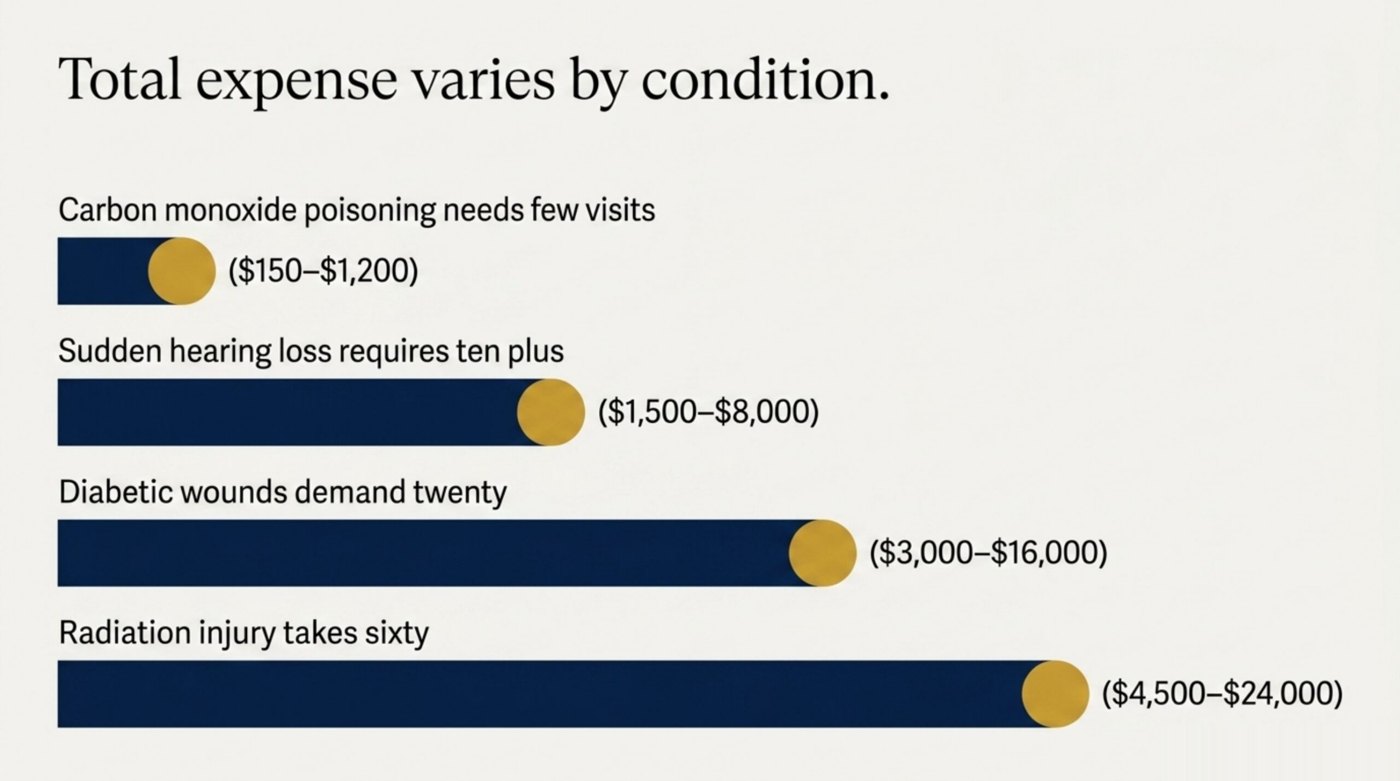
CO Poisoning
$150 to $1,200
1 to 3 sessions typical · covered at hospital programmes
Hearing Loss
$1,500 to $8,000
10 to 20 sessions typical · covered at hospital programmes
Diabetic Wound
$3,000 to $16,000
20 to 40 sessions typical · covered at hospital programmes
Radiation Injury
$4,500 to $24,000
30 to 60 sessions typical · covered at hospital programmes
At private clinics, a full HBOT course runs from about $150 for a single emergency carbon-monoxide session to roughly $24,000 for a 60-session radiation-injury course; hospital programmes treat all 14 recognised indications at $0 with a physician referral.
Course-cost estimates assume the per-session range of $150 to $400 multiplied by typical session counts. Hospital programmes provide treatment at no out-of-pocket cost for the 14 recognised conditions with a physician referral. For the underlying chamber licensing, CSA standards, and source-list adjudication, see our regulatory framework overview.
By province and territory
Cost by province and territory
All 13 Canadian provinces and territories below. Hospital cost reflects what a covered patient pays (typically $0 with physician referral). Private cost reflects self-pay rates at private clinics in the province.
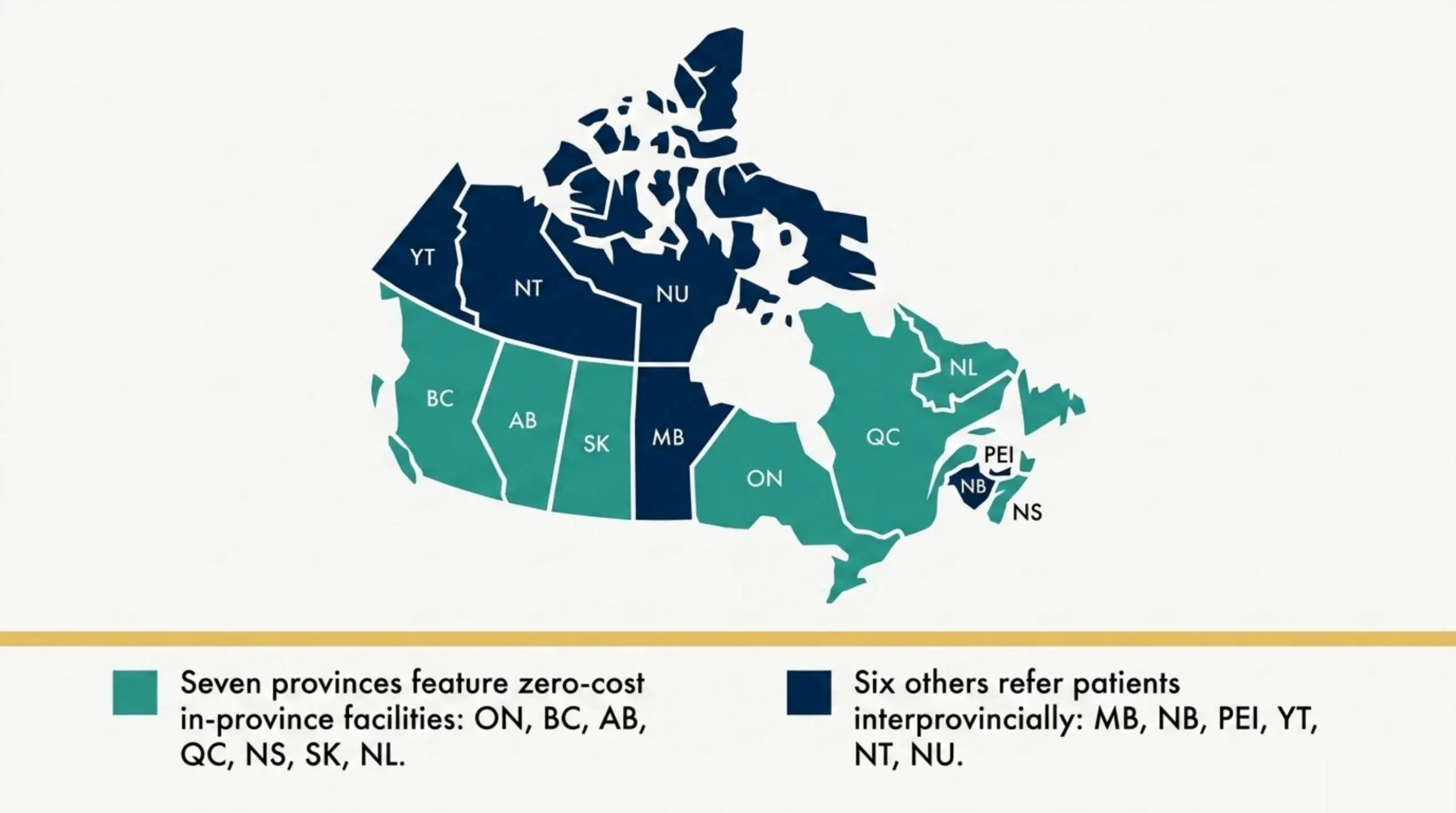
In short: hospital HBOT is publicly covered in 7 provinces (treated patients pay $0 with a referral), and everywhere else patients are referred interprovincially with covered costs or pay $150 to $400 per session at a private clinic.
| Province / Territory | Coverage | Plan | Hospital Cost | Private Range | Coverage Notes |
|---|---|---|---|---|---|
| Ontario | Hospital covered | OHIP | $0 | $150 to $400 | Covers 14 conditions at Toronto General, Hamilton General, The Ottawa Hospital. Select Independent Health Facilities may also bill OHIP for approved indications. |
| British Columbia | Hospital covered | MSP | $0 | $150 to $400 | Covers 14 conditions at Vancouver General Hospital only. Private clinics (BaroMedical) are self-pay. |
| Alberta | Hospital covered | AHCIP | $0 | $200 to $350 | Covers 14 conditions at Misericordia Edmonton and Foothills/AJECCC Calgary. CPSA accreditation required for private clinics. |
| Quebec | Hospital covered | RAMQ | $0 | $175 to $300 | Covers at Hopital du Sacre-Coeur de Montreal and Hotel-Dieu de Levis. |
| Nova Scotia | Hospital covered | MSI | $0 | No private clinics | Covers at QEII Health Sciences Centre, Halifax. 12 to 18 month wait for elective indications. |
| Manitoba | Private only | Manitoba Health | No hospital programme | $175 to $325 | No in-province hospital HBOT. Oxygen Manitoba (Winnipeg) is self-pay. Public referrals route to Edmonton or Ontario. |
| Saskatchewan | Hospital covered | Saskatchewan Health | $0 | No private clinics | Wigmore Hospital in Moose Jaw operates on reduced hours since July 2021 closure. Saskatchewan Ministry of Health may approve referrals to Calgary or Edmonton when in-province capacity is unavailable. |
| New Brunswick | Private only | Medicare NB | No hospital programme | $175 to $325 | O2 Hyperbaric Center (Dieppe) is self-pay. Public referrals route to QEII Halifax (12 to 18 month wait). |
| Newfoundland and Labrador | Hospital covered | MCP | $0 | No private clinics | Covers at Health Sciences Centre, St. John's. |
| Prince Edward Island | Referral out | PEI Medicare | No in-province HBOT | No private clinics | PEI patients are referred to QEII Halifax via reciprocal billing. |
| Yukon | Referral out | Yukon Health Care | No HBOT facility | No HBOT facility | Yukon patients are referred to BC or Alberta hospital programmes. |
| Northwest Territories | Referral out | NWT Health | No HBOT facility | No HBOT facility | NWT patients are referred to Alberta hospital programmes. |
| Nunavut | Referral out | Government of Nunavut | No HBOT facility | No HBOT facility | Nunavut patients are referred to The Ottawa Hospital. |
Of the 13 Canadian provinces and territories, 7 have an in-province hospital HBOT programme that treats covered patients at $0 with a physician referral (Ontario, British Columbia, Alberta, Quebec, Nova Scotia, Saskatchewan, and Newfoundland and Labrador); the other 6 refer patients interprovincially with covered treatment costs.
Private-clinic ranges reflect typical published rates as of 2026. Confirm current pricing with each clinic before booking. See our facility directory for the closest provider.
Price drivers
What affects the price
Five factors drive most of the per-session price variation across Canadian private clinics:
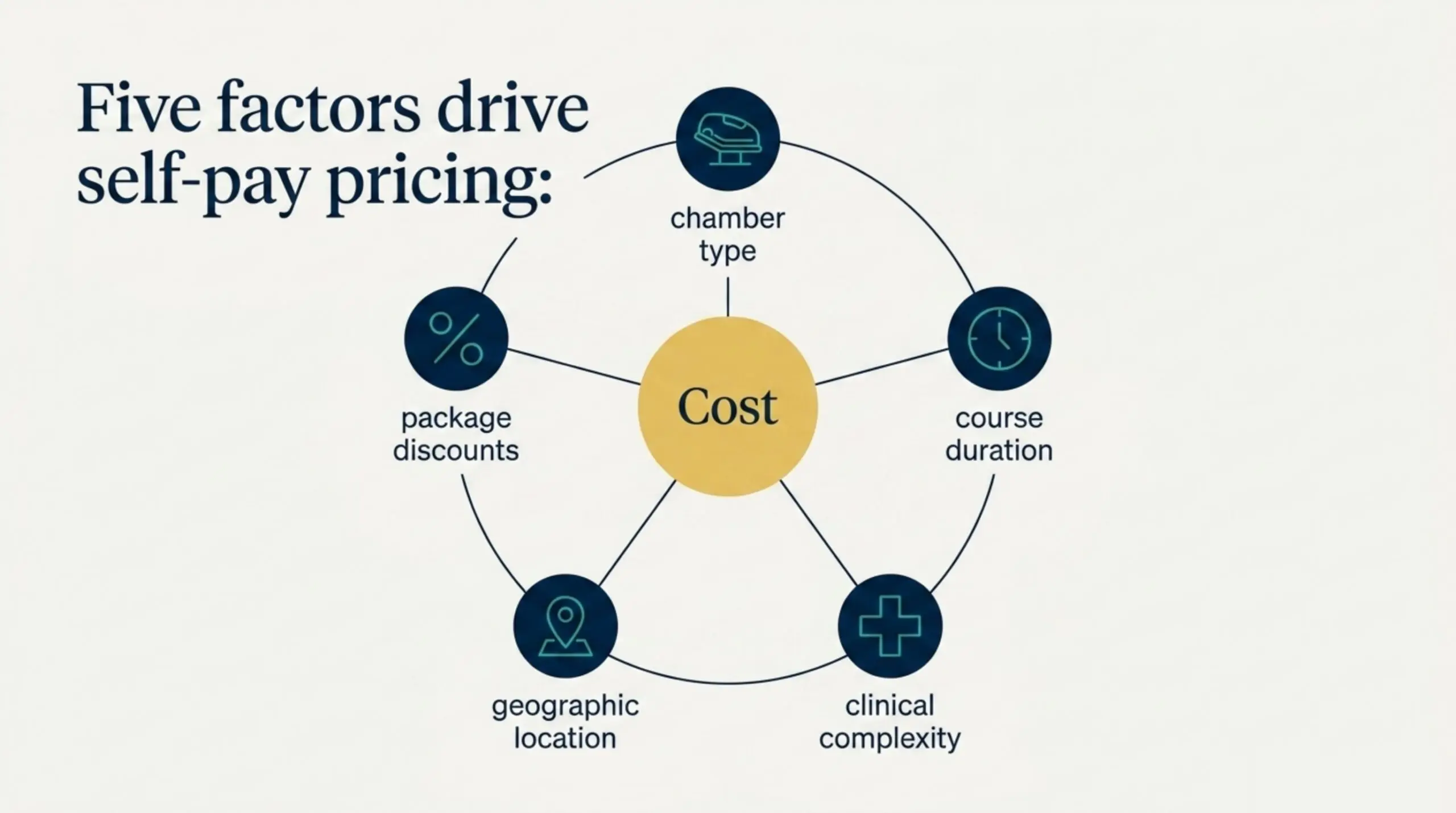
Chamber type
Multiplace chambers (multiple patients, attended by an inside attendant) are typically priced higher than monoplace chambers (single patient, no attendant). Both are clinical-grade rigid chambers; soft inflatable chambers are not equivalent and are not used for clinical HBOT.
Course length (number of sessions)
Most chronic indications require 20 to 40 sessions; some radiation indications require up to 60 sessions. Per-session rate is similar; total cost scales with course length.
Indication and clinical complexity
Treatment at higher pressures (2.4 ATA versus 2.0 ATA), longer session durations, or with monitoring requirements may carry premium pricing at some clinics.
Location and local market
Toronto and Vancouver clinics tend toward the upper end of the typical range. Edmonton private clinics typically quote $200 to $350. Smaller-market clinics may price lower.
Package discounts and introductory pricing
Most private clinics offer package discounts of 10 to 25 per cent for full 20 to 40 session courses paid up front. Some clinics offer introductory or single-session pricing as low as $79 to $150 to allow new patients to assess fit before committing. Always ask about both before booking a full course.
Coverage
Insurance and extended health
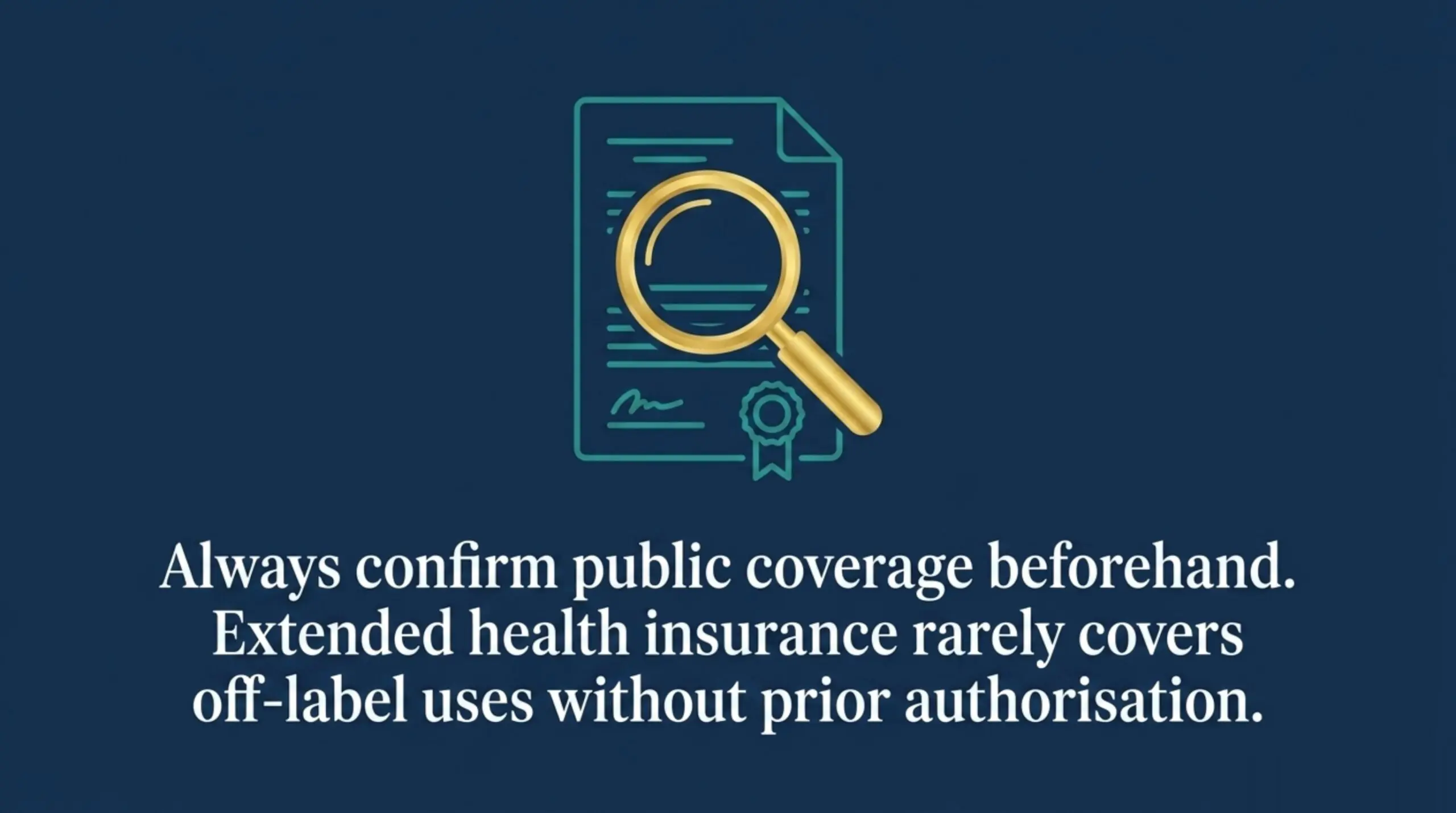
Provincial public coverage applies only to hospital-based programmes treating the 14 recognised conditions with a physician referral. Out-of-pocket cost is $0 in those cases. Private clinic treatment is generally not covered by provincial plans, with the limited exception of select Ontario IHFs that may bill OHIP for specific approved indications.
Private extended health insurance (workplace benefits or individually purchased plans) varies widely. Some plans cover specific HBOT indications when prescribed by a physician; many do not cover off-label uses. Pre-authorisation is typically required. Workplace benefits sometimes include health-spending-account dollars that can be applied to HBOT.
Workers' compensation may cover HBOT for work-related injuries (e.g., decompression sickness in commercial divers, crush injuries) on a case-by-case basis through provincial WCB or WSIB. The receiving clinic typically handles the billing once approval is secured.
Confirm before booking. Always check coverage with your specific plan administrator before committing to a treatment course. Provide the clinical indication and the proposed course length so the administrator can give a definitive answer.
Questions
Frequently asked questions: HBOT cost in Canada
What is hyperbaric oxygen therapy?
How does hyperbaric oxygen therapy work?
What conditions does hyperbaric oxygen therapy treat?
Is hyperbaric oxygen therapy safe?
How long are hyperbaric oxygen therapy sessions?
How many sessions of hyperbaric oxygen therapy do you need?
How much does hyperbaric oxygen therapy cost in Canada?
Is hyperbaric oxygen therapy covered by insurance?
How much does HBOT cost in Toronto?
How much does HBOT cost in Hamilton?
Does OHIP cover hyperbaric oxygen therapy?
How much does hyperbaric oxygen therapy cost in Ontario?
How much does HBOT cost in Ottawa?
How much does HBOT cost in Edmonton?
How much does HBOT cost in Calgary?
How much does HBOT cost in Montreal?
How much does HBOT cost in Vancouver?
Is hyperbaric oxygen therapy covered by MSP?
Is HBOT covered by OHIP, MSP, AHCIP, or other provincial plans?
What is the average cost of a hyperbaric chamber session at a private clinic?
How much is one hour in the hyperbaric chamber?
Why does HBOT cost so much at private clinics?
Are there package discounts for full HBOT treatment courses?
Is hyperbaric oxygen therapy a tax-deductible medical expense in Canada?
Does WCB or WSIB cover hyperbaric oxygen therapy?
How much does it cost to buy a hyperbaric chamber in Canada?
Is hyperbaric oxygen therapy worth the cost?
Does extended health insurance cover HBOT?
How much does a full course of hyperbaric oxygen therapy cost?
Is hyperbaric oxygen therapy cheaper at a hospital or a private clinic?
Will my benefits reimburse me for hyperbaric oxygen therapy?
How much does hyperbaric oxygen therapy cost for an off-label or unproven use?
Does the cost of HBOT vary depending on the type of chamber used?
Do private HBOT clinics charge extra fees beyond the per-session price?
Does the price of hyperbaric oxygen therapy change depending on which city or clinic you visit?
Do prices for HBOT include the initial consultation?
What payment methods do private HBOT clinics in Canada typically accept?
Transparency
How we verified these HBOT costs
Cost figures on this page are reconciled from canonical sources used across canadahyperbarics.ca and verified against provincial coverage information and clinic-published rates where available. Source documents include:
- Health Canada, Hyperbaric Oxygen Therapy for the 14 recognised conditions list
- The Ottawa Hospital Hyperbaric Medicine Unit as the canonical Ontario coverage reference
- Provincial health-plan documentation: OHIP, MSP, AHCIP, RAMQ, MSI, Manitoba Health, Saskatchewan Health, Medicare NB, MCP, PEI Medicare
- CUHMA Standards of Practice Guidelines for clinical-grade chamber definitions
- UHMS Hyperbaric Oxygen Therapy Indications, 15th Edition (2024) for international evidence base
- Per-clinic published rates from 33 verified facilities across 9 provinces
Private clinic rates can change. Confirm current pricing with the specific clinic before booking. Hospital-programme coverage decisions are made by the receiving programme based on the referring physician\'s assessment and provincial plan rules.
Keep going
Next steps
This page is informational and is not medical advice. Cost estimates reflect typical Canadian market rates as of 2026 and may change. Always confirm pricing directly with the specific facility before booking. Canada Hyperbarics does not accept payment from any facility, manufacturer, or treatment provider for listing, ranking, or promotion; listings are editorial. See our editorial policy and data sources pages for methodology.
Further Reading
How to Talk to Your Doctor About Hyperbaric Oxygen Therapy: A Step-by-Step Guide for Canadian Patients
TL;DR: If you think hyperbaric oxygen therapy (HBOT) might help you, the most reliable first step is an…
Hyperbaric Oxygen Therapy in Newfoundland and Labrador: A Patient’s Guide
TL;DR: Hyperbaric oxygen therapy in Newfoundland and Labrador is delivered through the public hospital system at the Health…
How Many Hyperbaric Oxygen Therapy Sessions Are Needed? A Patient FAQ for Canadians
TL;DR: Most people need a course of hyperbaric oxygen therapy (HBOT), not a single visit. The number of…
Hyperbaric Oxygen Therapy in New Brunswick: A Patient’s Guide
TL;DR: New Brunswick does not have a public hospital hyperbaric oxygen therapy (HBOT) chamber. Patients who need medically…