For physicians assessing a patient's suitability for HBOT. Hyperbaric oxygen therapy is publicly funded in Canada for 14 conditions, and at Canadian hospital-based programmes it is delivered as adjunctive or primary treatment within an established referral pathway. This guide is a clinical, neutral aid to the suitability assessment: confirming that the patient has an approved indication, judging fitness for pressure, working through absolute and relative contraindications, flagging the small number of medications that genuinely change the calculus, ordering a sensible pre-treatment workup, and knowing when a conversation with the hyperbaric physician should happen before the patient is referred. It is not a substitute for the assessing hyperbaric physician's own judgement, which governs every treatment decision.
Confirming an approved indication
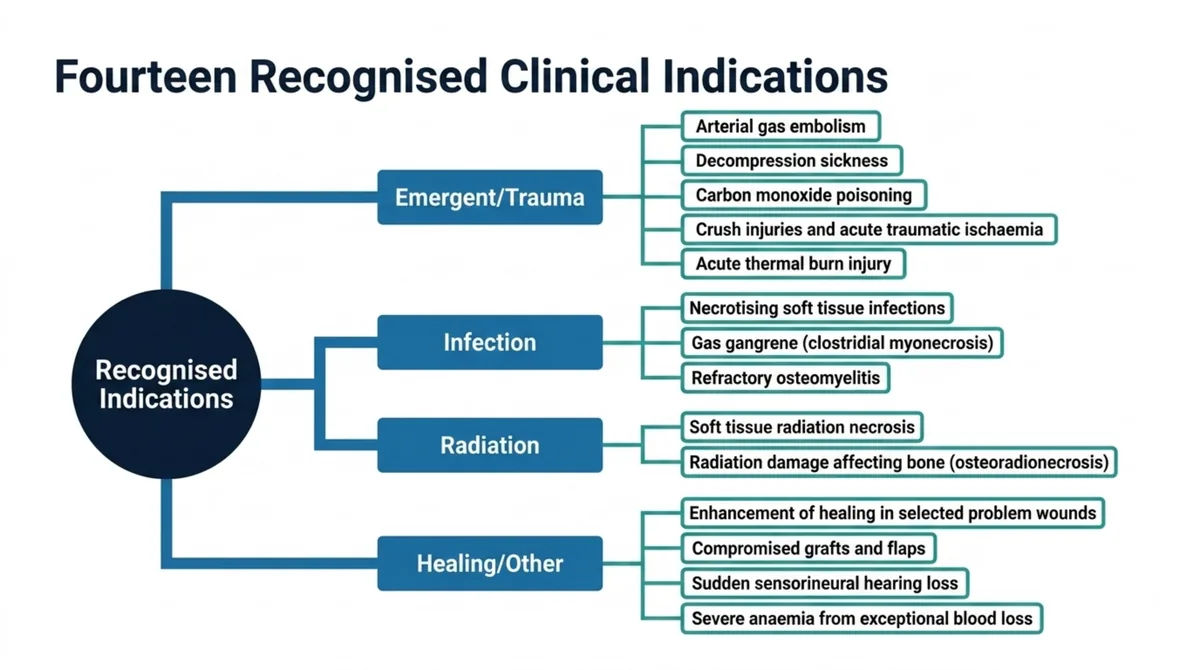
The first question in any HBOT assessment is whether the patient's diagnosis is one publicly funded in Canada. The fourteen recognised indications are:
1. Decompression sickness 2. Carbon monoxide poisoning 3. Arterial gas embolism 4. Enhancement of healing in selected problem wounds 5. Soft tissue radiation necrosis (soft tissue radionecrosis) 6. Radiation damage affecting bone (osteoradionecrosis) 7. Gas gangrene (clostridial myonecrosis) 8. Crush injuries and acute traumatic ischaemia 9. Necrotising soft tissue infections 10. Compromised grafts and flaps 11. Refractory osteomyelitis 12. Sudden sensorineural hearing loss 13. Severe anaemia from exceptional blood loss 14. Acute thermal burn injury
Two points matter when you match a patient to this list. First, the strength of evidence varies considerably across the indications, from conditions where HBOT is standard of care to conditions where it is a time-critical or adjunctive measure layered onto definitive treatment. The indication being recognised does not, on its own, tell you how strong the expected benefit is; that belongs to the condition-specific discussion. Second, HBOT should be offered only for these recognised indications. Uses outside this list are investigational, and a suitability assessment should not be framed as if benefit were established for them. If the working diagnosis does not map cleanly onto one of the fourteen, that is itself a reason to discuss the case with the hyperbaric physician before referring.
Fitness for pressure
A recognised indication establishes that HBOT may be appropriate. The next question is whether the patient can tolerate the physical environment of the chamber, where ambient pressure rises during compression and falls during decompression. Several systems deserve specific attention.
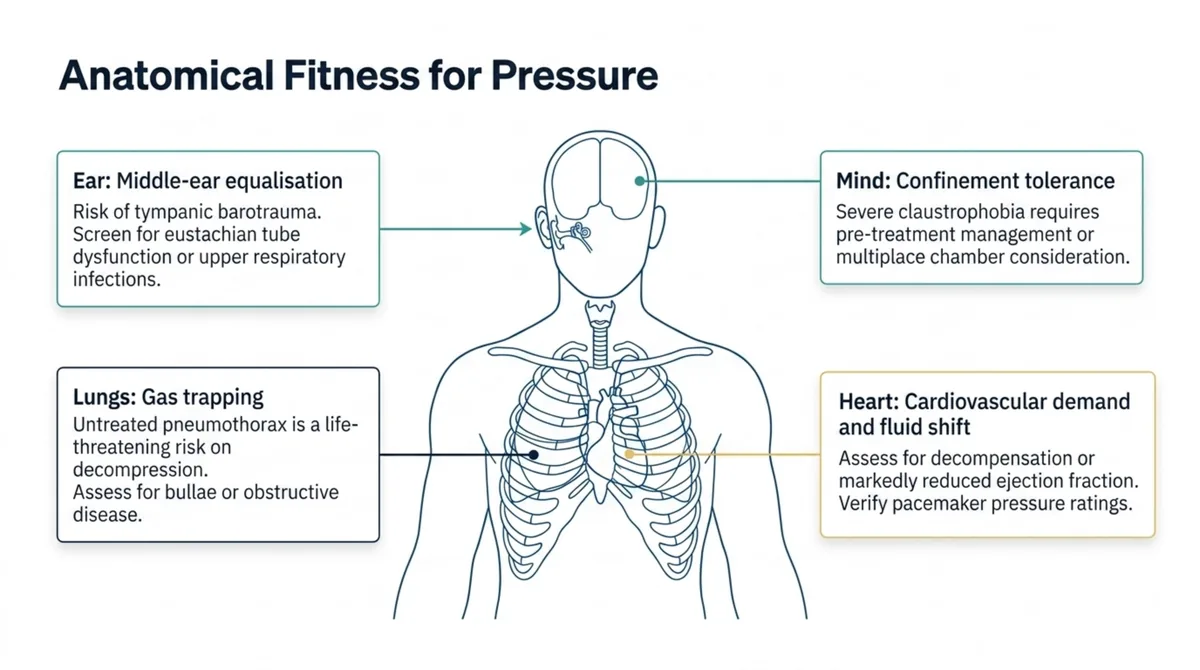
ENT and middle-ear clearance. The middle ear is the most common site of barotrauma, because the pressure change during descent must be equalised across the eustachian tube. A patient who cannot auto-inflate the middle ear, or who has an active upper respiratory infection, significant nasal or sinus congestion, or eustachian tube dysfunction, is at raised risk of tympanic membrane barotrauma. Assess the patient's ability to equalise, treat active congestion before referral where possible, and note any history of ear surgery. Patients who cannot equalise voluntarily may still be treatable with slower compression or, in some cases, myringotomy or tympanostomy tubes, but that is a hyperbaric-team decision.
Chest imaging and untreated pneumothorax. Lung imaging before treatment is the rule, because an untreated pneumothorax is the most widely recognised absolute contraindication to HBOT: gas trapped in the pleural space expands on decompression and can precipitate a life-threatening tension pneumothorax. Beyond an existing pneumothorax, look for air-trapping pathology such as bullae, blebs, or significant obstructive disease that could lead to gas trapping. Any suspected pneumothorax must be drained before chamber entry.
Cardiac status. Compression and the oxygen load place a demand on the cardiovascular system, and there is a fluid-shift consideration on decompression. Patients with poorly compensated heart failure, particularly those with markedly reduced ejection fraction, are at risk of decompensation or pulmonary oedema and warrant cardiology input and a careful risk discussion before referral. Note implanted cardiac devices: pacemakers and similar devices must be confirmed as pressure-rated for the planned depth, which is verified against the manufacturer's specification.
Claustrophobia. Tolerance of an enclosed chamber is a genuine practical determinant of suitability. Severe claustrophobia can make monoplace treatment difficult; it may be managed with a multiplace chamber, behavioural measures, or pre-medication. Screen for it during the assessment rather than discovering it at the chamber door.
Seizure threshold and glucose in diabetics. Oxygen at pressure lowers the threshold for central-nervous-system oxygen toxicity, which can occasionally manifest as a seizure. A history of poorly controlled seizures, active fever, and certain medications can lower that threshold further; seizures should be controlled before treatment is initiated. In patients with diabetes, monitor glucose around sessions, because HBOT tends to lower blood glucose during treatment. One retrospective hospital dataset (77 patients, 1,825 treatments) reported a fall in blood glucose in about three-quarters of treatments, with a median decrease of roughly 25 mg/dL (about 1.4 mmol/L); in that series clinically significant hypoglycaemia was uncommon, but a patient who arrives already low could become symptomatically hypoglycaemic in the chamber. Practical screening of pre-session glucose, and coordination with the patient's diabetes care, belong in the suitability plan.
Absolute and relative contraindications
The contraindication picture in hyperbaric medicine is unusually lopsided: there is a short list of absolute contraindications and a longer list of relative ones that are weighed case by case.
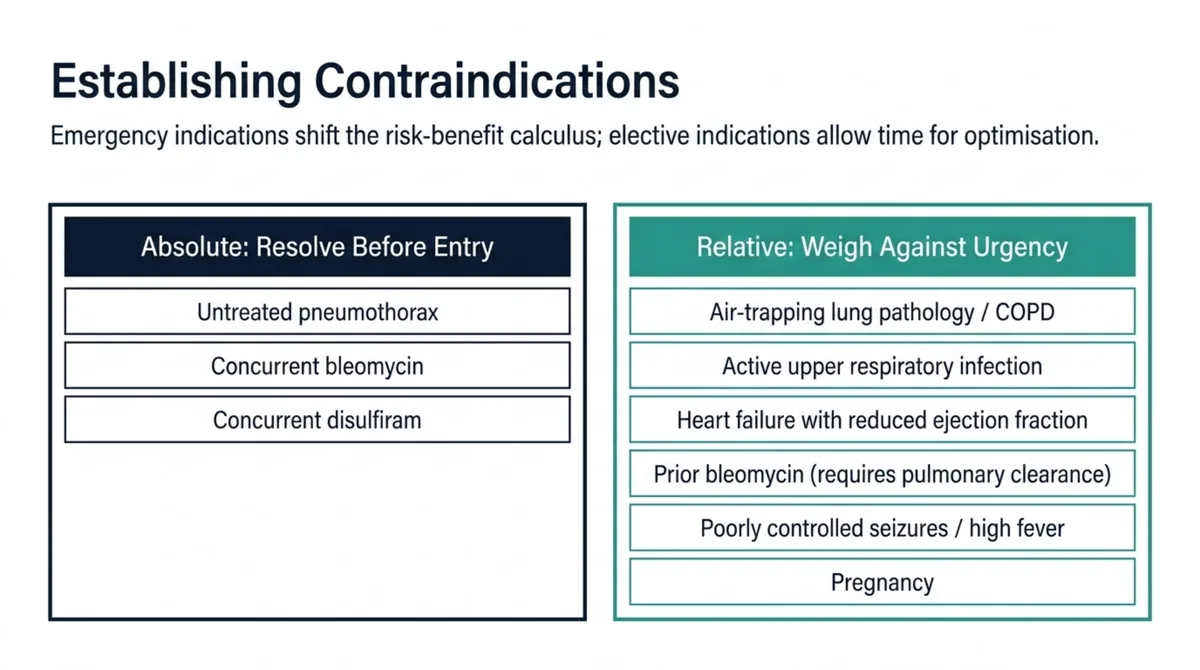
Absolute. Untreated pneumothorax is the most widely recognised absolute contraindication, and it must be addressed before any treatment. Classical hyperbaric teaching also treats two concurrent medications as absolute contraindications while they are on board: concurrent bleomycin (because hyperbaric oxygen can trigger or accelerate oxygen-induced pulmonary fibrosis) and concurrent disulfiram (because it inhibits superoxide dismutase, the enzyme that neutralises hyperbaric-oxygen-generated free radicals). Some centres also treat the presence of intraocular gas as absolute for non-emergency indications because of the vision risk on pressure change. Prior bleomycin exposure with documented pulmonary clearance is a relative, not absolute, contraindication and calls for individualised pulmonary review before HBOT.
Relative. Relative contraindications do not automatically exclude a patient; they shift the risk-benefit balance and call for optimisation, monitoring, or a modified protocol. They commonly include:
- Significant obstructive airways disease, air-trapping lung pathology (bullae, blebs), and a history of spontaneous pneumothorax
- Active upper respiratory infection, sinus disease, or eustachian tube dysfunction (middle-ear barotrauma risk)
- Poorly controlled seizure disorder, active high fever, and recent intracranial surgery
- Heart failure with markedly reduced ejection fraction
- Severe claustrophobia
- Prior bleomycin exposure with documented pulmonary clearance
- Poorly controlled diabetes (glucose at the extremes of range warrants stabilisation first)
- Pregnancy (a relative consideration in most settings, though the threshold is different in carbon monoxide poisoning, where treatment may be indicated)
- Certain ocular conditions and a history of ear or thoracic surgery
The weight of any relative contraindication depends on the indication. An emergency indication such as decompression sickness, arterial gas embolism, or carbon monoxide poisoning shifts the balance toward treatment even when relative cautions are present; an elective wound or radiation indication allows more time to optimise the patient first. This balancing is the hyperbaric physician's call.
Medication interactions
A small group of drugs interacts with hyperbaric oxygen in ways that change the assessment. They matter because the interaction is with the oxygen itself, not simply with the chamber, and because most are encountered in oncology patients who are also candidates for radiation-injury indications.
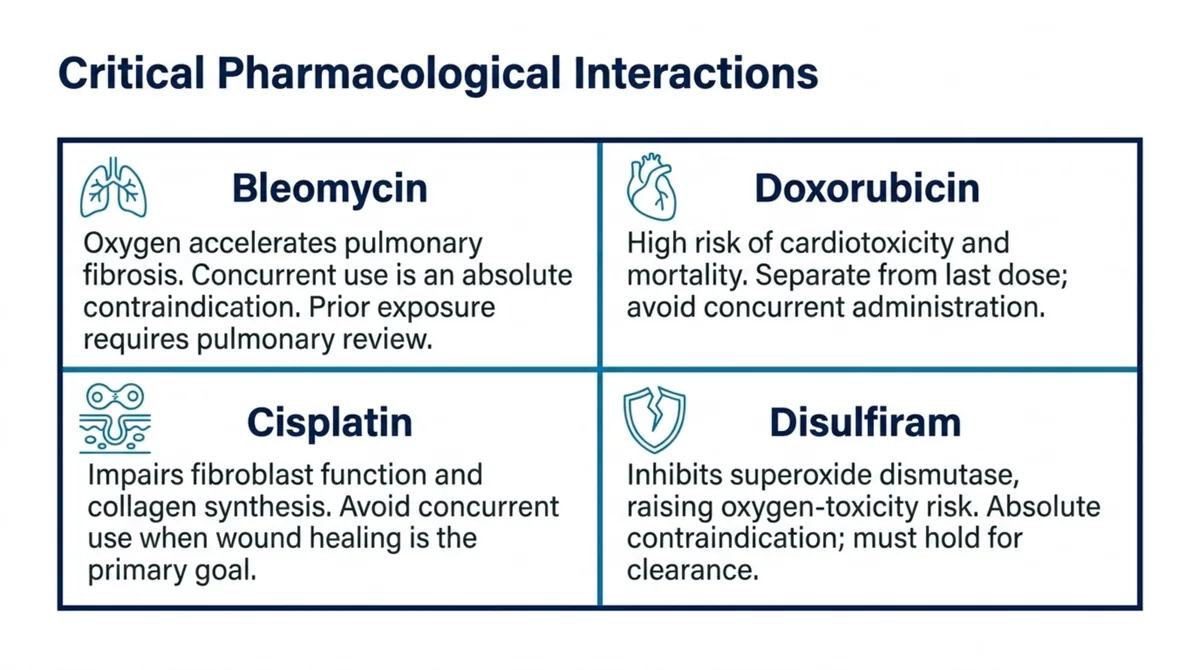
- Bleomycin. The concern is pulmonary. Bleomycin sensitises the lungs to oxygen-mediated injury, and high oxygen exposure can potentiate pulmonary toxicity and fibrosis. Concurrent bleomycin is treated as effectively absolute at most programmes, though the UHMS classifies it as a relative contraindication. Prior bleomycin exposure calls for a careful interval and an assessment for any sign of pulmonary fibrosis before HBOT is considered, with documented pulmonary clearance making it a relative contraindication that requires individualised pulmonary-function review.
- Doxorubicin. The concern is cardiac. Doxorubicin is cardiotoxic, and animal data have shown markedly increased mortality with concurrent hyperbaric oxygen, so concurrent administration is avoided and a separation from the last dose is observed before treatment.
- Cisplatin. The concern is wound healing. Cisplatin can impair fibroblast function and collagen synthesis, which works against the wound-healing goal of several HBOT indications; concurrent use is therefore generally avoided where healing is the objective, though an emergent indication can override the timing.
- Disulfiram. The concern is oxygen toxicity. Disulfiram inhibits superoxide dismutase, the enzyme that defends tissue against oxygen free radicals, which raises the risk of oxygen-toxicity effects under pressure. Concurrent disulfiram is treated as an absolute contraindication, so it is held off before treatment to allow clearance.
In a genuine emergency indication, these interactions are weighed pragmatically by the hyperbaric physician against the risk of withholding a time-critical treatment; in elective care they are respected as timing constraints. Either way, flag any of these agents in the referral so the hyperbaric physician can plan around them.
Pre-treatment workup
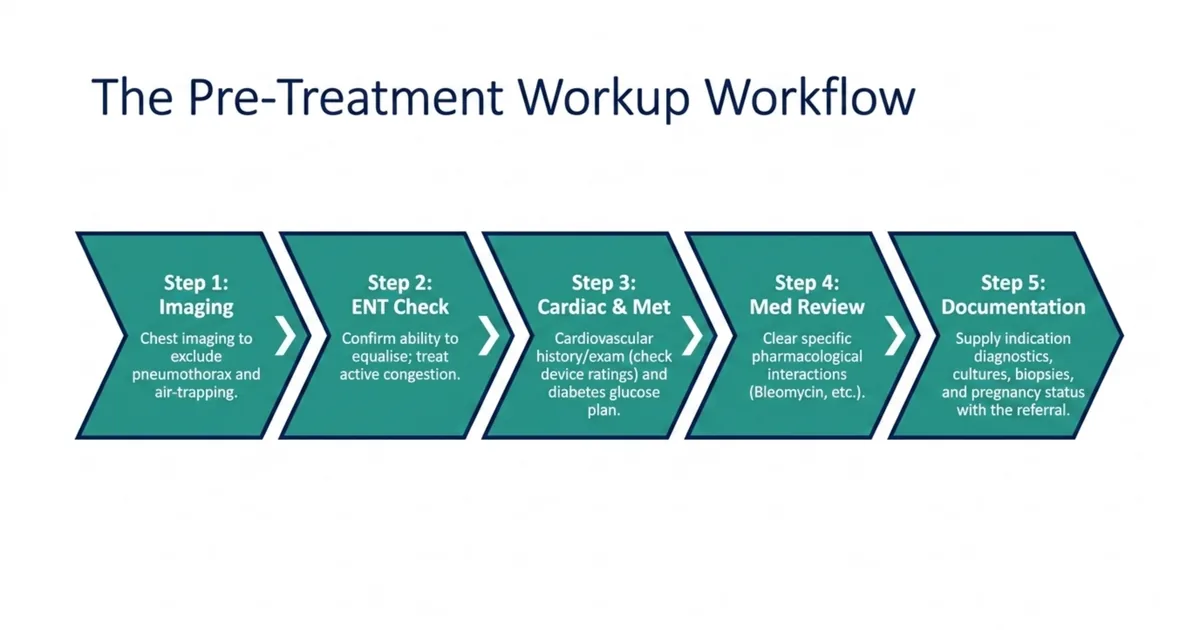
A focused workup makes the hyperbaric physician's assessment faster and safer. Tailor it to the indication, but the common elements are:
- Chest imaging to exclude pneumothorax and screen for air-trapping pathology before the first treatment.
- ENT assessment of the patient's ability to equalise the middle ear, with treatment of any active congestion or infection.
- Cardiac evaluation proportionate to risk: history and examination for all patients, and objective assessment of ventricular function where heart failure is suspected; confirmation that any implanted device is pressure-rated.
- Glucose assessment and a diabetes plan in patients with diabetes, including a pre-session glucose check and coordination with their usual diabetes care.
- A medication review specifically for bleomycin, doxorubicin, cisplatin, and disulfiram, with dates of last exposure.
- A clear statement of the indication and the working diagnosis, plus relevant imaging, cultures, or biopsy results for wound, infection, osteomyelitis, and radiation-injury referrals.
- Documentation of pregnancy status where applicable.
Send the supporting documents with the referral rather than after it. A complete package shortens the interval to assessment and avoids the patient being turned away at the chamber for a missing chest film or an unverified pacemaker rating.
When to discuss with the hyperbaric physician
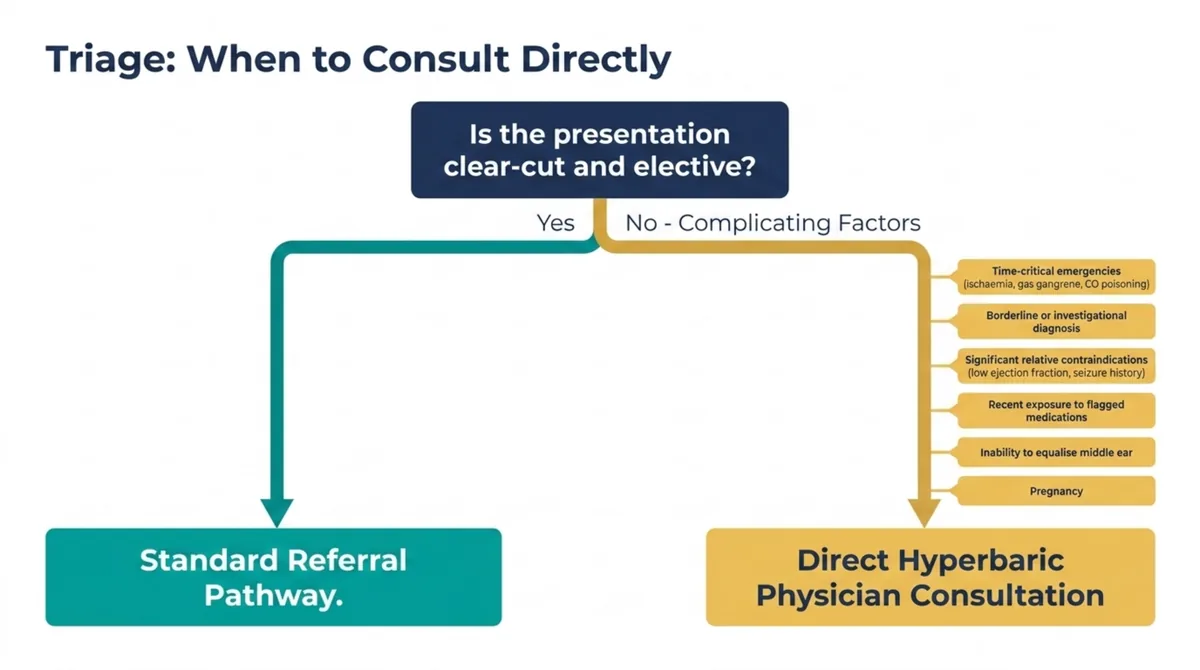
Refer in the usual way for clear-cut, well-documented cases that fit an approved indication and carry no significant cautions. Speak to the hyperbaric physician before referring when the assessment is not clean, including when:
- The working diagnosis does not map cleanly onto one of the fourteen recognised indications, or the indication is borderline.
- There is a time-critical emergency indication (decompression sickness, arterial gas embolism, carbon monoxide poisoning, gas gangrene, necrotising infection, crush injury with acute ischaemia), where speed matters and relative cautions should be weighed by the hyperbaric team rather than used to delay.
- A relative contraindication is present and you are unsure how much weight it carries for this indication, for example reduced ejection fraction, a seizure history, air-trapping lung disease, or significant claustrophobia.
- The patient has had recent bleomycin, doxorubicin, cisplatin, or disulfiram, or is currently on any of these, and you need to confirm the timing is safe.
- The patient cannot equalise the middle ear, or has a history of ear or thoracic surgery that complicates pressure tolerance.
- Brittle or poorly controlled diabetes raises a real risk of in-chamber hypoglycaemia.
- The patient is pregnant and an HBOT indication is being considered.
Canadian hospital-based hyperbaric programmes have established pathways for exactly these conversations, and the hyperbaric physician carries the final decision on suitability, protocol, and treatment depth. When the assessment leaves you uncertain, the discussion before referral is almost always faster than a referral that has to be unwound.