For referring physicians and surgeons in Canada. Chronic refractory osteomyelitis is one of the 14 conditions publicly funded in Canada for hyperbaric oxygen therapy (HBOT), and it is treated as an elective, adjunctive course at Canadian hospital-based hyperbaric programmes, covered by provincial health insurance. Unlike the emergency indications, HBOT here is scheduled rather than urgent: it complements surgical debridement and culture-targeted antibiotics, it does not replace them. This guide summarises when to refer, how to assess the patient before referral, what the evidence supports, the Canadian referral pathway, and contraindications. It closes with the complete list of open-access research published since 2020, each linked to its free full text.
When to refer
Refer for elective hyperbaric assessment when a patient meets the definition of refractory osteomyelitis: chronic bone infection that persists despite adequate surgical debridement and at least four to six weeks of culture-targeted antibiotics. A subset of chronic osteomyelitis cases become refractory after initial treatment. The strongest candidates for adjunctive HBOT include:
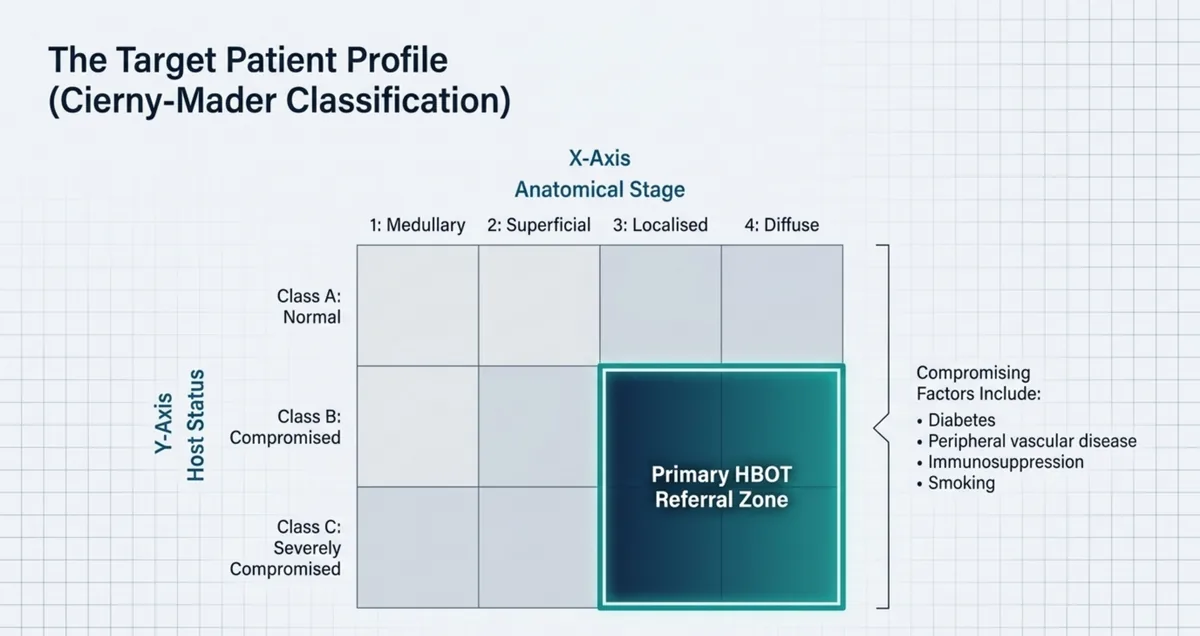
- Refractory disease in a compromised host. Using the Cierny-Mader classification, the typical referral is Stage 3 (localised) or Stage 4 (diffuse) disease in a Class B (compromised) or Class C (severely compromised) host. Diabetes, peripheral vascular disease, immunosuppression, and smoking all impair the local oxygen tension that HBOT is intended to restore.
- Post-radiation mandibular osteomyelitis. This is among the strongest indications and is often managed with a defined perioperative protocol rather than open-ended treatment.
- Vertebral osteomyelitis with discitis, where source control is difficult and the infected bed is poorly perfused.
- Sternal or sternoclavicular osteomyelitis after cardiac surgery, and tibial or femoral osteomyelitis after trauma.
- Calcaneal osteomyelitis complicating a diabetic foot ulcer, where the hypoxic, poorly perfused environment is central to non-healing.
Because this is an elective indication, referral does not need to precede surgery. The accepted sequence is surgical debridement of grossly infected and devitalised bone first, culture-targeted intravenous antibiotics second, and HBOT third, addressing the hypoxic tissue that surgery and antibiotics alone cannot correct.
Assessing the patient before referral
Before referring for hyperbaric assessment, the referring orthopaedic surgeon, infectious-disease physician, dental surgeon, or family physician should:
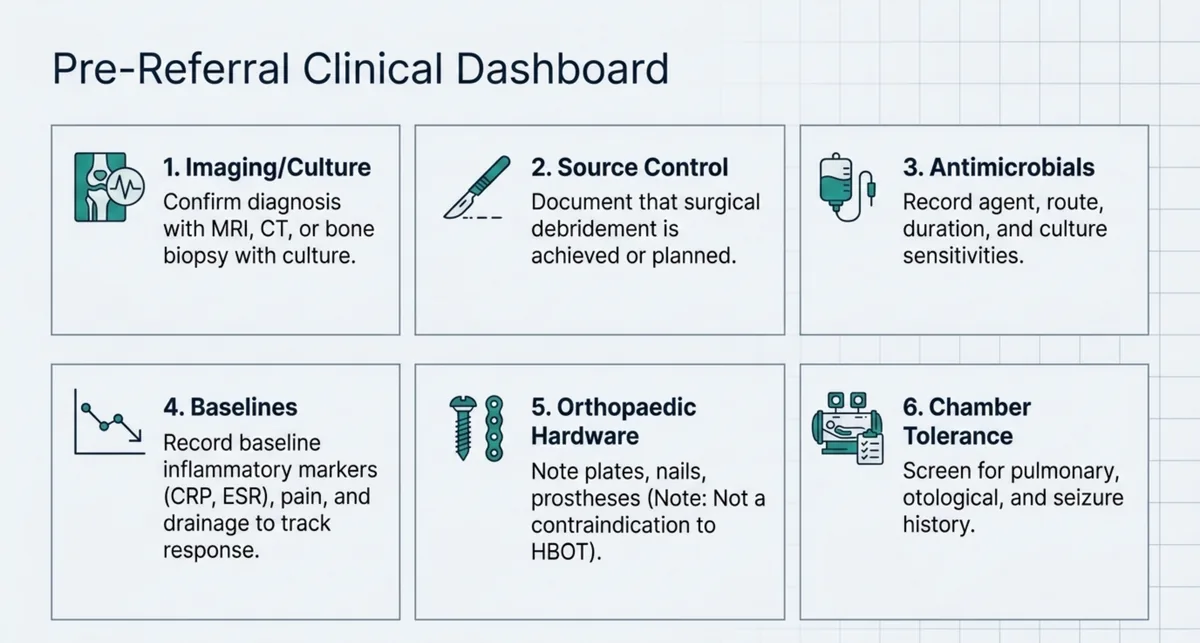
- Confirm the diagnosis with MRI, CT, or bone biopsy with culture, so the hyperbaric team has both anatomical staging and a microbiological target.
- Document that source control has been achieved or planned, since HBOT is an adjunct and not a substitute for debridement.
- Record the antibiotic course: agent, route, duration, and culture sensitivities. Aminoglycosides and fluoroquinolones depend on oxygen-dependent transport into tissue, which is part of the rationale for combining them with HBOT.
- Baseline the inflammatory markers (CRP and ESR) and document pain, drainage, and functional status, so response can be tracked. Most responders show measurable improvement over the course of treatment.
- Screen for contraindications and chamber tolerance (see below), including pulmonary, otological, and seizure history.
- Note any orthopaedic hardware. Plates, nails, and prostheses are not a contraindication to HBOT, though definitive eradication may eventually require their removal.
What the evidence supports
The evidence for adjunctive HBOT in refractory osteomyelitis is observational rather than randomised. Randomised controlled trials do not exist for this indication, and the body of evidence is best characterised as moderate (Level B). Case series report healing in roughly 80 to 85 percent of refractory cases when HBOT is added to surgery and antibiotics. The foundational work is Davis 1986 and Mader 1990, with later reviews by Goldman 2009 and Hart 2021. These figures reflect selected, refractory populations already managed surgically and medically, and the absence of randomised data means the magnitude of the independent HBOT effect cannot be stated with certainty.
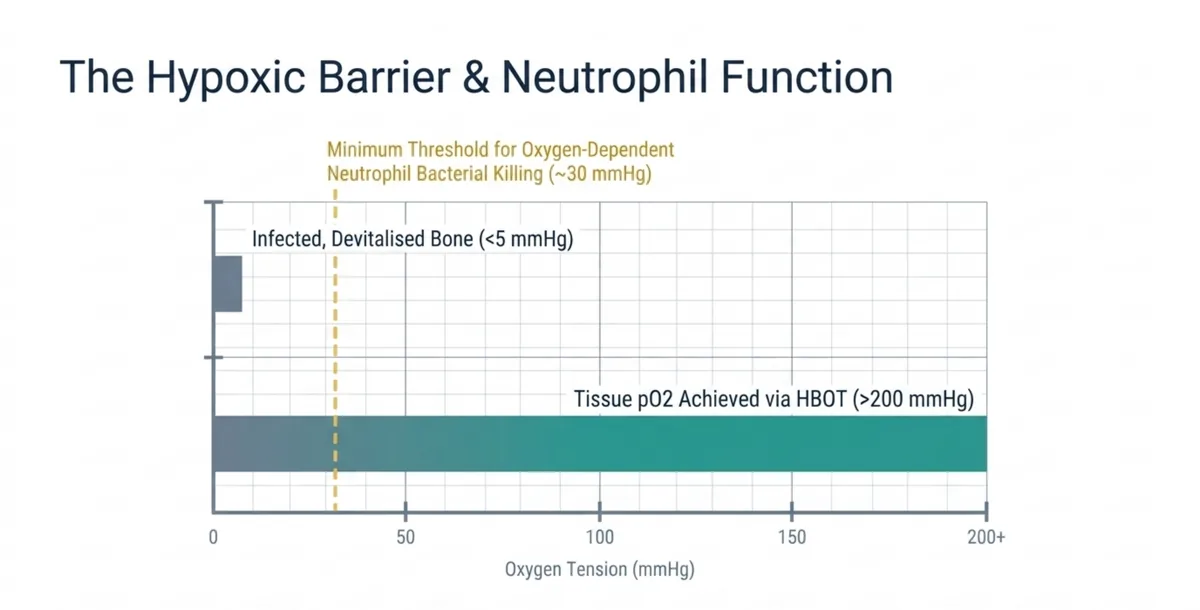
The mechanistic rationale is well established and converges on tissue oxygen. Oxygen-dependent neutrophil bacterial killing is impaired at low tissue pO2; infected, devitalised bone often measures below 5 mmHg, while HBOT can raise local oxygen tension to several hundred mmHg. Beyond restoring neutrophil function, elevated tissue oxygen restores the activity of oxygen-dependent antibiotics in tissue that was functionally drug-resistant, suppresses anaerobic organisms, supports osteoclast clearance of devitalised sequestra, and stimulates osteoblast and angiogenic activity, with measurable increases in capillary density reported after a 20- to 30-session course.
Clinical translation
Treat HBOT as a planned addition to a complete osteomyelitis programme, not as a rescue measure. The benefit signal depends on adequate surgery and culture-targeted antibiotics being in place first; HBOT corrects the hypoxic local environment that prevents those measures from succeeding. A standard course runs 2.0 to 2.5 ATA on 100 percent oxygen for 90 minutes per session, typically 20 to 40 sessions over four to eight weeks, extending toward 60 sessions in severe disease. Post-radiation mandibular cases are commonly managed with a Marx-style sequence of 30 sessions before surgery and 10 after. Response is judged on resolution of pain and drainage, falling inflammatory markers, and serial imaging, with most responders improving by sessions 15 to 20. When refractory disease has failed an adequate surgical and antibiotic course, refer for hyperbaric consultation rather than escalating antibiotics indefinitely. You can review the full clinical background on the chronic refractory osteomyelitis condition page.

The Canadian referral pathway
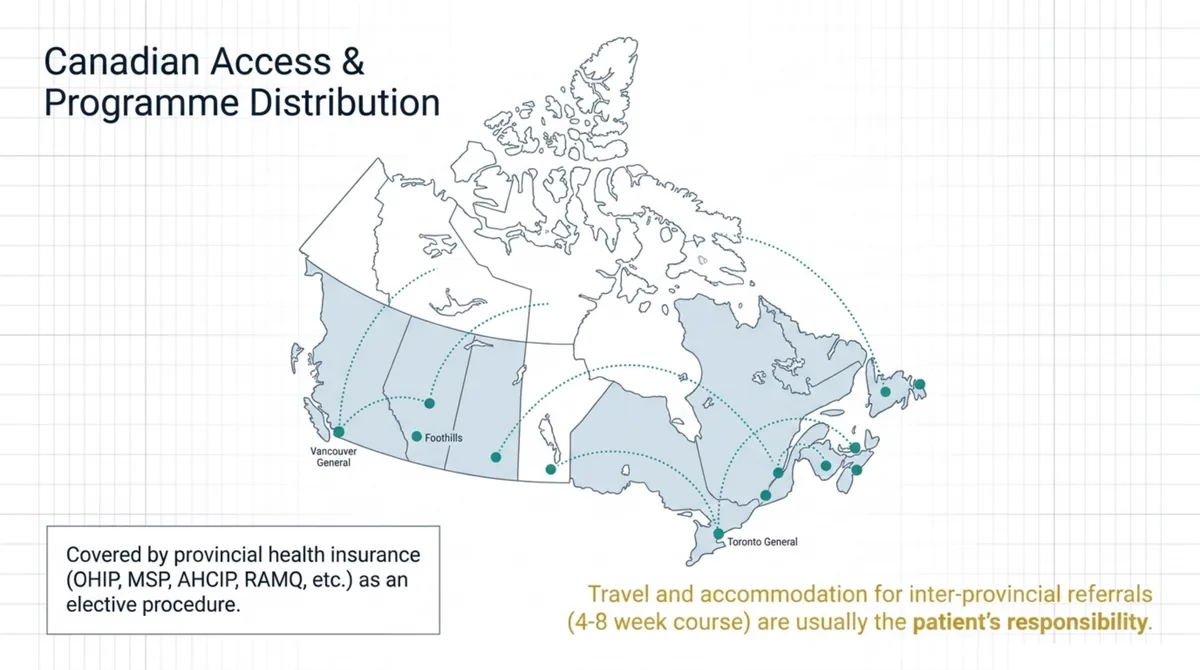
Chronic refractory osteomyelitis is treated as an elective, adjunctive indication at Canadian hospital-based hyperbaric programmes and is covered by provincial health insurance (OHIP, MSP, AHCIP, RAMQ, MSI, MCP, and the Saskatchewan Health Authority) when delivered at those programmes. Treatment is currently available at 11 hospital programmes across 7 provinces (Ontario, Quebec, British Columbia, Alberta, Nova Scotia, Newfoundland and Labrador, and Saskatchewan). Because the course is elective, referral is made directly to the nearest hospital hyperbaric programme rather than through an emergency coordination line, and treatment typically begins within one to four weeks of consultation.
- Ontario: referral to a hospital-based programme such as Toronto General (UHN), Hamilton General, or The Ottawa Hospital; covered under OHIP.
- British Columbia: referral to Vancouver General Hospital (Leon Judah Blackmore Pavilion), the only hospital chamber in the province; covered under MSP.
- Alberta: referral to Misericordia Community Hospital (Edmonton) or Foothills Medical Centre (Calgary); covered under AHCIP.
- Quebec: RAMQ covers Hopital du Sacre-Coeur de Montreal and Hotel-Dieu de Levis.
- Provinces and territories without an in-province hospital programme (Manitoba, New Brunswick, PEI, Yukon, NWT, Nunavut): inter-provincial referral to the nearest programme. Because the course runs four to eight weeks, patients should be counselled early that travel and accommodation are usually their own responsibility.
Confirm coverage and current referral criteria with the receiving programme, as accepted indications and intake processes vary by centre.
Contraindications and cautions
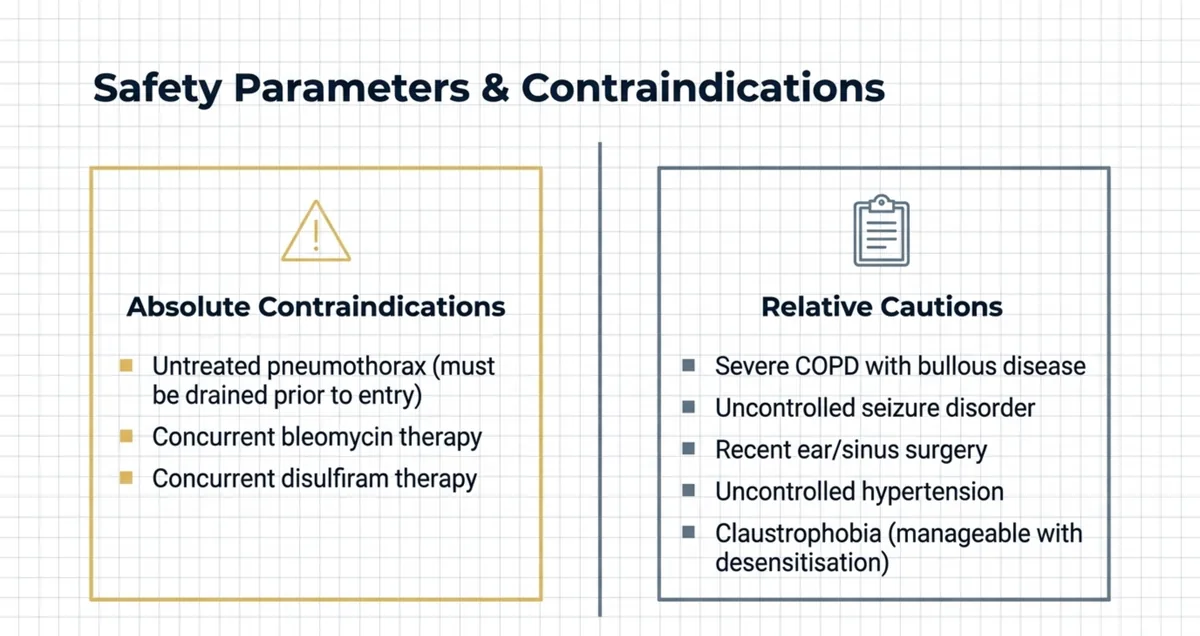
The only absolute contraindication relevant at the point of referral is an untreated pneumothorax, which must be drained before chamber entry. Concurrent bleomycin and concurrent disulfiram are also contraindications to elective hyperbaric care and should be flagged before referral. Relative cautions that warrant discussion with the hyperbaric team include severe COPD with bullous disease, an uncontrolled seizure disorder, recent ear or sinus surgery, uncontrolled hypertension, and claustrophobia, which is usually manageable with desensitisation strategies. Orthopaedic hardware is not a contraindication.
How to use the research list below
The list contains every chronic refractory osteomyelitis study in the Canada Hyperbarics database that was published in 2020 or later and has a freely available full-text version, each linked directly to that full text. Paywalled and abstract-only studies are excluded, and retracted studies are removed. This is a reference list, not a set of summaries. Counts and the open-access set refresh each quarter.
Open-access research, 2020 to present
13 studies with a free full-text version, grouped by year, newest first. Each entry links to the full text. The set refreshes each quarter; retracted and paywalled studies are excluded.
20253 studies
- Kumar M et al. Anterior Mandibular Osteomyelitis: A Narrative Review of Clinical Presentation, Diagnosis, and Management Strategies. Cureus. Full text (Unpaywall) ›
- Althaus L et al. A pathogen-detection's odyssey in a case of skull base osteomyelitis: Land ahoy!. Annals of clinical microbiology and antimicrobials. Full text (Unpaywall) ›
- Kjellberg A et al. A novel treatment strategy with hyperbaric oxygen of chronic osteomyelitis and pseudoarthrosis in a child with congenital hereditary sensory and autonomic neuropathy type 4 congenital insensitivity to pain with anhidrosis syndrome: a case report. J Med Case Rep. Full text (Unpaywall) ›
20243 studies
- Shimbo K et al. Role of Hyperbaric Oxygen Therapy in Maximizing Flap Survival in Compromised Free Flaps: A Case Report. Eplasty. Full text (Unpaywall) ›
- Menekse S Outcome of Chronic Foot Osteomyelitis Treated With Hyperbaric Oxygen: An Observational Study. The international journal of lower extremity wounds. Full text (Unpaywall) ›
- Serpa-Romero X et al. Craniofacial osteomyelitis in a patient with systemic involvement: a case report. Rev Cient Odontol (Lima). Full text (Unpaywall) ›
20232 studies
- Fernandes TL et al. A Case Report of Oral Bisphosphonate Treatment for Osteoporosis Leading to Atypical Femoral Fracture and Pathologic Mandibular Fracture. The American journal of case reports. Full text (Unpaywall) ›
- Tahir E et al. Skull Base Osteomyelitis Complicating COVID-19: A Novel Secondary Infection?. Journal of clinical practice and research. Full text (Unpaywall) ›
20214 studies
- Allal S et al. Case report of osteomyelitis of the mandible in osteopetrosis and management considerations. Int J Surg Case Rep. Full text (Unpaywall) ›
- Kitajima K et al. Usefulness of Quantitative Bone SPECT/CT for Evaluating Treatment Response in a Patient with Mandibular Osteomyelitis. Case Rep Oncol. Full text (Unpaywall) ›
- Robertsson C et al. Primary chronic osteomyelitis of the jaw: Rapid improvement after hormonal suppression in a girl with precocious puberty. Bone reports. Full text (Unpaywall) ›
- Lertwilaiwittaya P et al. Identification of novel mutation in RANKL by whole-exome sequencing in a Thai family with osteopetrosis; a case report and review of RANKL osteopetrosis. Molecular genetics & genomic medicine. Full text (Unpaywall) ›
20201 study
- Shier A et al. Short-Term Outcome and MRI Changes in Three Adult Patients with Sickle Cell Disease and Aseptic Osteonecrosis after Treatment with Hyperbaric Oxygen Therapy: A Preliminary Report. Case reports in oncology. Full text (Unpaywall) ›