For referring and emergency physicians in Canada. Compromised skin grafts and flaps are one of the 14 conditions publicly funded in Canada for hyperbaric oxygen therapy (HBOT), and the therapy is offered as an adjunct to plastic-surgery management at Canadian hospital-based hyperbaric programmes, covered by provincial health insurance. This is a semi-urgent tissue-salvage indication rather than an emergency: the goal is to rescue a failing graft or flap inside a narrow biological window, so referral should be timely but is made through the surgical and hyperbaric teams rather than via an emergency call. This guide summarises when to refer, how to assess the patient before referral, what the evidence supports, the Canadian referral pathway, and contraindications. It closes with the complete list of open-access research published since 2020, each linked to its free full text.
When to refer
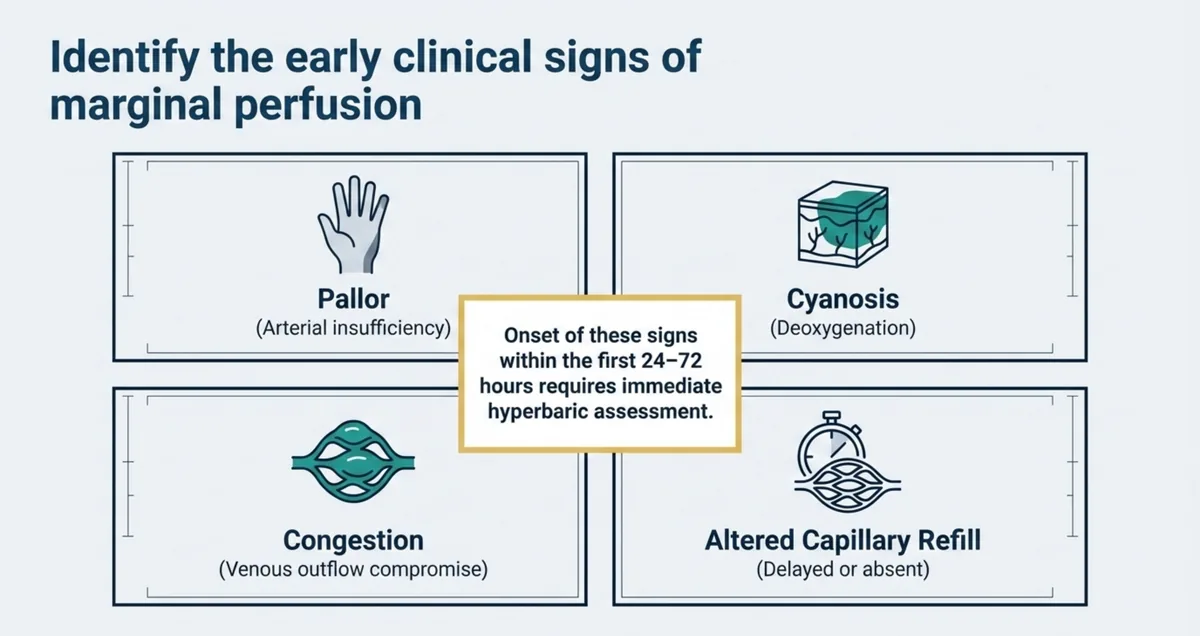
Refer for hyperbaric assessment promptly when a patient with a recent skin graft or flap shows early signs of compromise, because the salvage window is short and earlier intervention is associated with better outcomes. Consider referral when any of the following are present:
- Early signs of graft or flap compromise within the first 24 to 72 hours after the index operation: pallor, cyanosis, congestion, or changes in capillary refill. These signs of marginal perfusion are the core indication, and the biological window for post-operative HBOT is generally regarded as the first 24 to 72 hours after surgery.
- A flap or graft on a compromised recipient bed, particularly previously irradiated tissue, where baseline perfusion and angiogenic capacity are reduced.
- Pre-operative preparation of an irradiated or otherwise hypoxic recipient site before a planned graft or flap, where a course of HBOT can raise tissue oxygenation and vascularity before the reconstruction proceeds.
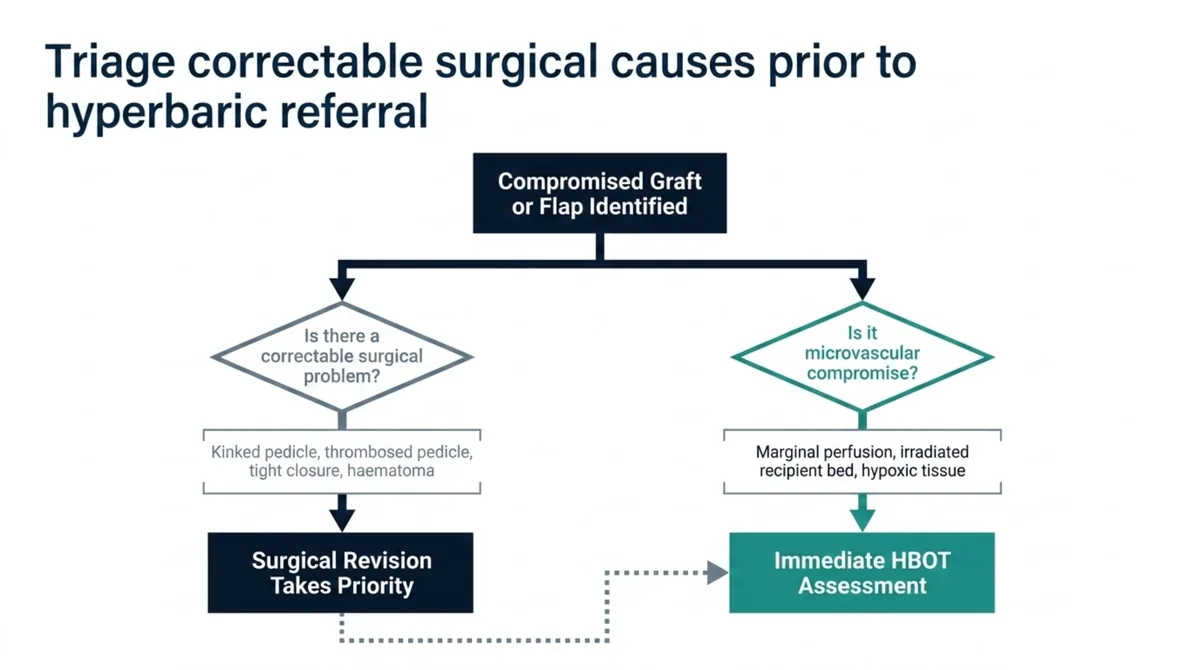
HBOT is an adjunct to plastic-surgery management, not a substitute for surgical re-exploration. If the clinical picture suggests a correctable surgical problem such as a kinked or thrombosed pedicle, a tight closure, or a haematoma, surgical revision takes priority. HBOT then supports the revised flap rather than replacing the operation.
Assessing the patient before referral
While arranging hyperbaric assessment in coordination with the surgical team, the referring service should:
- Document the timeline precisely: date and time of the index operation, the type of reconstruction (split- or full-thickness graft, local, regional, or free flap), and the time of onset of the compromise. The interval since surgery determines whether the patient is still inside the salvage window.
- Examine and record the perfusion status of the graft or flap: colour, capillary refill, temperature, turgor, and any venous congestion or arterial insufficiency. A serial description helps the hyperbaric team judge trajectory.
- Exclude a correctable surgical cause in consultation with plastic surgery, since re-exploration may need to precede HBOT.
- Review the recipient-bed history, especially prior radiation, prior surgery, infection, diabetes, smoking, or peripheral vascular disease, all of which raise the risk of failure.
- Screen for hyperbaric contraindications and ear or sinus barotrauma risk (see below), and confirm the patient can tolerate lying in a chamber for roughly 90 minutes per session.
What the evidence supports
The Undersea and Hyperbaric Medical Society classifies this indication at Level B (moderate evidence), reflecting support from controlled studies alongside clinical experience. The underlying randomised evidence is limited. A Cochrane review of HBOT for acute surgical and traumatic wounds (Eskes et al. 2013) found that two small trials suggested HBOT may improve the outcomes of skin grafting and trauma, but judged those trials to be at risk of bias and concluded that high-quality randomised trials are still needed. The benefit for compromised grafts and flaps should therefore be understood as plausible but not firmly established by high-quality trial evidence. The Canada Hyperbarics research database holds 140 peer-reviewed studies on this indication. You can read the vetted clinical overview on the compromised skin grafts and flaps condition page.
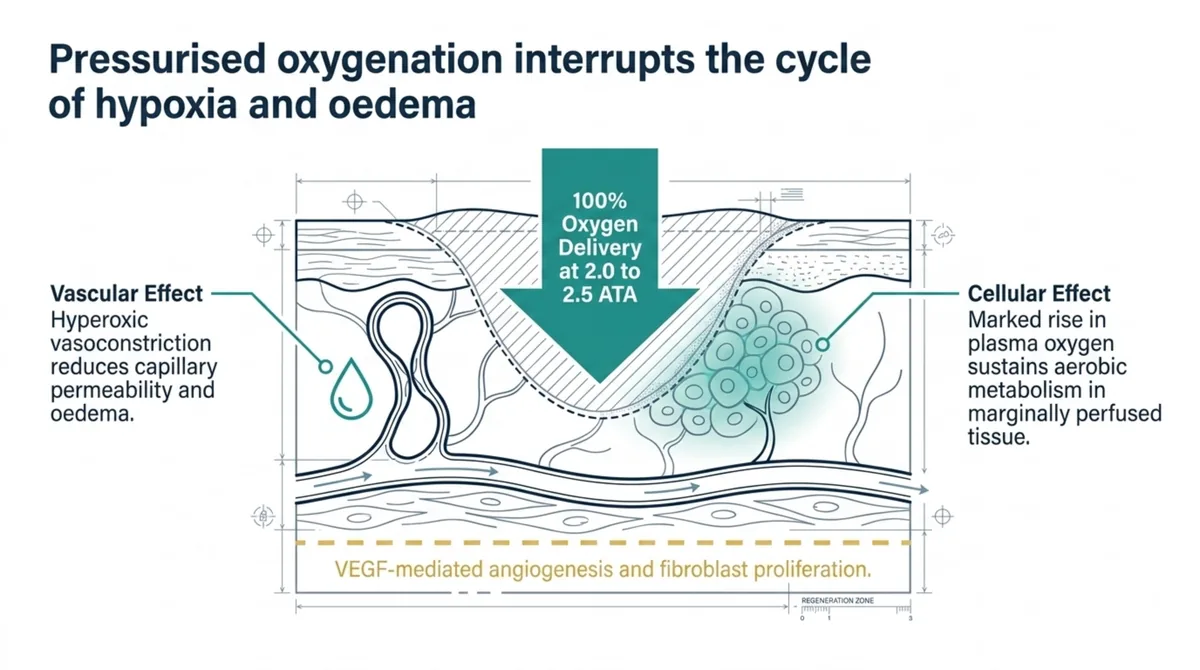
The mechanistic rationale is well established and is consistent with the observational and trial signal. At 2.0 to 2.5 ATA on 100 percent oxygen, plasma oxygen content rises markedly, raising tissue oxygen tension at the graft-wound interface and sustaining aerobic metabolism in marginally perfused tissue. Hyperoxic vasoconstriction can reduce capillary permeability and oedema while oxygen delivery to hypoxic tissue is preserved. Over a course, HBOT is thought to support VEGF-mediated angiogenesis and fibroblast proliferation, helping the graft or flap establish definitive vascularisation.
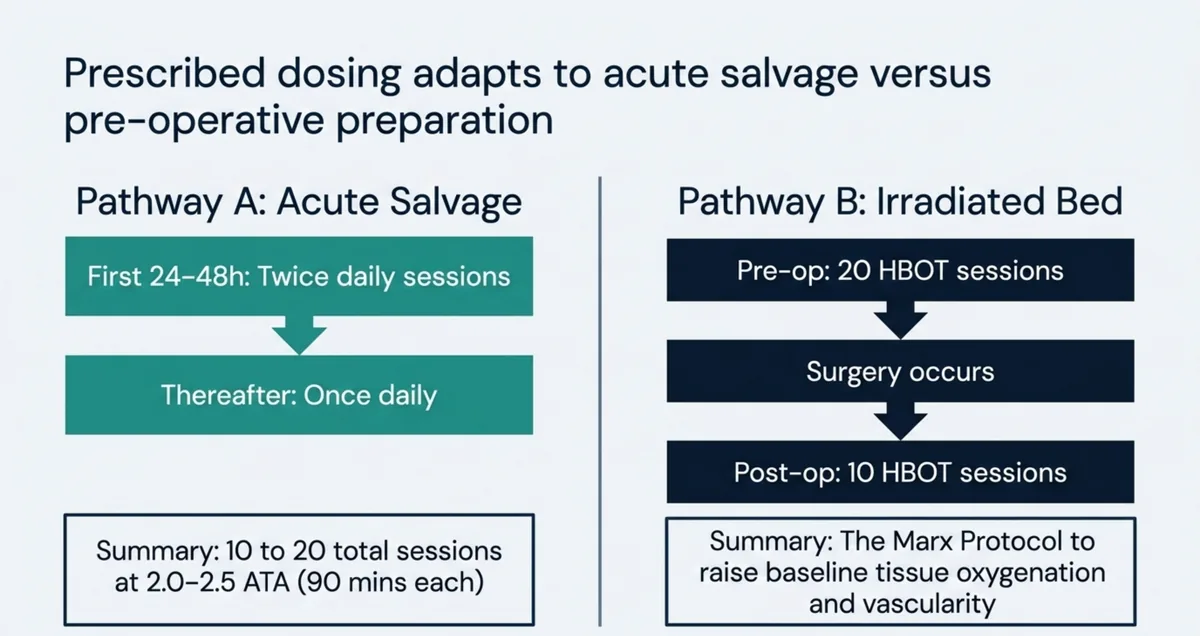
A consistent practical theme across the literature is timing. The biological window for post-operative HBOT is generally regarded as the first 24 to 72 hours after the index operation, and earlier intervention is associated with better salvage rates. In the pre-operative setting for irradiated beds, the Marx protocol of 20 HBOT sessions before the planned graft or flap and 10 sessions afterward has been described as a way to improve the vascularity of the recipient bed before reconstruction proceeds. The evidence does not establish HBOT as a guaranteed rescue, and it does not replace sound surgical technique or re-exploration; it is best understood as an adjunct intended to improve the odds for tissue at risk.
Clinical translation
Refer early. Because the salvage window is generally 24 to 72 hours and outcomes are better with earlier treatment, the decision to involve the hyperbaric team should be made as soon as compromise is recognised rather than after the graft or flap has clearly demarcated. A typical acute post-operative course is 90 minutes per session at 2.0 to 2.5 ATA, twice daily for the first 24 to 48 hours and then once daily, for a total of approximately 10 to 20 sessions, with the exact course set by the treating hyperbaric physician in conjunction with the surgeon. When a surgical problem is correctable, that revision comes first and HBOT follows.
The Canadian referral pathway
Compromised grafts and flaps are treated as a semi-urgent indication at Canadian hospital-based hyperbaric programmes and are covered by provincial health insurance. Referral is normally coordinated between the plastic-surgery service and the nearest hospital hyperbaric programme. If a patient with acute compromise presents to an emergency department without an established pathway, the receiving department coordinates transfer to the nearest hospital hyperbaric programme.
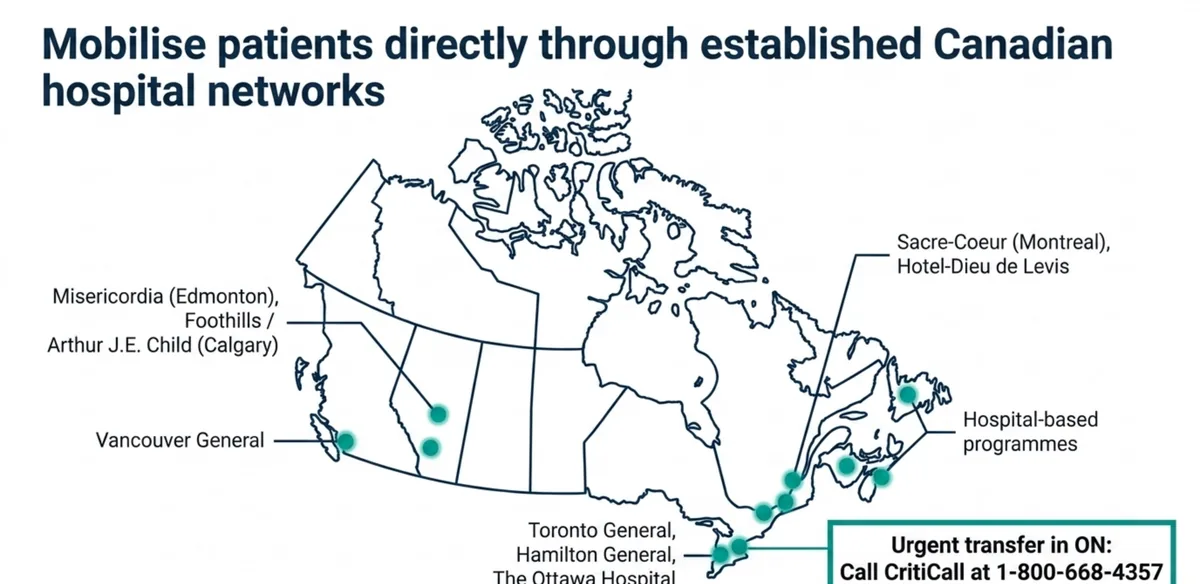
- Ontario: programmes at Toronto General (UHN), Hamilton General, and The Ottawa Hospital. For urgent inter-hospital coordination, CritiCall Ontario at 1-800-668-4357 connects emergency departments to these programmes and arranges transport when needed.
- British Columbia: Vancouver General Hospital (Leon Judah Blackmore Pavilion), the only hospital chamber in the province; covered under MSP.
- Alberta: Misericordia Community Hospital (Edmonton) or Foothills Medical Centre / Arthur J.E. Child Comprehensive Cancer Centre (Calgary); covered by Alberta Health.
- Quebec: RAMQ covers Hopital du Sacre-Coeur de Montreal and Hotel-Dieu de Levis.
- Nova Scotia, and Newfoundland and Labrador: hospital-based programmes serve these provinces.
- Saskatchewan: a hospital-based programme provides access in-province.
- Provinces and territories without a hospital programme: referral is arranged to the nearest accepting hospital programme in coordination with the surgical and hyperbaric teams.
Because the salvage window is short, telephone the receiving hyperbaric programme early to confirm capacity and timing rather than waiting for a formal written referral to be processed.
Contraindications and cautions
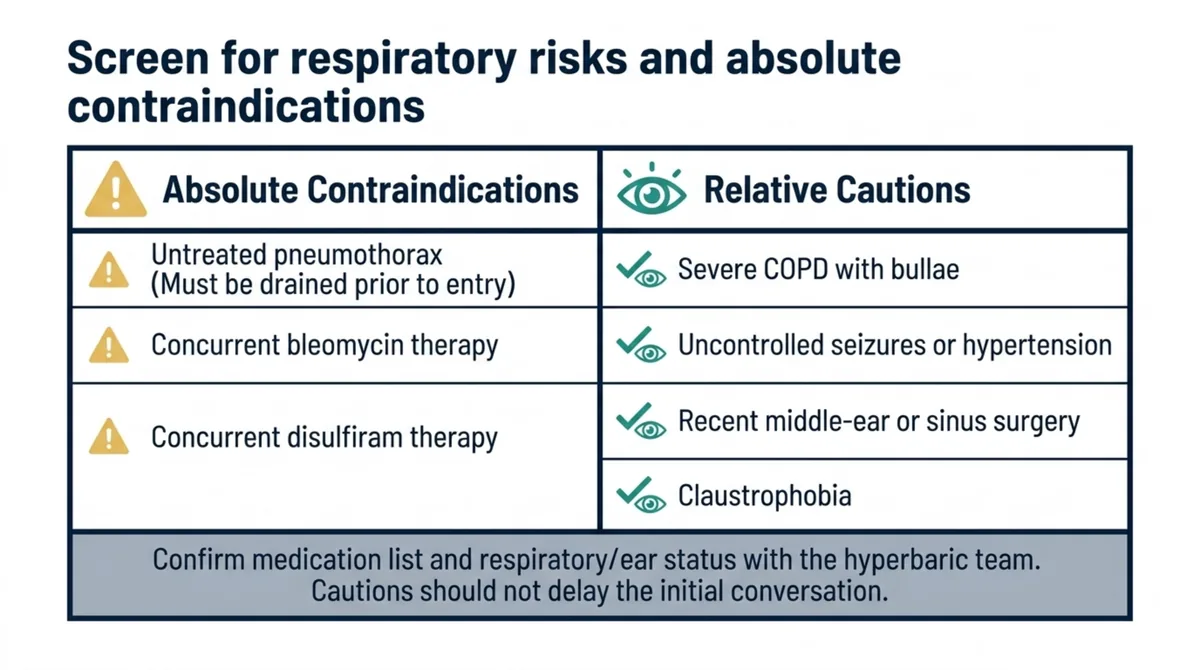
The absolute contraindications are an untreated pneumothorax, which must be drained before chamber entry, and concurrent bleomycin or concurrent disulfiram therapy. Relative cautions include severe chronic obstructive pulmonary disease with bullae, uncontrolled seizures, claustrophobia, recent middle-ear or sinus surgery, and uncontrolled hypertension. Because grafted and flapped patients are often post-operative and may be on multiple medications, confirm the medication list and respiratory and ear or sinus status with the hyperbaric team before referral. None of these cautions should delay a timely conversation with the hyperbaric programme when a graft or flap is failing.
How to use the research list below
The list contains every compromised-grafts-and-flaps study in the Canada Hyperbarics database that was published in 2020 or later and has a freely available full-text version, each linked directly to that full text. Paywalled and abstract-only studies are excluded, and retracted studies are removed. This is a reference list, not a set of summaries. Counts and the open-access set refresh each quarter.
Open-access research, 2020 to present
29 studies with a free full-text version, grouped by year, newest first. Each entry links to the full text. The set refreshes each quarter; retracted and paywalled studies are excluded.
20265 studies
- Coschignano M et al. A rare case of penile granulomatosis with polyangiitis: case report and multidisciplinary management approach. Front Urol. Full text (Unpaywall) ›
- Carter M et al. Systematic Review of Comparative Studies Evaluating Hyperbaric Oxygen Therapy on Skin Flap and Graft Surgical Indications. Plast Reconstr Surg Glob Open. Full text (Unpaywall) ›
- Weiss D Hyperbaric Oxygenationt for Ulcerative Graft-Versus-Host Disease: A Case Report. Clin J Oncol Nurs. Full text (Unpaywall) ›
- Leite C et al. Effect of Hyperbaric Oxygen Therapy on Early MRI-Based Graft Healing Following ACL Reconstruction With Hamstring Autografts. Orthop J Sports Med. Full text (Unpaywall) ›
- Talanker M et al. Multidisciplinary Approach to Complex Lower Extremity Limb Salvage in Pyogenic Arthritis, Pyoderma Gangrenosum, and Acne (PAPA) Syndrome: A Case Report. Microsurgery. Full text (Unpaywall) ›
20257 studies
- Zotikov D et al. Biological Nanoparticles for Enhancing Chronic Wound Regeneration. Cells. Full text (Unpaywall) ›
- Oley M et al. A descriptive retrospective study on the various uses of hyperbaric oxygen therapy. Int Marit Health. Full text (Unpaywall) ›
- Gao Y et al. Reduce Flap Necrosis After Autologous Breast Reconstruction: A Systematic Review. The Journal of craniofacial surgery. Full text (Unpaywall) ›
- Oley M et al. Hyperbaric oxygen therapy in managing fingertip injury after the thenar and VY flap procedure: A case series. Int J Surg Case Rep. Full text (Unpaywall) ›
- Zaman T et al. Hyperbaric Oxygen Therapy as an Effective Adjunctive Treatment in the Reconstruction of Tissue Defects With Graft in Diabetic Foot Patients: A Retrospective Cohort Study. Int Wound J. Full text (Unpaywall) ›
- Bezirgan U et al. Kahramanmaraş earthquake: From a microsurgical perspective of an orthopaedic hand surgery unit. Ulusal travma ve acil cerrahi dergisi = Turkish journal of trauma & emergency surgery : TJTES. Full text (Unpaywall) ›
- Pelly T et al. Systematic review: The management of unhealed wounds and persistent perineal sinuses following proctectomy in inflammatory bowel disease. Techniques in coloproctology. Full text (Unpaywall) ›
20244 studies
- Canıaz İ et al. [MSB-52] Neonatal Thrombosis in Pediatric Patients: A Report of Two Cases. Turk gogus kalp damar cerrahisi dergisi. Full text (Unpaywall) ›
- Dereli D et al. Hyperbaric oxygen treatment in bilateral orchiopexy and post-circumcision haematoma in a thrombocytopenic patient with Noonan syndrome. Diving Hyperb Med. Full text (Unpaywall) ›
- Abu-Zidan FM et al. Surgical and critical care management of earthquake musculoskeletal injuries and crush syndrome: A collective review. Turkish journal of emergency medicine. Full text (Unpaywall) ›
- Korambayil PM et al. Evaluating Hyperbaric Oxygen Therapy to Improve Single-Stage Dermal Substitute and Skin Grafting: A Comparative Study. Indian journal of plastic surgery : official publication of the Association of Plastic Surgeons of India. Full text (Unpaywall) ›
20232 studies
- Çelebi S Neo-glans reconstruction with dartos flaps covered with buccal mucosal graft after total glans amputation during circumcision: novel technique. Ulusal travma ve acil cerrahi dergisi = Turkish journal of trauma & emergency surgery : TJTES. Full text (Unpaywall) ›
- Oley MH et al. Serum BMP-2 and osteocalcin levels, and CT Hounsfield unit post hyperbaric oxygen therapy in patients with cleft lip and palate post alveolar bone graft: A case study. Heliyon. Full text (Unpaywall) ›
20225 studies
- Park SK et al. Superior gluteal artery perforator flap salvaged via hyperbaric oxygen therapy. BMJ case reports. Full text (Unpaywall) ›
- Almoshantaf MB et al. Successful management of scalp avulsion with full-thickness graft. Clinical case reports. Full text (Unpaywall) ›
- Zhao PX et al. Effect of hydrogen intervention on refractory wounds after radiotherapy: A case report. World journal of clinical cases. Full text (Unpaywall) ›
- Le JM et al. Computer-Assisted Microvascular Free Flap Reconstruction and Implant Rehabilitation of the Maxilla-Treatment of a Rare Post-orthognathic Complication. Journal of maxillofacial and oral surgery. Full text (Unpaywall) ›
- Firlar I et al. Functional Hydrogels for Treatment of Chronic Wounds. Gels. Full text (Unpaywall) ›
20213 studies
- Kara S et al. Results of hyperbaric oxygen treatment in an at-risk nasal flap following trauma. Diving and hyperbaric medicine. Full text (Unpaywall) ›
- Boughanmi F et al. Fournier's gangrene: its management remains a challenge. Pan Afr Med J. Full text (Unpaywall) ›
- Oley MH et al. Hyperbaric Oxygen Therapy for Reconstructive Urology Wounds: A Case Series. Research and reports in urology. Full text (Unpaywall) ›
20203 studies
- Boscá M et al. Recommendations of the Crohn's Disease and Ulcerative Colitis Spanish Working Group (GETECCU) for the treatment of perianal fistulas of Crohn's disease. Gastroenterol Hepatol. Full text (Unpaywall) ›
- Lee Y et al. Effects of hyperbaric oxygen on graft survival outcomes in composite grafting for amputated fingertip injury. Archives of plastic surgery. Full text (Unpaywall) ›
- Shen C et al. Effective administration of cranial drilling therapy in the treatment of fourth degree temporal, facial and upper limb burns at high altitude: A case report. World J Clin Cases. Full text (Unpaywall) ›