For referring and emergency physicians in Canada. Decompression sickness is one of the 14 conditions publicly funded in Canada for hyperbaric oxygen therapy (HBOT), and recompression is its definitive treatment, delivered as an emergency at Canadian hospital-based hyperbaric programmes and fully covered by provincial health insurance. This guide summarises when to refer, how to assess the patient before referral, what the evidence supports, the Canadian referral pathway, and contraindications. It closes with the complete list of open-access research published since 2020, each linked to its free full text.
When to refer
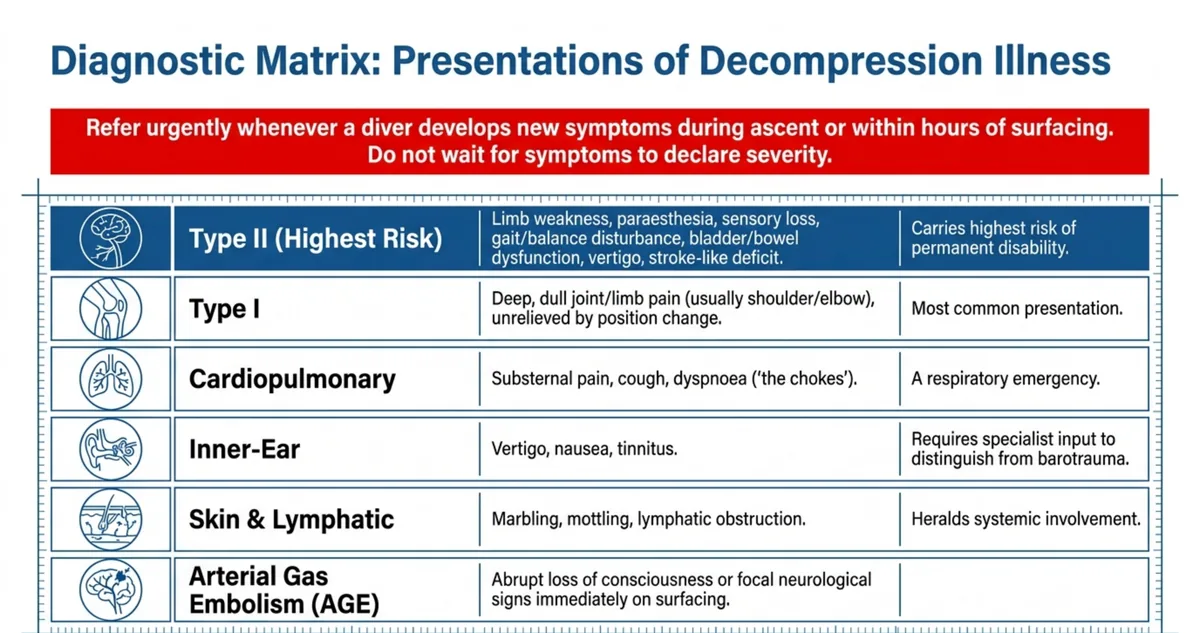
Refer urgently for recompression whenever a diver develops new symptoms during ascent or within hours of surfacing. Decompression sickness is a time-critical emergency, and the decision to refer should not wait for symptoms to declare their severity. Refer when any of the following are present after a compressed-gas dive:
- Neurological symptoms of any kind: limb weakness, paraesthesia, sensory loss, gait or balance disturbance, bladder or bowel dysfunction, vertigo, or stroke-like deficit. Spinal cord and cerebral involvement (Type II) carry the highest risk of permanent disability and warrant the most urgent referral.
- Joint or limb pain that is deep, dull, and unrelieved by position change. Pain (most often shoulder or elbow) is the most common presentation of Type I disease and still requires recompression.
- Cardiopulmonary symptoms such as substernal pain, cough, or dyspnoea ("the chokes"), which represent pulmonary decompression sickness and are a respiratory emergency.
- Inner-ear symptoms of vertigo, nausea, and tinnitus, which can be difficult to distinguish from inner-ear barotrauma and benefit from early specialist input.
- Skin marbling or mottling, often with lymphatic obstruction, which may herald more serious systemic involvement.
Onset is typically within minutes to several hours of surfacing. Suspected arterial gas embolism, which presents with abrupt loss of consciousness or focal neurological signs immediately on surfacing, is managed on the same emergency recompression pathway. When in doubt, treat the diver as having decompression illness and call for hyperbaric advice early.
Assessing the patient before referral
While arranging recompression, the receiving emergency department should:
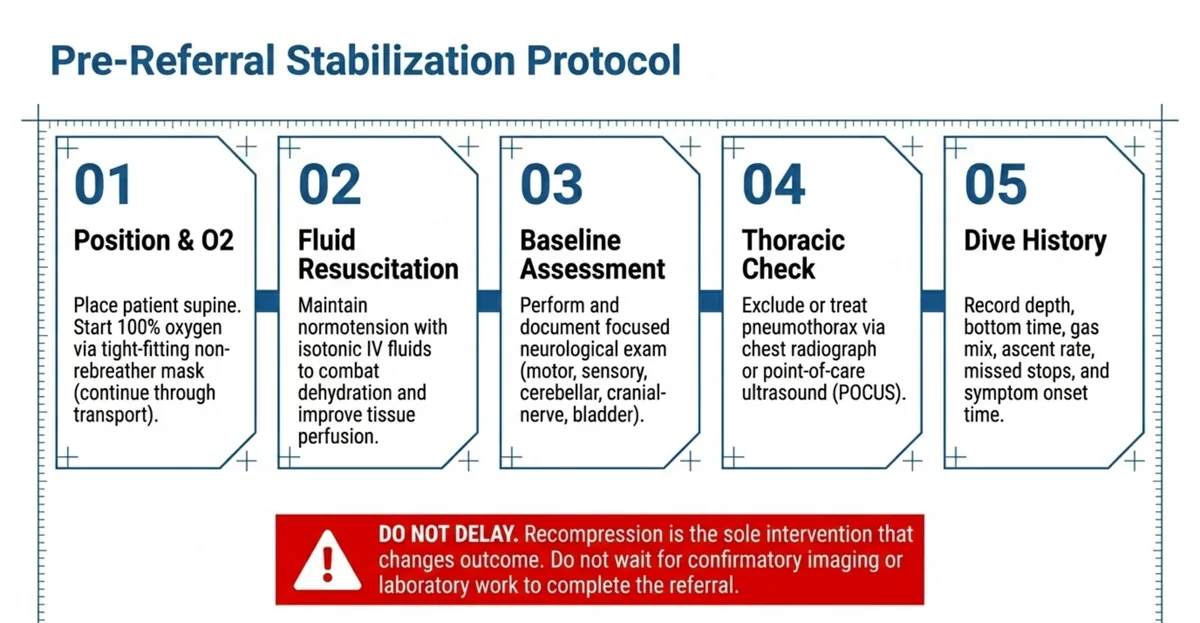
- Place the patient supine and start 100 percent oxygen by a tight-fitting non-rebreather mask immediately, continuing it through transport. Surface oxygen accelerates inert-gas washout and can improve symptoms before chamber entry.
- Keep the patient normotensive with isotonic intravenous fluids; divers are frequently dehydrated and hypovolaemia worsens tissue perfusion.
- Perform and document a focused neurological examination (motor, sensory, cerebellar, cranial-nerve, and bladder function) to establish a baseline against which response to recompression can be tracked.
- Exclude or treat pneumothorax before any thought of chamber entry; a chest radiograph or point-of-care ultrasound is appropriate where the history or examination raises concern.
- Record a detailed dive history: depth and bottom time, gas mix (air, nitrox, or heliox), number and profile of dives, rate of ascent, any missed decompression stops, the surface interval, and the time of symptom onset relative to surfacing.
Do not delay referral to complete imaging or laboratory work. Recompression is the intervention that changes outcome, and adjunctive investigations should not hold up the call to the chamber.
What the evidence supports
Hyperbaric oxygen, delivered as recompression, is the only definitive treatment for decompression sickness. No pharmacological alternative reverses the underlying nitrogen-bubble pathophysiology. The condition page rates the evidence base as strong, supported by high-quality studies and systematic reviews, and grounded in a coherent and well-established mechanism.
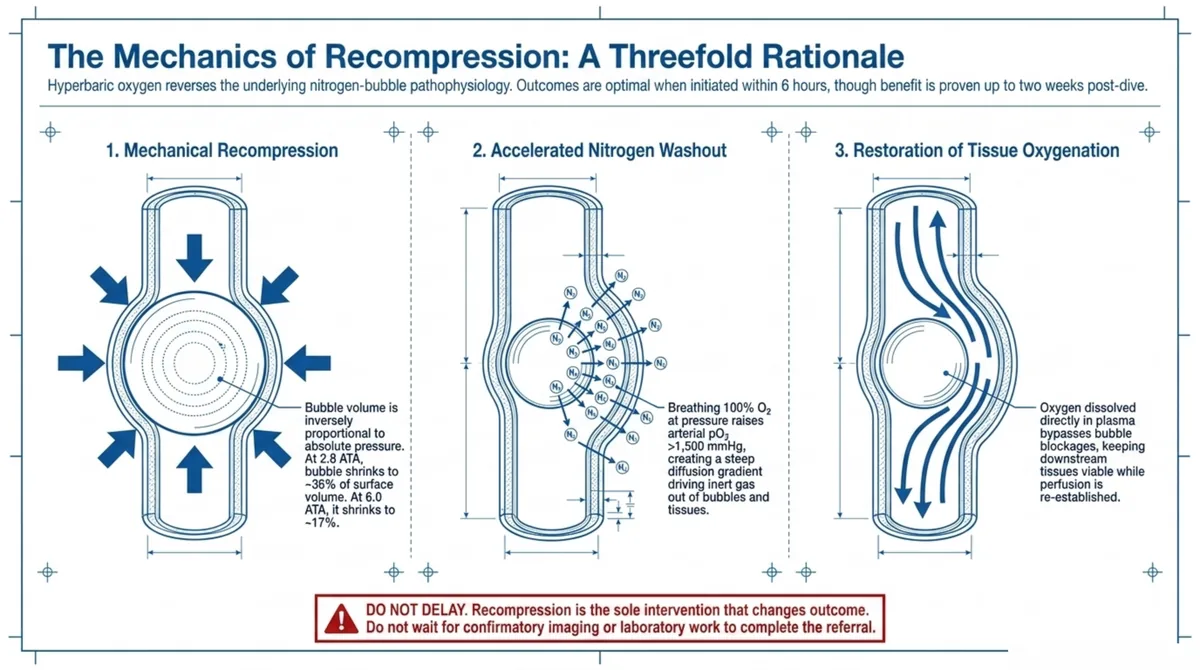
The mechanistic rationale is threefold and convergent. First, mechanical recompression: bubble volume is inversely proportional to absolute pressure, so at the standard treatment depth of 2.8 ATA a bubble shrinks to roughly 36 percent of its surface volume, and at 6.0 ATA to about 17 percent. Second, accelerated nitrogen washout: breathing 100 percent oxygen at pressure raises arterial pO2 above 1,500 mmHg, creating a steep diffusion gradient that drives inert gas out of bubbles and tissues. Third, restoration of tissue oxygenation: oxygen dissolved in plasma can supply tissue downstream of bubble obstruction while perfusion is re-established.
The strongest predictor of neurological outcome is time to recompression. Outcomes are best when treatment begins within 6 hours of symptom onset, but benefit has been documented at 24 hours and beyond, and recompression is offered at any interval up to two weeks after the dive for residual symptoms. Complete resolution occurs in the majority of mild Type I cases treated promptly. Severe Type II cases (spinal cord, cerebral, and vestibular decompression sickness) have higher rates of residual deficit but still benefit substantially from prompt, adequate recompression. Because the condition can progress to permanent disability or death without treatment, recompression is offered even at long intervals and even when the diagnosis is uncertain.
Clinical translation
Refer immediately and start surface oxygen at once. The benefit of recompression is greatest when it begins early, so the decision to refer should never wait for symptoms to worsen or for confirmatory investigations. Surface oxygen and isotonic fluids are the two interventions a referring physician can start without delay, and both improve the diver's condition on the way to the chamber. For any neurological, cardiopulmonary, or inner-ear presentation, treat it as a recompression emergency and call the hyperbaric team or the Divers Alert Network without delay.
The Canadian referral pathway
Decompression sickness is accepted as an emergency indication at all 11 Canadian hospital-based hyperbaric programmes and is covered by every provincial plan without prior authorisation. You can read the full clinical background on the Canada Hyperbarics decompression sickness page.
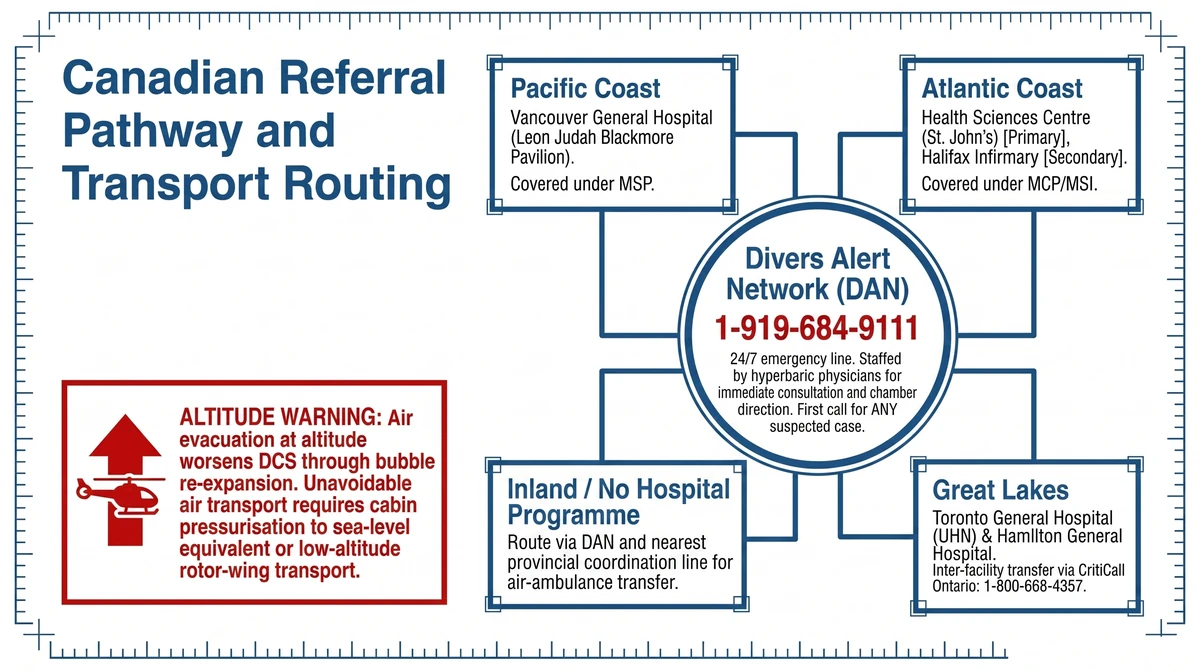
- First call for any suspected case: the Divers Alert Network (DAN) 24/7 emergency line at 1-919-684-9111, staffed by hyperbaric physicians, provides immediate consultation, treatment-table guidance, and direction to the nearest accepting chamber.
- Pacific coast: Vancouver General Hospital (Leon Judah Blackmore Pavilion) is the principal Pacific-coast chamber, serving recreational divers along the BC coast and the commercial offshore and aquaculture sectors; covered under MSP.
- Atlantic coast: Health Sciences Centre in St. John's is the principal Atlantic-coast chamber, serving recreational divers and the offshore oil and gas sector, with the Halifax Infirmary as a secondary referral centre; covered under MCP (Newfoundland and Labrador) and MSI (Nova Scotia).
- Great Lakes: Toronto General Hospital (UHN) and Hamilton General Hospital serve Great Lakes recreational diving. In Ontario, CritiCall Ontario at 1-800-668-4357 is the standard inter-facility transfer line and arranges transport when needed.
- Inland and regions without a hospital programme: route via DAN and the nearest provincial coordination line to the closest accepting programme, with air-ambulance transfer where required.
Air evacuation at altitude can worsen decompression sickness through bubble re-expansion. Where air transport is unavoidable, cabin pressurisation to a sea-level equivalent, or low-altitude rotor-wing transport, is preferred.
Contraindications and cautions
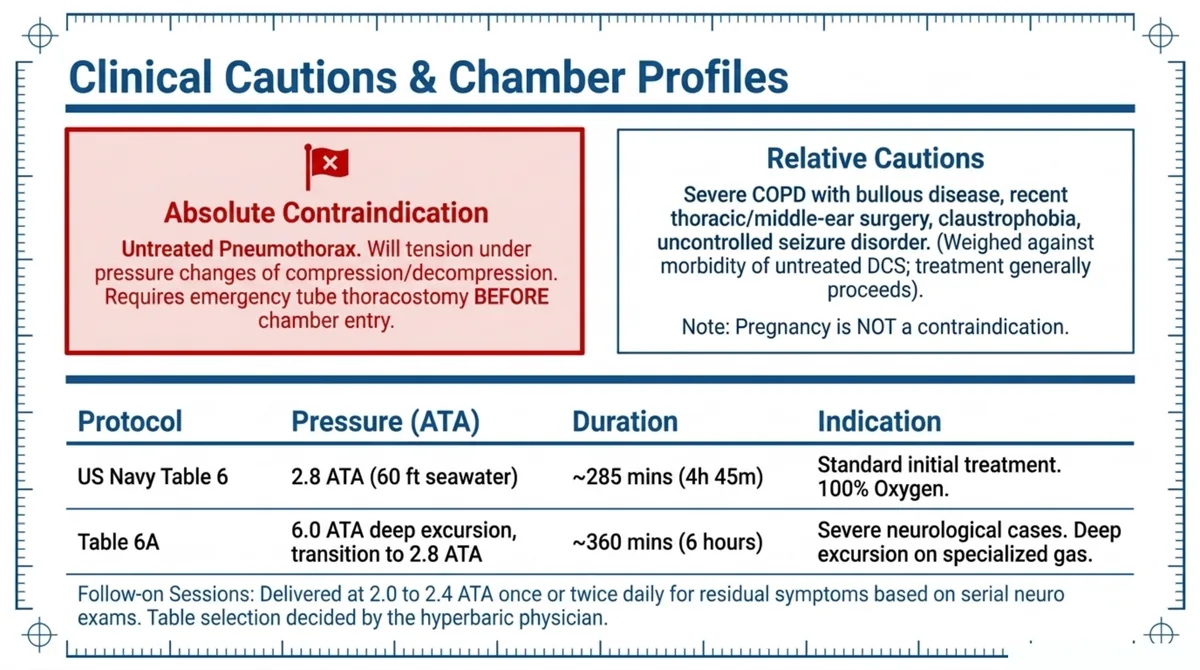
There are no absolute contraindications to recompression in suspected decompression sickness, because the condition can progress to permanent disability or death without treatment. The single condition that must be addressed before chamber entry is an untreated pneumothorax, which will tension under the pressure changes of compression and decompression; emergency tube thoracostomy is performed first.
Relative contraindications such as severe chronic obstructive pulmonary disease with bullous disease, recent thoracic or middle-ear surgery, claustrophobia, and uncontrolled seizure disorder are weighed against the certain morbidity of untreated decompression sickness, and treatment generally proceeds. Pregnancy is not a contraindication.
The standard initial treatment is US Navy Treatment Table 6: recompression to 2.8 ATA (60 feet of seawater equivalent) on 100 percent oxygen, with a total duration of approximately 285 minutes (4 hours, 45 minutes). Severe neurological cases may be managed with Table 6A, which begins with a deeper excursion to 6.0 ATA before transitioning to oxygen at 2.8 ATA, taking close to 6 hours; the breathing gas for the deep excursion is selected by the treating hyperbaric physician. Follow-on sessions at 2.0 to 2.4 ATA are delivered once or twice daily for residual symptoms, with the number of sessions guided by serial neurological examination. Table selection and the treatment course are decided by the hyperbaric physician.
How to use the research list below
The list contains every decompression sickness study in the Canada Hyperbarics database that was published in 2020 or later and has a freely available full-text version, each linked directly to that full text. Paywalled and abstract-only studies are excluded, and retracted studies are removed. This is a reference list, not a set of summaries. Counts and the open-access set refresh each quarter.
Open-access research, 2020 to present
46 studies with a free full-text version, grouped by year, newest first. Each entry links to the full text. The set refreshes each quarter; retracted and paywalled studies are excluded.
20263 studies
- Zhou J et al. Induction of protective proteins is fundamental to hyperbaric oxygen preconditioning. Front Cell Dev Biol. Full text (Unpaywall) ›
- Obeidat M et al. Blinded by the depths: A case of acute loss of vision in a scuba diver. Medical journal, Armed Forces India. Full text (Unpaywall) ›
- Jittanonta P et al. A 4-year retrospective descriptive study on treatment outcomes of decompression illness patients in various hyperbaric chamber centers in Thailand. Int Marit Health. Full text (Unpaywall) ›
20259 studies
- Theron M et al. N(2) exchanges in hyperbaric environments: toward a model based on physiological gas transport (O(2) and CO(2)). J Appl Physiol (1985). Full text (Unpaywall) ›
- Kamiimabeppu D et al. Surgical Management for Acute Ischemic Colitis Associated with Decompression Sickness. Surgical case reports. Full text (Unpaywall) ›
- Takagi G Hyperbaric Oxygen Therapy in Japan, Now and in the Future. Journal of Nippon Medical School = Nippon Ika Daigaku zasshi. Full text (Unpaywall) ›
- Canarslan Demir K et al. Longitudinal study of changes in pulmonary function among inside attendants of hyperbaric oxygen therapy. Diving Hyperb Med. Full text (Unpaywall) ›
- Wilmshurst P et al. Cutaneous decompression sickness after an air dive with oxygen breathed during decompression in a commercial diver with a persistent foramen ovale. Diving and hyperbaric medicine. Full text (Unpaywall) ›
- Avci A et al. Longitudinal Evaluation of Hearing Function in Hyperbaric Oxygen Therapy Inside Attendants. J Int Adv Otol. Full text (Unpaywall) ›
- Gouin E et al. Diving practices in technical divers' community and behaviour towards self-reported unusual symptoms. Diving and hyperbaric medicine. Full text (Unpaywall) ›
- Hoyt J et al. Revised guideline for central nervous system oxygen toxicity exposure limits when using an inspired PO2 of 1.3 atmospheres. Diving Hyperb Med. Full text (Unpaywall) ›
- Stokes R et al. Vestibular rehabilitation and recovery in divers with inner ear decompression sickness: a case series. Diving Hyperb Med. Full text (Unpaywall) ›
202412 studies
- Smart D Five consecutive cases of sensorineural hearing loss associated with inner ear barotrauma due to diving, successfully treated with hyperbaric oxygen. Diving Hyperb Med. Full text (Unpaywall) ›
- Blake D et al. Divers treated in Townsville, Australia: worse symptoms lead to poorer outcomes. Diving Hyperb Med. Full text (Unpaywall) ›
- Tournoy KG et al. Modelling the risk factors for accidents in recreational divers: results from a cross-sectional evaluation in Belgium. Diving and hyperbaric medicine. Full text (Unpaywall) ›
- Wilmshurst P et al. Recurrent cutaneous decompression sickness in a hyperbaric chamber attendant with a large persistent foramen ovale. Diving Hyperb Med. Full text (Unpaywall) ›
- Mrakic-Sposta S et al. Decompression Illness After Technical Diving Session in Mediterranean Sea: Oxidative Stress, Inflammation, and HBO Therapy. International journal of molecular sciences. Full text (Unpaywall) ›
- Kot J et al. Decompression sickness of medical personnel of a hyperbaric centre: A report of cases during 25 years of activity. Int Marit Health. Full text (Unpaywall) ›
- Wood F et al. Dive medicine capability at Rothera Research Station (British Antarctic Survey), Adelaide Island, Antarctica. Diving Hyperb Med. Full text (Unpaywall) ›
- Ashworth E et al. A novel method for tracking nitrogen kinetics in vivo under hyperbaric conditions using radioactive nitrogen-13 gas and positron emission tomography. J Appl Physiol (1985). Full text (Unpaywall) ›
- Schmitz G et al. Bispectral index with density spectral array (BIS-DSA) monitoring in a patient with inner ear and cerebral decompression sickness. Diving Hyperb Med. Full text (Unpaywall) ›
- Clavell C et al. Multimodal imaging analysis of retinal and choroidal microvascular abnormalities in a case of ocular decompression sickness. American journal of ophthalmology case reports. Full text (Unpaywall) ›
- Colvin AP et al. Shunt-mediated decompression sickness in a compressed air worker with an atrial septal defect. Diving and hyperbaric medicine. Full text (Unpaywall) ›
- Franco MA et al. The Influence of Advanced Hyperbaric Medical Training on Arterial Gas Embolism Treatment. Military medicine. Full text (Unpaywall) ›
20233 studies
- Mason JS et al. A retrospective review of divers treated for inner ear decompression sickness at Fiona Stanley Hospital hyperbaric medicine unit 2014-2020. Diving and hyperbaric medicine. Full text (Unpaywall) ›
- Hjelte C et al. Risk assessment of SWEN21 a suggested new dive table for the Swedish armed forces: bubble grades by ultrasonography. Diving and hyperbaric medicine. Full text (Unpaywall) ›
- de Jong FJM et al. Analysis of Volatile Organic Compounds in Exhaled Breath Following a COMEX-30 Treatment Table. Metabolites. Full text (Unpaywall) ›
202213 studies
- Rosén A et al. Protein tau concentration in blood increases after SCUBA diving: an observational study. European journal of applied physiology. Full text (Unpaywall) ›
- Sánchez-Villalobos J et al. Breath-Hold Diving-Related Decompression Sickness with Brain Involvement: From Neuroimaging to Pathophysiology. Tomography. Full text (Unpaywall) ›
- Mareyam A et al. A New Phased-Array Magnetic Resonance Imaging Receive-Only Coil for HBO2 Studies. Sensors (Basel). Full text (Unpaywall) ›
- Imbert JP et al. A review of accelerated decompression from heliox saturation in commercial diving emergencies. Diving and hyperbaric medicine. Full text (Unpaywall) ›
- Chevasutho P et al. Descriptive study of decompression illness in a hyperbaric medicine centre in Bangkok, Thailand from 2015 to 2021. Diving Hyperb Med. Full text (Unpaywall) ›
- Sokolowski S et al. Delayed treatment for decompression illness: factors associated with long treatment delays and treatment outcome. Diving Hyperb Med. Full text (Unpaywall) ›
- Castillo R et al. Biological effects due to exposure to different concentrations of oxygen from hypo to hyperoxemia. Rev Med Chil. Full text (Unpaywall) ›
- Banham N et al. A prospective single-blind randomised clinical trial comparing two treatment tables for the initial management of mild decompression sickness. Diving Hyperb Med. Full text (Unpaywall) ›
- Okeya K et al. Urticaria-like decompression illness in a caisson worker treated successfully in a monoplace chamber. Acute Med Surg. Full text (Unpaywall) ›
- Harfoush A et al. Right cardiac chambers echo-bubble contrast in a patient with decompression sickness: A case report and a literature review. Clinical case reports. Full text (Unpaywall) ›
- Kurtul S et al. Dysbaric osteonecrosis in diving fisherman: a case report. La Medicina del lavoro. Full text (Unpaywall) ›
- Kassar EV et al. Portal and Mesenteric Vein Thrombosis Associated with Decompression Sickness in a 48-Year-Old Deep Sea Self-Contained Underwater Breathing Apparatus (SCUBA) Diver. The American journal of case reports. Full text (Unpaywall) ›
- Savioli G et al. Dysbarism: An Overview of an Unusual Medical Emergency. Medicina (Kaunas). Full text (Unpaywall) ›
20212 studies
- Brampton W et al. Decompression sickness after a highly conservative dive in a diver with known persistent foramen ovale: Case report. Diving and hyperbaric medicine. Full text (Unpaywall) ›
- Yanagawa Y et al. Ultrasound in the diagnosis of acute-phase decompression sickness. Radiology case reports. Full text (Unpaywall) ›
20204 studies
- Tsiamis C et al. Lessons from a historic example of diving safety rules violation: the case of Greek sponge divers. Int Marit Health. Full text (Unpaywall) ›
- Pougnet R et al. Temporary and permanent unfitness of occupational divers. Brest Cohort 2002-2019 from the French National Network for Occupational Disease Vigilance and Prevention (RNV3P). Int Marit Health. Full text (Unpaywall) ›
- Clarke R Monoplace chamber treatment of decompression illness: Review and commentary. Diving and hyperbaric medicine. Full text (Unpaywall) ›
- Dapena JC et al. Persistent extravascular bubbles on radiologic imaging after recompression treatment for decompression sickness: A case report. Diving and hyperbaric medicine. Full text (Unpaywall) ›