For referring and emergency physicians in Canada. Exceptional blood loss anaemia is one of the 14 conditions publicly funded in Canada for hyperbaric oxygen therapy (HBOT), and it is treated as an emergency at every Canadian hospital-based hyperbaric programme, fully covered by provincial health insurance. The indication is narrow: severe, symptomatic anaemia in which transfusion is impossible, refused, or insufficient, and in which dissolved plasma oxygen can bridge tissue oxygenation until red-cell mass recovers or compatible blood becomes available. This guide summarises when to refer, how to assess the patient before referral, what the evidence supports, the Canadian referral pathway, and contraindications. It closes with the complete list of open-access research published since 2020, each linked to its free full text.
When to refer
Refer urgently for hyperbaric assessment when a patient has severe, symptomatic anaemia with evidence of tissue hypoxia or end-organ decompensation, and transfusion is unavailable or will not be given. The defining feature of this indication is the gap between oxygen demand and red-cell oxygen-carrying capacity that cannot be closed by transfusion. Consider referral when:
- Haemoglobin is critically low with continuing decompensation. Values below roughly 5 to 6 g/dL with ongoing signs of tissue hypoxia are typical referral triggers. Case reports document survival from values below 3 g/dL when HBOT is used as a bridge, so a very low haemoglobin should prompt a call rather than be treated as futile.
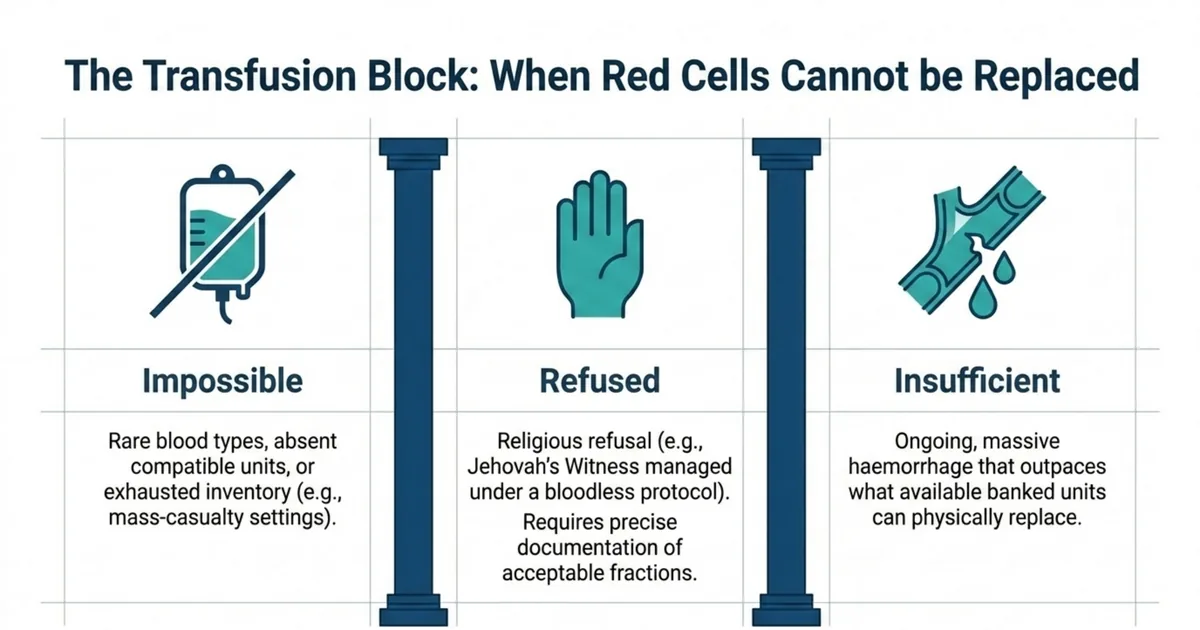
- Transfusion is impossible, refused, or insufficient. This includes religious refusal (most commonly Jehovah's Witness patients managed under a bloodless protocol), rare blood types or absent compatible units, exhausted inventory in a mass-casualty setting, or ongoing loss that outpaces what available units can replace.
- There is evidence of end-organ hypoxia such as ischaemic ECG changes, lactic acidosis, altered mental status, or other signs that oxygen delivery is failing despite maximal supportive care.
HBOT here is a bridge, not a cure: it sustains tissue viability while definitive measures (control of bleeding, erythropoiesis, or eventual transfusion) take effect. The decision to refer should be made jointly with the team managing the underlying blood loss.
Assessing the patient before referral
While arranging hyperbaric assessment, the receiving team should:
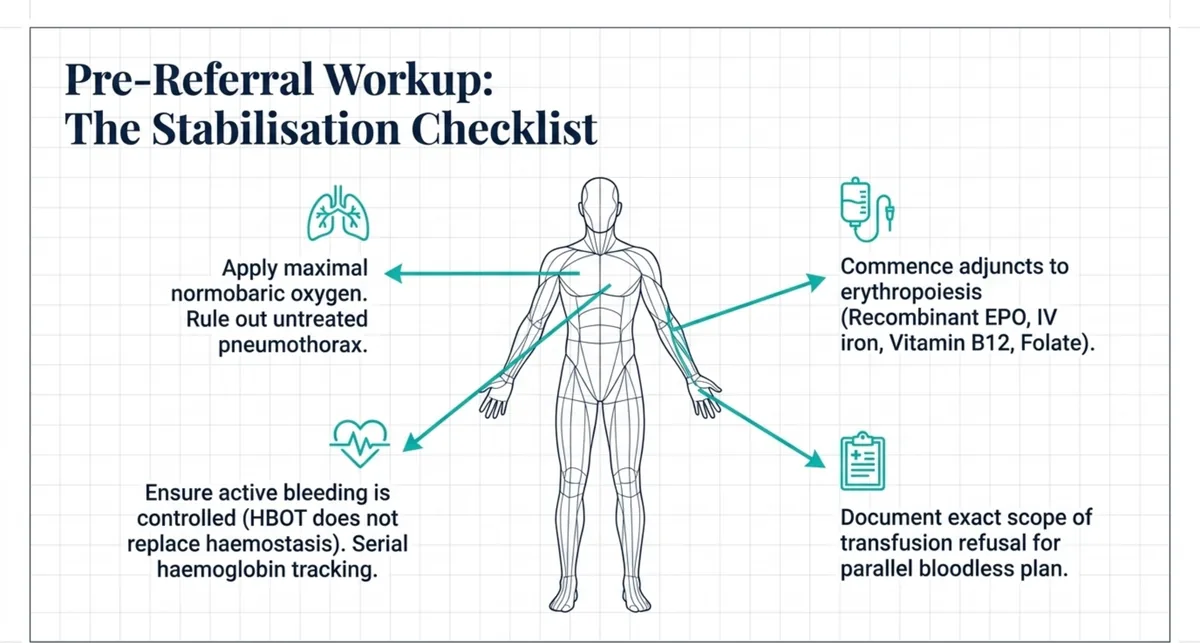
- Continue maximal normobaric oxygen and standard resuscitation, and ensure active bleeding is controlled or being controlled. HBOT does not replace haemostasis.
- Confirm the haemoglobin and trend with serial measurement, since the rate of decline often matters more than a single value for deciding urgency and session frequency.
- Document the reason transfusion is unavailable (refusal and its documented scope, absent compatible units, or insufficiency relative to loss). For a patient refusing blood, clarify in advance which fractions and adjuncts are acceptable, as this shapes the parallel bloodless plan.
- Assess for end-organ hypoxia: mental status, 12-lead ECG, lactate, and urine output.
- Screen for chamber contraindications, particularly an untreated pneumothorax, and assess haemodynamic stability and airway, since the most severely ill patients may need a monoplace or critical-care-capable multiplace setting.
- Begin or coordinate adjuncts to erythropoiesis where appropriate, including recombinant erythropoietin, intravenous iron, vitamin B12, and folate, so the bridge has a destination.
What the evidence supports
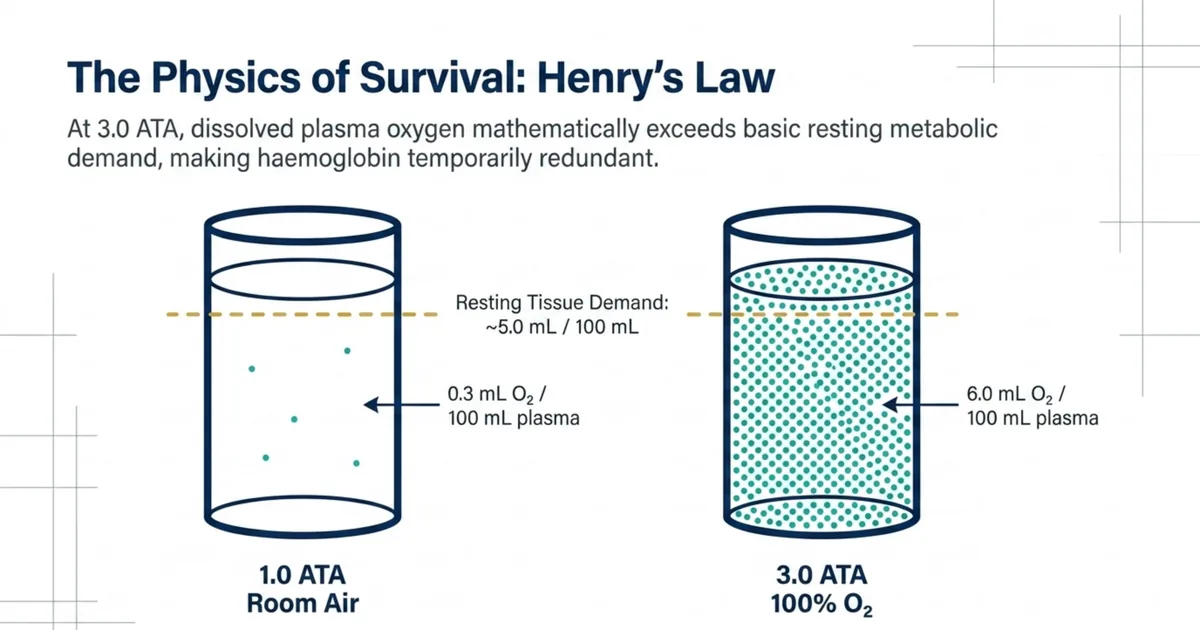
The mechanistic rationale is well established and is what makes this indication coherent. Under Henry's law, oxygen dissolves directly into plasma in proportion to its partial pressure, independent of haemoglobin. On room air at sea level, plasma carries only about 0.3 mL of oxygen per 100 mL; at 3.0 ATA on 100 percent oxygen, dissolved plasma oxygen rises to roughly 6 mL per 100 mL. Because resting tissue demand is approximately 5 mL per 100 mL of perfusing blood, this dissolved fraction can, transiently, meet basic metabolic needs even when haemoglobin is critically depleted. This is the principle behind Boerema's 1960 "life without blood" experiments, in which pigs survived near-total exchange of red cells for plasma while maintained at 3 ATA hyperbaric oxygen.
The clinical evidence base is far thinner than the mechanism. The indication carries UHMS Indication status with a Level B (moderate) evidence rating, meaning it is supported by controlled studies and clinical evidence rather than by randomised trials. Most published human experience is observational: case reports and small case series, predominantly in patients for whom transfusion was refused or unavailable. There are no randomised controlled trials, which is expected given the rarity of the scenario and the ethics of withholding HBOT from a patient with no transfusion option. The evidence should therefore be read as supporting HBOT as an adjunctive bridge in a defined emergency, not as establishing a survival benefit with the precision available for better-studied indications.
Clinical translation
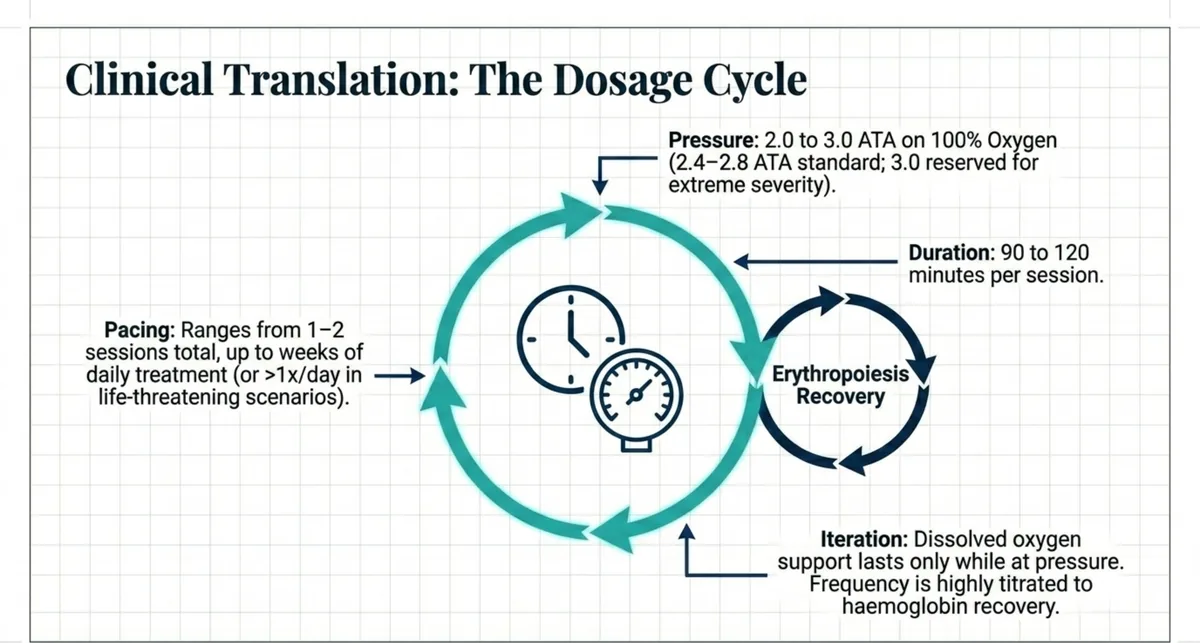
Refer early and treat HBOT as one component of a coordinated bloodless or salvage strategy. Reported chamber protocols in this setting use pressures of roughly 2.0 to 3.0 ATA on 100 percent oxygen for about 90 to 120 minutes per session, with 2.4 to 2.8 ATA covering most cases and 3.0 ATA reserved for the most severe presentations. Because dissolved-oxygen support lasts only while the patient is at pressure, treatment frequency is titrated to the haemoglobin recovery rate: from one or two sessions to several weeks of daily treatment, and in life-threatening cases more than one session in 24 hours. The goal throughout is to hold tissue oxygenation while erythropoiesis, haemostasis, or transfusion catch up. When in doubt, call the hyperbaric team early rather than waiting for the haemoglobin to reach a notional floor.
The Canadian referral pathway
Exceptional blood loss anaemia is treated as an emergency at Canadian hospital-based hyperbaric programmes and is covered by every provincial plan without prior authorisation in the acute setting. Because these patients are often critically ill, route early to a programme that can manage a ventilated or haemodynamically supported patient.
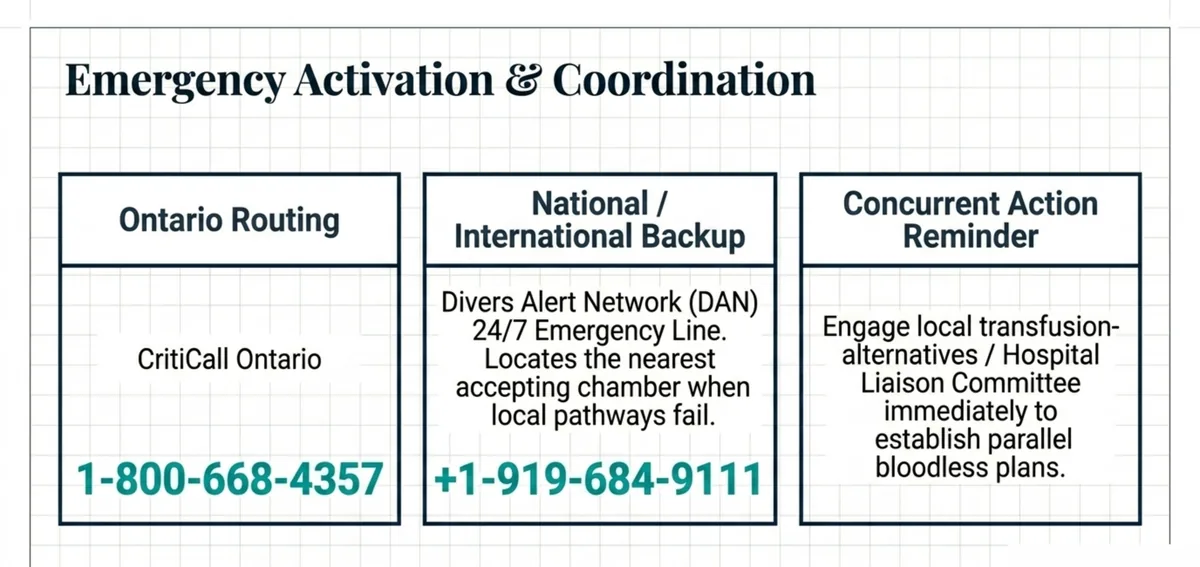
- Ontario: call CritiCall Ontario at 1-800-668-4357, the single coordination line that connects emergency departments to the Toronto General (UHN), Hamilton General, and The Ottawa Hospital programmes and arranges Ornge transport when needed.
- British Columbia: route to Vancouver General Hospital (Leon Judah Blackmore Pavilion), the only hospital chamber in the province; covered under MSP.
- Alberta: route to Misericordia Community Hospital (Edmonton) or Foothills Medical Centre / Arthur J.E. Child Comprehensive Cancer Centre (Calgary); covered by Alberta Health.
- Quebec: RAMQ covers Hôpital du Sacré-Cœur de Montréal and Hôtel-Dieu de Lévis.
- Provinces and territories without a hospital programme (Manitoba, New Brunswick, PEI, Yukon, NWT, Nunavut): inter-provincial air-ambulance referral to the nearest receiving hospital programme.
For a patient refusing blood, coordinate early with the local transfusion-alternatives or patient blood management service and, where relevant, the Hospital Liaison Committee, so the hyperbaric bridge sits inside an agreed bloodless plan. The Divers Alert Network 24/7 emergency line at 1-919-684-9111 can also help Canadian emergency departments locate the nearest accepting chamber when local pathways fail.
Contraindications and cautions
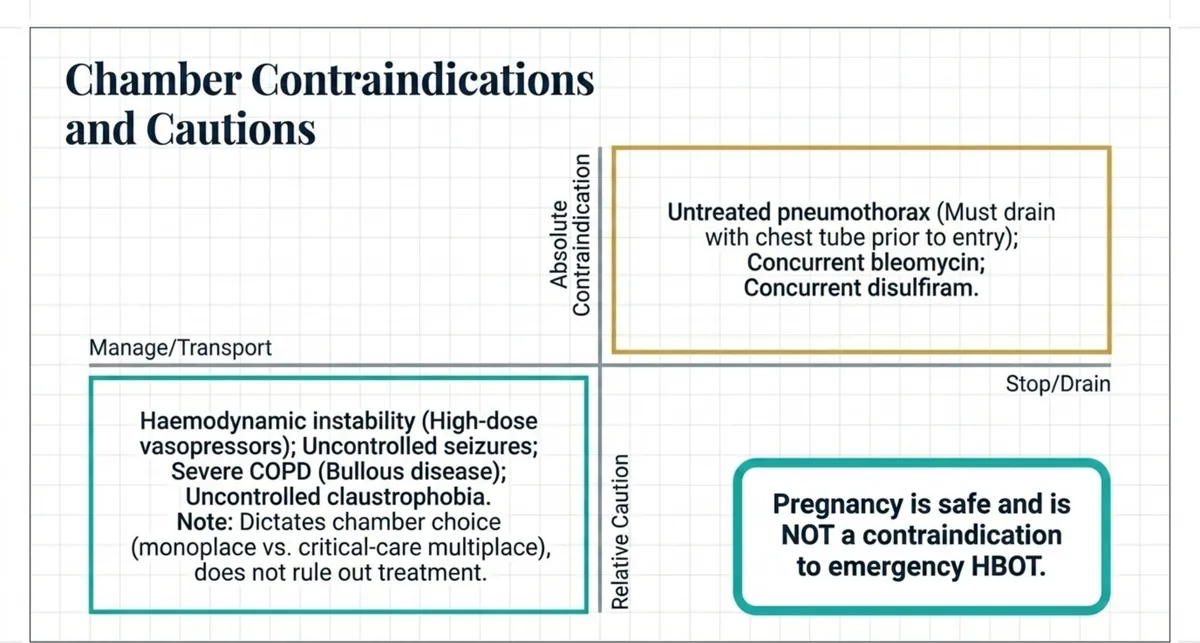
The only absolute contraindication relevant in the emergency setting is an untreated pneumothorax, which must be drained with a chest tube before chamber entry. Concurrent bleomycin and concurrent disulfiram are likewise contraindications; in a life-threatening anaemia emergency they are weighed pragmatically against the risk of fatal tissue hypoxia. Relative cautions include haemodynamic instability requiring continuous high-dose vasopressor support, uncontrolled seizure disorder, severe COPD with bullous lung disease, and uncontrolled claustrophobia, each of which affects the choice of chamber and the safety of transport rather than ruling treatment out. Pregnancy is not a contraindication. Above all, HBOT does not stop bleeding or replace red cells; it must run alongside haemostasis, erythropoietic support, and any feasible route to transfusion.
How to use the research list below
The list contains every exceptional blood loss anaemia study in the Canada Hyperbarics database that was published in 2020 or later and has a freely available full-text version, each linked directly to that full text. For this indication, no open-access study published in 2020 or later met the inclusion criteria, so the list below is empty. This reflects the rarity of the scenario and the predominance of older case reports and paywalled material, not an absence of clinical basis. For the underlying evidence and mechanism, rely on the severe anaemia condition page and on the UHMS hyperbaric oxygen indication guidance, which assigns this condition a Level B (moderate) evidence rating. This is a reference list, not a set of summaries. Counts and the open-access set refresh each quarter.