For referring and emergency physicians in Canada. Gas gangrene (clostridial myonecrosis) is one of the 14 conditions publicly funded in Canada for hyperbaric oxygen therapy (HBOT), and it is treated as a surgical emergency at every Canadian hospital-based hyperbaric programme, fully covered by provincial health insurance. HBOT is adjunctive: it does not replace urgent surgical debridement and broad-spectrum intravenous antibiotics, which remain the primary determinants of survival. This guide summarises when to refer, how to assess the patient before referral, what the evidence supports, the Canadian referral pathway, and contraindications. It closes with the complete list of open-access research published since 2020, each linked to its free full text.
When to refer
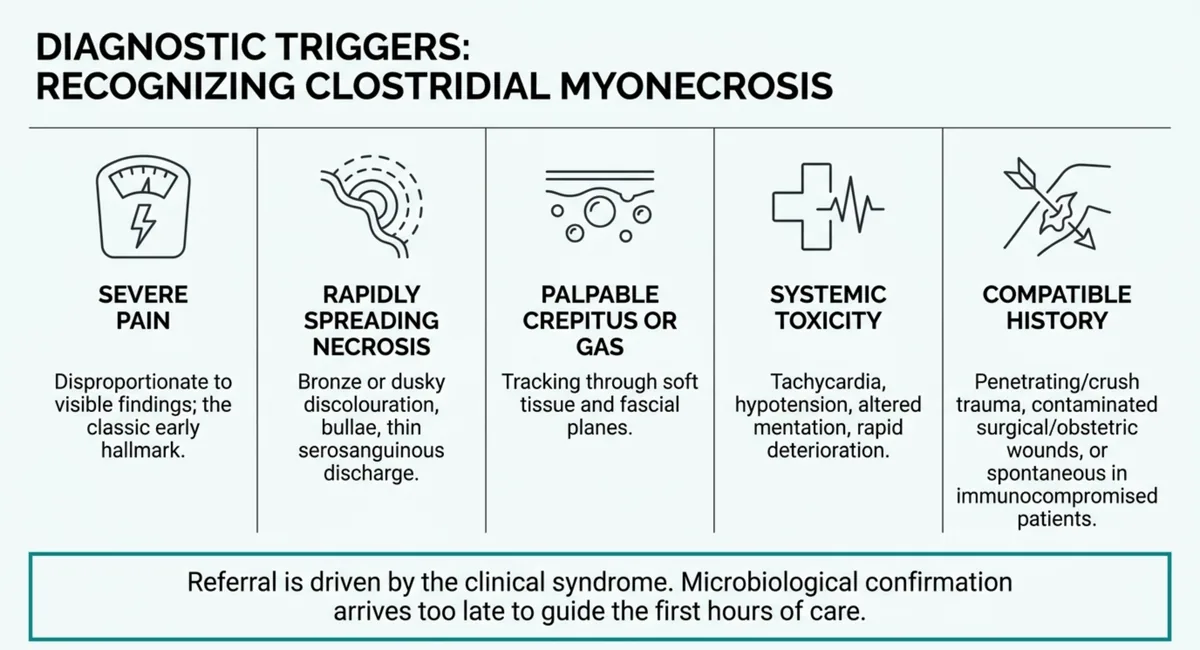
Refer immediately, in parallel with surgical and antibiotic management, when a patient has confirmed or strongly suspected clostridial myonecrosis. Do not wait for hyperbaric assessment before debriding, and do not delay debridement to arrange transfer. The clinical picture that should prompt an emergency referral includes:
- Severe pain disproportionate to visible findings, the classic early hallmark, often preceding overt skin changes.
- Rapidly spreading muscle necrosis with bronze or dusky discolouration, bullae, and a thin serosanguinous discharge.
- Palpable crepitus or radiographic gas tracking through soft tissue and fascial planes.
- Systemic toxicity out of proportion to local findings: tachycardia, hypotension, altered mentation, and rapid clinical deterioration.
- A compatible exposure history, most often penetrating or crush trauma, contaminated surgical or obstetric wounds, or, less commonly, spontaneous (non-traumatic) myonecrosis in an immunocompromised or malignancy patient.
Time to surgical debridement is the strongest single predictor of survival, and delayed debridement beyond 12 to 24 hours has been associated with worse outcomes. The referral decision is therefore driven by the clinical syndrome, not by microbiological confirmation, which arrives too late to guide the first hours of care.
Assessing the patient before referral
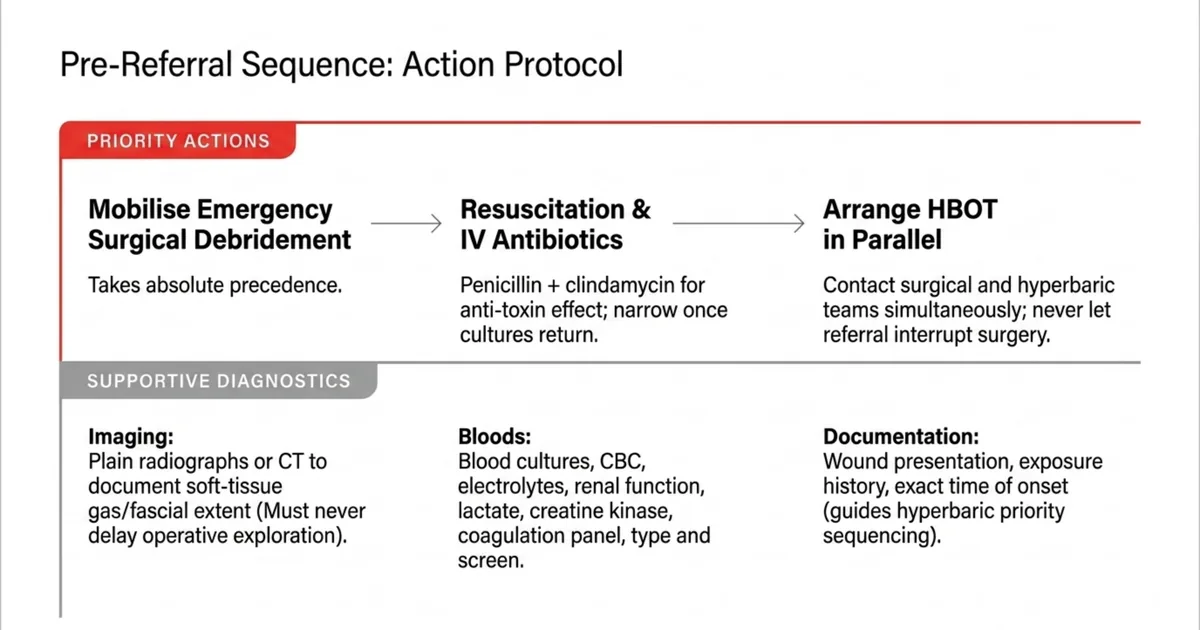
While arranging surgical management and hyperbaric assessment, the receiving team should:
- Begin resuscitation and broad-spectrum intravenous antibiotics without delay, using a regimen with clostridial coverage (typically a penicillin plus clindamycin for its anti-toxin effect), narrowed once cultures return.
- Mobilise emergency surgical debridement, which takes precedence over every other step. The treatment sequence is debride first, antibiotics second, HBOT third.
- Obtain plain radiographs or CT of the affected region to document soft-tissue gas and the extent of fascial involvement, recognising that imaging supports but never delays operative exploration.
- Draw blood cultures, a complete blood count, electrolytes, renal function, lactate, creatine kinase, and a coagulation panel, and type and screen for likely operative blood loss.
- Document the wound, the exposure history, and the time of onset, so the hyperbaric team can prioritise the first session relative to the index debridement.
What the evidence supports
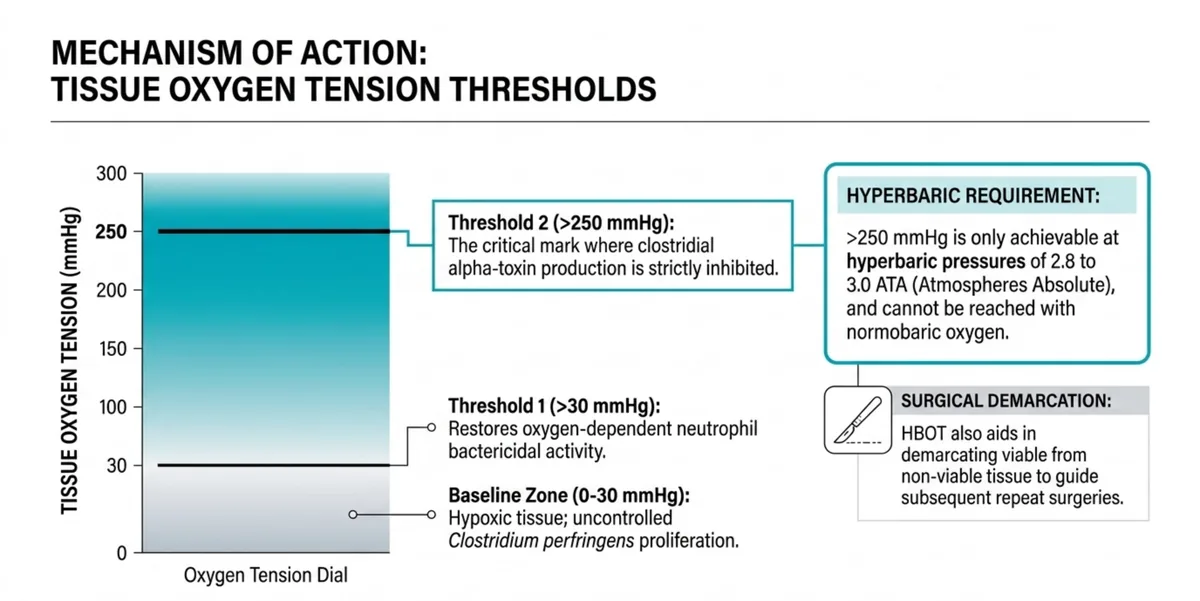
The clostridial alpha-toxin produced by *Clostridium perfringens* drives the fulminant tissue destruction characteristic of this infection. The mechanistic rationale for HBOT is well established: alpha-toxin production is inhibited once tissue oxygen tension exceeds roughly 250 mmHg, a threshold reached only at hyperbaric pressures of 3.0 ATA and not achievable with normobaric oxygen. At these pressures the chamber also restores oxygen-dependent neutrophil bactericidal activity, which is impaired at low tissue oxygen tension, and supports clearer demarcation of viable from non-viable tissue to guide subsequent surgical debridement. The Undersea and Hyperbaric Medical Society classifies gas gangrene as an accepted indication.
Randomised controlled trials are not ethically feasible in a rapidly fatal condition where withholding an established adjunct would be untenable, so the human evidence is observational. Retrospective cohort and case-control studies suggest that adjunctive HBOT is associated with reduced mortality and a reduced extent of definitive amputation, although these designs cannot establish causation and are subject to confounding by indication and centre-level differences in surgical care. Reported mortality remains around 50 percent even with optimal modern care, which underscores that HBOT is one component of an aggressive combined surgical, antimicrobial, and critical-care response rather than a treatment that stands on its own.
Clinical translation
Refer early, and never let the referral interrupt surgery. The benefit signal depends on starting hyperbaric treatment as soon as possible after the index debridement, while definitive surgical source control and antibiotics proceed. The first session does not substitute for repeat operative debridement, which is often required as the infection declares its margins. When clostridial myonecrosis is suspected, contact both the surgical team and the hyperbaric team at the same time.
The Canadian referral pathway
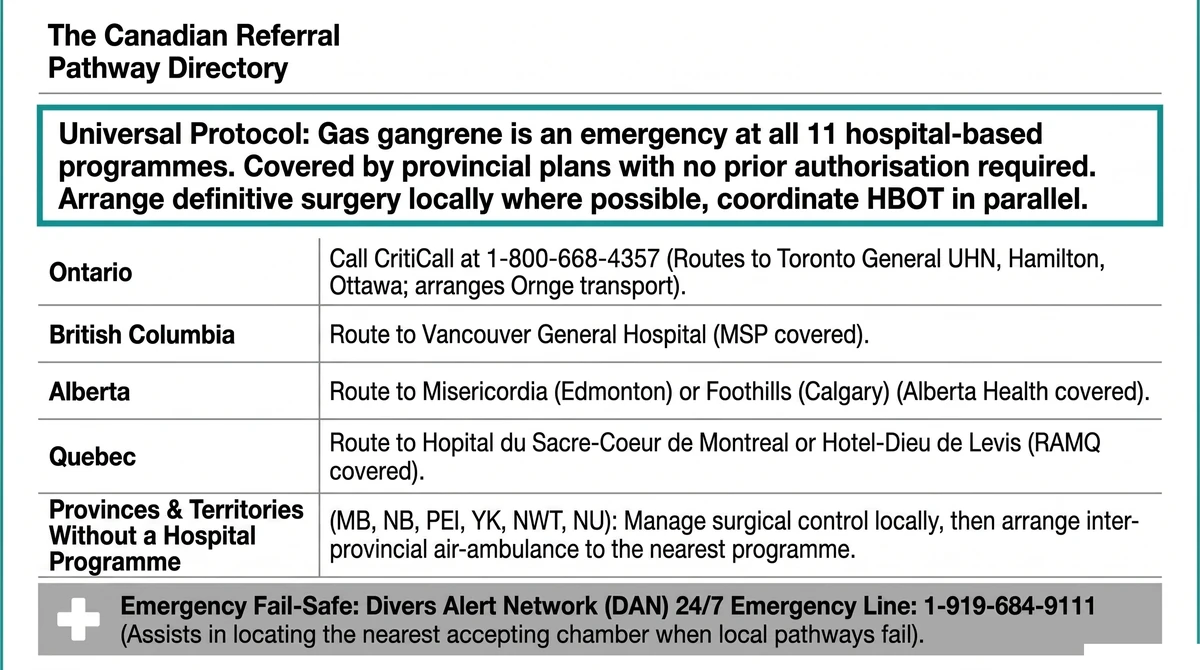
Gas gangrene is treated as an emergency at all 11 Canadian hospital-based hyperbaric programmes and is covered by every provincial plan without prior authorisation. Because the priority is rapid surgical source control, the receiving centre should arrange definitive surgery locally where possible and coordinate hyperbaric treatment in parallel.
- Ontario: call CritiCall Ontario at 1-800-668-4357, the single coordination line that connects emergency departments to the Toronto General (UHN), Hamilton General, and The Ottawa Hospital programmes and arranges Ornge transport when needed.
- British Columbia: route to Vancouver General Hospital (Leon Judah Blackmore Pavilion), the only hospital chamber in the province; covered under MSP.
- Alberta: route to Misericordia Community Hospital (Edmonton) or Foothills Medical Centre / Arthur J.E. Child Comprehensive Cancer Centre (Calgary); covered by Alberta Health.
- Quebec: RAMQ covers Hopital du Sacre-Coeur de Montreal and Hotel-Dieu de Levis.
- Provinces and territories without a hospital programme (Manitoba, New Brunswick, PEI, Yukon, NWT, Nunavut): manage surgical source control locally and arrange inter-provincial air-ambulance referral to the nearest chamber, most commonly Misericordia Edmonton or the Ontario programmes.
The Divers Alert Network 24/7 emergency line at 1-919-684-9111 can also help Canadian emergency departments locate the nearest accepting chamber when local pathways fail. Detailed clinical background is available on the gas gangrene condition page.
Contraindications and cautions
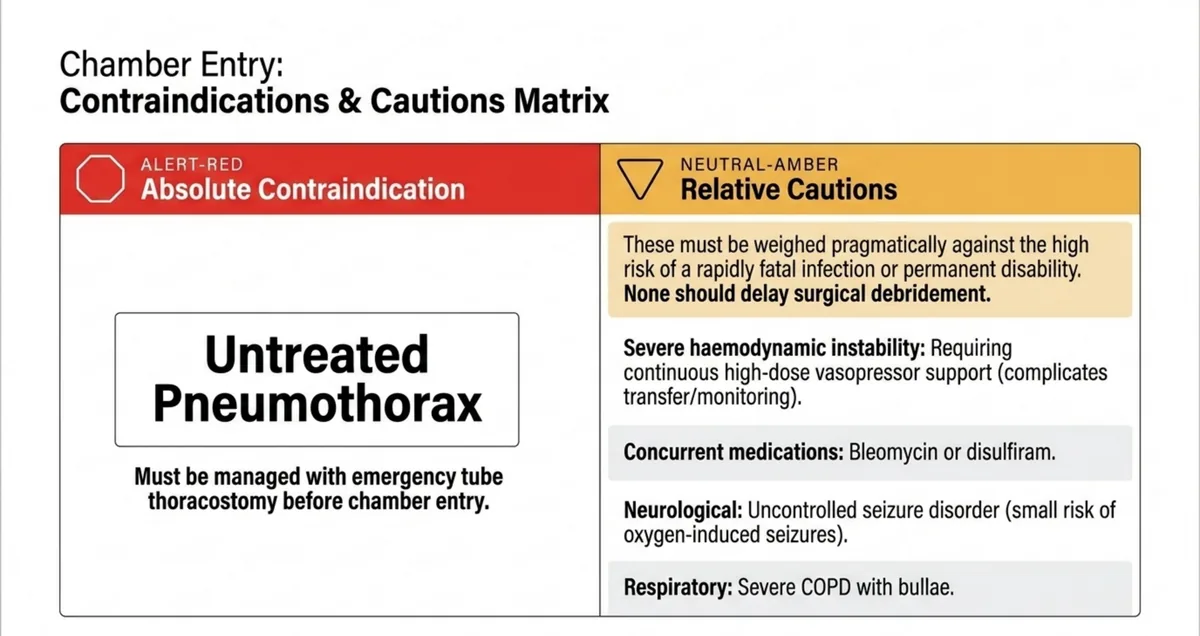
The only absolute contraindication relevant in the emergency setting is an untreated pneumothorax, which must be managed with emergency tube thoracostomy before chamber entry. Several relative contraindications are weighed pragmatically against the risk of a rapidly fatal infection: severe haemodynamic instability requiring continuous high-dose vasopressor support, which can complicate transfer and monitoring in the chamber; concurrent bleomycin or disulfiram; an uncontrolled seizure disorder, given the small risk of oxygen-induced seizures at treatment pressure; and severe chronic obstructive pulmonary disease with bullae. None of these should delay surgical debridement, and in the acute setting the hyperbaric team weighs each against the likelihood of permanent disability or death.
How to use the research list below
The list contains every gas gangrene study in the Canada Hyperbarics database that was published in 2020 or later and has a freely available full-text version, each linked directly to that full text. Paywalled and abstract-only studies are excluded, and retracted studies are removed. This is a reference list, not a set of summaries. Counts and the open-access set refresh each quarter.
Open-access research, 2020 to present
14 studies with a free full-text version, grouped by year, newest first. Each entry links to the full text. The set refreshes each quarter; retracted and paywalled studies are excluded.
20261 study
- Patel A et al. Hyperbaric oxygen therapy and Fournier's gangrene: a systematic review and meta-analysis. Medical gas research. Full text (Unpaywall) ›
20252 studies
- Azmi YA et al. The impact of sodium-glucose cotransporter-2 inhibitors on the incidence, therapy, and outcomes of fournier gangrene: insights from a systematic review of case reports. Systematic reviews. Full text (Unpaywall) ›
- Takeno K et al. Polymicrobial infection presenting as non-clostridial gas gangrene in a patient with an open pelvic ring fracture accompanied by abdominal evisceration: a case report. AME Case Rep. Full text (Unpaywall) ›
20242 studies
- Alhumam T et al. Relationship Between Symmetrical Peripheral Gangrene Patients and Using Vasopressors in the Intensive Care Unit. Cureus. Full text (Unpaywall) ›
- Hussain H et al. Clostridial Myonecrosis: A Comprehensive Review of Toxin Pathophysiology and Management Strategies. Microorganisms. Full text (Unpaywall) ›
20232 studies
- Muroya D et al. Effects of Hyperbaric Oxygen Therapy for Clostridioides difficile-associated Colitis: A Retrospective Study. J Anus Rectum Colon. Full text (Unpaywall) ›
- Wójcik B et al. Advances in Management of Fournier's Gangrene by Coupling Intensive Hospital Treatment With Innovative Post-discharge Hyperbaric Oxygen Therapy Rehabilitation: A Case Report. Cureus. Full text (Unpaywall) ›
20222 studies
- Tutino R et al. Which Role for Hyperbaric Oxygen Therapy in the Treatment of Fournier's Gangrene? A Retrospective Study. Front Surg. Full text (Unpaywall) ›
- Raizandha MA et al. The role of hyperbaric oxygen therapy in Fournier's Gangrene: A systematic review and meta-analysis of observational studies. International braz j urol : official journal of the Brazilian Society of Urology. Full text (Unpaywall) ›
20214 studies
- Schneidewind L et al. Hyperbaric Oxygenation in the Treatment of Fournier's Gangrene: A Systematic Review. Urol Int. Full text (Unpaywall) ›
- Trama F et al. Multimodal approach in a patient with Fournier's gangrene during the coronavirus pandemic. Urol Case Rep. Full text (Unpaywall) ›
- Creta M et al. Fournier's Gangrene in Patients with Oncohematological Diseases: A Systematic Review of Published Cases. Healthcare (Basel). Full text (Unpaywall) ›
- Feres O et al. Hyperbaric oxygen therapy decreases mortality due to Fournier's gangrene: a retrospective comparative study. Medical gas research. Full text (Unpaywall) ›
20201 study
- Chu YT et al. Acute chorioamnionitis complicated with symmetrical peripheral gangrene. Taiwanese journal of obstetrics & gynecology. Full text (Unpaywall) ›