For physicians referring patients to hyperbaric oxygen therapy in Canada. Hyperbaric oxygen therapy (HBOT) is publicly funded across most of the country for a defined set of conditions, but the referral pathway differs sharply between an acute emergency and an elective course, and chambers are unevenly distributed. This guide outlines which indications are time-critical, where patients are actually treated, what a useful referral contains, how HBOT sits alongside standard care, how to find the nearest chamber, and what to expect after the referral is made. It is grounded in the 14 conditions publicly funded in Canada for hyperbaric oxygen therapy and in the publicly funded hospital-based programmes that deliver covered care.
Emergency versus elective referral
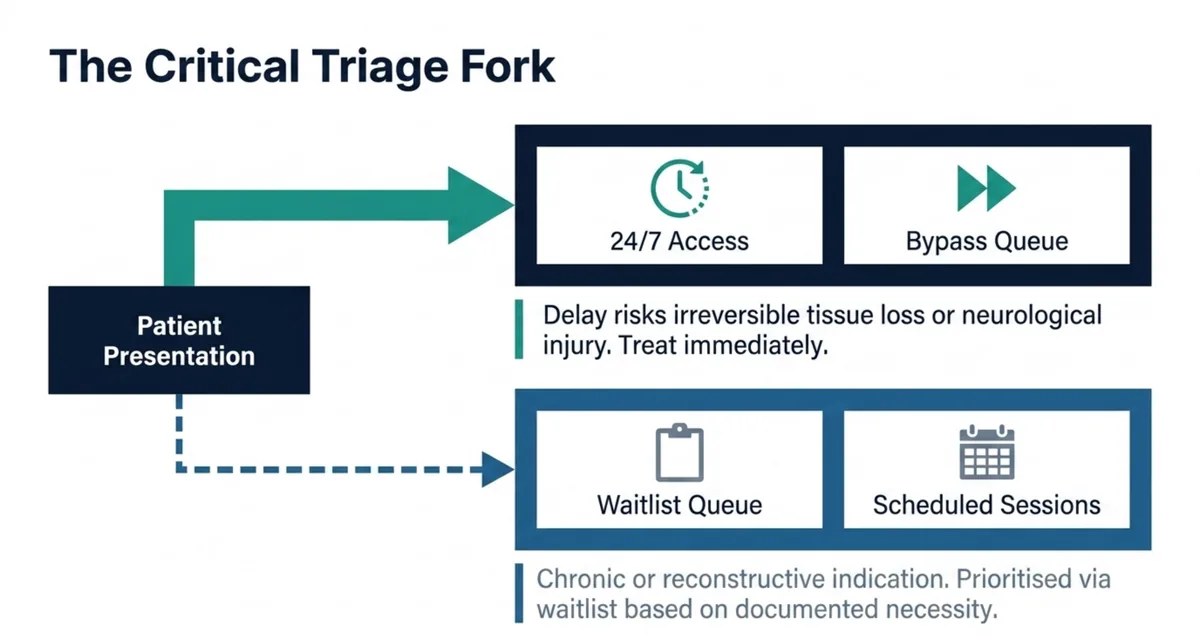
The single most important triage decision is whether the indication is an emergency or an elective one, because the two follow entirely different pathways. Emergencies bypass elective queues and access 24/7 hospital-based programmes immediately through provincial emergency networks. Elective referrals enter a waitlist.
Treat as an emergency (refer immediately, do not wait for a falling lab value or for delayed symptoms):
- Carbon monoxide poisoning with loss of consciousness, neurological or cardiac involvement, pregnancy, or persistent symptoms after normobaric oxygen.
- Decompression sickness and arterial gas embolism (diving injuries, iatrogenic gas embolism). These are managed on recompression protocols and are genuinely time-dependent.
- Gas gangrene (clostridial myonecrosis) as an adjunct to surgical debridement and antibiotics. The hyperbaric component is delivered urgently and at high pressure (UHMS guidance specifies recompression to 3.0 ATA on 100 per cent oxygen for this indication).
- Necrotising soft tissue infections as an adjunct alongside emergent surgery and broad-spectrum antibiotics.
- Crush injury, compartment syndrome, and acute traumatic ischaemia, where early treatment supports threatened tissue.
For these, the benefit signal is tied to early intervention, so the decision to refer should not wait for laboratory normalisation or for the patient to deteriorate. When in doubt, telephone the hyperbaric team or the regional coordination line and let them triage.
Refer electively (through the standard waitlist): the chronic and reconstructive indications among Health Canada's recognised conditions, including enhancement of healing in selected problem wounds, soft tissue radiation necrosis, radiation damage affecting bone, chronic osteomyelitis, compromised skin grafts and flaps, and sudden sensorineural hearing loss. Exceptional blood loss anaemia and thermal burns are recognised indications whose urgency depends on the clinical context. Elective wait times vary by province and by chamber capacity, and can range from a few weeks to many months for chronic indications at the busiest sites.
A practical rule: if delay risks irreversible tissue loss or neurological injury, treat it as an emergency referral. If the indication is a chronic wound or a late radiation effect, treat it as elective and document thoroughly so the receiving programme can prioritise appropriately.
Where patients are treated in Canada
Covered HBOT in Canada is delivered through hospital-based programmes, not through provincial coverage of private clinics (with narrow, province-specific exceptions). These hospital programmes provide 24/7 emergency coverage and accept the relevant provincial health plan with a physician referral. Across the country there are 11 hospital-based hyperbaric programmes; the broader facility landscape includes private clinics as well, but those generally operate on a self-pay basis and during business hours.
In general terms, hospital-based programmes operate in several provinces while others rely on interprovincial referral:
- Seven provinces run hospital-based programmes that bill the provincial plan: Ontario, Alberta, Quebec, British Columbia, Nova Scotia, Newfoundland and Labrador, and Saskatchewan (the Saskatchewan programme has operated on limited hours).
- Provinces and territories without an in-province hospital programme (Manitoba, New Brunswick, Prince Edward Island, Yukon, Northwest Territories, and Nunavut) refer patients interprovincially, most often by air ambulance for emergencies.
Coverage scope is not identical everywhere. Most participating provinces cover the recognised indications at hospital programmes with valid provincial insurance and a physician referral, at no out-of-pocket cost to the patient. A few cover a narrower subset of conditions, and elective access in the Atlantic region in particular can involve substantial waits because a single chamber serves a wide catchment. Because the precise covered-condition list and the specific operating hours can change, confirm current coverage and capacity with the receiving programme or the regional coordination line before counselling the patient, rather than relying on a fixed figure. The site's coverage page maintains a province-by-province overview and is a useful starting point.
This guide deliberately avoids steering patients toward any private clinic. Naming the publicly funded hospital programme in the patient's region is appropriate; the receiving programme will confirm whether the indication is covered and how soon the patient can be seen.
What to include in a referral
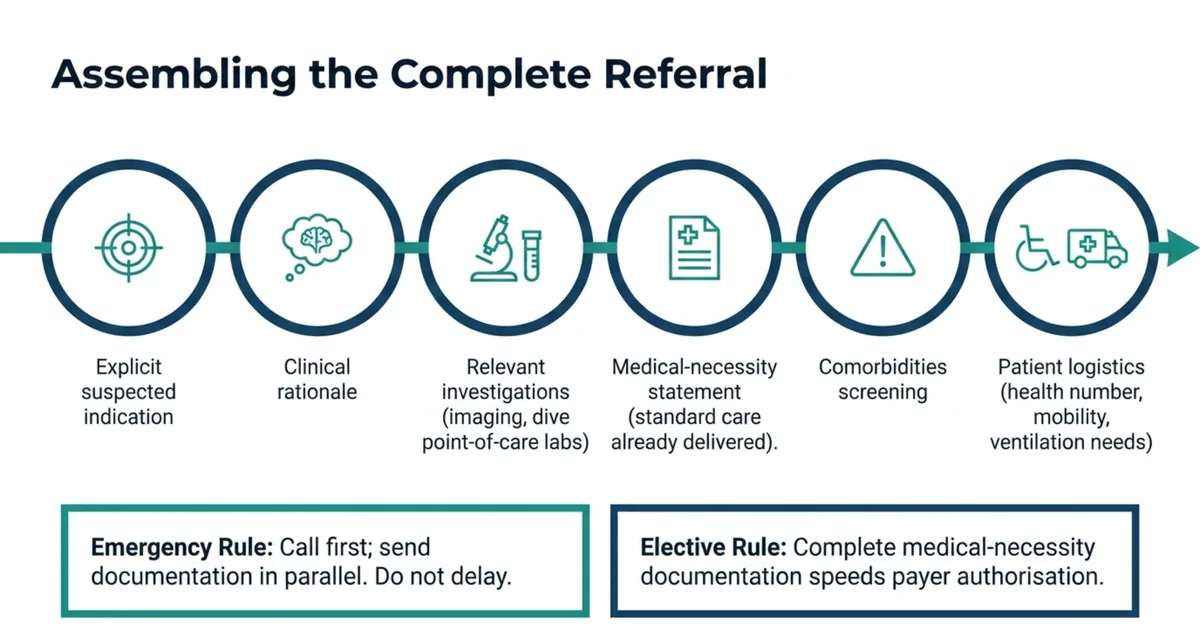
A complete referral speeds triage and reduces back-and-forth. For both emergency and elective referrals, include:
- The suspected indication, stated explicitly, and where relevant which of the recognised conditions it corresponds to.
- A clear clinical rationale: why HBOT is being considered now, and what makes this patient a candidate.
- Relevant investigations: for an emergency, the time of exposure or onset, vital signs, and any point-of-care results (for carbon monoxide, the co-oximetry carboxyhaemoglobin level, ECG, and troponin; for diving injuries, the dive profile and timeline). For an elective wound or radiation referral, supporting imaging, wound measurements or photographs, and the treatments already tried.
- A medical-necessity statement documenting what standard care has been delivered and why HBOT is now indicated. Elective programmes and third-party payers commonly require this.
- Comorbidities and contraindications: untreated pneumothorax (an absolute contraindication in the acute setting that must be drained before chamber entry), concurrent bleomycin or disulfiram, poorly controlled seizures, claustrophobia, recent thoracic or ear surgery, and any device or implant concerns. Flagging these early prevents a wasted transfer.
- Patient logistics: provincial health number, contact details, mobility and ventilation needs, and whether the patient can tolerate a monoplace or requires a multiplace environment.
For emergency referrals, place the call first and send documentation in parallel rather than waiting to assemble a complete package. For elective referrals, the more complete the medical-necessity documentation, the smoother the intake and any payer authorisation.
How HBOT fits alongside standard care
For essentially all of its recognised indications, HBOT is adjunctive. It supplements, and does not replace, the standard of care: surgical debridement and antibiotics for necrotising infection and gas gangrene; normobaric oxygen, supportive care, and monitoring for carbon monoxide poisoning; wound care, offloading, vascular assessment, and glycaemic control for problem wounds; and oncological and reconstructive management for radiation injury. The referral should make clear that standard care is already underway, not deferred while HBOT is arranged.
The mechanistic rationale is that breathing 100 per cent oxygen at pressures above one atmosphere markedly raises dissolved plasma oxygen, supporting tissue oxygenation where perfusion or oxygen-carrying capacity is compromised, accelerating elimination of carbon monoxide, and modulating inflammatory and infective processes. Clinical-grade chambers in Canadian practice typically operate in the region of 2.0 to 2.8 ATA on 100 per cent oxygen, with higher pressure used for specific indications such as gas gangrene.
The strength of the evidence varies by indication, and HBOT should be framed accordingly. It is well established for the acute emergencies and for several chronic indications, while for others the evidence supports it as a reasonable adjunct rather than a guaranteed benefit. HBOT is licensed and funded only for the recognised conditions; it should not be presented as effective for off-label or unproven uses, which are not covered by provincial health insurance and fall outside the scope of a covered referral.
Locating the nearest chamber
Because chambers are unevenly distributed, the nearest covered programme may not be the nearest hospital. To identify it:
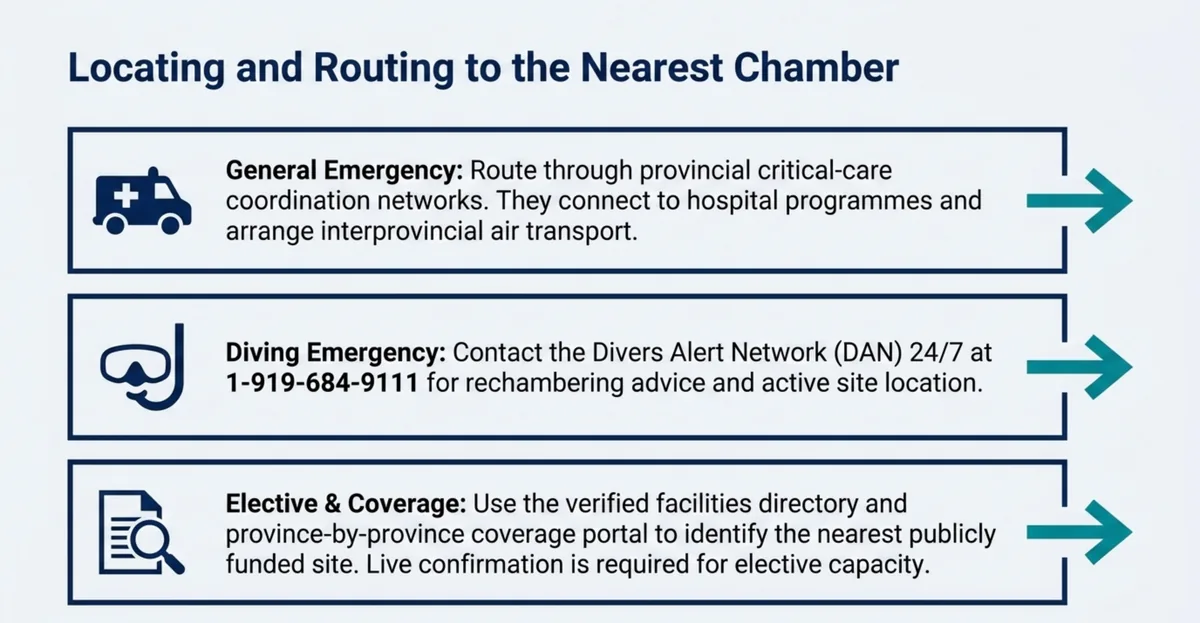
- Use the facilities directory on the site, which lists verified Canadian hyperbaric facilities and lets a patient or referrer enter a postal code to find the nearest centres with distances. The coverage page complements this with the province-by-province funding picture.
- For diving emergencies, the Divers Alert Network 24/7 line at 1-919-684-9111 can help locate the nearest active recompression chamber and advise on management while transfer is arranged.
- For other emergencies, route through the relevant provincial emergency or critical-care coordination network, which can connect the referring department to a hospital programme and arrange transport, including interprovincial air ambulance where no in-province chamber exists.
Confirm acceptance and availability with the receiving programme directly. Operating hours and capacity, particularly for elective slots, change over time, so a live confirmation is worth more than any static list.
After referral
What happens next depends on whether the referral was an emergency or elective.
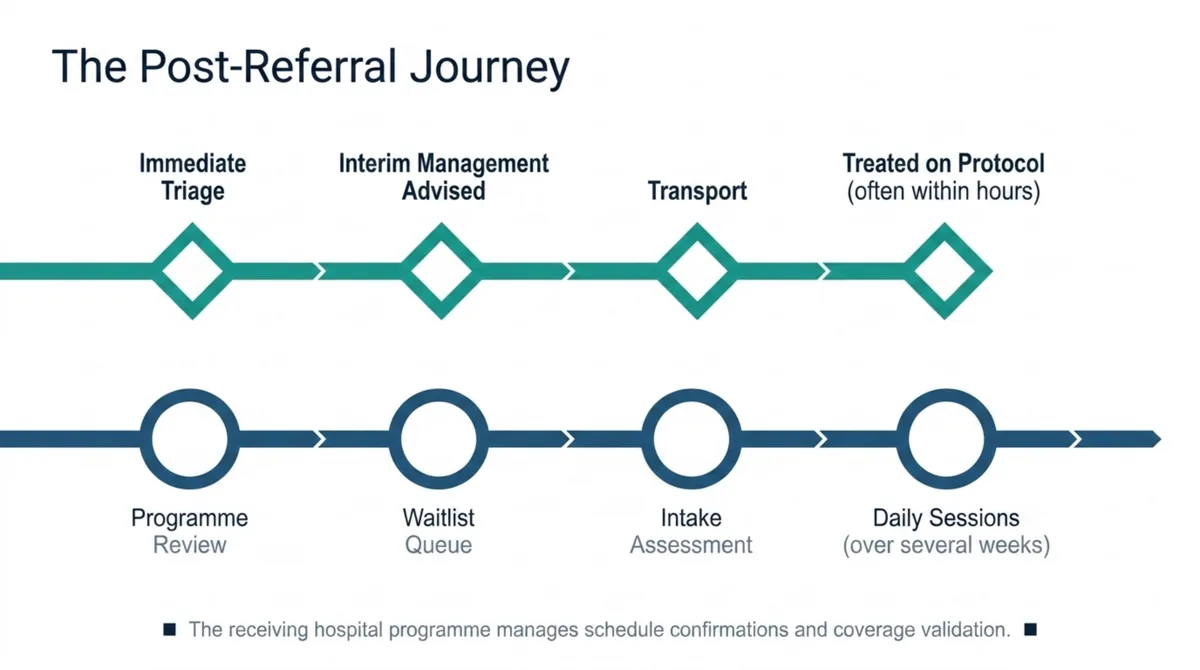
Emergency referrals are triaged immediately. The hyperbaric team will confirm acceptance, advise on interim management (for example, continued high-flow oxygen for carbon monoxide), and coordinate transfer. The patient is treated on the indication-specific protocol, often urgently and sometimes within hours of the call. Communicate the time of onset or exposure clearly, because it drives urgency.
Elective referrals are reviewed by the receiving programme for eligibility against the covered indications and for clinical suitability, including a contraindication check. The patient is then placed in the queue. Wait times depend on the province and the chamber's capacity; for chronic indications at high-demand sites they can be lengthy, so set realistic expectations. A typical elective course involves a series of daily sessions over several weeks, with the exact number determined by the indication and the patient's response; the programme will outline the plan at intake.
In both cases, advise the patient that the hospital programme, not the referring physician, will confirm coverage and scheduling, and that they should report any new respiratory, cardiac, or ear symptoms before treatment begins. Where a patient is travelling to another province for care, the receiving programme can advise on the funding pathway. Keep the line of communication open: hyperbaric programmes generally welcome a call from the referring physician to clarify urgency or eligibility, and a brief conversation often resolves questions faster than repeated paperwork.