For referring and emergency physicians in Canada. Delayed radiation injury is one of the 14 conditions publicly funded in Canada for hyperbaric oxygen therapy (HBOT), and the soft-tissue forms (radiation cystitis, radiation proctitis, and soft-tissue radionecrosis) are treated electively at Canadian hospital-based hyperbaric programmes, covered by provincial health insurance. This guide summarises when to refer, how to assess the patient before referral, what the evidence supports, the Canadian referral pathway, and contraindications. It does not cover osteoradionecrosis, which is addressed in a separate guide. It closes with the complete list of open-access research published since 2020, each linked to its free full text.
When to refer
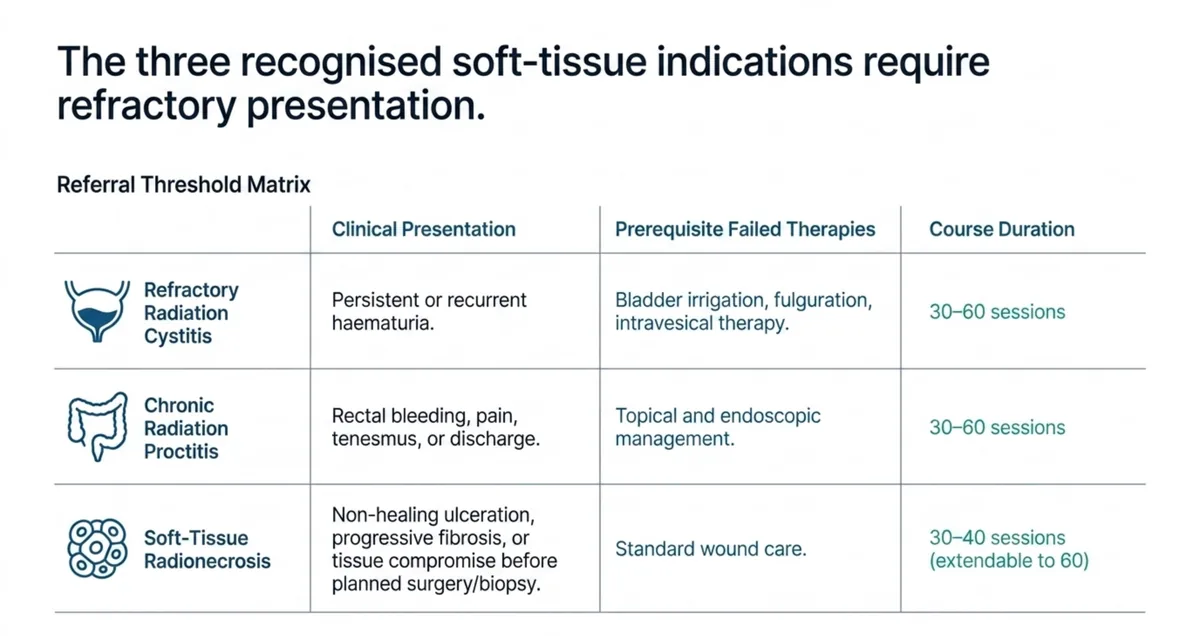
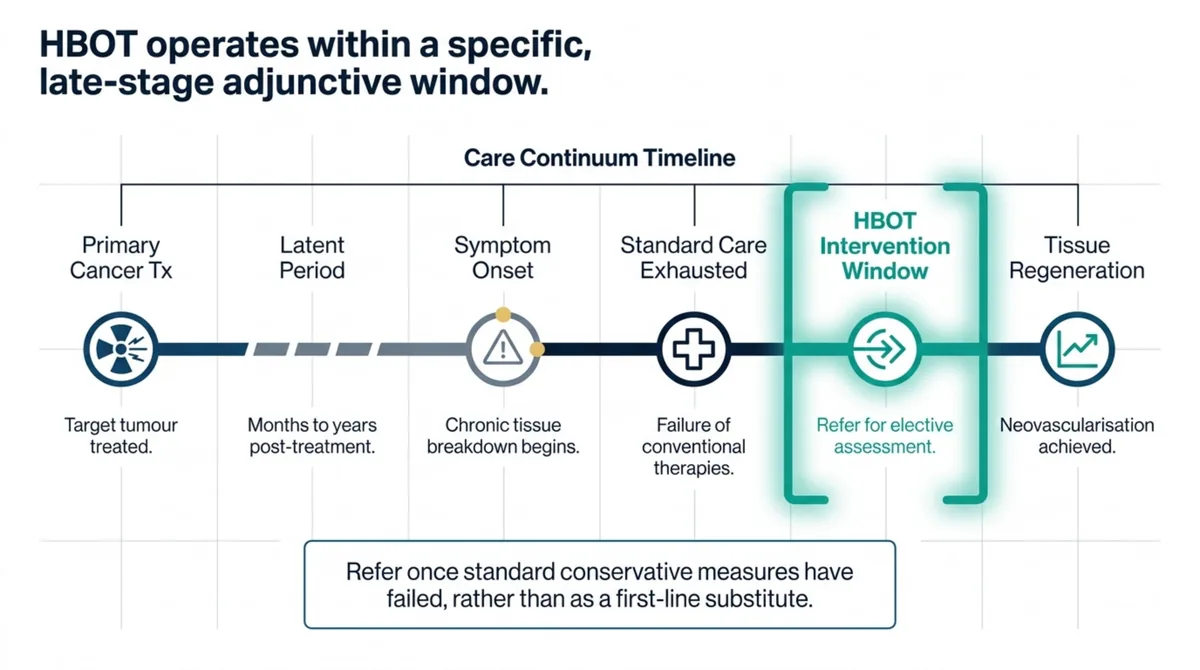
Refer for elective hyperbaric assessment when a patient with a history of radiotherapy develops chronic, refractory soft-tissue injury in the irradiated field, typically months to years after treatment, in any of the following forms:
- Refractory radiation cystitis with persistent or recurrent haematuria that has not responded to conventional measures such as bladder irrigation, fulguration, or intravesical therapy.
- Chronic radiation proctitis with rectal bleeding, pain, tenesmus, or discharge that persists despite topical and endoscopic management.
- Soft-tissue radionecrosis with non-healing ulceration, a chronic wound, or progressive fibrosis in previously irradiated tissue.
- Tissue compromise before planned surgery or biopsy in an irradiated field, where HBOT may be considered to improve healing potential of an otherwise hypovascular, hypocellular bed.
HBOT in this setting is adjunctive. It is used alongside, not in place of, the urology, gastroenterology, surgical, or wound-care management already in progress. Referral is appropriate once standard conservative measures have failed rather than as a first-line treatment.
Assessing the patient before referral
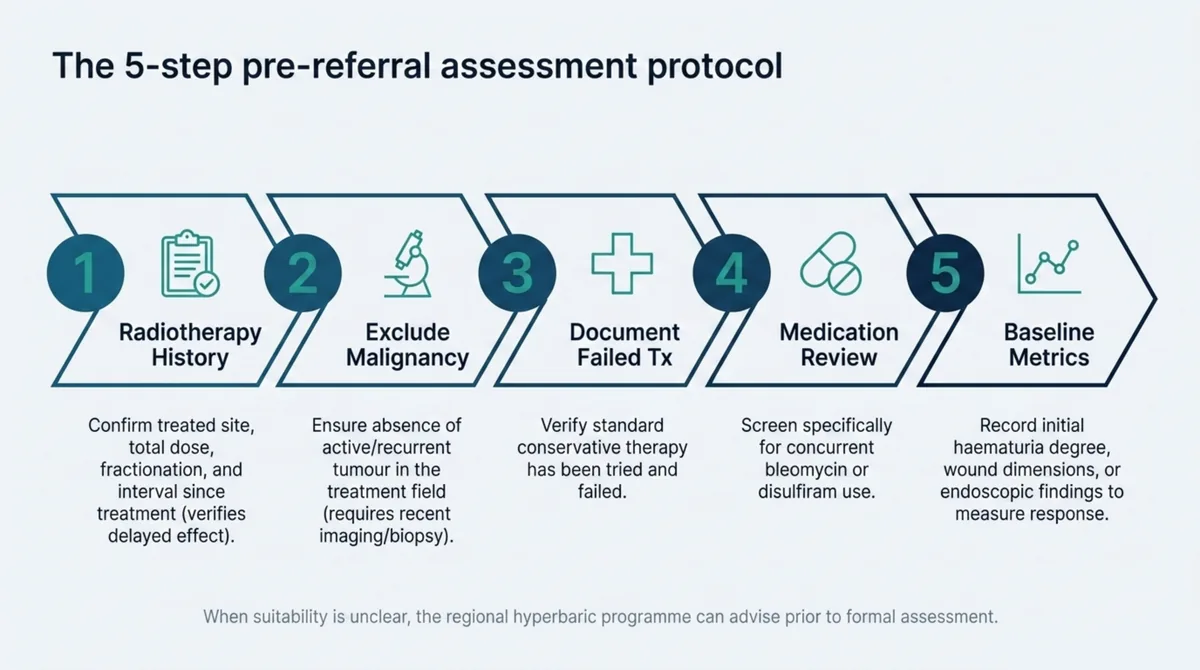
Before referral for elective hyperbaric care, the referring physician should:
- Confirm the radiotherapy history: the treated site, total dose, fractionation if available, and the interval since treatment, which establishes the injury as a delayed radiation effect rather than another process.
- Exclude active or recurrent malignancy in the treatment field. Most Canadian programmes confirm the absence of recurrent disease before committing a patient to a long course, so recent imaging, endoscopy, or biopsy results should accompany the referral.
- Document that conventional therapy has been tried and has failed, since HBOT is reserved for refractory disease.
- Review the medication and chemotherapy history, specifically current or recent bleomycin and current disulfiram, both of which bear on eligibility.
- Screen for chamber-relevant comorbidity: severe COPD with bullous disease, uncontrolled seizures, untreated pneumothorax, uncontrolled hypertension, and claustrophobia.
- Provide a baseline of the target lesion, for example the degree of haematuria, endoscopic findings, or wound dimensions, so response can be measured over the course.
What the evidence supports
The evidence base is strongest for late radiation cystitis and radiation proctitis, where randomised data exist, and is supported by a Cochrane systematic review across radiation tissue injury.
For late radiation cystitis, the reference trial is RICH-ART (Oscarsson et al., Lancet Oncology 2019, 79 patients across five Nordic hospitals), which reported a 10.1-point absolute improvement in the EPIC urinary total score at six to eight months for hyperbaric-treated patients versus standard care (95% CI 2.2 to 18.1; p=0.013), using a protocol of 240 to 250 kPa for 80 to 90 minutes over 30 to 40 sessions.
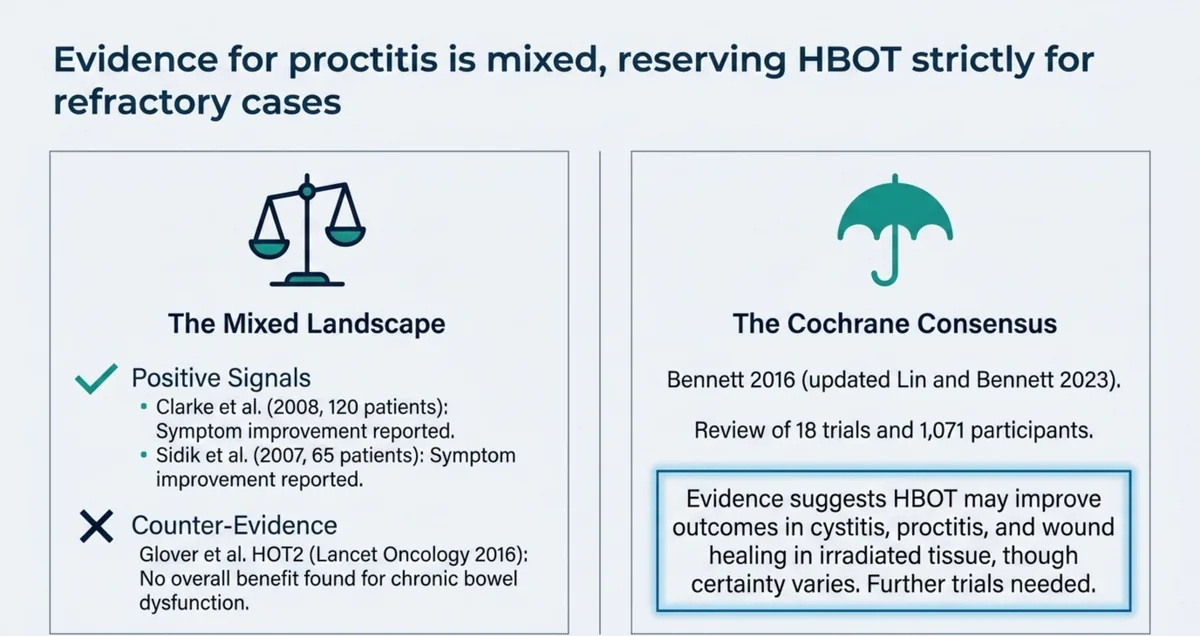
For radiation proctitis, the evidence is mixed. Clarke et al. (IJROBP 2008, 120 patients) and Sidik et al. (Acta Med Indones 2007, 65 patients) each reported symptom improvement with HBOT, while Glover et al. (HOT2, Lancet Oncology 2016) found no overall benefit for chronic bowel dysfunction. This counter-evidence informs Canadian practice, which reserves HBOT for refractory cases rather than applying it broadly.
The Cochrane review (Bennett 2016, updated Lin and Bennett 2023, 18 trials and 1,071 participants) found evidence that HBOT may improve some outcomes in radiation proctitis, radiation cystitis, and wound healing in irradiated tissue, while noting that the certainty of evidence varies across outcomes and that further trials are needed.
The mechanistic rationale is well established. Radiation injury produces hypoxic, hypovascular, and hypocellular tissue with impaired healing capacity. HBOT at 2.0 to 2.4 ATA raises tissue oxygen tension, and the proposed mechanism is that this stimulates angiogenesis through release of vascular endothelial growth factor (VEGF) and stromal cell-derived factor-1 (SDF-1), recruits endothelial progenitor cells, and supports collagen synthesis. The resulting improvement in tissue vascularity may persist after a completed course. Available clinical and registry data have not shown an increased risk of cancer recurrence in irradiated cancer survivors who received HBOT, though this evidence is observational.
Clinical translation
Refer once standard care has been exhausted, not as a substitute for it. Because soft-tissue radiation injury is a delayed and chronic process, there is no emergency time pressure, but persistent refractory haematuria, bleeding, or non-healing wounds warrant timely referral rather than indefinite conservative management. Where active or recurrent malignancy in the field is suspected, that question should be resolved before a long hyperbaric course begins. When the situation is unclear, the hyperbaric programme can advise on suitability.
The Canadian referral pathway
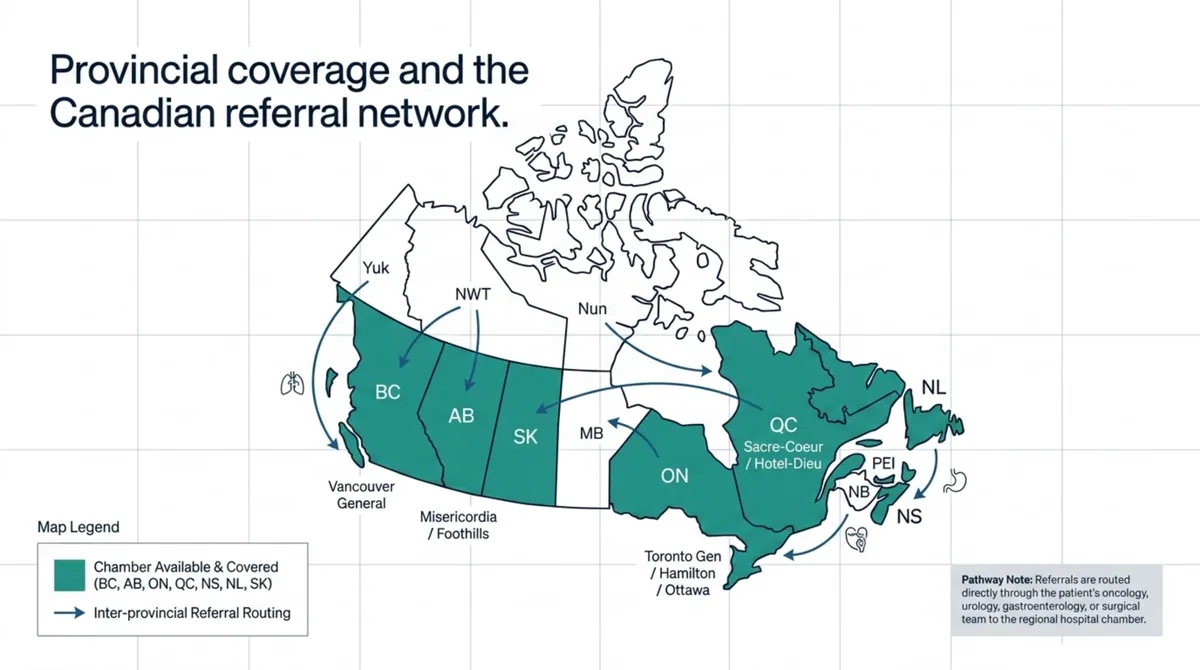
Soft-tissue radiation injury is treated electively at Canadian hospital-based hyperbaric programmes and is covered by provincial health insurance for the recognised indications. These indications are available at hospital programmes across seven provinces (Ontario, Quebec, British Columbia, Alberta, Nova Scotia, Newfoundland and Labrador, and Saskatchewan). Referrals are routed through the patient's oncology, urology, gastroenterology, or surgical team to the regional hospital chamber.
- Ontario: programmes at Toronto General (UHN), Hamilton General, and The Ottawa Hospital.
- British Columbia: Vancouver General Hospital (Leon Judah Blackmore Pavilion), the hospital chamber for the province, covered under MSP.
- Alberta: Misericordia Community Hospital (Edmonton) and Foothills Medical Centre (Calgary), covered by Alberta Health.
- Quebec: RAMQ covers Hopital du Sacre-Coeur de Montreal and Hotel-Dieu de Levis.
- Nova Scotia, Newfoundland and Labrador, and Saskatchewan: regional hospital programmes accept referrals for these indications.
- Provinces and territories without a hospital programme (Manitoba, New Brunswick, PEI, Yukon, NWT, Nunavut): interjurisdictional referral to the nearest programme, coordinated by the patient's oncology or surgical team.
A typical course runs five days a week for 90 minutes per session: roughly 30 to 60 sessions for radiation cystitis or proctitis, and 30 to 40 sessions for soft-tissue radionecrosis (extended toward 60 if the response is incomplete), spanning about 6 to 12 weeks. Further detail on this indication is available on the Canada Hyperbarics delayed radiation injury page.
Contraindications and cautions
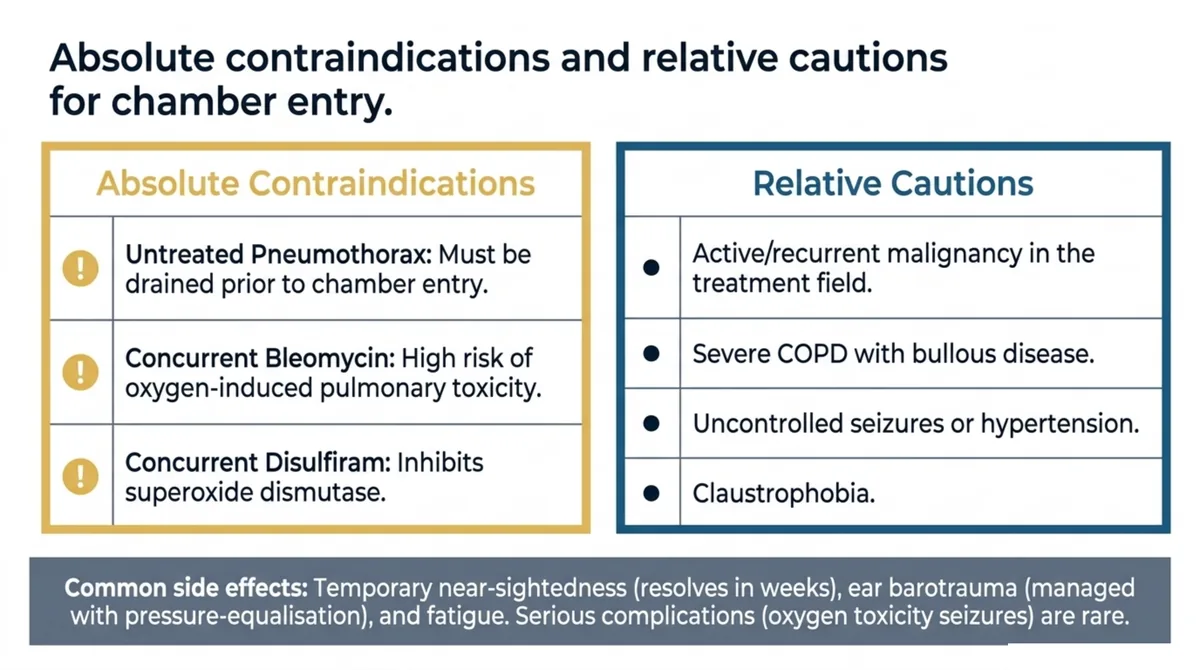
The absolute contraindications relevant to elective hyperbaric care are an untreated pneumothorax, which must be drained before chamber entry, concurrent bleomycin (because of the risk of oxygen-induced pulmonary toxicity), and concurrent disulfiram (which inhibits superoxide dismutase). Relative cautions include active or recurrent malignancy in the treatment field, which most Canadian programmes confirm is absent before a long course, along with severe COPD with bullous disease, uncontrolled seizures, claustrophobia, and uncontrolled hypertension. Common side effects are temporary near-sightedness that usually resolves within weeks, ear barotrauma managed with pressure-equalisation techniques, and fatigue; serious complications such as pneumothorax or oxygen toxicity seizures are rare at standard pressures.
How to use the research list below
The list contains every delayed radiation injury study in the Canada Hyperbarics database that was published in 2020 or later and has a freely available full-text version, each linked directly to that full text. Paywalled and abstract-only studies are excluded, and retracted studies are removed. This is a reference list, not a set of summaries. Counts and the open-access set refresh each quarter.
Open-access research, 2020 to present
23 studies with a free full-text version, grouped by year, newest first. Each entry links to the full text. The set refreshes each quarter; retracted and paywalled studies are excluded.
20261 study
- Dejonckheere CS et al. Hyperbaric oxygen therapy for chronic radiotherapy-related adverse effects: A clinically focused review. CA: a cancer journal for clinicians. Full text (Unpaywall) ›
20257 studies
- Fraga Carvalho C et al. Hyperbaric Oxygen Therapy for Patients With Viral or Radiation-Induced Hemorrhagic Cystitis. Cureus. Full text (Unpaywall) ›
- Friedberg S et al. An Atypical Presentation of Radiation-Induced Enteritis Treated With Hyperbaric Oxygen Therapy. ACG case reports journal. Full text (Unpaywall) ›
- Pereira JA et al. Supratrigonal systectomy: last line treatment for radiation-induced hemorrhagic cystitis. Archivio italiano di urologia, andrologia : organo ufficiale [di] Societa italiana di ecografia urologica e nefrologica. Full text (Unpaywall) ›
- Mihailidis T et al. The Practical Management of Intractable Haematuria Within the National Health Service of the United Kingdom: A Literature Review. Cureus. Full text (Unpaywall) ›
- Oscarsson N et al. Radiation-induced cystitis treated with hyperbaric oxygen therapy (RICH-ART): long-term follow-up of a randomised controlled, phase 2-3 trial. EClinicalMedicine. Full text (Unpaywall) ›
- Lin L et al. Case report: Successful treatment of hyperbaric oxygen for radiation-induced hemorrhagic cystitis in a 95-year-old patient with bladder cancer. Frontiers in oncology. Full text (Unpaywall) ›
- Wang Y et al. Hyperbaric oxygen therapy for radiation enteritis and clinical parameters: a systematic review and meta-analysis. Frontiers in medicine. Full text (Unpaywall) ›
20243 studies
- Yang TK et al. Efficacy and Safety of Hyperbaric Oxygen Therapy for Radiation-Induced Hemorrhagic Cystitis: A Systematic Review and Meta-Analysis. Journal of clinical medicine. Full text (Unpaywall) ›
- Arana Ribeiro J et al. Hyperbaric oxygen therapy in the treatment of late-onset hemorrhagic cystitis after allogeneic hematopoietic stem cell transplantation. Sci Rep. Full text (Unpaywall) ›
- Gatsinga R et al. Radiation-Induced Hemorrhagic Cystitis in Prostate Cancer Survivors: The Hidden Toll. Medicina (Kaunas, Lithuania). Full text (Unpaywall) ›
20235 studies
- Jefferson F et al. Hemorrhagic Cystitis: Making Rapid and Shrewd Clinical and Surgical Decisions for Improving Patient Outcomes. Res Rep Urol. Full text (Unpaywall) ›
- Moreira Monteiro A et al. The effectiveness of hyperbaric oxygen therapy for managing radiation-induced proctitis - results of a 10-year retrospective cohort study. Frontiers in oncology. Full text (Unpaywall) ›
- Liu L et al. Comparative efficacy of oral drugs for chronic radiation proctitis - a systematic review. Systematic reviews. Full text (Unpaywall) ›
- Wang Y et al. Advances in the management of radiation-induced cystitis in patients with pelvic malignancies. International journal of radiation biology. Full text (Unpaywall) ›
- Gulli F et al. Investigation of the physiological response of radiation-induced cystitis patients using hyperbaric oxygen. Clinical and translational radiation oncology. Full text (Unpaywall) ›
20224 studies
- Sarrió-Sanz P et al. Efficacy, tolerance and predictors of response to the treatment with hyperbaric oxygen therapy for patients with hemorrhagic radiation cystitis. Arch Esp Urol. Full text (Unpaywall) ›
- Ozturk H et al. Hyperbaric oxygen treatment for refractory haemorrhagic cystitis occurring after chemotherapy and haematopoietic stem cell transplantation: retrospective analysis of 25 patients. Diving and hyperbaric medicine. Full text (Unpaywall) ›
- Vanneste BGL et al. Development of a Management Algorithm for Acute and Chronic Radiation Urethritis and Cystitis. Urologia internationalis. Full text (Unpaywall) ›
- Meyer F et al. Intravesical instillations for inflammatory and sensory chronic bladder diseases: Literature review and guide to clinical practice. Progres en urologie : journal de l'Association francaise d'urologie et de la Societe francaise d'urologie. Full text (Unpaywall) ›
20212 studies
- Ju Z et al. The clinical research of 5 steps sequential method for whole treatment of hemorrhagic radiation cystitis in china. International journal of medical sciences. Full text (Unpaywall) ›
- Alpuim Costa D et al. Hyperbaric oxygen therapy as a complementary treatment for radiation proctitis: Useless or useful? - A literature review. World journal of gastroenterology. Full text (Unpaywall) ›
20201 study
- Andren J et al. An observational trial to establish the effect of hyperbaric oxygen treatment on pelvic late radiation tissue injury due to radiotherapy. Diving and hyperbaric medicine. Full text (Unpaywall) ›