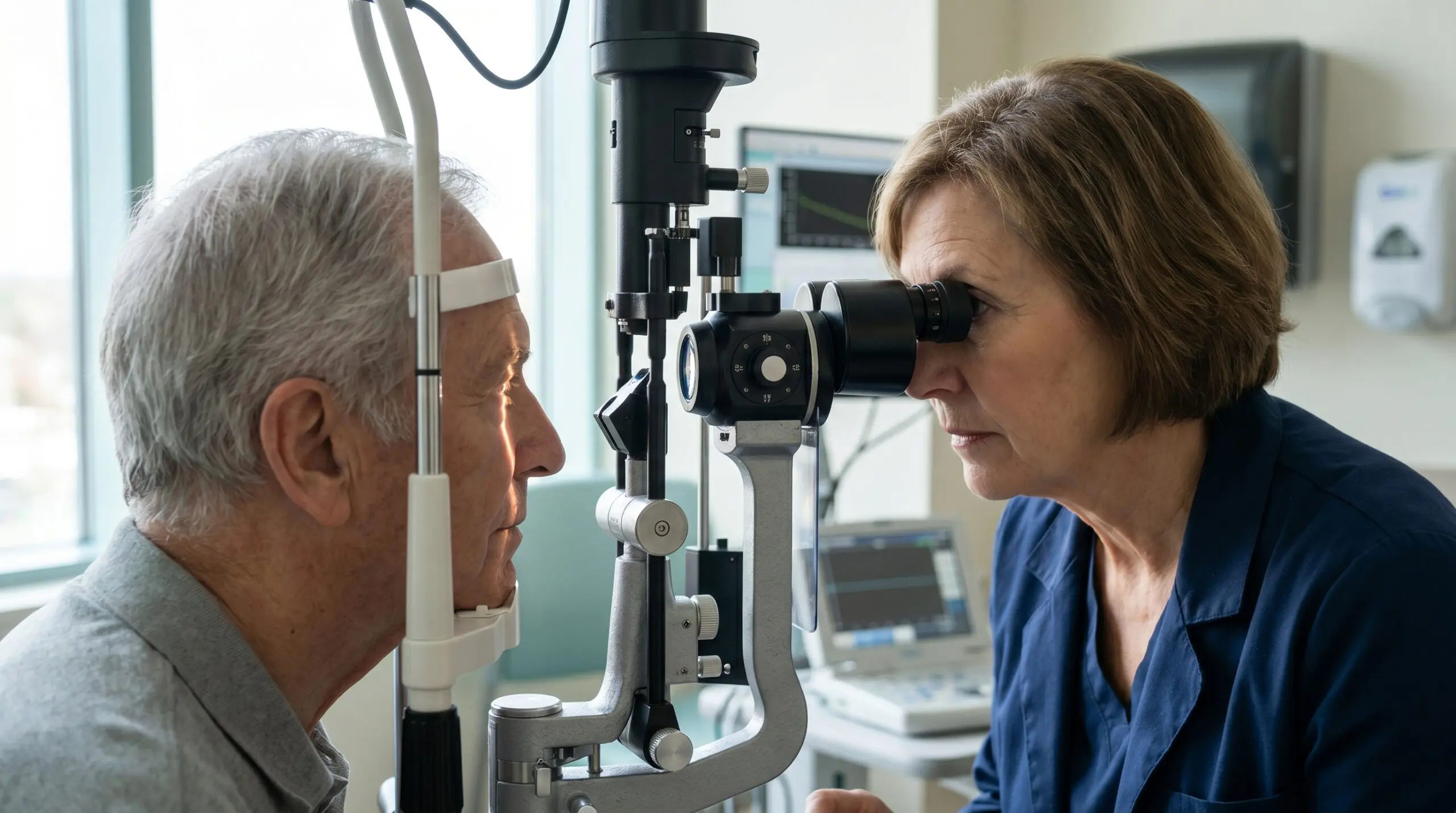
TL;DR: Central retinal artery occlusion (CRAO) is an ophthalmic stroke that causes sudden painless monocular vision loss. Hyperbaric oxygen therapy (HBOT) is a Class IIb recommendation that can preserve retinal viability while reperfusion is awaited. Visual outcomes are time-dependent: best results occur when HBOT begins within 8 hours of symptom onset, and benefit may persist out to 24 hours. Canadian referring physicians should treat suspected CRAO as a Code Stroke equivalent and route patients immediately to the nearest hospital or regulated facility with hyperbaric capability.
Central retinal artery occlusion (CRAO) is a sudden blockage of the main artery supplying the inner retina, typically by embolic material from the carotid arteries or heart. It presents as painless, profound monocular vision loss and is widely recognised as an “eye stroke” with the same biological clock as a cerebral infarct. For Canadian referring physicians, the operational question is not whether HBOT works in a general sense, but how fast a patient with suspected CRAO can be moved through the system to a facility that can deliver pressurized oxygen.
This guide summarizes the current evidence base, the Undersea and Hyperbaric Medical Society (UHMS) treatment recommendation, the Canadian referral logistics, and the screening considerations that determine whether a patient is likely to benefit. Canada Hyperbarics maintains a national directory of hospitals and regulated facilities to assist referring physicians during these time-sensitive emergencies.
What is central retinal artery occlusion and why is it a hyperbaric emergency?
CRAO is uncommon, with an estimated incidence of about 1 to 2 cases per 100,000 person-years, but it is profoundly disabling when it occurs. The retina has the highest oxygen consumption per gram of any tissue in the body, and the inner retinal layers depend almost exclusively on the central retinal artery. When that vessel is occluded, the inner retina becomes ischaemic within minutes, and animal models suggest irreversible damage begins around 97 minutes of complete ischaemia. In clinical practice, however, occlusions are often incomplete, which extends the window during which the retina may still be salvageable.
The rationale for HBOT is mechanistic and direct. Under normobaric conditions, the inner retina depends on the central retinal artery for oxygen. The outer retina is supplied by the choroidal circulation, which is unaffected in CRAO. Under hyperbaric conditions (typically 2.0 to 2.5 atmospheres absolute), enough oxygen dissolves in plasma that the choroid can fully oxygenate the inner retina by diffusion alone, regardless of whether the central retinal artery is patent. This buys time for the body to lyse the embolus, for collateral flow to develop, or for any planned intervention to be performed.
What does the recent evidence show for HBOT in non-arteritic CRAO?
The evidence base is observational and retrospective rather than randomised, but it has grown substantially since 2020. Key Canadian-relevant studies are summarized below.
| Study | Design | Patients | Key Finding |
|---|---|---|---|
| Rozenberg et al., Eye (Lond) 2021 (PubMed) | Retrospective two-centre comparison | 121 HBOT vs 23 standard of care | Mean best-corrected visual acuity (BCVA) improved from 2.89 to 2.15 logMAR with HBOT (p<0.001) vs no significant change in controls |
| St Peter et al., Undersea Hyperb Med 2023 (PubMed) | Retrospective single-centre | 38 non-arteritic CRAO patients | Mean BCVA improvement of 0.5 logMAR overall; 0.9 logMAR improvement when HBOT started within 8 hours (p=0.009) |
| Di Vincenzo et al., Undersea Hyperb Med 2022 (PubMed) | Prospective single-centre with standardised protocol | 28 retinal artery occlusion patients | BCVA improved from 1.5 to 0.9 logMAR after HBOT (p=0.001); twice-daily 2.5 ATA protocol safe and effective |
| Murphy-Lavoie, Butler & Hagan, Undersea Hyperb Med 2022 (PubMed) | UHMS indications committee review | Narrative review | Reaffirms HBOT as the only intervention with consistent evidence of benefit for acute CRAO when initiated promptly |
| Dogruya et al., J Invest Surg 2025 (PubMed) | Retrospective comparative | 15 patients (7 HBOT, 8 PPV) | Both groups showed visual gain after emergency medical therapy; differences were not statistically significant given small sample |
According to PubMed-indexed reviews including Celebi 2021 (Patient Selection and Perspectives (PubMed)) and the 2025 emergency-medicine narrative review by Lakkis et al. (PubMed), three themes are consistent across the literature: HBOT is safe, the time-to-treatment effect is large, and the absence of randomised trials means recommendations remain at the Class IIb (American Heart Association) and UHMS-recommended levels.
How quickly does a CRAO patient need to reach hyperbaric oxygen therapy?
The single most actionable variable a referring physician controls is door-to-chamber time. The UHMS-cited window for initiating HBOT after CRAO is 24 hours from symptom onset, but the gradient within that window is steep:
- 0 to 8 hours from symptom onset: the strongest visual gains in the literature. Treat as a hyper-acute referral.
- 8 to 12 hours: meaningful but smaller benefit; still urgent.
- 12 to 24 hours: benefit becomes less predictable but is still considered worth attempting in patients with salvageable vision (i.e., not no light perception).
- Beyond 24 hours: generally considered outside the standard treatment window; case-by-case decisions should be made with the hyperbaric facility.
This time-dependence has practical implications for triage. In rural and remote regions of Canada where the nearest hospital-based hyperbaric facility may be several hours away, the referring physician should initiate transfer as soon as CRAO is suspected, rather than waiting for confirmatory ophthalmology assessment. If the patient still has light perception or better, the case for transport is strong.
Which patients with CRAO are candidates for HBOT?
The patient selection criteria are relatively straightforward and largely match the standard CRAO workup. A typical candidate has:
- Acute, painless, monocular vision loss
- Symptom onset within 24 hours of presentation (ideally within 8 hours)
- Funduscopic findings consistent with CRAO (retinal whitening, cherry-red spot, attenuated arterioles, sometimes a visible embolus)
- Non-arteritic etiology (arteritic CRAO from giant cell arteritis requires urgent high-dose corticosteroids first and is generally not the typical HBOT target)
- Residual vision better than no light perception
- No absolute contraindications to hyperbaric oxygen (see below)
A key point: arteritic CRAO must be ruled out before assuming an embolic mechanism. Erythrocyte sedimentation rate, C-reactive protein, and a careful history for jaw claudication, scalp tenderness, headache, polymyalgia symptoms, and constitutional features should be obtained. If giant cell arteritis is suspected, intravenous corticosteroids are the immediate priority, with temporal artery biopsy to follow. HBOT may still be considered as an adjunct in selected cases, but the disease process is fundamentally different.
What is the typical HBOT protocol used for CRAO in Canadian hospital facilities?
Protocols vary by facility, but most Canadian hospital-based hyperbaric programs follow a pattern similar to the UHMS-endorsed approach. A representative sequence:
- Initial session: 90 minutes at 2.4 to 2.8 ATA. If vision improves during the first session, the protocol continues.
- Days 1 to 3: two 90-minute sessions per day at 2.0 to 2.5 ATA.
- Days 4 onward: continued daily or twice-daily sessions until visual recovery plateaus, typically 10 to 20 sessions in total.
- Stop criterion: when no further visual gain is observed across consecutive sessions, or when reperfusion is confirmed on fluorescein angiography.
The Di Vincenzo protocol (twice daily, 90 minutes, 2.5 ATA, 7 days per week for at least 15 days, with a fluorescein angiography checkpoint at day 15) is one well-documented standardised approach used in Europe. Canadian facilities often individualize the schedule based on early response.
How do I refer a patient with suspected CRAO in Canada?
Referral pathways differ by province because hyperbaric medicine is delivered through a small number of hospital-based programs rather than through a primary care or community route. A practical workflow:
- Confirm the clinical suspicion. Snellen or pinhole acuity, pupillary exam (an afferent pupillary defect is expected), and fundoscopy. If ophthalmology is on site, involve them immediately, but do not let an ophthalmology delay block transfer.
- Initiate standard CRAO emergency therapy where appropriate. This may include ocular massage, anterior chamber paracentesis if performed at your centre, intraocular pressure reduction, and an evaluation for arteritic etiology with ESR and CRP.
- Call the nearest hyperbaric facility directly. Hospital-based hyperbaric programs accept direct physician-to-physician referrals. The receiving physician will confirm eligibility and arrange the chamber slot.
- Arrange urgent transfer. Treat this like any time-critical stroke transfer. The patient should be moving toward the chamber within the first hour of recognition wherever possible.
- Initiate the systemic workup in parallel. Carotid imaging, echocardiogram, lipid panel, HbA1c, ECG, and rhythm monitoring are all appropriate and can be completed at either the referring or receiving centre.
The full directory of Canadian hospitals and regulated facilities with hyperbaric capability is maintained on the Canada Hyperbarics facilities page. Pre-printing or bookmarking the facility nearest to your hospital is a sensible preparedness step for emergency departments and ophthalmology clinics.
What are the contraindications and adverse-event considerations?
HBOT for CRAO uses the same screening framework as any other indication. Absolute contraindications include untreated pneumothorax. Relative contraindications and considerations that require pre-treatment evaluation include:
- Severe chronic obstructive pulmonary disease with bullous lung disease
- Recent thoracic or middle-ear surgery
- Current upper respiratory infection or significant Eustachian tube dysfunction (this is common and often manageable with myringotomy tubes)
- Uncontrolled congestive heart failure or unstable angina
- Current use of certain chemotherapy agents (bleomycin, cisplatin, doxorubicin in particular)
- History of seizure disorder (oxygen toxicity risk)
- Claustrophobia in monoplace chambers (often manageable with sedation or transfer to a multiplace unit)
The most frequent adverse events are mild middle-ear barotrauma and transient myopic refractive shift. Serious adverse events such as oxygen toxicity seizures or pulmonary toxicity are rare with appropriate screening. The receiving hyperbaric physician will perform the full safety assessment, but flagging any of the above when you make the referral call saves time.
How does HBOT for CRAO fit alongside thrombolysis and surgical options?
The CRAO treatment landscape has evolved. Intravenous thrombolysis with alteplase, given within hours of onset, is being investigated for central retinal artery occlusion; the THEIA randomised trial (2025) found no significant visual-acuity benefit over aspirin, and the larger REVISION trial is ongoing. Pars plana vitrectomy with embolectomy is performed at a small number of vitreoretinal centres internationally. Intravenous tissue plasminogen activator within standard stroke time windows is increasingly considered when systems align. None of these has displaced HBOT, and several centres now combine modalities.
For a Canadian referring physician, the practical takeaway is that HBOT remains the most accessible time-critical intervention with a positive risk-benefit profile and the most consistent retrospective evidence. It does not preclude thrombolytic or surgical pathways and can be coordinated alongside them. Patients should not be denied HBOT because a thrombolysis decision is pending.
Frequently asked questions from referring physicians
Is HBOT for CRAO covered by provincial health insurance?
When delivered in a Canadian hospital-based facility for the management of CRAO, HBOT is delivered under the hospital global budget and covered by the patient’s provincial health plan in the same way as any other inpatient or emergency department intervention. There is no separate fee schedule for the patient. Plan names vary by province (OHIP in Ontario, MSP in British Columbia, AHCIP in Alberta, RAMQ in Quebec, and so on); confirm with the receiving facility for any provincial-specific paperwork.
What if my nearest hospital-based chamber is several hours away?
Initiate transfer as soon as CRAO is recognised. The therapeutic window extends to 24 hours, and the choroidal oxygenation principle does not require uninterrupted oxygen delivery during transport. Provide high-flow normobaric oxygen by non-rebreather mask en route. The longer transfer is not a reason to forgo HBOT; it is a reason to start moving sooner.
Should I attempt ocular massage or anterior chamber paracentesis first?
Standard CRAO emergency manoeuvres can be performed in parallel with the referral call. Their evidence base is weaker than that for HBOT, but they are non-invasive (in the case of digital massage) and may dislodge an embolus distally. Do not allow these steps to delay transfer.
How many HBOT sessions will my patient need?
Typically 10 to 20 sessions over one to three weeks, with the exact number determined by the receiving hyperbaric physician based on visual response. Treatment continues until no further visual improvement is observed across consecutive sessions or until reperfusion is documented on fluorescein angiography.
What outcomes can my patient realistically expect?
Outcomes vary widely and depend heavily on time to treatment. Across the recent retrospective series, mean BCVA gains of 0.5 to 0.9 logMAR are typical, with the strongest gains in patients treated within 8 hours. Be honest with patients that complete recovery of pre-CRAO vision is uncommon and that the goal is to maximize the chance of meaningful functional improvement.
Does HBOT change the need for a stroke workup?
No. CRAO is a thromboembolic event with the same vascular implications as a cerebral transient ischaemic attack or stroke. Full systemic vascular workup including carotid imaging, echocardiography, lipid profile, glycaemic assessment, and rhythm evaluation is essential. HBOT addresses the ocular tissue salvage problem; the secondary prevention problem must be addressed in parallel.
Are randomised controlled trials available?
Not yet. The evidence base is observational and retrospective. Randomised trials face ethical and logistical challenges given the rarity of CRAO, the narrow treatment window, and the inability to blind hyperbaric therapy. The 2022 UHMS indications review and the 2025 acute-care narrative review both call for prospective multicentre work. In the meantime, the consistency of retrospective signal, the mechanistic plausibility, and the favourable safety profile underpin current Class IIb recommendations.
Bottom line for Canadian referring physicians
CRAO is an under-referred condition for hyperbaric oxygen therapy in Canada. The therapy is safe, is mechanistically sound, has consistent retrospective evidence of benefit, and is most effective when initiated within 8 hours of symptom onset. Referring physicians who recognise CRAO and act with the urgency of a stroke transfer give their patients the best chance of meaningful visual recovery. Canada Hyperbarics provides up-to-date information on Canadian HBOT research and a national directory of hospitals and regulated facilities to support this referral pathway. For broader context on the regulatory landscape and recognised indications, see Health Canada’s resources and the UHMS Indications list.
This content is for informational purposes only and does not constitute medical advice. Clinical decisions remain the responsibility of the treating physician.