Is HBOT Right For Me | Canada Hyperbarics

Patient Decision Guide

Is Hyperbaric Oxygen Therapy Right For You?

A self-assessment guide for patients and caregivers considering hyperbaric oxygen therapy (HBOT). Use this page to understand whether HBOT may be relevant to your situation, then bring the conversation to your physician.

· Canada Hyperbarics Editorial Team · Sources

Who is hyperbaric oxygen therapy for?

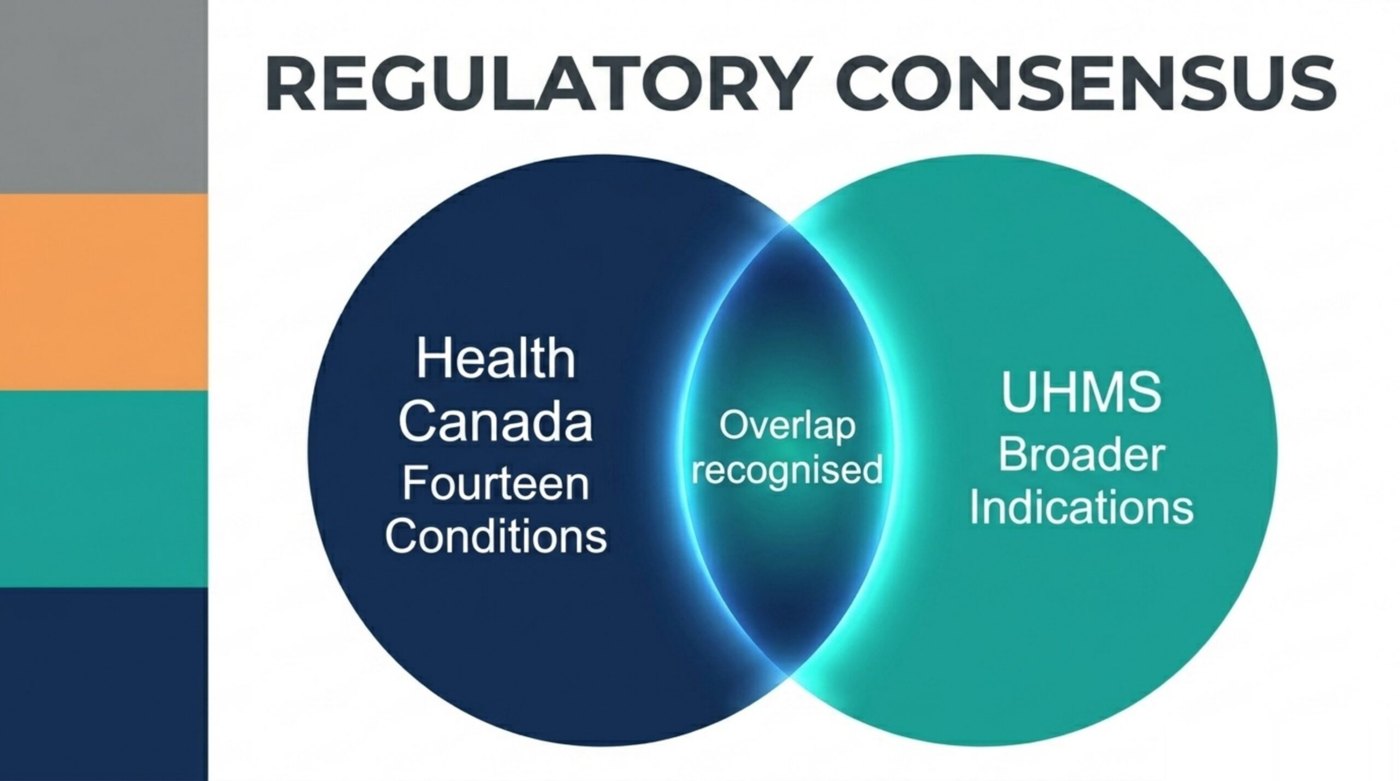
Hyperbaric oxygen therapy is appropriate when your medical condition appears on Health Canada's list of 14 recognised indications, which includes diabetic foot ulcers and other non-healing wounds, decompression sickness, carbon monoxide poisoning, delayed radiation injury, gas gangrene, necrotising soft-tissue infections, and several others. The decision to pursue HBOT is medical, not consumer: it should always be made in consultation with a physician familiar with your medical history. This page helps you understand whether HBOT may be relevant before that conversation.

A 4-step decision path

Most people considering HBOT can self-assess in four short steps before booking a consultation.

STEP 1

Identify your condition

Write down the specific medical condition or symptom you're considering HBOT for, in clinical terms (e.g. "diabetic foot ulcer that hasn't healed in 6 months" rather than "wound").

STEP 2

Check the recognised indications

Compare your condition against the 14 Health Canada-recognised conditions. If it matches, your physician can refer you to a hospital HBOT programme.

STEP 3

Discuss with your physician

Bring your notes plus the questions in the section below. Your physician will assess clinical fit, contraindications, and whether HBOT is the right next step in your care plan.

STEP 4

Find a facility + check coverage

Once your physician confirms HBOT is appropriate, use our facility directory and provincial coverage guide to find the closest option and understand cost.

Strong fit: the 14 Health Canada-recognised conditions

These are the indications for which HBOT has accepted clinical evidence and is publicly funded at hospital programmes across Canada with a physician referral. If your condition matches one of these, HBOT is a recognised treatment option. Click any condition to read the full clinical reference.

Source: Health Canada, Hyperbaric Oxygen Therapy · UHMS HBO Indications 15th Edition (2024) · canonical list mirrored from The Ottawa Hospital hyperbaric programme.

Worth discussing: UHMS-approved beyond Health Canada

The Undersea and Hyperbaric Medical Society (UHMS) maintains a broader international evidence base. The following indication is UHMS-approved but not currently on Health Canada's 14-condition list. Coverage in Canada is variable; some hospital programmes will treat these cases on a case-by-case basis.

Intracranial abscess

Adjunctive to neurosurgery and antibiotics for brain abscesses. UHMS-approved indication.

Active research: emerging indications

These indications have promising RCT evidence but are not yet recognised by Health Canada or fully endorsed by UHMS. Research is ongoing. Patients pursuing HBOT for these conditions typically self-pay at private clinics; coverage by provincial plans is rare. Discuss the current state of evidence with your physician before committing to a treatment course.

Long COVID / post-COVID syndrome
Israeli RCTs (Hadanny et al., Scientific Reports 2022) showed neurocognitive improvements; replication trials ongoing.
Traumatic brain injury (TBI) and concussion
Mixed RCT evidence (Harch 2012, Efrati). Active research area, particularly relevant in contact sports communities.
Stroke recovery
Israeli pilot RCTs (Efrati, PLoS ONE 2013) showed neurological improvements in chronic stroke. Larger replication trials needed.
Fibromyalgia
Single-centre RCT (Efrati, PLoS ONE 2015) showed improvements in pain thresholds and brain SPECT findings. Not yet replicated at scale.

Browse our research database of 14,451 peer-reviewed HBOT studies to assess the evidence for any specific indication.

Not supported by current evidence

Some private clinics market HBOT for indications without supporting clinical evidence. We list these honestly because patient awareness matters. Pursuing HBOT for an unsupported indication carries cost, time, and opportunity cost without expected clinical benefit.

Indications without supporting evidence as of 2026:

  • General "wellness", anti-ageing, or longevity (no RCT support; UHMS does not list as an indication)
  • Cosmetic enhancement, skin tightening, or dermatologic anti-ageing
  • Autism spectrum disorder (multiple RCTs, including Granpeesheh et al. 2010, found no benefit over sham)
  • Cerebral palsy in children (Collet et al., Lancet 2001 RCT found no benefit over sham)
  • Athletic performance or recovery in healthy athletes (no consistent benefit shown in controlled trials)
  • Cancer treatment as a primary therapy (HBOT has accepted role in radiation injury after cancer treatment, but is not itself a cancer treatment)

If a clinic recommends HBOT for an indication on this list, ask for the specific peer-reviewed RCT evidence and the source. The absence of credible answers is itself an answer.

When HBOT is not safe: contraindications

HBOT involves pressure changes that affect closed gas-filled spaces in the body, plus high-dose oxygen exposure. The following situations require physician judgment and may rule out HBOT entirely.

Absolute contraindication (HBOT must not proceed):

  • Untreated pneumothorax (collapsed lung). Pressure changes can convert a simple pneumothorax to a life-threatening tension pneumothorax. Must be treated before HBOT.

Relative contraindications (require physician assessment, may exclude HBOT depending on indication and severity):

  • Severe chronic obstructive pulmonary disease (COPD), particularly with bullae or carbon dioxide retention
  • Active upper respiratory tract infection or significant middle-ear pathology (risk of barotrauma)
  • Recent ear, sinus, or thoracic surgery
  • Untreated congestive heart failure
  • High fever (raises CNS oxygen toxicity risk)
  • Seizure disorder (raises CNS oxygen toxicity risk at higher pressures)
  • Severe claustrophobia (relative; multiplace chambers and pre-treatment counselling may help)
  • Pregnancy (relative; some indications such as carbon monoxide poisoning justify treatment)
  • Concurrent or recent doxorubicin, bleomycin, cisplatin, or disulfiram (drug-oxygen interactions)

Source: UHMS Hyperbaric Oxygen Therapy Indications, 15th Edition (2024); CUHMA Standards of Practice. This list is a general orientation and is not a substitute for individual physician assessment.

What to ask your physician

Bring these questions to the consultation. Each one helps clarify whether HBOT is the right next step for your specific situation.

What specific evidence supports HBOT for my condition?
Ask for the peer-reviewed studies, systematic reviews, or clinical guidelines that justify HBOT for your specific indication. For Health Canada-recognised conditions there is established RCT or systematic-review evidence. For off-label uses the evidence quality is highly variable; a credible physician can summarise it for you.
How many HBOT sessions would my treatment course involve, and at what pressure?
Standard protocols range from 20 to 40 daily sessions for chronic indications, with some radiation injuries requiring up to 60 sessions. Each session typically lasts 90 to 120 minutes at pressures of 2.0 to 2.4 ATA. Acute indications such as carbon monoxide poisoning or decompression sickness use different protocols (often US Navy Treatment Tables 5, 6, or 6A).
Are there any contraindications based on my medical history?
Untreated pneumothorax is an absolute contraindication. Several relative contraindications exist (severe COPD, recent ear surgery, certain medications, pregnancy depending on indication). Your physician will review your history and current medications.
Where is the closest hospital programme that treats my indication?
Canada has 11 hospital-based hyperbaric programmes across 7 provinces. For OHIP-, MSP-, MSI- or other provincial-plan-covered treatment, you need a referral to a hospital programme. Use our facility directory filtered by province for the closest option.
Will the treatment be covered by my provincial health plan, and if not, what does it cost?
Provincial coverage varies. Health Canada-recognised indications are covered at hospital programmes in provinces with HBOT capacity. Private clinic treatment is generally self-pay (typically $175 to $350 per session, $7,000 to $14,000 for a full course). See our provincial coverage guide for details.
What are the realistic expected outcomes and timelines for my condition?
Outcomes vary substantially by indication. Acute conditions (carbon monoxide poisoning, decompression sickness) often show measurable improvement within hours. Chronic conditions (problem wounds, radiation injury) typically show response over weeks to months. A credible physician will give you a specific expected outcome range and the evidence behind it.
What are the side effects I should expect?
Common: ear pressure during compression (most patients learn equalisation techniques), temporary myopia (vision change reverts after the treatment course ends, typically within weeks). Less common: middle ear barotrauma, sinus barotrauma, claustrophobia. Rare: oxygen toxicity (managed by air breaks during sessions), pneumothorax. Serious adverse events are uncommon at standard pressures and protocols.

This page is informational and is not medical advice. The decision to pursue hyperbaric oxygen therapy must be made in consultation with a physician familiar with your medical history. Canada Hyperbarics is an independent research project and has no commercial affiliation with any facility, manufacturer, or treatment provider listed on this site. See our editorial policy and data sources pages for methodology.