
A hyperbaric chamber is a pressurised medical device used to deliver hyperbaric oxygen therapy (HBOT) at pressures greater than 1 atmosphere absolute. Under Canadian law, every hyperbaric chamber sold for medical use must hold a Health Canada licence, and every clinic that operates one must verify that licence is current.
TL;DR: Hyperbaric chambers are Class III medical devices under Canada’s Medical Devices Regulations. Operating a chamber in a Canadian clinic requires using a Health Canada licensed device, while importing or distributing chambers for sale requires a Medical Device Establishment Licence (MDEL). Health Canada has issued chamber licences only for the 14 conditions it recognises for hyperbaric use; its device-licensing framework references the separate Undersea and Hyperbaric Medical Society (UHMS) indications list. The 2026 compliance landscape brings a refreshed CSA Z275.1:23 standard aligned with ASME PVHO-1, active enforcement against unauthorised soft-shelled chambers, and continued post-market vigilance obligations for Class III devices. This update walks Canadian HBOT clinic owners through what must be verified in their compliance file this year.
Why are hyperbaric chambers regulated as medical devices in Canada?
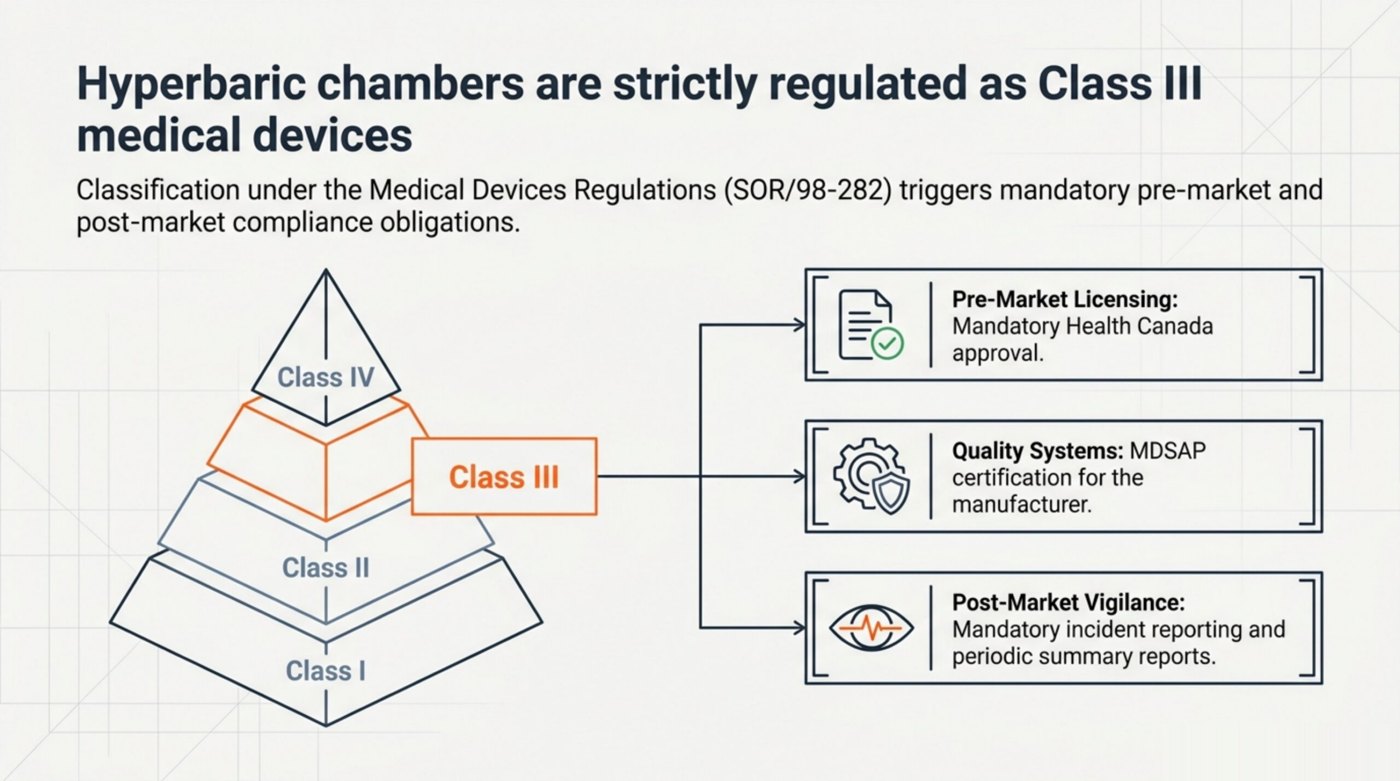
A hyperbaric chamber is a medical device under the federal Medical Devices Regulations (SOR/98-282), issued under the Food and Drugs Act. Health Canada uses a risk-based classification system that places non-in-vitro diagnostic devices into one of four classes, with Class I being lowest risk and Class IV being highest. The classification rules are set out in Health Canada’s risk-based classification guidance.
Hyperbaric chambers used for medical treatment are Class III devices. That classification triggers a pre-market licensing process for manufacturers, quality management system certification under the Medical Device Single Audit Program (MDSAP), and post-market vigilance obligations such as mandatory incident reporting and periodic summary reports.
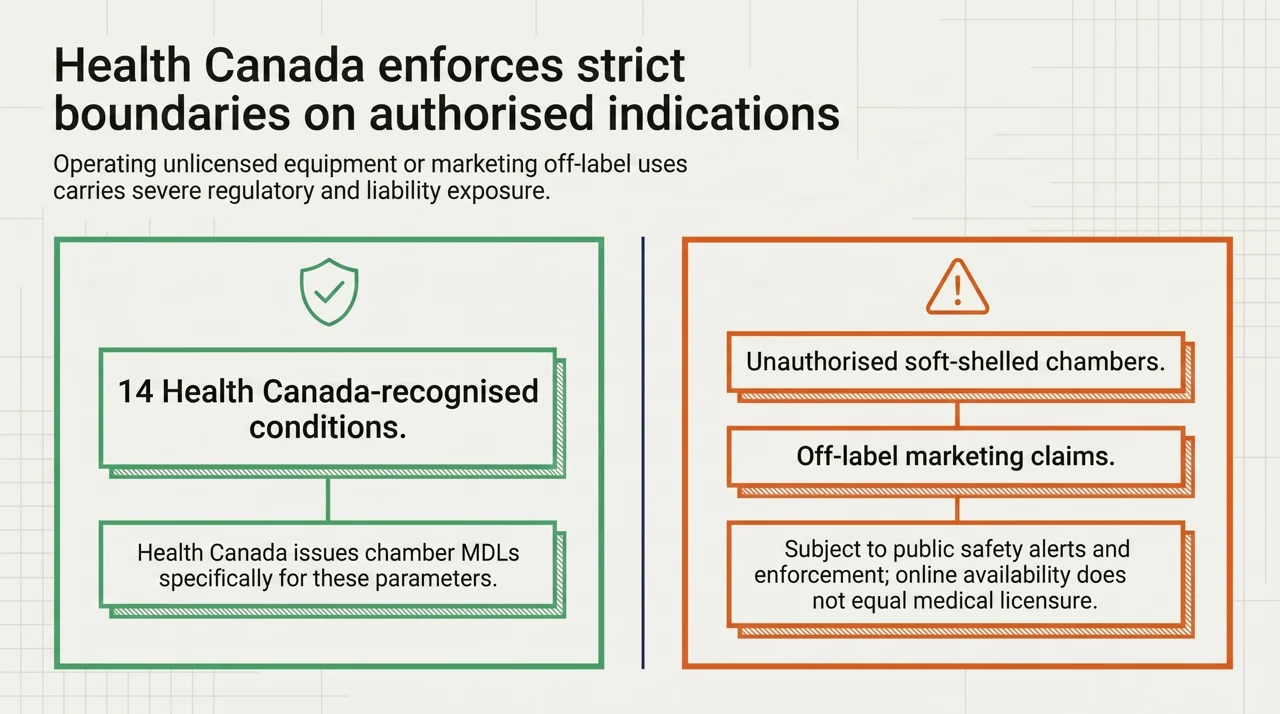
On its Hyperbaric Oxygen Therapy information page, Health Canada is explicit: the federal regulator has issued medical device licences for hyperbaric chambers to treat only 14 recognised conditions, a list its device-licensing framework maps to the separate UHMS indications. The directory of Canadian HBOT hospitals and regulated facilities is curated on the Canada Hyperbarics facilities page. Off-label or investigational use of a chamber is a separate clinical and regulatory question, distinct from whether the chamber model itself is licensed.
What is the difference between an MDL and an MDEL?
These two licences are routinely confused, and the confusion is one of the most common compliance errors among new Canadian HBOT clinic owners. They are not interchangeable.
A Medical Device Licence (MDL) is issued to the manufacturer of a Class II, III, or IV device. It authorises that specific device model to be sold in Canada. Every hyperbaric chamber lawfully placed on the Canadian market must hold an active MDL, which can be verified in Health Canada’s Medical Devices Active Licence Listing (MDALL). MDLs are device-specific and remain in force as long as the manufacturer pays the annual renewal fee and maintains MDSAP certification.
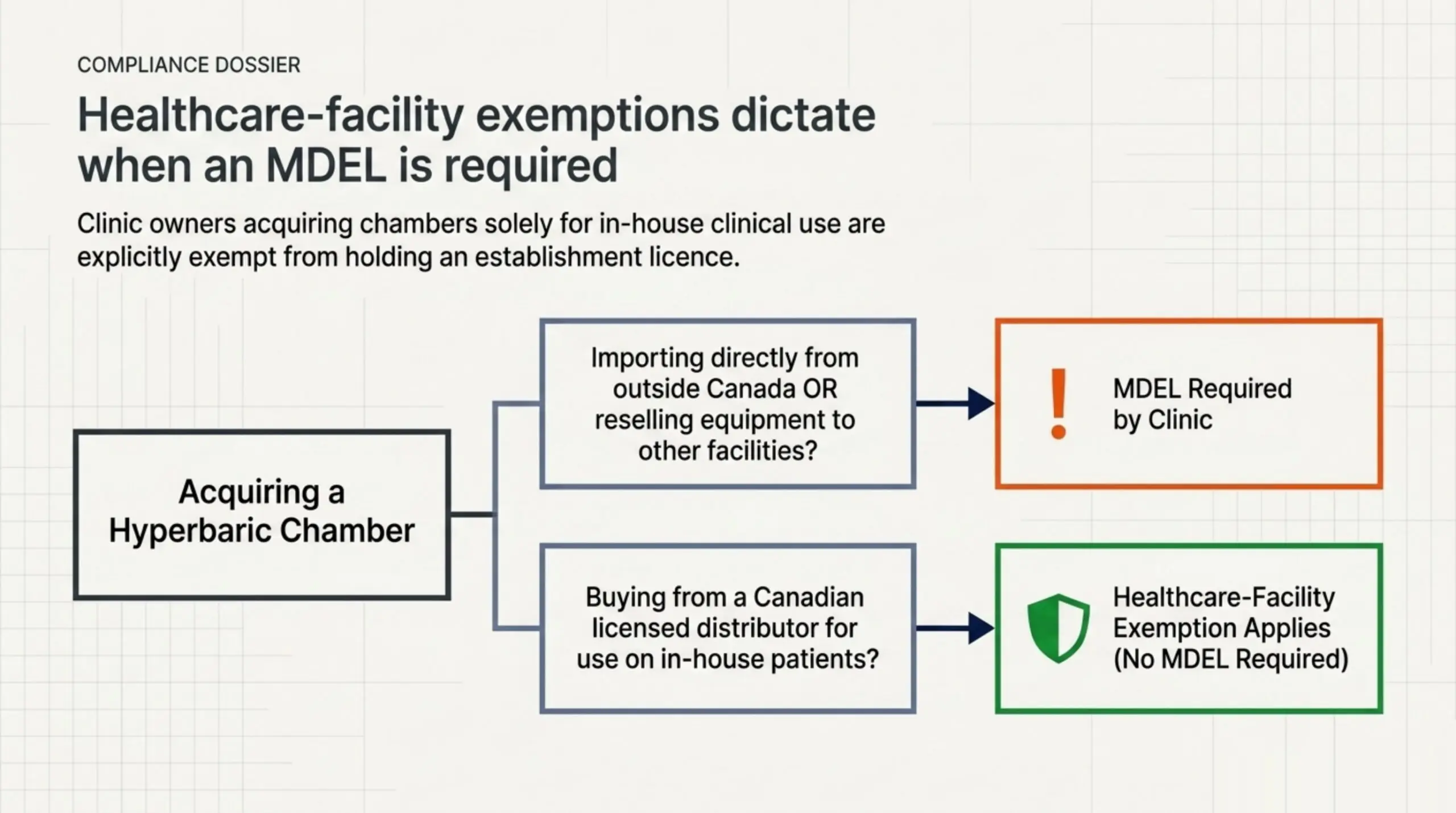
A Medical Device Establishment Licence (MDEL) is a separate authorisation covering the establishment (the company), not the device. Per Health Canada’s GUI-0016 establishment licensing guidance, an MDEL is required by any person who imports or sells a medical device in Canada, with a healthcare-facility exemption for devices acquired solely for in-house clinical use.
The practical effect for a Canadian HBOT clinic is straightforward. If the clinic buys a chamber from a Canadian licensed distributor and uses it on its own patients, no MDEL is required by the clinic. If the clinic imports a chamber directly from a manufacturer outside Canada, or resells used chambers to other facilities, an MDEL is required.
| Feature | Medical Device Licence (MDL) | Medical Device Establishment Licence (MDEL) |
|---|---|---|
| What it licenses | A specific device model | A company’s activities |
| Who holds it | The device manufacturer | Importer or distributor |
| Required for a clinic using a chamber in-house? | No, but the chamber it uses must have an active MDL | No, healthcare-facility exemption applies |
| Required for a clinic importing a chamber directly? | No (the device’s MDL is held by the manufacturer) | Yes |
| Renewal | Annual | Annual (by 1 April each year) |
| Where to verify | MDALL public database | MDEL public listing |
How do I verify a chamber’s Health Canada licence before purchase?
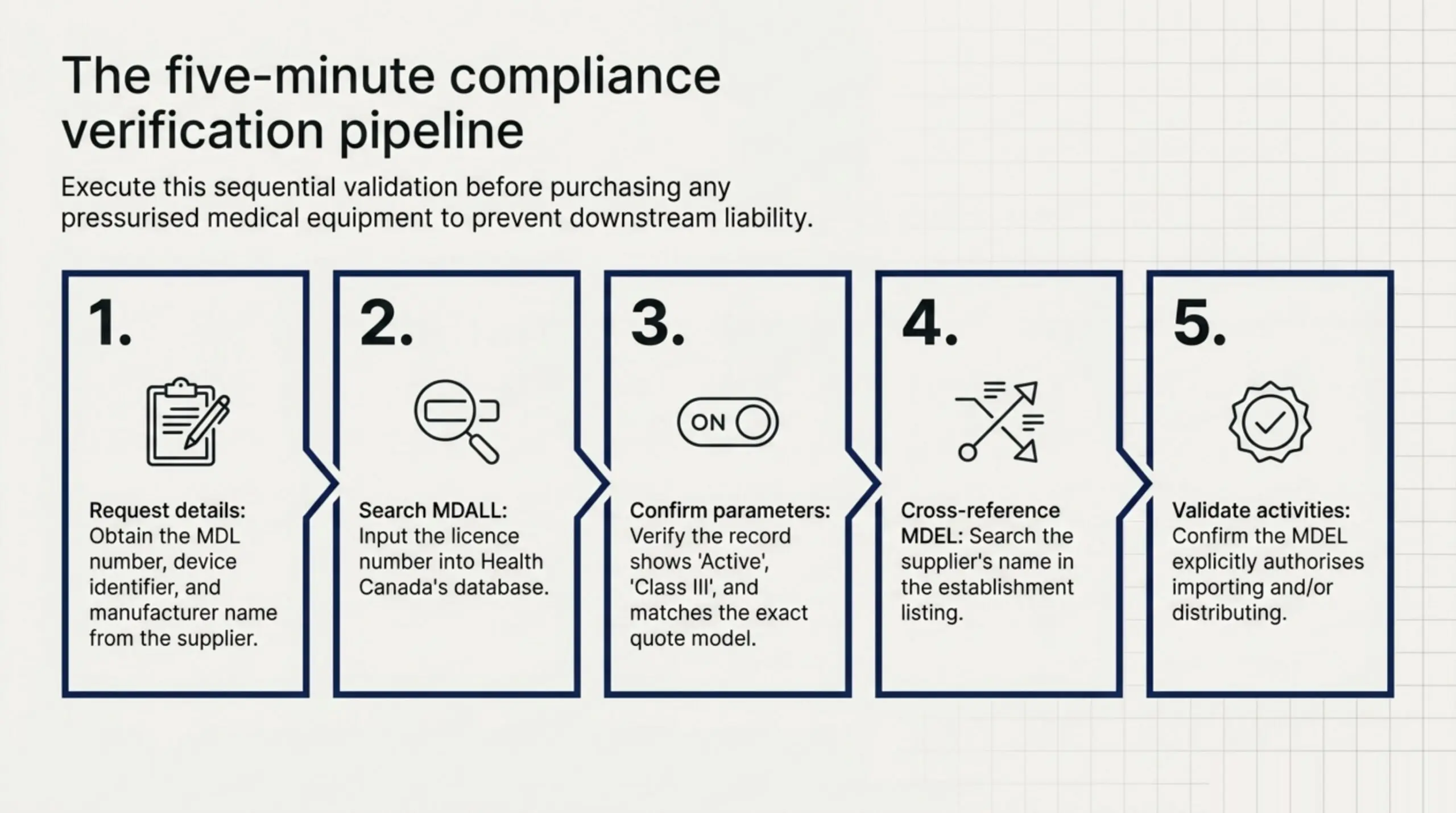
Verifying the chamber’s MDL is a five-minute exercise that protects the clinic against acquiring an unlicensed or non-compliant unit.
- Ask the supplier for the chamber’s Health Canada licence number, device identifier, and manufacturer name.
- Search the device licence number in Health Canada’s MDALL.
- Confirm the record shows the licence is active, the device class is III, and the device name matches the chamber model on the quote.
- Cross-reference the supplier’s MDEL by searching the company name in the Medical Devices Establishment Licence Listing.
- Confirm the MDEL covers the activities you are buying from them (importing, distributing, or both) and that it is current.
If either licence cannot be verified, do not proceed with the purchase. The downstream consequences of operating an unlicensed Class III device range from forced decommissioning of equipment to liability exposure for any adverse event that occurs during treatment.
What does the 2026 standards landscape look like?
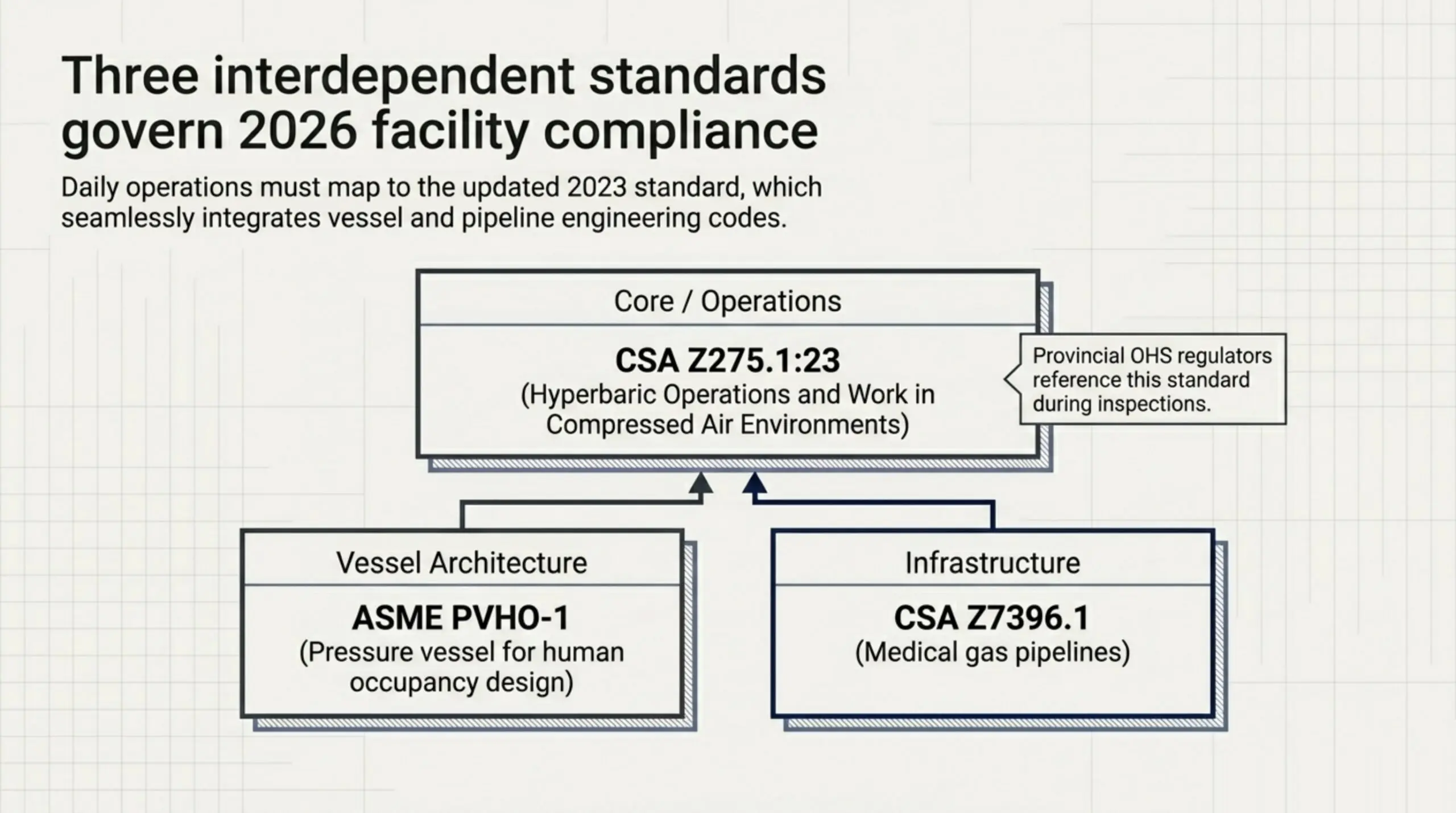
The single most important standards reference for a Canadian HBOT operator is CSA Z275.1:23, Hyperbaric Operations and Work in Compressed Air Environments. The 2023 edition is the sixth and most current version of the standard. It is significantly reorganised relative to CSA Z275.1-16, with requirements from CSA Z275.3 folded into the main standard, and it has been technically updated to align with ASME PVHO-1, the international pressure-vessel-for-human-occupancy standard.
For clinic owners, the practical implication is that any chamber compliance file built against an older edition needs to be re-mapped to the current 23 edition this year. Areas that drew the most updates include chamber design and construction, periodic testing and certification, oxygen-handling systems, and emergency procedures. Provincial and territorial occupational health and safety regulators routinely reference CSA Z275.1 when inspecting hyperbaric workplaces, so the up-to-date edition is the document inspectors are expected to use.
The chamber’s manufacturer should be able to produce a current statement of compliance with CSA Z275.1:23 and ASME PVHO-1 on request. The same applies to the medical gas pipeline supplying the chamber, which is governed by CSA Z7396.1 within Canadian medical facilities.
What recent enforcement actions should clinic owners know about?
Health Canada has been publicly active about unauthorised soft-shelled chambers, issuing an alert that unauthorised soft-shelled hyperbaric chambers may pose serious health risks. The alert focuses on chambers being sold or used outside the conditions of any Health Canada licence, often marketed for indications that are not authorised. For a Canadian HBOT clinic, the alert is a useful reminder that available for purchase online is not the same as licensed for medical use in Canada.
The broader enforcement signal is that Health Canada will act publicly against unlicensed devices and against marketing of HBOT for indications outside the licensed scope. Clinic owners who advertise off-label uses, or who allow third-party referrers to do so on their behalf, carry the same regulatory exposure as if they made the claim directly.
What does current research say about the HBOT safety profile?
Two 2026 systematic reviews are useful anchors for documenting HBOT’s safety profile inside a clinic’s quality file.
A 2026 systematic review and network meta-analysis of gas-based therapies for chronic wounds (Zheng et al., PubMed | Our Assessment) pooled 27 randomised controlled trials and 1,673 participants. The authors evaluated comparative effectiveness, safety, and evidence certainty using PRISMA 2020 methodology with GRADE assessment, and reported that gas therapies were associated with significantly greater complete healing versus standard care in pairwise pooling (RR 2.17, 95% CI 1.61 to 2.94). The methodology and safety reporting in this network meta-analysis are a useful model for the kind of evidence summary a clinic should keep on hand when discussing chronic wound HBOT with referring physicians.
A 2026 systematic review and meta-analysis of HBOT in psychiatric disorders (Al-Shamali et al., PubMed | Our Assessment) reported that across 17 studies and 920 participants, adverse events associated with HBOT were mild and transient. The review is the most current pooled safety read on HBOT in a non-traditional indication area, and the safety findings are consistent with the broader hyperbaric literature on adverse-event profiles.
On the operational side, a 2026 phenomenological study of patients receiving scheduled HBOT in a multiplace chamber (Vila-Vidal et al., PubMed | Our Assessment) reported that patients described initial uncertainty, ear-pressure and mask-related discomfort, and a clear preference for earlier and clearer information about the procedure. Patient communication and staff support are not regulatory line items in CSA Z275.1:23, but a quality management system that documents how they are addressed reduces both clinical complaints and regulatory exposure.
What should be in my 2026 compliance file?
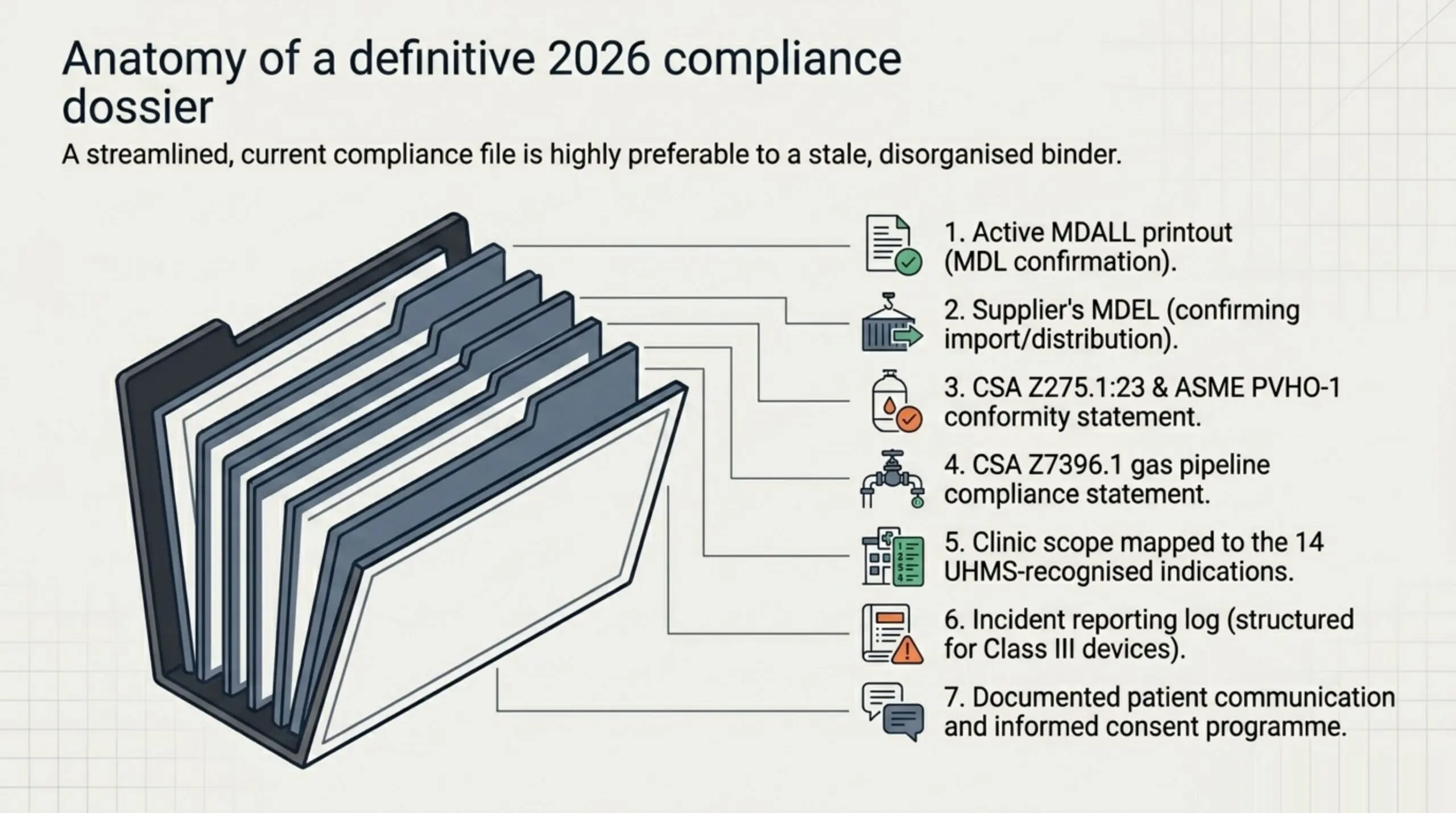
A short, current compliance file is more useful than a thick, stale one. The 2026 file should at minimum contain:
- The chamber manufacturer’s current Health Canada MDL number and a recent MDALL printout confirming active status.
- The supplier’s current MDEL number, with the activities (importing, distributing) explicitly listed.
- The chamber’s most recent statement of conformity to CSA Z275.1:23 and ASME PVHO-1.
- The medical gas pipeline’s compliance statement under CSA Z7396.1.
- A written list of the conditions the clinic treats, mapped to the 15 UHMS indications and to any clearly disclosed investigational protocols.
- An incident reporting log structured against Health Canada’s mandatory reporting requirements for Class III devices.
- A patient communication and informed consent procedure that addresses the discomfort and uncertainty themes documented in current patient-experience research.
Canada Hyperbarics maintains an editorial directory of Canadian hospitals and regulated facilities, useful for benchmarking against current operating standards in other Canadian programmes. The provincial coverage guide and research database are also useful upstream references when discussing indications with referring physicians.
Frequently asked questions about HBOT chamber licensing in Canada
Does my hyperbaric clinic need a Medical Device Establishment Licence?
If the clinic buys a Health Canada licensed chamber from a Canadian licensed distributor and uses it on its own patients, no MDEL is required by the clinic. If the clinic imports a chamber directly from outside Canada, or resells equipment to other facilities, an MDEL is required.
What device class is a hyperbaric chamber in Canada?
Hyperbaric chambers used for medical treatment are Class III devices under Health Canada’s risk-based classification system. Class III triggers pre-market licensing, MDSAP certification of the manufacturer’s quality system, and post-market vigilance obligations.
How do I verify that a chamber holds a current Health Canada licence?
Search the chamber’s device licence number in the public Medical Devices Active Licence Listing. The record should show an active licence, Class III, and the device name matching the chamber model on the supplier’s quote.
Which standards apply to a Canadian HBOT chamber installation in 2026?
CSA Z275.1:23 is the current Canadian standard for hyperbaric operations. ASME PVHO-1 governs pressure-vessel-for-human-occupancy design and is referenced by CSA Z275.1:23. CSA Z7396.1 governs the medical gas pipeline. Provincial occupational health and safety regulators routinely reference these standards in inspections.
Can my clinic treat conditions outside the 15 UHMS indications?
Health Canada has issued chamber licences only for the 14 conditions it recognises for hyperbaric use. Off-label or investigational use is a separate clinical and regulatory question, distinct from the chamber’s device licence. Clinics that offer non-UHMS indications should disclose the investigational nature in informed consent and avoid marketing claims that would be read as endorsements by the regulator.
What is Health Canada’s position on soft-shelled chambers?
Health Canada has issued a public alert that unauthorised soft-shelled hyperbaric chambers may pose serious health risks. The alert focuses on chambers being sold or used outside the conditions of any Health Canada licence. Clinic owners should treat the alert as a reminder that online availability is not the same as licensed for medical use in Canada.
Where to next?
Compliance is rarely a single-event project. Canada Hyperbarics maintains a directory of Canadian hospitals and regulated facilities on the facilities page, with detail at the provincial level for benchmarking. The research database and conditions library are useful upstream references when refining the clinic’s documented scope of practice.
This content is for informational purposes only and does not constitute medical advice, legal advice, or regulatory advice. Clinic owners should consult Health Canada directly or a qualified regulatory affairs consultant for definitive guidance on licensing, classification, and compliance obligations.