
TL;DR: In Canada, a hyperbaric clinic may only advertise therapeutic claims that match what its chamber is authorized to do. Health Canada has authorized hard-shell hyperbaric chambers to treat 14 specific medical conditions, and any advertising must be truthful, not misleading, and supported by adequate evidence. Promoting hyperbaric oxygen therapy for conditions outside that authorization, or marketing an unauthorized device, can breach the Food and Drugs Act, the Competition Act, and the Canadian Code of Advertising Standards. This 2026 guide explains the rules clinic owners need to follow. (About a 7 minute read.)
Hyperbaric oxygen therapy is a medical treatment that delivers 100 percent oxygen inside a pressurised chamber, and that chamber is a regulated medical device in Canada. If you operate a hyperbaric clinic, the safest rule for your marketing is simple: advertise only what your chamber is authorized to treat, and only what the evidence genuinely supports. Hyperbaric oxygen therapy advertising rules in Canada are not a single document. They come from three overlapping systems, and a single brochure or web page can fall under all three at once.
Hyperbaric oxygen therapy (HBOT) advertising compliance is the practice of making sure every public claim about your service is consistent with the device’s authorization from Health Canada, is truthful and not misleading, and is backed by proper testing. Getting this wrong is one of the fastest ways for a clinic to attract a regulator’s attention, so it is worth understanding before you write your next advertisement.
What can a Canadian hyperbaric clinic legally advertise?
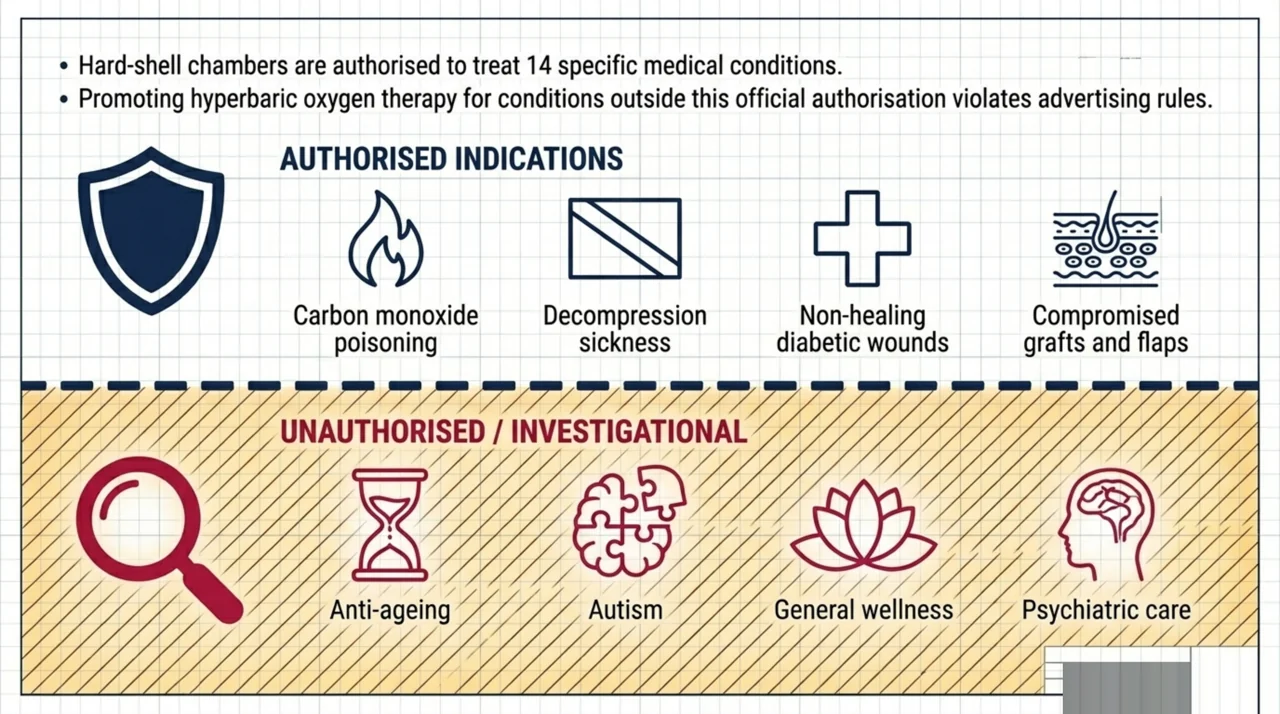
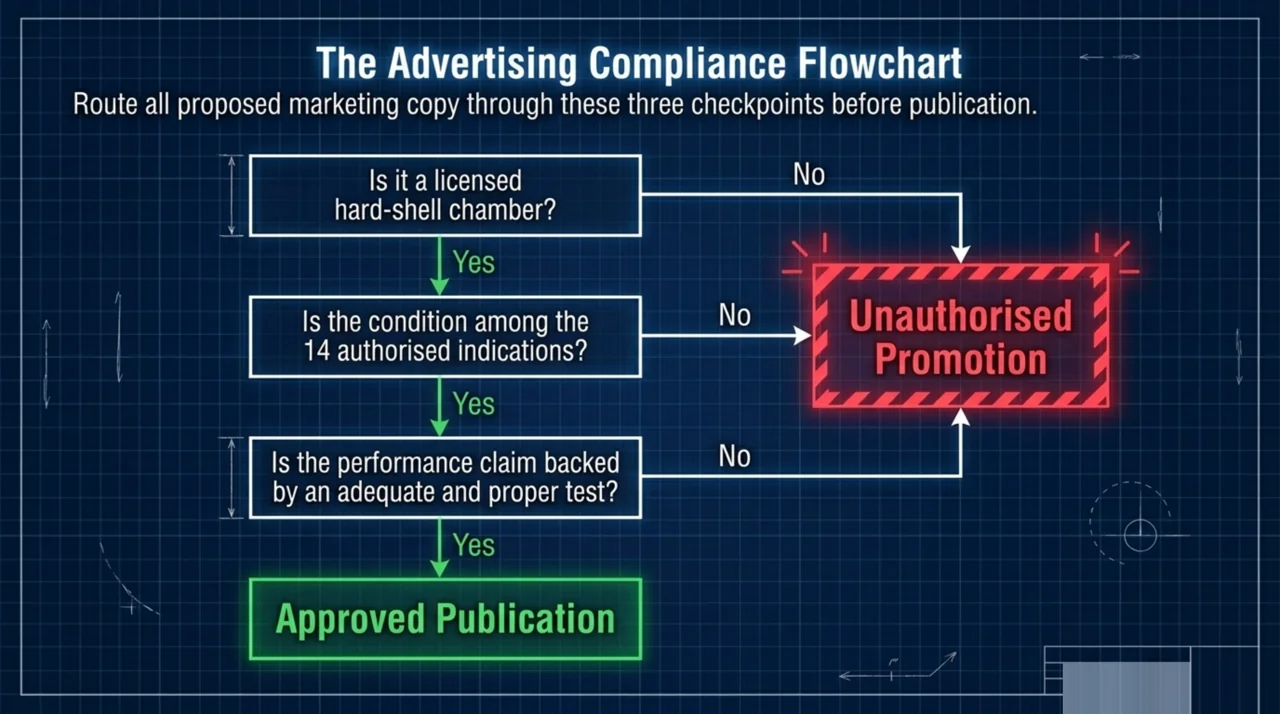
A Canadian clinic can advertise hyperbaric oxygen therapy for the conditions its chamber is authorized to treat, described in plain and accurate terms. Hyperbaric chambers are regulated as medical devices under the Food and Drugs Act and the Medical Devices Regulations, and Class III and IV chambers must hold a medical device licence before they can be imported, sold, or used in Canada. That licence defines the authorized uses.
In its June 2026 public advisory, Health Canada confirmed that hard-shell hyperbaric chambers are proven to treat 14 specific conditions. These are the recognised medical indications, such as carbon monoxide poisoning, decompression sickness, non-healing diabetic wounds, and compromised grafts and flaps. You can read about each of them on our conditions overview. Advertising your service for these uses, accurately and without exaggeration, is on solid ground.
The trouble starts when a clinic advertises hyperbaric oxygen therapy for conditions that sit outside its device authorization, such as anti-ageing, autism, or general wellness. Even when early research exists, an unauthorized use cannot be promoted as an established treatment.
Which laws govern HBOT advertising in Canada?
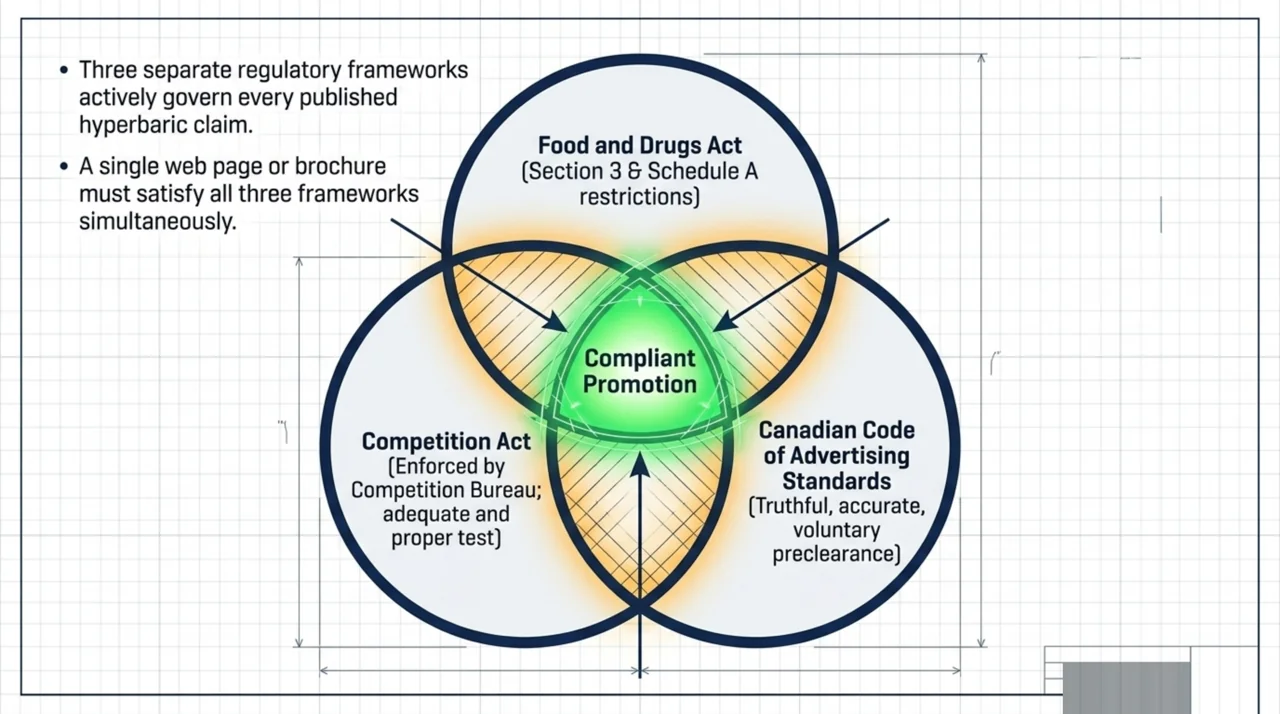
Three frameworks apply to hyperbaric oxygen therapy advertising, and clinic owners should treat all three as live at once.
- Health Canada and the Food and Drugs Act. Section 3 and Schedule A of the Act restrict advertising that claims to treat, prevent, or cure certain serious diseases. Health Canada’s advertising requirements for drugs and medical devices also state that only products authorized for sale may be advertised, and that advertising must not be false, misleading, or deceptive. The Schedule A and Section 3 guidance sets out which conditions trigger the strictest limits.
- The Competition Act, enforced by the Competition Bureau. Under the performance-claims rule, you cannot make a claim about a treatment’s effectiveness unless it is based on an adequate and proper test, and that test must be completed before the claim is made.
- The Canadian Code of Advertising Standards. The Code, administered by Ad Standards, requires advertising to be truthful, fair, and accurate. Ad Standards also offers voluntary preclearance of health product advertising, and it will only approve claims that Health Canada has authorized.
How does the evidence behind a claim affect compliance?
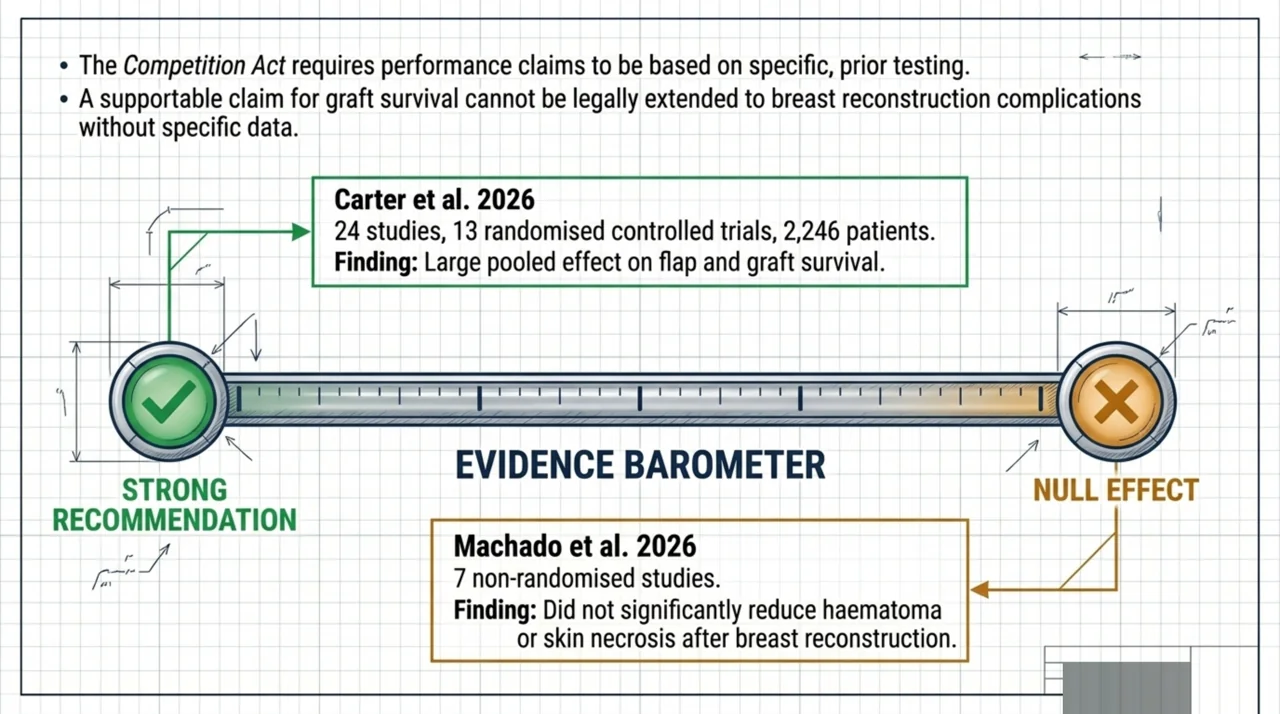
The Competition Act’s adequate-and-proper-test standard means the strength of the published evidence directly shapes what you may say. A claim that is fine for one indication can be non-compliant for another, because the evidence is not the same.
For recognised surgical indications, the evidence can be comparatively strong. A 2026 systematic review and meta-analysis of 24 studies (13 randomised controlled trials, 2,246 patients) issued a strong recommendation to use HBOT to heal flaps and grafts in soft-tissue injury and trauma wounds, with four randomised trials showing a large pooled effect on flap and graft survival (Carter and colleagues, PubMed | Our Assessment). The authors graded overall certainty from very low to moderate, so even a supportable claim should stay measured rather than absolute.
Evidence is not uniform even within wound care. A separate 2026 systematic review and meta-analysis of seven non-randomised studies found that HBOT did not significantly reduce haematoma, skin necrosis, or reoperation after breast reconstruction (Machado and colleagues, PubMed | Our Assessment). A clinic could not honestly advertise that HBOT prevents those complications, because the data do not show it.
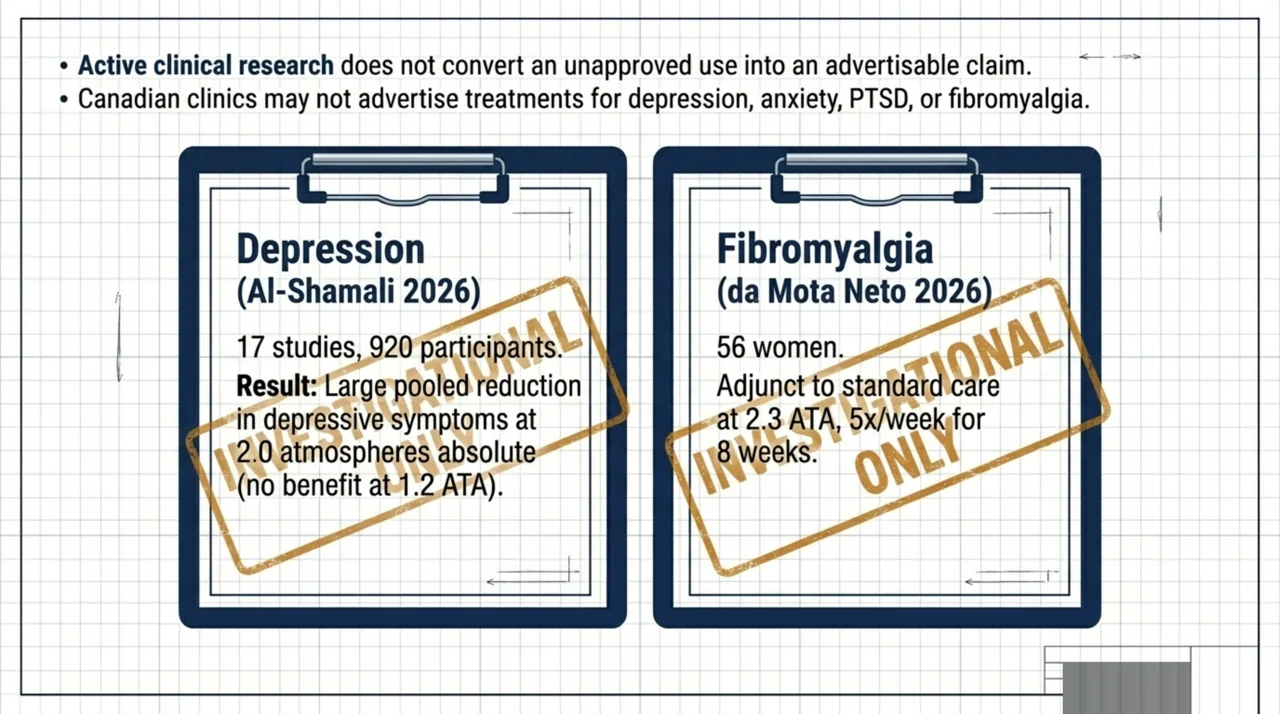
For investigational conditions, the limits are firmer still. Psychiatric care is a clear example: a 2026 systematic review and meta-analysis of 17 studies (920 participants) reported that HBOT was associated with a large pooled reduction in depressive symptoms at 2.0 atmospheres absolute, with no benefit at 1.2 atmospheres (Al-Shamali and colleagues, PubMed | Our Assessment). These are emerging findings, not an authorized indication, so a Canadian clinic may not advertise HBOT as a treatment for depression, anxiety, or post-traumatic stress disorder. The same caution applies to fibromyalgia, where a 2026 randomised controlled trial evaluated HBOT at 2.3 atmospheres absolute, five times per week over eight weeks, in 56 women as an adjunct to standard care (da Mota Neto and colleagues, PubMed | Our Assessment). Active research is welcome, but it does not convert an unapproved use into an advertisable claim.
What does a compliant claim look like compared with a non-compliant one?
The table below shows how the same idea can be compliant or non-compliant depending on how it is framed and whether it matches the device authorization.
| Non-compliant claim | Compliant alternative | Governing rule |
|---|---|---|
| “HBOT cures long COVID and reverses ageing.” | “Hyperbaric oxygen therapy is authorized for 14 recognised medical conditions; other uses are investigational.” | Food and Drugs Act, Section 3 |
| “Our chamber prevents wound complications in all patients.” | “HBOT is used as an adjunct for selected non-healing wounds, based on a physician assessment.” | Competition Act, adequate-and-proper-test |
| “Clinically proven anti-ageing oxygen therapy.” | “Evidence for wellness uses is preliminary and not an authorized indication.” | Canadian Code of Advertising Standards |
| Marketing a soft-shelled chamber for medical treatment. | Using a licensed hard-shell chamber for authorized indications. | Medical Devices Regulations |
What did Health Canada’s June 2026 advisory mean for clinics?
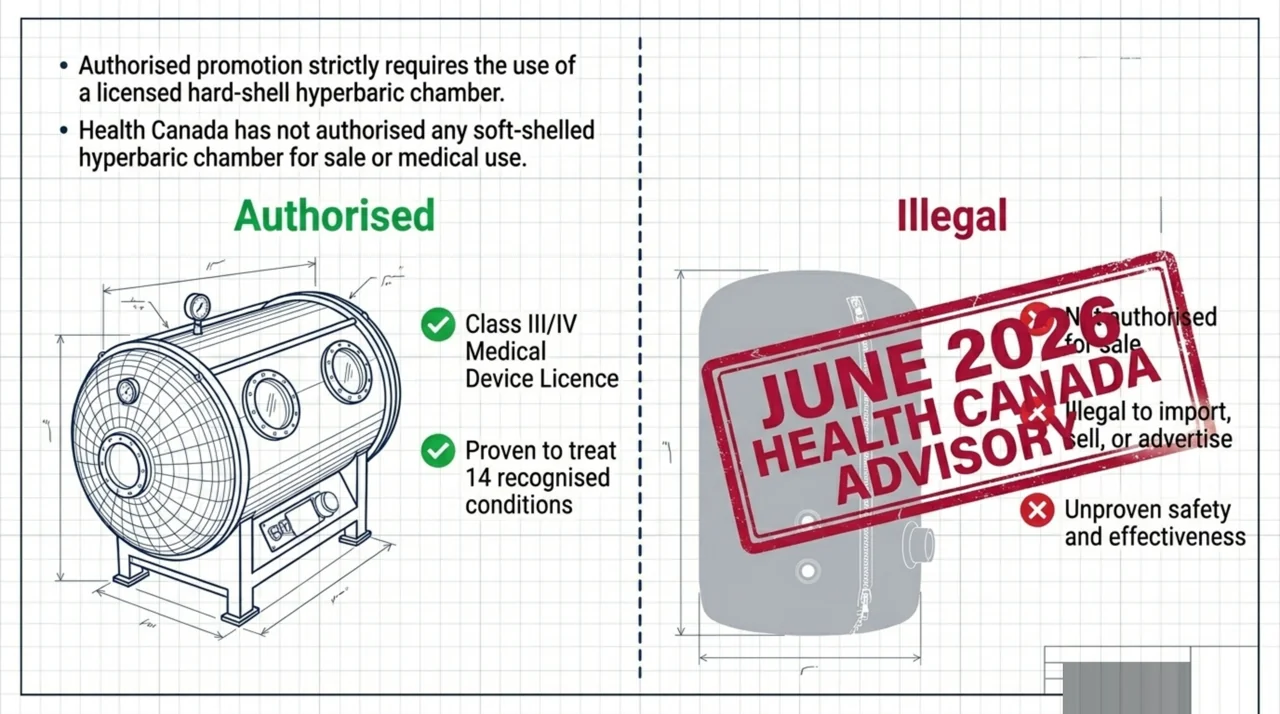
On 16 June 2026, Health Canada issued a public advisory warning that it has not authorized any soft-shelled hyperbaric chamber for sale in Canada, because it has not received the evidence needed to confirm these devices meet safety, effectiveness, and quality requirements. The advisory states plainly that it is illegal to import, sell, and advertise soft-shelled hyperbaric chambers in Canada, and warns that such devices may be ineffective for the purposes for which they are advertised.
For a compliant clinic, the message is reassuring and clear. Use a licensed hard-shell chamber, advertise only the authorized indications, and keep your claims tied to the evidence. Canada Hyperbarics maintains a directory of Canadian hospitals and regulated facilities so patients can find authorized programmes, and clinics that follow these rules stand apart from the operators the advisory targets. If you are unsure whether a specific claim is defensible, the Ad Standards preclearance route or independent regulatory advice is the conservative path.
Frequently asked questions about HBOT advertising in Canada
Can a clinic advertise hyperbaric oxygen therapy for off-label conditions?
No. A clinic should not advertise HBOT for conditions outside its device authorization, even if a physician may use it off-label in individual cases. Advertising an unauthorized use as an established treatment can breach the Food and Drugs Act and the Competition Act.
Does Health Canada have to approve my advertisements before they run?
Preclearance is voluntary for most health product advertising, but Health Canada strongly encourages it. Ad Standards reviews advertising against the product’s authorized uses and approves only claims that Health Canada has already authorized.
What counts as an adequate and proper test for a performance claim?
The Competition Bureau says testing must be fit and suitable for the claim being made, and it must be completed before the claim is published. The stronger and more specific your claim, the more robust the supporting evidence needs to be.
Is it legal to sell or advertise a soft-shelled hyperbaric chamber?
No. Health Canada’s June 2026 advisory states that no soft-shelled hyperbaric chamber is authorized for sale in Canada, and that importing, selling, and advertising these devices is illegal.
Can I cite published research in my clinic’s advertising?
You can reference evidence, but the claim it supports must still match your device authorization and must not overstate the findings. Quoting an associational study to imply a guaranteed cure is misleading even when the study is real.
Where can patients verify that a clinic uses an authorized chamber?
Authorized devices appear in Health Canada’s Medical Devices Active Licence Listing. Patients can also use directories of Canadian hospitals and regulated facilities, such as the one Canada Hyperbarics maintains, to find established programmes.
The bottom line for clinic owners
Compliant hyperbaric oxygen therapy advertising in Canada comes down to alignment: your claims must match your device authorization, the published evidence, and the truthfulness standards in the Food and Drugs Act, the Competition Act, and the Canadian Code of Advertising Standards. When in doubt, describe what HBOT is authorized to do, stay measured about emerging uses, and let patients make informed decisions. To see how authorized programmes are organized across the country, explore our directory of hospitals and regulated facilities, and learn more about our independent editorial approach on our about page.
This content is for informational purposes only and does not constitute medical advice, legal advice, or regulatory advice. Clinic owners should confirm current requirements with Health Canada, the Competition Bureau, and qualified legal counsel before publishing advertising. Always consult a qualified health professional about diagnosis and treatment.