
TL;DR: A hyperbaric chamber is a sealed pressure vessel that raises the pressure around the whole patient to 1.5 to 3.0 atmospheres absolute (ATA), while an oxygen concentrator is a device that delivers higher-concentration oxygen at ordinary room pressure. The two are not interchangeable. The therapeutic effect of medical hyperbaric oxygen therapy comes from pressure, not concentration alone, so a concentrator cannot replicate it. For a Canadian clinic owner, the two devices sit in different regulatory classes, carry different costs and safety duties, and must be described accurately in any marketing. This guide compares hyperbaric chamber vs oxygen concentrator across mechanism, evidence, regulation, and equipment planning.
If you operate or plan to open a hyperbaric service in Canada, one question comes up early: is a medical hyperbaric chamber different from an oxygen concentrator, and could a concentrator do the same job for less money? The short answer is no. A hyperbaric chamber is a sealed pressure vessel that increases the ambient pressure around a patient so they breathe oxygen under pressure. An oxygen concentrator is a device that filters room air to deliver a higher concentration of oxygen at normal atmospheric pressure. The difference between hyperbaric chamber vs oxygen concentrator is pressure, and that difference changes the biology, the regulation, and your capital plan.
Canada Hyperbarics is an evidence-based resource for Canadian patients, clinicians, and operators. This comparison is written to help owners make accurate equipment and compliance decisions, not to promote any particular product or facility.
What is the difference between a hyperbaric chamber and an oxygen concentrator?
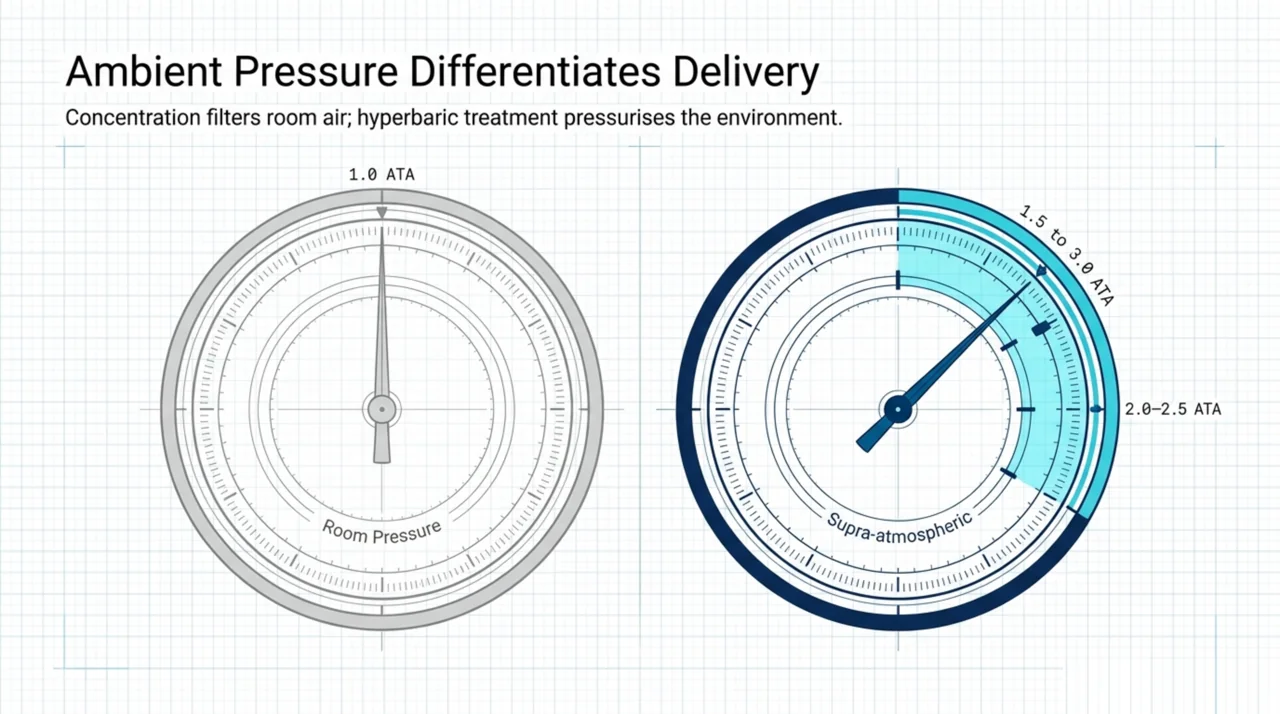
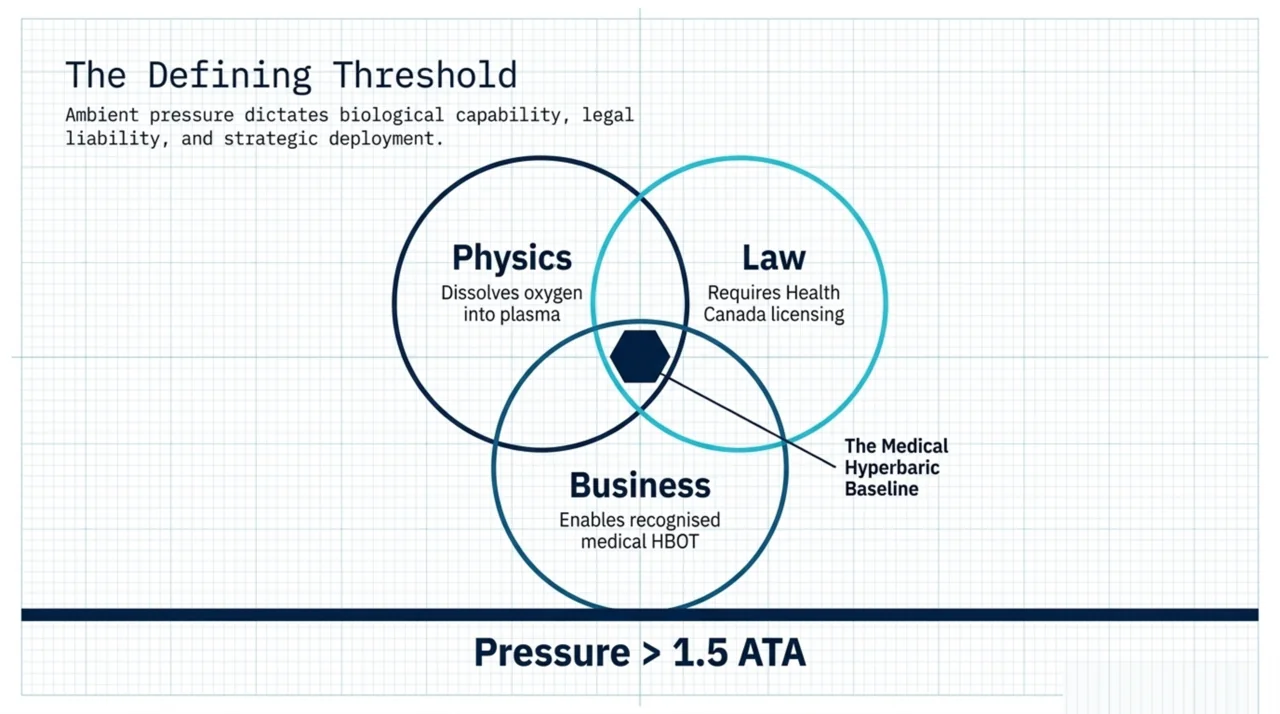
The Undersea and Hyperbaric Medical Society defines hyperbaric oxygen therapy as the medical use of greater than 99% oxygen at an ambient pressure higher than atmospheric pressure (UHMS). The key phrase is ambient pressure higher than atmospheric. A medical chamber pressurizes the entire space around the patient, usually to 2.0 to 2.5 ATA, so far more oxygen dissolves into the blood plasma than is possible at sea level.
An oxygen concentrator does something quite different. It pulls in room air, removes most of the nitrogen, and supplies oxygen at roughly 90 to 95% concentration through a mask or nasal cannula. Crucially, it delivers that oxygen at normal room pressure, about 1 ATA. A concentrator is the right tool for people with chronically low blood oxygen, such as some patients with severe lung disease, but it does not pressurize anyone. No matter how pure its output, it cannot create the pressurized conditions that define medical hyperbaric oxygen therapy.
| Feature | Medical hyperbaric chamber | Oxygen concentrator |
|---|---|---|
| Pressure delivered | Raises ambient pressure to 1.5 to 3.0 ATA (commonly 2.0 to 2.5) | Normal room pressure, about 1 ATA |
| Oxygen delivered | About 100% oxygen, breathed under pressure | About 90 to 95% oxygen at ambient pressure |
| Primary purpose | Recognised hyperbaric indications (medical HBOT) | Supplemental oxygen for low blood oxygen levels |
| Can it raise plasma oxygen to hyperbaric levels? | Yes | No |
| Health Canada device class | Higher-risk medical device requiring a medical device licence | Lower-risk medical device |
| Staffing and safety | Trained hyperbaric staff, fire-safety controls, facility standards | Minimal training, portable |
| Capital cost | Major capital investment | Relatively low cost |
Why can an oxygen concentrator not replace a hyperbaric chamber?
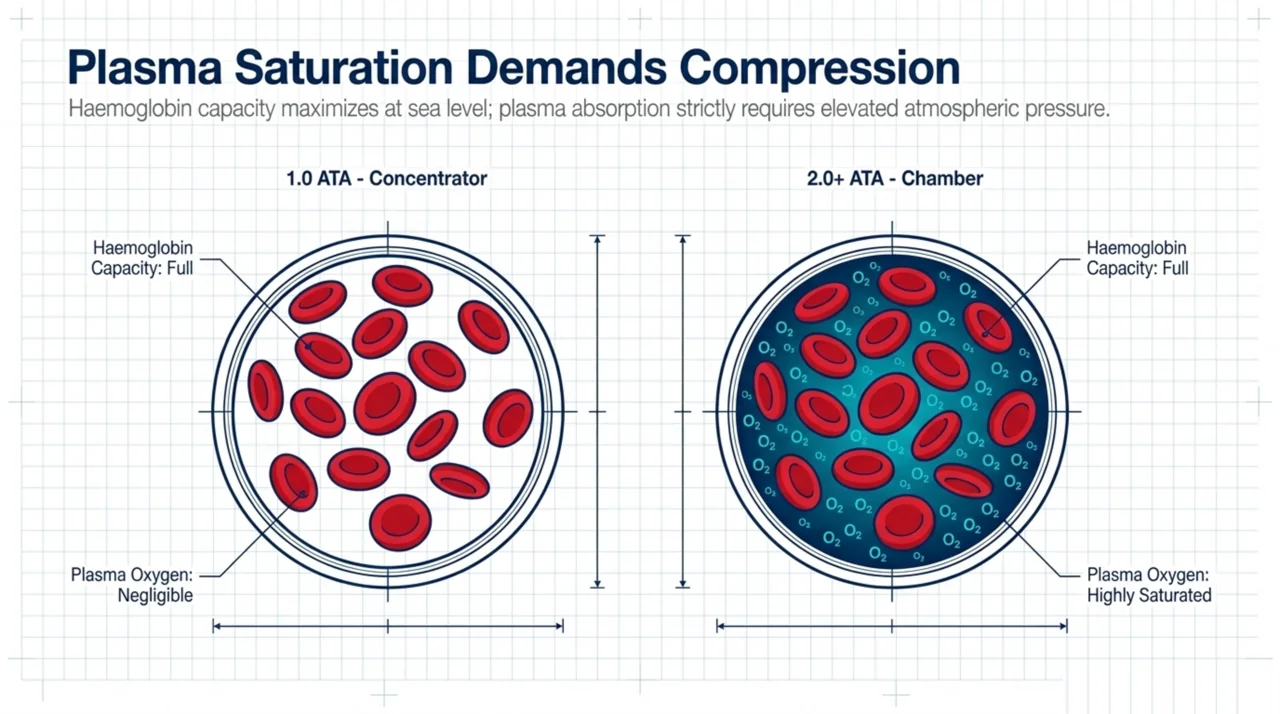
The answer lies in basic physics and biology. The amount of oxygen that dissolves into blood plasma rises in proportion to the pressure of the oxygen the patient breathes. At normal pressure, almost all oxygen is carried by haemoglobin, which is already nearly full. Raising the pressure inside a chamber forces a large additional volume of oxygen to dissolve directly into the plasma, reaching tissues that red blood cells struggle to supply. An oxygen concentrator, working at room pressure, cannot drive that extra oxygen into solution.
This pressurized oxygen also sets off cellular signals that ordinary oxygen does not. A 2026 mechanistic review explains that hyperbaric oxygen, defined as breathing 100% oxygen at elevated atmospheric pressure, triggers a controlled burst of reactive oxygen species that switches on protective genes and proteins, and that the exposure protocol, including pressure, regulates how strongly this response is induced (PubMed | Our Assessment). In other words, pressure is the active ingredient. Remove the pressure and you remove the mechanism.
What does the research say about pressure being the active ingredient?
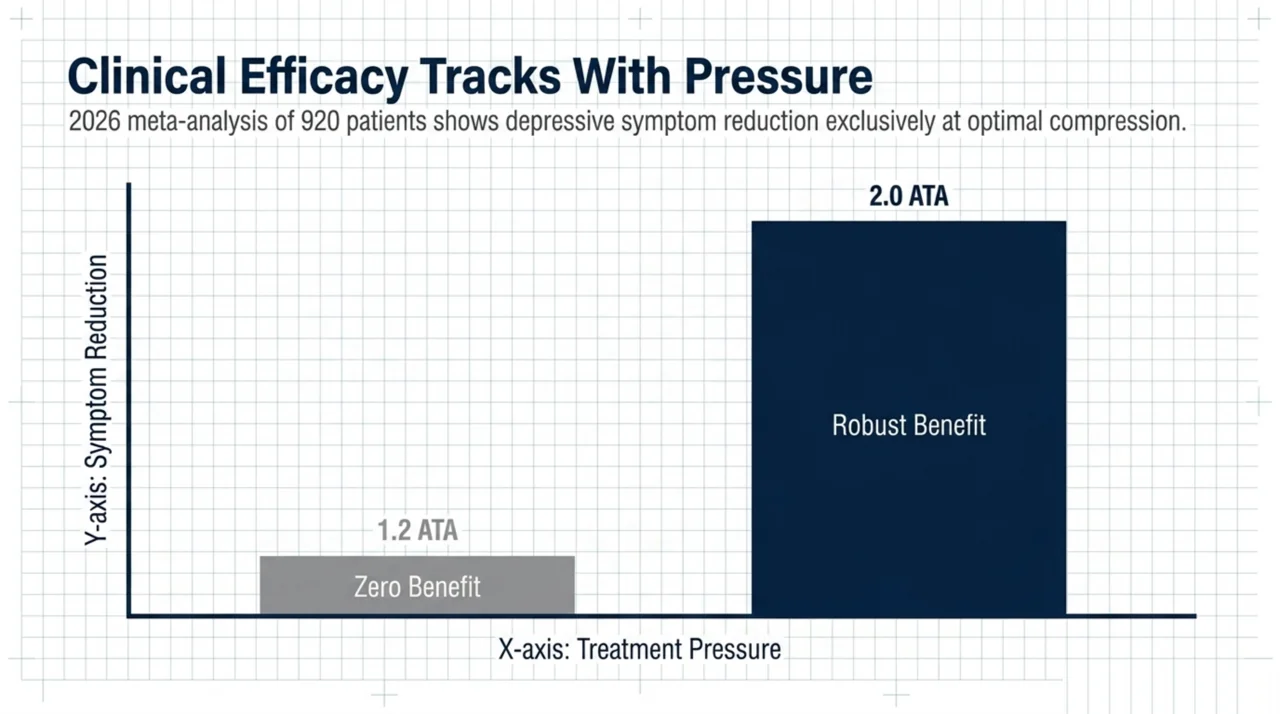
Several recent studies show that outcomes change with the pressure delivered, which is exactly the variable a concentrator cannot provide. A 2026 systematic review and meta-analysis of 17 studies (920 patients, including nine randomised controlled trials) reported that hyperbaric oxygen therapy was associated with a large reduction in depressive symptoms, and it found a clear dose-response by pressure: a robust benefit at 2.0 ATA but none at 1.2 ATA (PubMed | Our Assessment). The gap between 1.2 ATA and 2.0 ATA is small in absolute terms, yet the review reports it tracked with whether a benefit appeared at all.
A second 2026 study points the same way. A retrospective review of 312 carbon monoxide poisoning patients found that lower-pressure regimens (2.0 ATA) were associated with a higher rate of delayed neuropsychiatric sequelae than higher-pressure regimens (2.8 ATA), at 36.2% versus 19.3% (PubMed | Our Assessment). Because this was an observational review, it shows an association rather than proof of cause, but it reinforces a consistent theme: the pressure of the treatment matters. A device that delivers oxygen at room pressure simply cannot reach these treatment ranges.
For the full plain-language summaries of these and thousands of other studies, owners and clinicians can browse our research library.
How are hyperbaric chambers and oxygen concentrators regulated in Canada?
Health Canada groups medical devices into four classes based on risk, from Class I (lowest risk) to Class IV (highest risk), and manufacturers of Class II, III, and IV devices must hold a medical device licence to sell them in Canada (Health Canada). A medical hyperbaric chamber is a higher-risk device that carries a heavier regulatory and clinical-evidence burden than a simple oxygen concentrator. This is not a paperwork detail. It reflects the real difference in how the two devices act on the body.
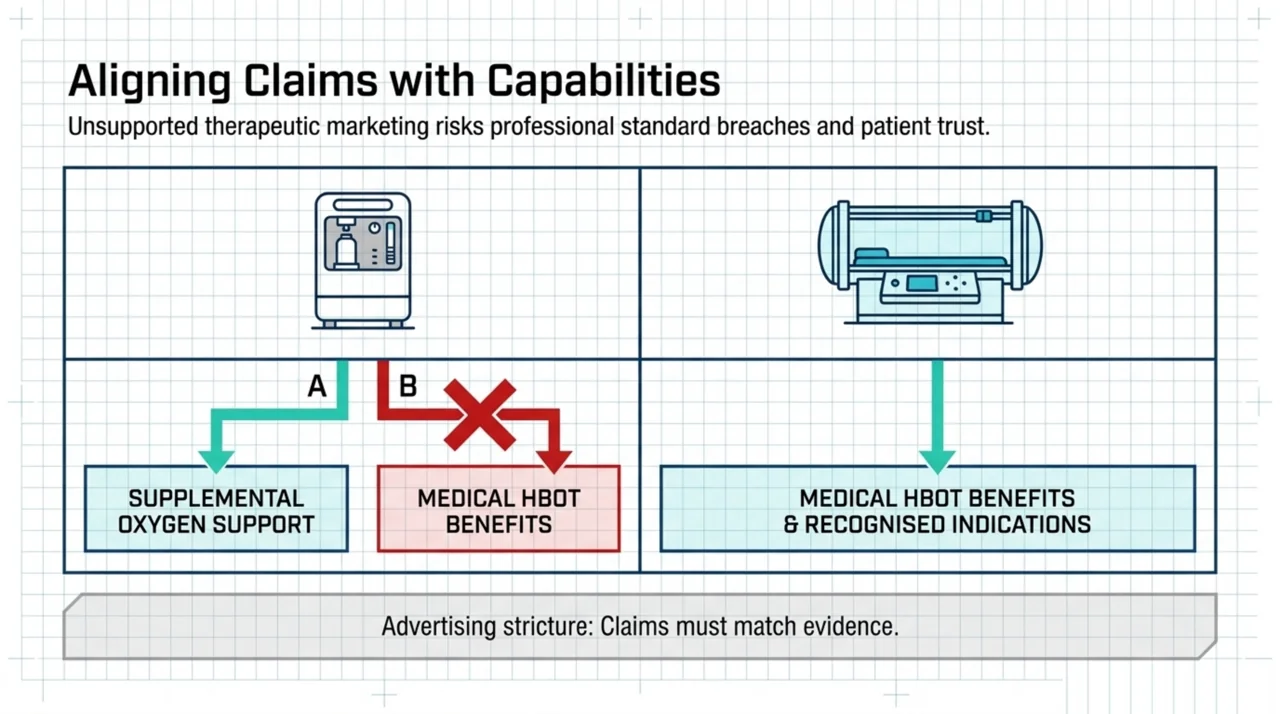
For clinic owners, the most important compliance point is language. Describing an oxygen concentrator, or a low-pressure inflatable enclosure paired with a concentrator, as equivalent to medical hyperbaric oxygen therapy can mislead patients and stray into unsupported therapeutic claims. Health Canada advertising rules and provincial professional standards both expect therapeutic claims to match the evidence and the device. Match your marketing to the device you actually operate. If you offer medical HBOT, say so precisely; if you offer supplemental oxygen, do not imply hyperbaric benefits.
Coverage follows the same logic. Provincial public plans that fund hyperbaric oxygen therapy do so for recognised medical indications delivered at hospitals and regulated facilities, not for oxygen-concentrator setups. Patients researching what is funded in their province can review our provincial coverage guide.
What does this mean for a Canadian clinic owner choosing equipment?
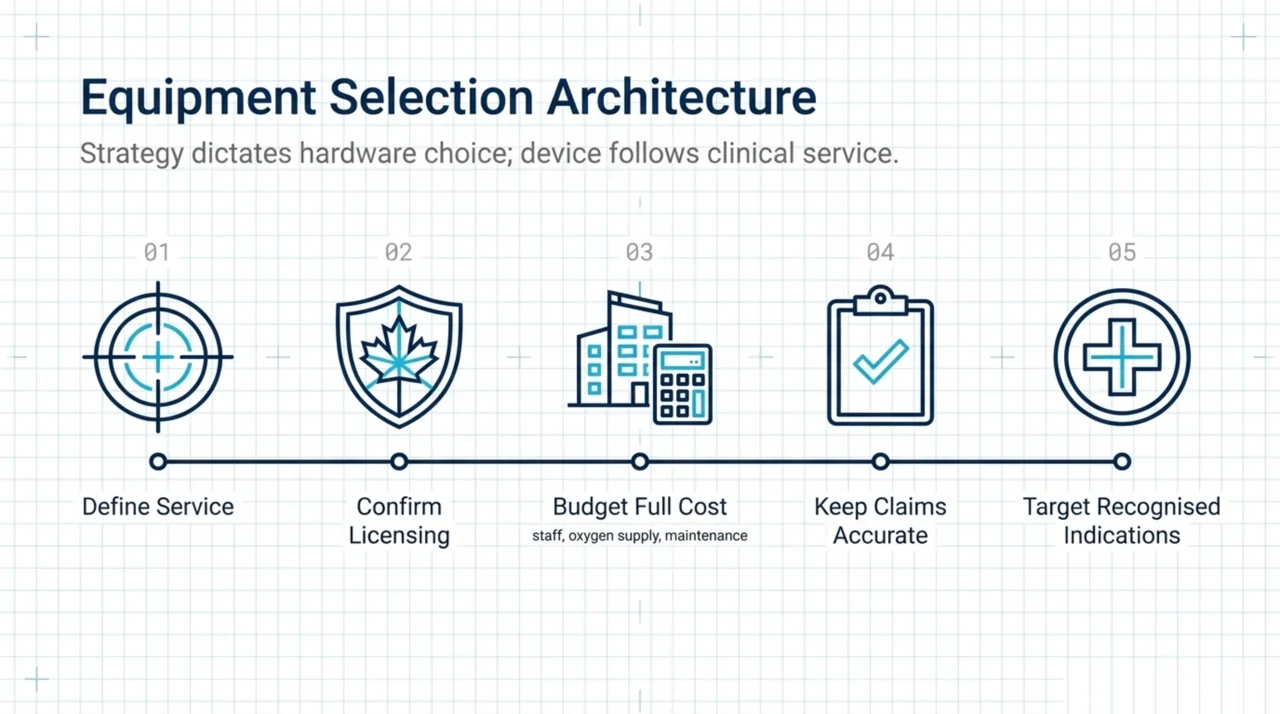
The decision is not really chamber versus concentrator, because they do different jobs. The real question is which clinical service you intend to deliver, and then which device that service requires. Medical hyperbaric oxygen therapy is used for a defined set of indications, and the pressurized delivery is what makes it work. For example, a 2026 phase I/II feasibility and safety trial delivered six hyperbaric sessions at 2.4 ATA as an add-on for selected patients with left-sided infective endocarditis and reported that the treatment was feasible and safe, with no serious adverse events recorded (PubMed | Our Assessment). That kind of pressurized protocol is only possible inside a chamber.
Use this checklist before committing capital:
- Define the service first. Decide whether you are providing medical hyperbaric oxygen therapy for recognised indications or supplemental oxygen support. The device follows the service, not the other way around.
- Confirm Health Canada licensing. Verify that any chamber you buy is a licensed medical device and that your facility meets device and fire-safety standards for an oxygen-enriched environment.
- Budget for the full cost of a chamber. Beyond the vessel itself, plan for trained hyperbaric staff, oxygen supply, maintenance, and accreditation, none of which a concentrator requires.
- Keep your claims accurate. Do not market a concentrator or low-pressure enclosure as medical HBOT. Mismatched claims are both a compliance risk and a trust risk.
- Point patients to recognised indications. Align your service with established hyperbaric indications, which you can review on our conditions overview.
Canada Hyperbarics keeps a verified directory of Canadian programmes so owners and patients can see how regulated services are delivered across the country at hospitals and regulated facilities.
Frequently asked questions about hyperbaric chambers and oxygen concentrators
Is an oxygen concentrator the same as a hyperbaric chamber?
No. An oxygen concentrator delivers concentrated oxygen at ordinary room pressure, while a hyperbaric chamber raises the pressure around the patient so they breathe oxygen under pressure. Only the pressurized chamber produces the high plasma oxygen levels that define medical hyperbaric oxygen therapy.
Can I run a hyperbaric service with just an oxygen concentrator?
No. A concentrator cannot create supra-atmospheric pressure, so it cannot deliver medical hyperbaric oxygen therapy. Marketing concentrator-based oxygen as hyperbaric therapy risks both misleading patients and breaching Health Canada advertising rules.
Why does pressure matter so much in hyperbaric oxygen therapy?
Higher pressure dissolves more oxygen directly into the blood plasma and drives cellular responses that ordinary oxygen does not. Research has reported dose-response patterns where benefits appear at standard treatment pressures, such as 2.0 ATA, but not at very low pressures like 1.2 ATA.
Are hyperbaric chambers and oxygen concentrators regulated differently in Canada?
Yes. Health Canada classifies medical devices by risk, and a medical hyperbaric chamber is a higher-risk device requiring a medical device licence, with a greater clinical-evidence and safety burden than a lower-risk oxygen concentrator.
What does an oxygen concentrator actually do?
An oxygen concentrator filters room air to remove nitrogen and supplies about 90 to 95% oxygen at room pressure. It is useful for patients with chronically low blood oxygen, but it is not a substitute for pressurized hyperbaric treatment.
How should a clinic owner decide between the two devices?
Start with the clinical service you want to offer, then choose the device that service requires. If you intend to provide medical hyperbaric oxygen therapy, you need a licensed hyperbaric chamber, trained staff, and the supporting safety infrastructure, not a concentrator.
The bottom line for Canadian clinic owners
A hyperbaric chamber and an oxygen concentrator are complementary tools for different jobs, not competitors. Pressure is what makes medical hyperbaric oxygen therapy work, and only a chamber can deliver it. Before you invest, define your service, confirm Health Canada licensing, budget for the full cost of safe chamber operation, and keep your marketing precise. If you would like to see how regulated hyperbaric care is organized in Canada, explore the verified directory of hospitals and regulated facilities, and learn more about our editorial approach on our about page.
This content is for informational purposes only and does not constitute medical advice. It is not a substitute for assessment by a qualified health professional or for regulatory and legal guidance specific to your facility. Always confirm current Health Canada requirements and provincial standards before making equipment or compliance decisions.