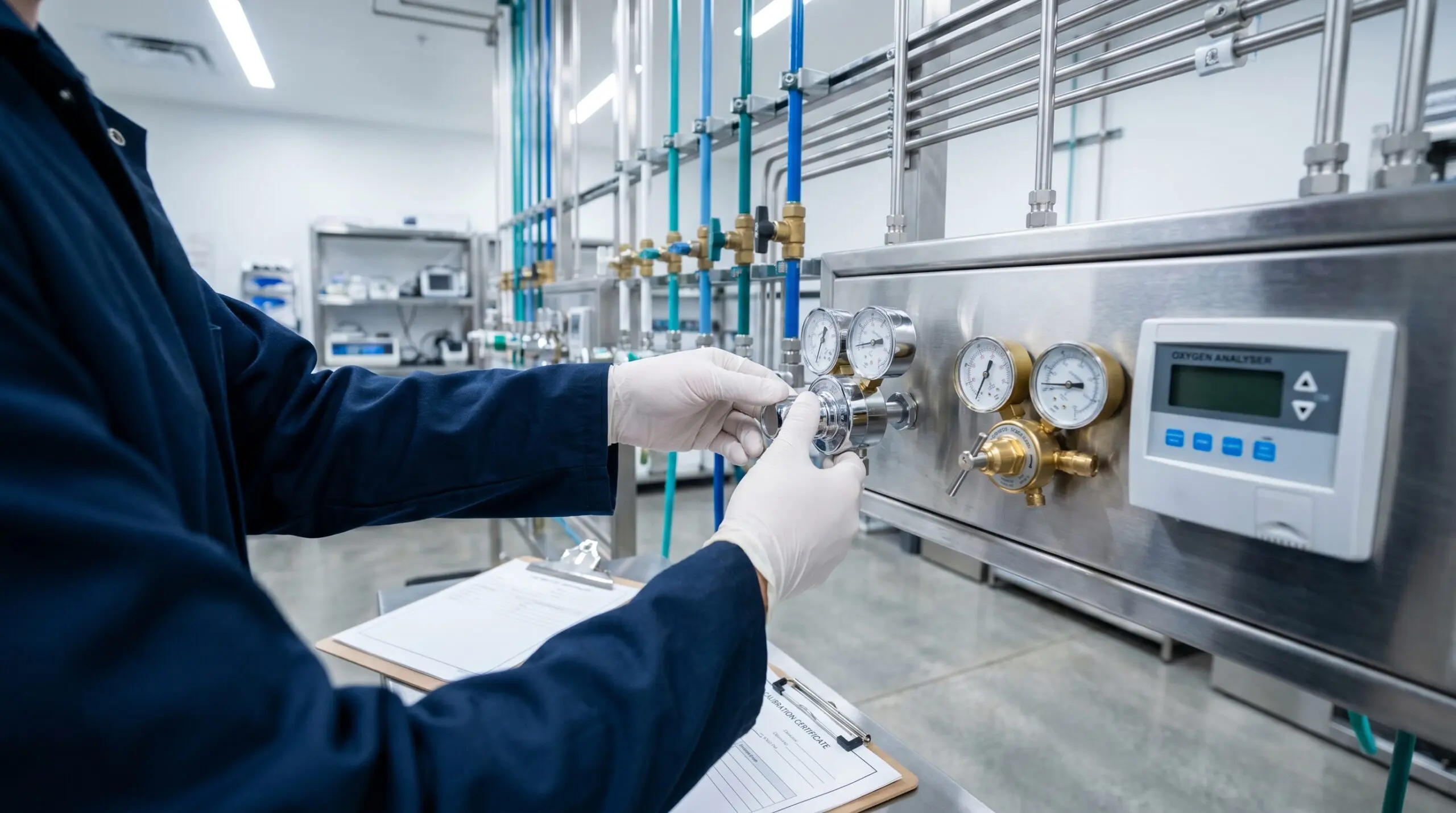
TL;DR: Hyperbaric chamber preventive maintenance is a structured, documented programme of inspections, calibrations, component replacements, and operator drills that keeps a Canadian clinic’s pressure vessel and life-support systems within the parameters set by CSA Z180.1, ASME PVHO-1/PVHO-2, and Health Canada device licensing. A well-run programme reduces fire risk, oxygen-toxicity exposure, barotrauma, and downtime; it also produces the audit trail that UHMS and CUHMA-aligned accreditation reviewers expect. This guide outlines the regulatory framework, the equipment categories that require routine attention, recommended inspection intervals, the most common safety risks Canadian operators encounter, and how to document the work so it stands up to inspection.
Hyperbaric chamber preventive maintenance is the planned, scheduled care of a pressure vessel and its connected life-support systems so the chamber operates within manufacturer and regulatory tolerances every treatment day. It is not the same as corrective maintenance, which responds to a failure after it occurs. For Canadian clinic owners, preventive maintenance is the operational backbone of patient safety, staff safety, and equipment longevity. It is also the work that produces the documentation auditors, accrediting bodies, and Health Canada inspectors expect to see.
This guide is written for owners and operators of hyperbaric facilities in Canada. It outlines the regulatory framework, the equipment categories that require routine attention, recommended inspection intervals, the most common safety risks Canadian operators encounter, and how to document the work so it stands up to inspection. Canada Hyperbarics maintains the national directory of hospital and private hyperbaric facilities, and the operational standards summarised here are consistent with what accredited Canadian programmes already follow.
Why does preventive maintenance matter for Canadian hyperbaric clinics?
A hyperbaric chamber is a pressure vessel for human occupancy. When operated correctly it has an excellent safety profile: a 2026 systematic review of HBOT in psychiatric populations across 17 studies and 920 patients reported that adverse events were mild and transient, consistent with the broader HBOT literature (Al-Shamali et al., Psychiatry Clin Neurosci 2026). That safety profile depends, in operational terms, on the equipment performing exactly as designed. Preventive maintenance is what keeps it performing as designed.
The therapeutic mechanism itself is also pressure-dependent. A 2026 narrative review of HBOT in modern surgical practice emphasised that the therapy works by creating a transient hyperoxic milieu at supra-atmospheric pressure, which drives angiogenesis, antimicrobial activity, and matrix repair (Gonzalez Flores et al., Cureus 2026). If the chamber cannot reliably reach and hold the prescribed pressure, the clinical effect degrades. Compressor performance, valve integrity, and gauge accuracy are therefore clinical issues, not just engineering ones.
There is also a regulatory dimension. Hyperbaric chambers sold and used in Canada are Class III medical devices regulated by Health Canada under the Medical Devices Regulations. Manufacturers are required to maintain a quality management system and report problems; clinic owners are required to use the device per the recognised indications and the manufacturer’s instructions for use, which include a maintenance schedule. A clinic that skips scheduled maintenance is, in effect, operating outside the conditions of the device licence.
What Canadian standards govern hyperbaric chamber maintenance?
The families of standards most relevant to Canadian clinic owners are:
- CSA Z275.1, Hyperbaric facilities (2016 edition; the 2023 6th edition is titled Hyperbaric operations and work in compressed air environments). This is the primary Canadian standard for hyperbaric facilities, and its scope explicitly covers human-occupancy chambers used for clinical HBOT. For a Canadian clinic it is the domestic standard most directly relevant to facility operations; the US-origin ASME PVHO and NFPA 99 Chapter 14 documents are widely referenced in practice and accreditation but are not the primary Canadian regulatory standard.
- CSA Z180.1-19, Compressed breathing air and systems. Governs the breathing-air supply, including air quality limits, testing intervals, and filtration. Applies to the compressed air the chamber uses for pressurisation and to any breathing air delivered to occupants or attendants.
- ASME PVHO-1, Safety Standard for Pressure Vessels for Human Occupancy. Sets the design and construction standard for the chamber itself. Most clinical chambers in Canada are PVHO-1 compliant by manufacturer specification.
- ASME PVHO-2, In-Service Guidelines for Pressure Vessels for Human Occupancy. The companion in-service standard. Sets out inspection, maintenance, repair, alteration, and re-rating practices. This is the standard most directly relevant to preventive maintenance.
Two additional reference frameworks matter operationally. The UHMS Clinical Hyperbaric Facility Accreditation Manual is the de facto North American accreditation framework and is referenced by most Canadian programmes that pursue voluntary accreditation. The Canadian Undersea and Hyperbaric Medical Association (CUHMA) publishes Canadian-specific position statements and aligns with UHMS clinical guidance. Neither the UHMS manual nor CUHMA position statements have force of law in Canada, but accredited programmes treat them as the practical operational standard.
The provincial layer adds further requirements. Provincial workplace safety regulators (for example WorkSafeBC and the Ontario Ministry of Labour) cover pressure-vessel registration and operator competency requirements that vary by jurisdiction. Provincial fire codes (typically adopting the National Fire Code of Canada by reference) cover oxygen storage and chamber-room ventilation. Clinic owners should confirm their local boiler-and-pressure-vessel authority’s registration requirements directly, since these vary by province.
What equipment categories require routine preventive maintenance?
A hyperbaric facility is not a single device. It is a system. Preventive maintenance addresses every element in that system. The categories below cover what an operational programme has to track. Specific intervals come from the chamber manufacturer’s instructions for use; the categories themselves are consistent across monoplace and multiplace installations.
| Equipment category | What it covers | Typical safety risk if neglected |
|---|---|---|
| Pressure vessel shell and viewports | Acrylic windows, weld inspection, hatch seals, hinge alignment | Loss of vessel integrity; viewport crazing or failure |
| Gas supply systems | Compressors, receivers, dryers, filters, oxygen storage | Air quality failure; oxygen contamination; fire propagation |
| Valves, regulators, and gauges | Pressure relief valves, regulators, calibrated gauges | Over-pressurisation; inaccurate dose; barotrauma risk |
| Breathing systems (BIBS, hoods, masks) | Built-in breathing systems, demand regulators, mask seals | Hypoxic events; oxygen leak into chamber atmosphere |
| Ventilation and atmosphere control | Chamber air handling, CO2 scrubbing (multiplace), oxygen monitors | Hypercapnia; elevated chamber oxygen percentage; fire risk |
| Fire safety systems | Deluge or suppression systems, fire detection | Inability to respond to ignition events |
| Communication systems | Two-way audio, video monitoring, paging | Loss of operator-occupant contact during treatment |
| Electrical and instrumentation | Through-hull penetrators, intrinsically safe wiring, control panel | Ignition source inside the pressurised oxygen-enriched space |
| Documentation and software | Treatment logs, alarm logs, control software updates | Loss of audit trail; uncontrolled software changes |
How often should each subsystem be inspected?
Inspection cadence is set by the chamber manufacturer’s instructions for use and by the applicable ASME PVHO-2 in-service guidance, with local regulatory overlays. The pattern most accredited Canadian programmes follow uses a layered cadence:
- Pre-treatment (every treatment day): visual inspection, alarm test, communications check, oxygen analyser zero-and-span check, fire suppression status verification, hatch seal inspection.
- Weekly: compressor and dryer status, filter differential pressure, breathing-air sample if continuous monitoring is not in place, BIBS demand-valve function check.
- Monthly: calibrated gauge cross-check against reference, formal breathing-air quality test against CSA Z180.1 limits (or per manufacturer interval), fire suppression hydrostatic and discharge readiness check, emergency drill.
- Annually: pressure relief valve bench test or replacement, BIBS regulator overhaul or replacement per manufacturer schedule, oxygen sensor replacement (most cells have a 12-24 month service life), viewport visual inspection per PVHO-2.
- Multi-year cycles (typically 5-year and 10-year): full PVHO-2 in-service inspection, viewport re-rating or replacement per manufacturer interval, full system documentation review.
Two cautions. First, intervals listed here are typical, not prescriptive. The chamber’s own manufacturer document is the controlling reference, and intervals tighten with higher utilisation. Second, every interval needs a person assigned and a place where the completed work is recorded. An interval without an owner is an interval that gets missed.
What are the most common equipment-related safety risks?
Fire is the headline risk. A hyperbaric chamber is a confined pressurised atmosphere; in a monoplace the atmosphere is 100% oxygen, and in a multiplace it is normally compressed air with oxygen delivered by BIBS, but any oxygen leak elevates the chamber percentage. The fire triangle of fuel, oxygen, and ignition is permanently primed. Preventive maintenance is one of the two primary controls on this risk, alongside operator protocols. The other primary control is what occupants and operators carry into the chamber.
The fire-risk concern explains why electronics inside a chamber are scrutinised so heavily. A 2026 Undersea Hyperbaric Medicine feasibility study tested four laptop-style point-of-care ultrasound machines inside a multiplace chamber at treatment pressures and reported no instances of fire or spark and no surface temperatures above 120 degrees F on any of the four units (Thacker et al., Undersea Hyperb Med 2026). That kind of structured pre-clearance is exactly the discipline a maintenance programme has to apply before any new equipment goes into a chamber: bench-tested, documented, signed off, and added to the equipment register.
Beyond fire, the recurring equipment-related risks Canadian programmes plan against are:
- Barotrauma from uncontrolled pressure change. Faulty relief valves, sticky compressors, or undetected gauge drift can produce compression or decompression rates outside the prescribed profile. Patients commonly report ear pressure or mask issues during routine treatments; a 2026 phenomenological study of 12 adults receiving scheduled HBOT in a multiplace hospital chamber found ear pressure and mask-related discomfort were among the most commonly reported physical experiences during sessions (Vila-Vidal et al., Nursing Reports 2026). Some discomfort is expected during a normal profile; novel or escalating discomfort is a flag that warrants an equipment check.
- Breathing-air contamination. Compressor lube oil, intake placement near a vehicle bay or generator exhaust, or a saturated dryer can introduce hydrocarbons, carbon monoxide, or moisture. CSA Z180.1 sets the analytical limits; a missed quarterly air test is a missed opportunity to catch a slow drift.
- Oxygen monitor failure. Galvanic oxygen cells age and read low. A multiplace chamber with a failed monitor can run elevated for an entire treatment without anyone noticing. Calibration on every treatment day, plus scheduled cell replacement, is non-negotiable.
- BIBS mask leak or demand-valve fault. A poor mask seal lets oxygen vent into the chamber atmosphere (raising fire risk) while simultaneously delivering an under-dose to the patient. Mask fit checks before every session and demand-valve overhaul on schedule are the controls.
- Communication system failure. Loss of two-way audio during a treatment is an emergency. Daily comm checks and a documented backup procedure are the minimum.
How do clinic centres translate this into a maintenance programme?
A workable preventive maintenance programme has six elements. None of them is exotic, but they have to coexist:
- An asset register. Every component with a maintenance interval is listed once, with its serial number, install date, manufacturer service interval, and next-due date.
- A schedule and an owner. Each interval has a named role responsible for executing it (chamber operator, biomedical engineer, certified inspector). Daily checks belong to operators; specialised inspections belong to vendors or accredited inspectors.
- Standard work for each task. A one-page procedure per interval, with the acceptance criteria stated. “Oxygen monitor calibrated” is not standard work; “oxygen monitor zeroed in room air, spanned against medical-grade reference gas, reading within plus or minus 1% at 21.0% and 100%” is.
- A log. Each completed task generates a dated, signed record. Paper or digital is fine; missing or back-filled records are not.
- An escalation rule. An out-of-tolerance result locks the chamber out of service until the deficiency is corrected and re-verified. The rule has to be written down before it is needed.
- An annual review. Intervals, suppliers, parts inventory, and operator training are reviewed once a year, with the review documented.
The single most common failure mode at Canadian start-up clinics is item 4, the log. Clinics know what to do, they do it, and they do not record it. From an inspector’s perspective, undocumented work did not happen.
What documentation does Health Canada and accreditation expect?
Health Canada’s Medical Devices Regulations require that the manufacturer’s instructions for use be followed. In practice this means the clinic owner should be able to produce, on request:
- The current manufacturer instructions for use for the chamber and every connected device, with revision dates.
- The maintenance schedule that aligns daily, weekly, monthly, annual, and multi-year intervals to those instructions.
- Completed maintenance logs covering at least the prior 12 months (longer for capital-cycle items).
- Calibration certificates for reference gauges, reference gas, and any third-party test equipment.
- Breathing-air test results meeting CSA Z180.1 limits, dated and signed.
- Pressure relief valve test or replacement records.
- PVHO-2 in-service inspection report on the published interval.
- Incident and near-miss log, with corrective action records linked.
- Operator training and competency records.
For accreditation reviews (UHMS or CUHMA-aligned), reviewers will additionally look for emergency procedure documentation, a documented quality assurance programme, and evidence of an annual management review. A clinic that already runs the preventive maintenance programme described above will have most of this material in hand. The work is mostly about presenting it coherently.
How does centre-level reliability affect patient outcomes?
Variation between hyperbaric centres is real, even when each centre is individually competent. A 2026 four-year retrospective of 178 decompression-illness patients across multiple Thai hyperbaric chamber centres reported that 73.6% achieved complete resolution of symptoms while 26.4% had residual symptoms, with incomplete outcomes associated with traditional (fishermen) diving status, missed safety stops on ascent, and spinal cord involvement (Jittanonta et al., Int Marit Health 2026). The headline drivers in that dataset were patient and exposure factors rather than centre identity, but for owners the practical takeaway still holds: chamber readiness is what determines whether a centre can deliver treatment at all. A chamber that is in service when the patient arrives is the foundation; a chamber that is down for an unscheduled fault is the failure mode.
How should owners think about chamber lifecycle and capital replacement?
Clinical hyperbaric chambers are long-lived capital assets. With a disciplined preventive maintenance programme a chamber’s pressure vessel can have a service life well in excess of 20 years; many Canadian hospital programmes run chambers older than that. What ages out faster is the supporting equipment: compressors, dryers, oxygen sensors, control electronics, and BIBS components. A useful planning model separates the chamber shell (decadal capital cycle) from the support systems (3-10 year capital cycles) and from consumables (annual or sub-annual).
Owners should also model the cost of downtime. An unscheduled shutdown for a 6-week part lead time is not just a maintenance issue; it cancels treatment series mid-course, which has direct clinical and revenue consequences. Holding critical spares (oxygen sensors, common valves, masks, mask seals, hoses) on-site shortens that recovery window from weeks to hours. Vendor service contracts, where available, can guarantee response time and parts access.
Across the Canada Hyperbarics directory of hospital and private facilities, the operational pattern that distinguishes the most reliable programmes is not unusual equipment; it is unusual discipline. Daily checks happen daily. Logs are complete. Out-of-tolerance results lock the chamber until verified back in tolerance. That is what a preventive maintenance programme looks like in practice.
Frequently asked questions
Is hyperbaric chamber preventive maintenance required by Health Canada?
Health Canada licenses hyperbaric chambers as Class III medical devices and requires that they be used in accordance with the manufacturer’s instructions for use, which include a maintenance schedule. Skipping scheduled maintenance is functionally operating outside the conditions of the device licence. Provincial workplace safety and boiler-and-pressure-vessel authorities add registration and inspection requirements that vary by province.
How often does a hyperbaric chamber need a full inspection?
Cadence is set by the chamber manufacturer’s instructions for use and by ASME PVHO-2 in-service guidance, with provincial pressure-vessel-authority requirements on top. The pattern is layered: daily pre-treatment checks, weekly compressor and breathing-system checks, monthly air quality and calibration verification, annual relief valve and oxygen sensor service, and multi-year (typically 5 and 10 year) full in-service inspections.
What is the difference between CSA Z180.1 and ASME PVHO?
CSA Z180.1 is a Canadian standard covering compressed breathing air and its supply systems, including air quality limits and testing intervals. ASME PVHO-1 is the design and construction standard for pressure vessels for human occupancy; ASME PVHO-2 is the companion in-service standard for inspection and maintenance. The standards are complementary: PVHO governs the chamber itself, CSA Z180.1 governs the air that goes into it. Most Canadian clinical chambers comply with both by manufacturer specification.
Who is qualified to perform preventive maintenance on a hyperbaric chamber?
Daily and weekly operator checks are performed by trained chamber operators (typically nurses or technicians with chamber-specific training). Calibration, regulator overhaul, and PVHO-2 in-service inspections require certified technicians or the chamber manufacturer’s authorised service provider. Pressure-vessel inspections in regulated provinces require an inspector certified by the provincial boiler-and-pressure-vessel authority. The clinic owner is responsible for verifying credentials and keeping copies on file.
What are the highest-risk failure modes for clinical hyperbaric chambers?
Fire risk inside an oxygen-enriched atmosphere is the highest-consequence failure mode and is the driver behind most chamber-design and maintenance controls. Other significant failure modes are breathing-air contamination, oxygen-monitor drift or failure (especially in multiplace chambers where chamber atmosphere is air with BIBS-delivered oxygen), pressure-relief-valve failure, BIBS mask leak, and loss of operator-occupant communication.
How long should we keep maintenance records?
Operational practice is to keep daily and weekly logs for a minimum of two years and to keep capital-cycle inspection reports, PVHO-2 inspections, viewport documentation, and incident reports for the service life of the chamber. Accreditation reviewers and Health Canada inspectors typically request the prior 12 months of logs, but the longer history matters when re-rating viewports or selling the chamber.
Do I need a maintenance programme if I use a portable or low-pressure chamber?
Yes. Soft-sided low-pressure chambers and small monoplace chambers still need scheduled maintenance per the manufacturer’s instructions for use, and they are still medical devices for the purposes of Health Canada. The risk profile is different and the documentation burden is lighter, but the underlying obligations are the same.
Where can a Canadian operator find chamber-specific operator training?
Chamber operator training in Canada is typically delivered by the chamber manufacturer at install and then maintained through UHMS-accredited courses, CUHMA-aligned continuing education, or in-house competency programmes documented to UHMS Clinical Hyperbaric Facility Accreditation Manual standards. Competency records form part of the documentation set inspectors review.
Where to learn more
Canada Hyperbarics maintains a public directory of Canadian hospitals and regulated facilities that offer hyperbaric oxygen therapy, along with summaries of approved indications and a searchable research database of HBOT studies. For Canadian regulatory background, see Health Canada’s Medical Devices guidance and the Canadian Undersea and Hyperbaric Medical Association. International accreditation reference: the Undersea and Hyperbaric Medical Society publishes the Clinical Hyperbaric Facility Accreditation Manual.
This content is for informational purposes only and does not constitute medical advice, legal advice, or engineering advice. Hyperbaric chamber maintenance must follow the chamber manufacturer’s instructions for use and all applicable federal, provincial, and local regulations. Consult the chamber manufacturer, your provincial boiler-and-pressure-vessel authority, and qualified accreditation reviewers for facility-specific guidance.