
TL;DR: In Canada, what you pay for hyperbaric oxygen therapy depends almost entirely on two things: whether your condition is on Health Canada’s approved list, and whether you are treated in a public hospital or a private clinic. For an approved indication treated in a hospital or regulated facility on a doctor’s referral, your provincial health plan covers the therapy and you usually pay nothing for the treatment itself. For uses outside the approved list, or at private clinics, you pay out of pocket, and individual sessions are commonly quoted in the range of roughly $150 to $400 each. Because a full course often runs 20 to 40 sessions, private out-of-pocket costs can reach several thousand dollars.
The cost of hyperbaric oxygen therapy is one of the most common questions Canadian patients ask, and it is also one of the most misunderstood. Hyperbaric oxygen therapy is a medical treatment in which you breathe 100 percent oxygen inside a pressurised chamber, raising the amount of oxygen carried in your blood to help certain tissues heal. The price you face is not a single number. It changes based on your diagnosis, your province, and whether your care happens in the public hospital system or a private clinic. This patient FAQ from Canada Hyperbarics explains the hyperbaric oxygen therapy cost picture across Canada in plain language, so you can plan before you book.
How much does hyperbaric oxygen therapy cost in Canada?
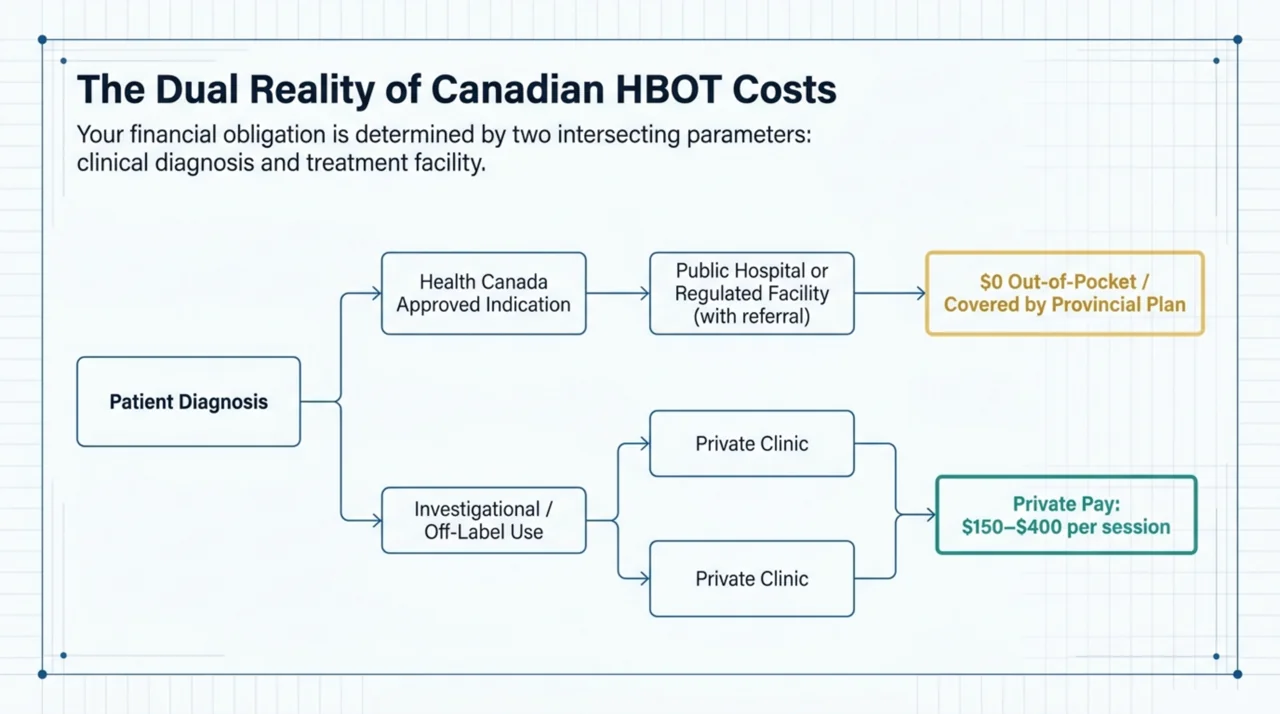
For a Health Canada-approved indication treated in a public hospital, hyperbaric oxygen therapy is covered by your provincial health plan, and you generally pay nothing for the therapy itself. For non-approved uses, or treatment sought at a private clinic, you pay out of pocket. Private sessions in Canada are commonly quoted in the range of roughly $150 to $400 per session, though prices vary widely by location, chamber type, and clinic. Always confirm current pricing directly with any facility, because published figures change and this guide does not list prices for any specific clinic.
The table below shows how the same treatment can cost very different amounts depending on the pathway you take.
| Treatment pathway | Who pays for the therapy | Typical out-of-pocket cost |
|---|---|---|
| Approved indication, public hospital, with referral | Your provincial health plan | $0 for the therapy |
| Approved indication, eligible private clinic (Ontario) | OHIP (Ontario only) | $0 for the therapy |
| Non-approved or off-label use, private clinic | You, or possibly private insurance | Roughly $150 to $400 per session |
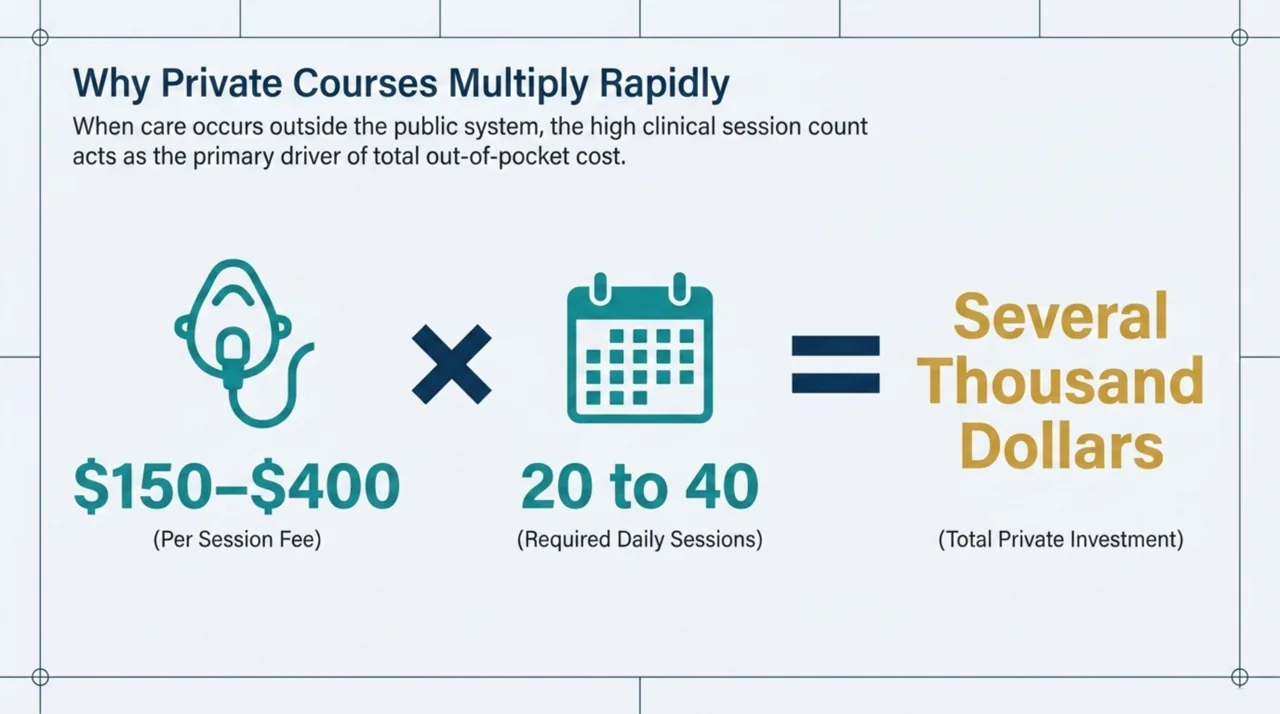
| Full private course (20 to 40 sessions) | You, or possibly private insurance | Often several thousand dollars |
Is hyperbaric oxygen therapy covered by provincial health insurance?
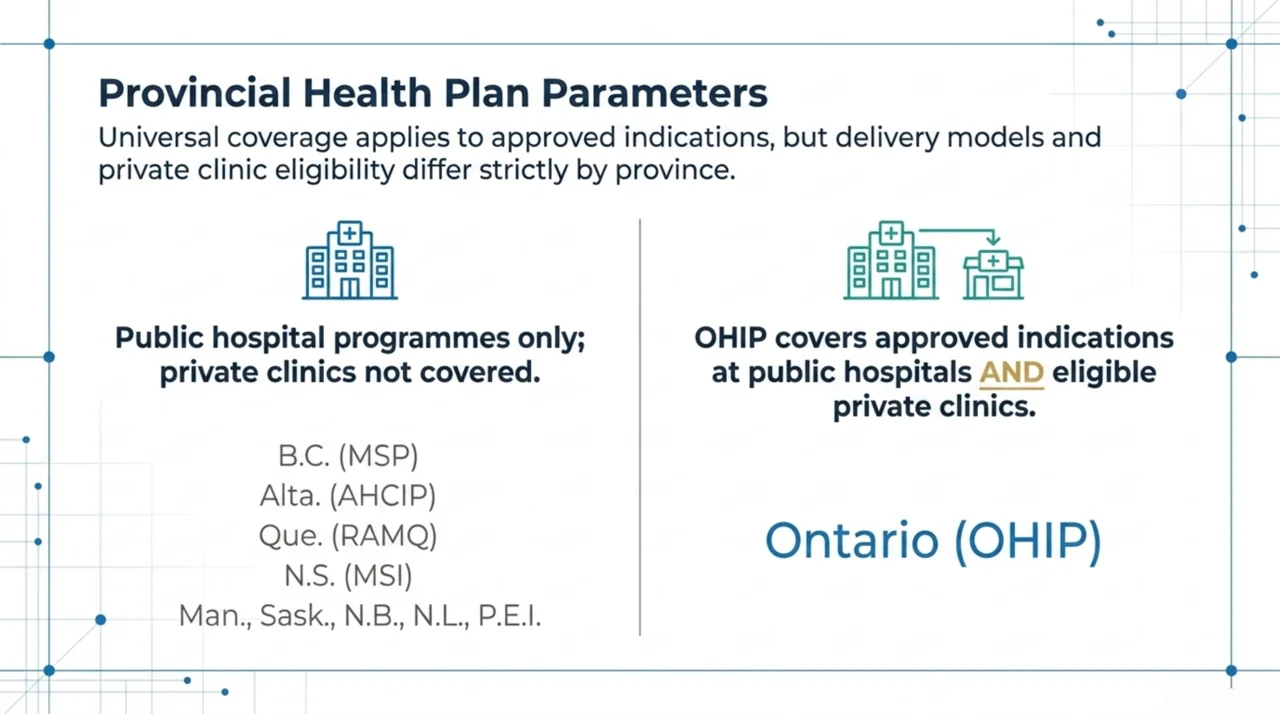
Yes, for approved indications, but the details differ by province. Every province covers hyperbaric oxygen therapy for Health Canada-approved conditions when the treatment is delivered through the public hospital system on a physician referral. What varies is where that public treatment is available and whether any private clinics are covered. In most provinces, public coverage is tied to one or two hospital programs, and private clinics are not covered by the provincial plan. You can read the full breakdown on our provincial coverage guide.
| Province | Health plan | Public HBOT coverage |
|---|---|---|
| Ontario | OHIP | Approved indications at hospitals and eligible private clinics |
| British Columbia | MSP | Vancouver General Hospital; private clinics not covered |
| Alberta | AHCIP | Hospital clinics in Calgary and Edmonton; private not covered |
| Quebec | RAMQ | Hospital-based programs; private not covered |
| Nova Scotia | MSI | QEII Health Sciences Centre, Halifax; private not covered |
| Man., Sask., N.B., N.L., P.E.I. | Provincial plans | Hospital treatment where available; private clinics not covered |
Note for Ontario residents: OHIP covers approved hyperbaric indications at both hospitals and eligible private clinics that bill OHIP, so Ontario is not a hospital-only province. If you live elsewhere and your nearest public program has a long wait, ask your physician about an out-of-province referral.
How much do private hyperbaric oxygen therapy sessions cost?
When you pay privately, the cost is charged per session. Across Canada, private hyperbaric sessions are commonly quoted in the range of roughly $150 to $400 each, and the exact figure depends on the clinic, the city, the chamber type, and the length of the session. Some clinics offer package pricing for a block of sessions, which can lower the per-session rate. Canada Hyperbarics does not publish or recommend prices for any individual clinic, so treat any range here as a general guide and confirm the current cost with the facility before you commit.
Why does a full course of HBOT cost so much?
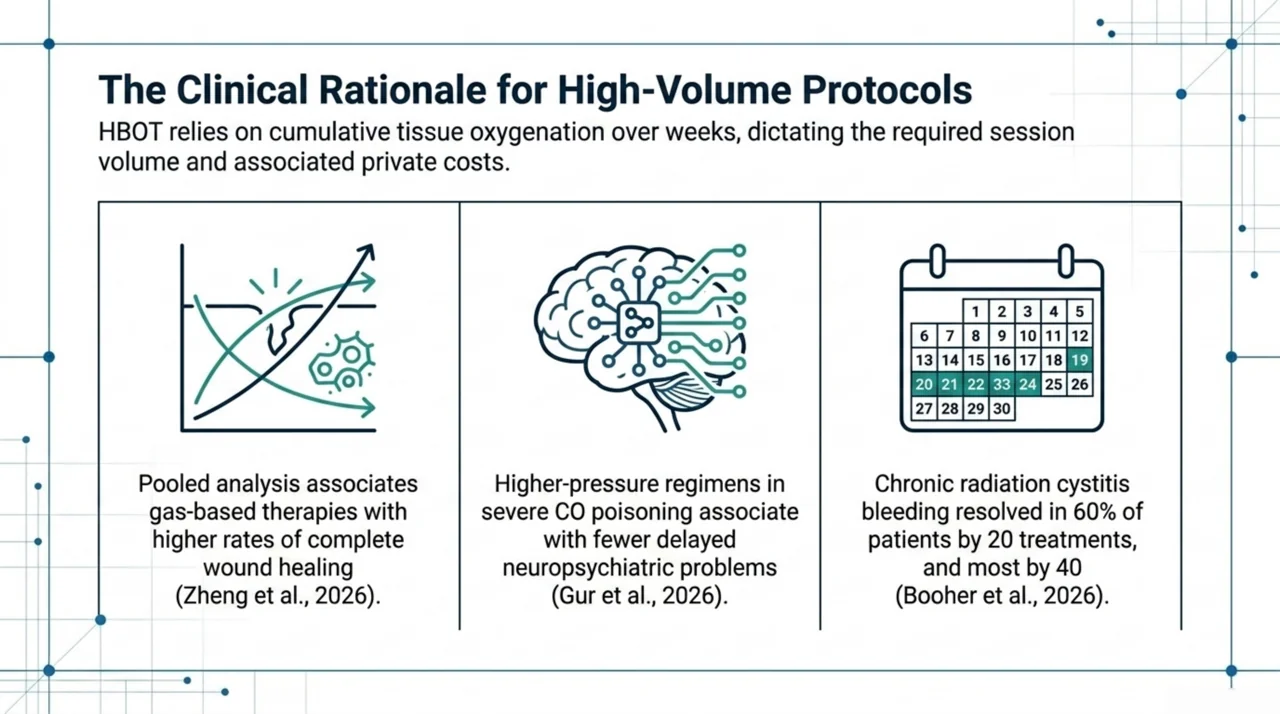
Hyperbaric oxygen therapy is almost never a single visit. Most protocols call for a series of daily sessions over several weeks, which is why a private course adds up. A typical course runs from 20 to 40 sessions, and some conditions need even more. For example, in a 2026 study of patients with chronic radiation cystitis, a bladder injury caused by earlier cancer radiation, visible blood in the urine resolved in 60 percent of patients by 20 treatments and in most patients by 40 treatments, and hyperbaric oxygen was associated with fewer hospital admissions for bleeding (Booher et al., PubMed | Our Assessment). When each of those sessions carries a private fee, the session count is the single biggest driver of total cost.
Which conditions are covered, and which are paid out of pocket?
Health Canada has approved hyperbaric oxygen therapy for a defined list of indications. These approved conditions are the ones your provincial health plan will cover in the public hospital system. They include emergencies and serious wounds such as decompression sickness, arterial gas embolism, severe carbon monoxide poisoning, gas gangrene, compromised skin grafts and flaps, sudden hearing loss, necrotizing soft-tissue infections, and delayed radiation injury. You can browse plain-language explanations on our conditions index, and review the official list on the Health Canada hyperbaric oxygen therapy page.
The evidence behind these covered uses is strongest for tissue that is starved of oxygen. A 2026 narrative review found that clinical evidence supports hyperbaric oxygen for chronic ischaemic wounds such as diabetic foot ulcers, venous leg ulcers, burn injuries, and radiation-induced tissue damage, with improved wound closure and reduced infection risk (Gonzalez Flores et al., PubMed | Our Assessment). A separate 2026 review explained that wound healing depends on tissue oxygenation, which is the underlying rationale for using hyperbaric oxygen on selected problem wounds (Huang et al., PubMed | Our Assessment).
Uses outside this approved list are considered investigational and are not covered. If you are seeking hyperbaric oxygen for a condition that is not on the approved list, expect to pay privately, and ask the clinic to be clear about what the evidence does and does not show for your situation.
Does private or extended health insurance cover HBOT?
Sometimes. Some extended health and private insurance plans reimburse part of the cost of hyperbaric oxygen therapy, but coverage is not guaranteed and varies plan to plan. Insurers are far more likely to consider claims for an approved indication supported by a physician’s documentation. Before booking a private course, call your insurer, ask whether hyperbaric oxygen therapy is an eligible benefit, and find out what paperwork they require. Keep every receipt and referral letter, because most plans will not reimburse without them.
What hidden costs should I budget for?
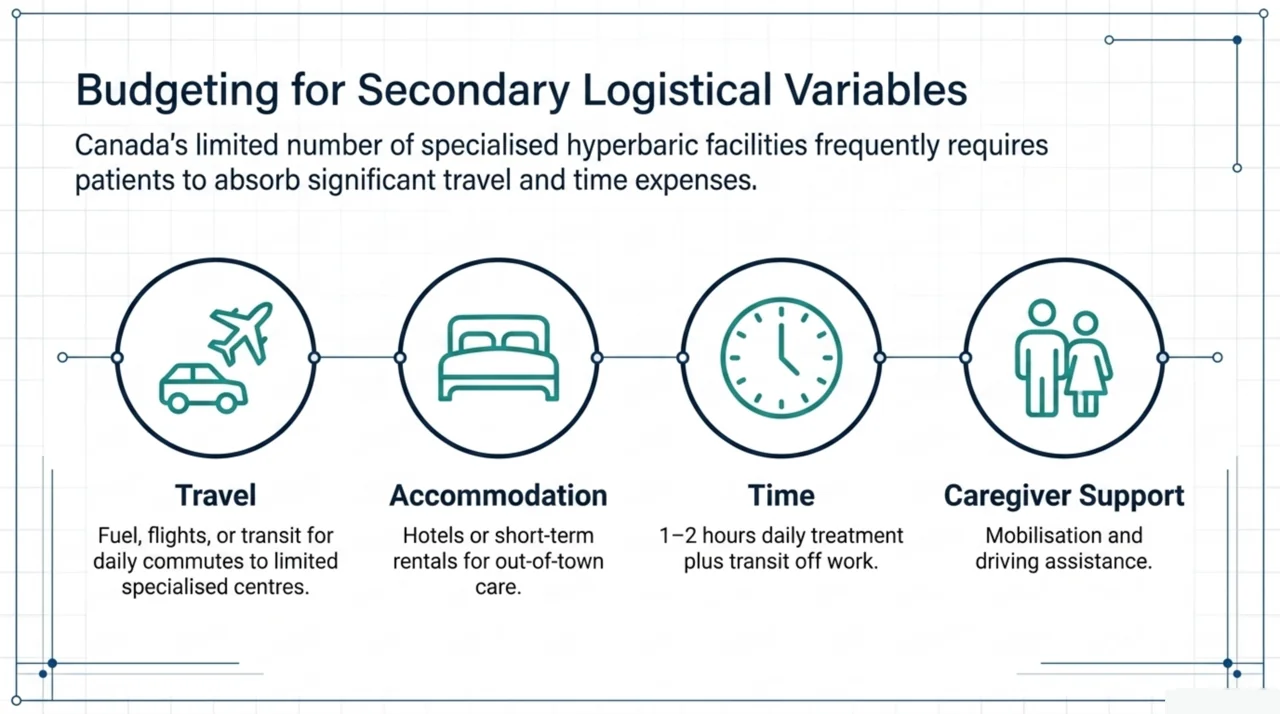
The session fee is not the whole story, especially if you live outside a major centre. Canada has a limited number of hospitals and regulated facilities offering hyperbaric oxygen therapy, so many patients travel for care. Plan for these added costs:
- Travel: fuel, flights, or public transit to and from the facility, often repeated daily across a multi-week course.
- Accommodation: a hotel or short-term rental near the facility if you live too far to commute each day.
- Time off work: sessions can take one to two hours plus travel, which adds up over 20 to 40 visits.
- Caregiver support: a family member or friend may need time off to drive or stay with you.
You can find the locations of hospitals and regulated facilities across the country in our directory, which helps you estimate travel before you commit to a course.
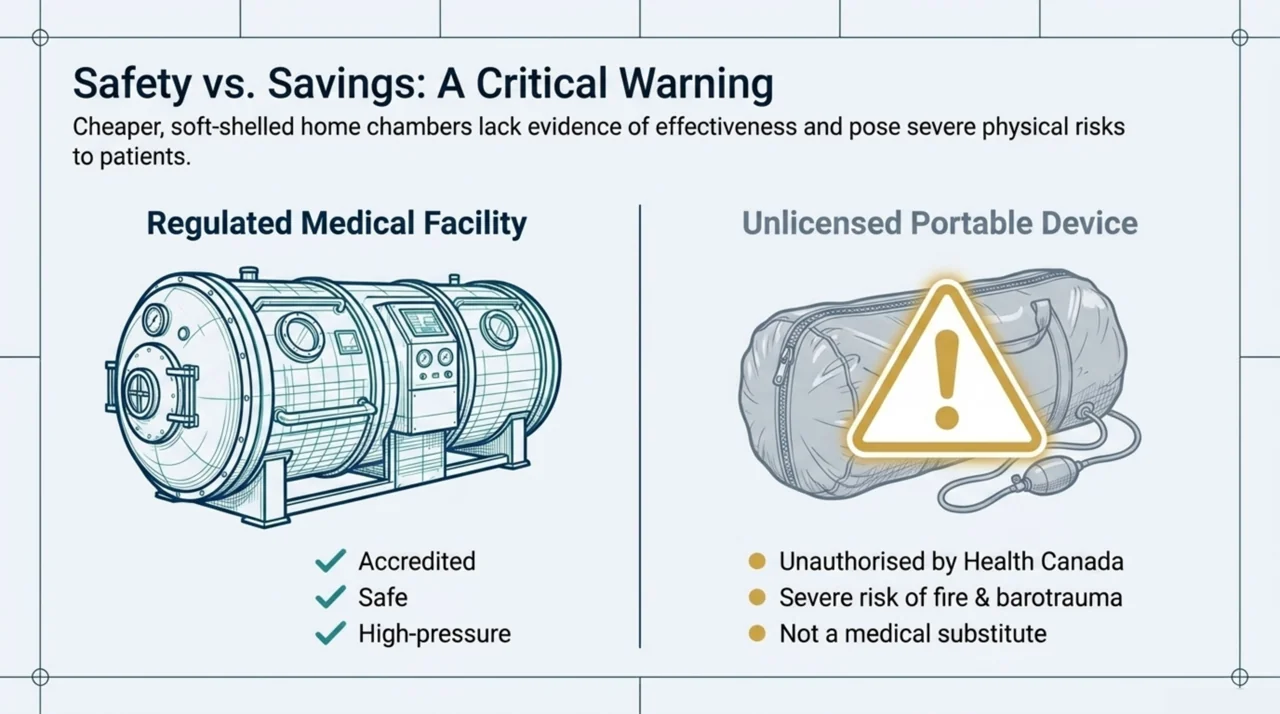
Are cheap home or portable chambers a safe way to save money?
No, and this is an important safety point, not just a cost one. Health Canada has not licensed any soft-shelled or inflatable hyperbaric chambers and has issued safety warnings against their use, because these devices have not been evaluated for safety, quality, or effectiveness and can pose serious risks including fire, barotrauma, and infection. A cheaper device that is not licensed is not a real substitute for medical-grade hyperbaric oxygen therapy. Choosing a regulated facility protects you, even though it may cost more. For more on why accreditation matters, see our about page and the standards published by the Canadian Undersea and Hyperbaric Medical Association.
Is hyperbaric oxygen therapy worth the cost?
For approved indications, the value question is easier, because the public system covers the therapy and the evidence base is strongest. A 2026 systematic review and network meta-analysis of 27 randomised trials with 1,673 patients reported that gas-based therapies, a group that includes hyperbaric oxygen, were associated with higher rates of complete wound healing than standard care in pooled analysis, though the authors noted substantial variation between the trials and their network ranking did not confirm any one therapy as clearly superior (Zheng et al., PubMed | Our Assessment). For emergencies such as carbon monoxide poisoning, hyperbaric oxygen is delivered urgently in hospital; a 2026 study of 312 poisoned patients found that higher-pressure treatment regimens were associated with fewer delayed neuropsychiatric problems than lower-pressure regimens (Gur et al., PubMed | Our Assessment). For uses outside the approved list, weigh the out-of-pocket cost against evidence that is often less certain, and discuss it honestly with your physician.
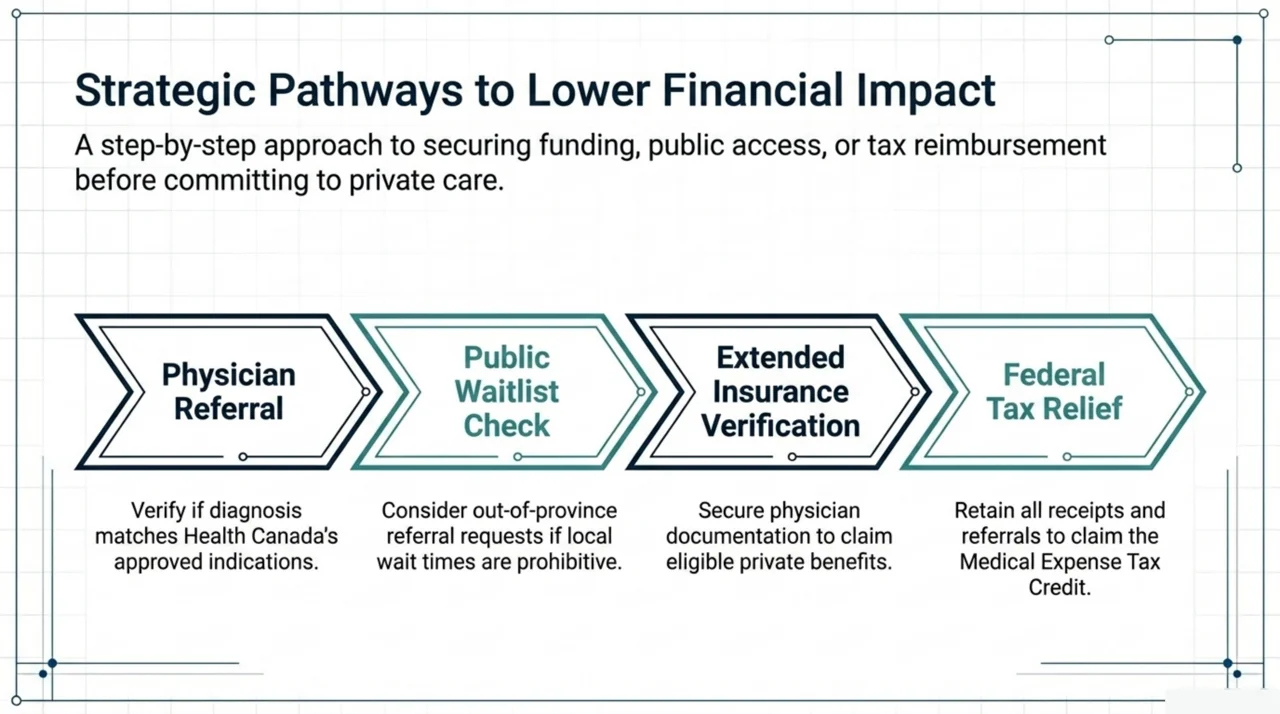
How can I lower my out-of-pocket cost?
The single most effective way to reduce what you pay is to find out whether your condition qualifies for public coverage. Take these steps:
- Ask your physician whether your diagnosis is a Health Canada-approved indication. If it is, you may qualify for covered treatment in the public system.
- Request a referral to a public hospital program in your province or, if there is a long wait, ask about an out-of-province referral.
- Check your extended health insurance for hyperbaric oxygen therapy benefits and the documentation they need.
- Compare private clinics on price, chamber type, and accreditation if public coverage is not available for your situation.
- Budget for travel and accommodation early, and ask facilities whether any patient travel-assistance programs apply in your province.
For more answers to common questions, visit our frequently asked questions page or read more of the research on our research bank.
Frequently asked questions about hyperbaric oxygen therapy cost
Is hyperbaric oxygen therapy free in Canada?
It can be. For a Health Canada-approved indication treated in the public hospital system on a referral, the therapy is covered by your provincial health plan and is effectively free to you. For non-approved uses or private clinic treatment, you pay out of pocket.
Does OHIP pay for hyperbaric oxygen therapy?
Yes. In Ontario, OHIP covers approved hyperbaric indications at both hospitals and eligible private clinics that bill OHIP. Coverage applies to the approved condition list, not to investigational uses.
How many HBOT sessions will I need?
It depends on the condition, but most courses run 20 to 40 daily sessions, and some require more. Your treating physician sets the number based on your diagnosis and response, which is why total private cost can be hard to predict up front.
Can I claim hyperbaric oxygen therapy on my taxes?
Possibly. Amounts you pay out of pocket for medically necessary treatment may be eligible for the federal Medical Expense Tax Credit. Keep all receipts and your physician’s referral, and ask a tax professional or check Canada Revenue Agency guidance to confirm eligibility for your situation.
Why is hyperbaric oxygen therapy not covered for my condition?
Provincial plans cover hyperbaric oxygen only for Health Canada-approved indications. If your condition is not on that approved list, it is considered investigational, and public coverage does not apply, even if a clinic offers the treatment privately.
Where can I find a hyperbaric oxygen therapy facility in Canada?
Canada Hyperbarics maintains an independent directory of hospitals and regulated facilities offering hyperbaric oxygen therapy across the country. Whether you are pursuing covered treatment through the public system or weighing a private course, start by locating the facilities nearest you and confirming what they treat and what they charge.
Find hospitals and regulated hyperbaric facilities near you in our Canada-wide directory.
This content is for informational purposes only and does not constitute medical advice. Coverage, eligibility, and pricing change over time and vary by province and facility. Always confirm current costs and coverage with your physician, your provincial health plan, and the facility before beginning treatment.