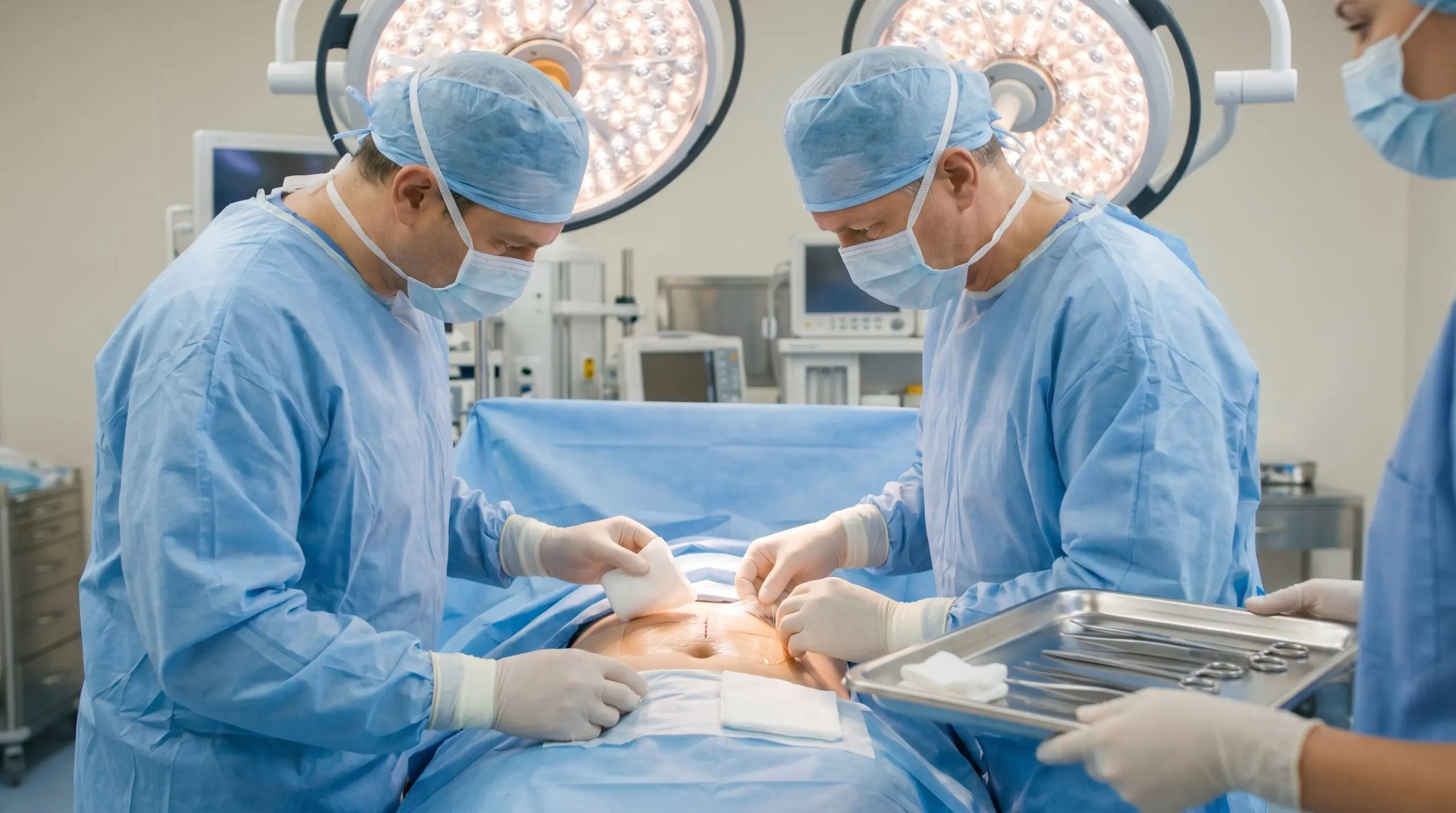
HBOT for compromised skin grafts and flaps is among the indications recognised by the Undersea and Hyperbaric Medical Society (UHMS) and accepted at Health Canada-licensed hyperbaric centres. New 2024 to 2026 research strengthens the case for early adjunctive use in mastectomy reconstruction, traumatic skin grafting, and crush-injury salvage. This evidence review summarises five recent studies, including two systematic reviews, of practical interest to Canadian referring physicians.
TL;DR: Hyperbaric oxygen therapy almost doubled mastectomy pocket salvage rates in a 552-breast retrospective study. A randomised controlled trial of 64 trauma patients showed faster split-thickness skin graft uptake and donor-site healing with HBOT. Evidence supports referral within 24 hours of compromise. UHMS recognises compromised grafts and flaps as a recognised indication.
What does HBOT do for compromised skin grafts and flaps?
A compromised skin graft or flap is tissue with marginal perfusion at risk of partial or full necrosis. Hyperbaric oxygen therapy is the delivery of 100 percent oxygen at pressures between 2.0 and 2.5 atmospheres absolute (ATA), performed inside a Health Canada-licensed monoplace or multiplace chamber. The increased dissolved oxygen reaches hypoxic tissue beyond the limits of normal red-cell oxygen carriage, supporting the metabolic demands of healing tissue while neovascularisation re-establishes perfusion.
The mechanism is well-characterised. HBOT corrects tissue hypoxia, reduces oedema through vasoconstriction at oxygenated arteriolar beds, modulates the inflammatory response, and promotes angiogenesis through hypoxia-inducible factor signalling. For surgical referrers, the practical implication is that perfusion-marginal tissue can often be salvaged when HBOT is initiated promptly.
Which 2024 to 2026 studies should referring physicians know about?
Five studies published between 2024 and 2026 deserve attention. Each is summarised below with the methodology, primary outcome, and clinical implications relevant to Canadian referrers.
Zhu et al. 2025 – Tissue expander breast reconstruction
Zhu and colleagues at Johns Hopkins published a six-year retrospective review of 348 patients (552 breasts) who underwent immediate tissue expander breast reconstruction, comparing outcomes with and without postoperative HBOT for mastectomy skin flap ischaemia. Among patients with confirmed mastectomy skin necrosis, HBOT salvaged 76 percent of mastectomy pockets compared with 41 percent in untreated controls, a near doubling of pocket salvage. The study also showed that prepectoral expander placement carried higher ischaemia risk than subpectoral placement, helping referring breast surgeons identify which patients warrant early hyperbaric consultation.
The study is summarised on our research bank at HBOT in immediate tissue expander breast reconstruction.
Uniyal et al. 2025 – Randomised controlled trial of split-thickness skin grafts
This Indian multi-centre randomised controlled trial enrolled 64 trauma patients undergoing split-thickness skin grafting (STSG). Patients were randomised to standard care or standard care plus adjunctive HBOT. Outcome measures included graft uptake at postoperative days 4 and 7 and donor-site healing time.
Results favoured the HBOT group on every endpoint. Mean graft uptake on day 4 was 92.4 percent in the HBOT group versus 88.1 percent in controls (P = 0.036), and on day 7 the gap widened to 91.7 percent versus 83.1 percent (P = 0.026). Donor-site healing was completed in 15.2 days with HBOT versus 18.0 days with standard care alone (P less than 0.001). The control group also recorded four cases of flap necrosis and one death from sepsis, while no flap necrosis occurred in the HBOT group. Full summary at RCT on STSG uptake with HBOT.
Idris et al. 2024 – Systematic review in nipple-sparing mastectomy
Published in the Journal of Clinical Medicine, this systematic review pooled seven studies covering 63 female patients who underwent nipple-sparing mastectomy with breast reconstruction. The review found HBOT effective for mitigating post-mastectomy complications including infection, re-operation, flap loss, seroma, and haematoma. The authors classified four studies as ASPS Level III evidence, one as Level IV, and two as Level V, and called for further rigorous trials with defined control groups. Source on PubMed.
Gao et al. 2024 – Systematic review of autologous breast reconstruction
This Chinese systematic review of 68 studies examined risk factors, assessment techniques, and treatments for flap necrosis after autologous breast reconstruction. Identified risk factors included smoking, advanced age, obesity, diabetes, large breast volume, previous radiotherapy, and prior abdominal surgery. The authors concluded that HBOT, alongside thorough planning, perioperative monitoring, and targeted postoperative interventions, plays a role in lowering the incidence of flap necrosis. Internal summary at flap necrosis after autologous reconstruction.
Casimiro et al. 2024 – Crush injury timing analysis
This Portuguese case series followed 19 patients with upper-limb crush injuries who received adjunctive HBOT after surgical management. Only six patients started HBOT within the first 24 hours. Among the four patients who developed acute complications (tissue necrosis or local infection), half had started HBOT more than 24 hours after injury. None of the patients with late complications (pseudarthrosis, late deep infection) had started HBOT within the first 24 hours. The European Committee for Hyperbaric Medicine recommends initiation as rapidly as possible. Internal summary at HBOT in upper-limb crush injury.
How does this evidence translate into referral decisions?
Three referral patterns emerge from the 2024 to 2026 literature.
- Refer compromised mastectomy reconstructions early. Skin necrosis after immediate tissue expander reconstruction is reasonably predictable from intra-operative findings. Same-day or next-day referral correlates with the highest pocket salvage rates.
- Refer trauma patients with compromised grafts within 24 hours. The Casimiro data and the European Committee position both support rapid initiation. Late referral after necrosis develops removes most of the upside of HBOT.
- Identify high-risk patients prospectively. Smoking, diabetes, obesity, prior radiotherapy, and large reconstruction volume warrant early discussion with a hyperbaric physician, not delayed referral after compromise appears.
What does the standard HBOT protocol look like for graft and flap salvage?
The UHMS protocol for compromised grafts and flaps typically uses 2.0 to 2.5 ATA, treatment durations of 90 to 120 minutes, and an initial twice-daily schedule for the first 48 to 72 hours, transitioning to once daily until the threatened tissue is stable or fully healed. Most patients receive between 10 and 30 sessions, depending on tissue response and surgical context. Detailed protocol parameters vary by indication and centre, and the referring physician does not need to specify them. The hyperbaric physician will determine pressure, duration, and total session count.
What does the evidence base show for outcomes by tissue type?
| Tissue type | Best evidence (2024-2026) | Reported benefit |
|---|---|---|
| Mastectomy skin flap | Zhu 2025 retrospective (n=552 breasts) | Pocket salvage 76% vs 41% |
| Split-thickness skin graft (trauma) | Uniyal 2025 RCT (n=64) | +8.6% graft uptake at POD 7; faster donor-site healing |
| Nipple-sparing mastectomy | Idris 2024 systematic review (n=63) | Reduced infection, flap loss, re-operation |
| Autologous breast reconstruction | Gao 2024 systematic review (n=68 studies) | Adjunct to standard care for at-risk patients |
| Upper-limb crush injury | Casimiro 2024 case series (n=19) | Earlier initiation reduces late complications |
Where can patients access HBOT for compromised grafts and flaps in Canada?
Canadian access is delivered through provincial hospitals and regulated private facilities. Compromised grafts and flaps are a UHMS-recognised indication and accepted at most Canadian hospital programmes. Coverage by provincial health insurance varies. Acute hospital-based hyperbaric services for trauma and post-surgical indications are typically covered when delivered through the hospital pathway. Outpatient adjunct sessions at private facilities are generally patient-funded or covered under specific extended-health policies.
The directory of Canadian hospitals and regulated facilities lists hyperbaric centres by province, including emergency-capable hospital programmes for time-critical indications. Canada Hyperbarics maintains an updated list of accredited Canadian centres and the conditions each accepts.
Frequently asked questions from referring physicians
How urgently should I refer a patient with a compromised flap?
Same-day referral is appropriate when the surgical team identifies marginal perfusion. The Casimiro data and the European Committee for Hyperbaric Medicine support initiation within the first 24 hours when feasible. Delayed referral after frank necrosis develops yields lower salvage rates.
Is HBOT contraindicated in any postoperative reconstruction patient?
The only absolute contraindication to HBOT is untreated pneumothorax. Concurrent bleomycin chemotherapy is treated as effectively absolute at most Canadian programmes (the Undersea and Hyperbaric Medical Society classifies it as relative) because of the risk of oxygen-induced pulmonary toxicity. Other relative contraindications include uncontrolled seizure disorder, severe COPD with bullae, recent ear surgery, and other chemotherapy agents such as doxorubicin. The hyperbaric physician will perform a full screening review at consultation. The UHMS-recognised indications page describes screening considerations in more detail.
Will HBOT replace surgical revision?
No. HBOT is adjunctive to standard surgical care, not a substitute for revision when revision is indicated. The Uniyal 2025 RCT and the Zhu 2025 retrospective both ran HBOT alongside standard care; HBOT did not replace surgical management.
How many sessions are typically required?
Between 20 and 40 sessions are common, depending on tissue response. The hyperbaric physician will reassess periodically and stop when the threatened tissue is stable.
Is the evidence base strong enough for routine adjunctive use?
The 2024 to 2026 evidence base includes one randomised controlled trial, two systematic reviews, and two large retrospective and case-series studies. UHMS lists compromised grafts and flaps among its recognised indications. Routine adjunctive use is supported in defined high-risk scenarios, particularly mastectomy reconstruction with marginal perfusion and trauma-related skin grafting.
Where can I find UHMS guidance directly?
The Undersea and Hyperbaric Medical Society publishes the official indications list and protocol summaries at UHMS HBO indications.
Where to refer in Canada
Canada Hyperbarics maintains a complete directory of Canadian hospitals and regulated facilities that accept compromised graft and flap referrals. The directory includes emergency-capable hospital programmes for acute trauma cases and outpatient centres for post-surgical adjunctive treatment. Referring physicians can also review the full research bank for additional evidence summaries by indication.
This content is for informational purposes only and does not constitute medical advice. Decisions regarding hyperbaric oxygen therapy should be made in consultation with a qualified hyperbaric physician and the patient surgical team. Canada Hyperbarics is an informational resource and does not provide direct patient care.