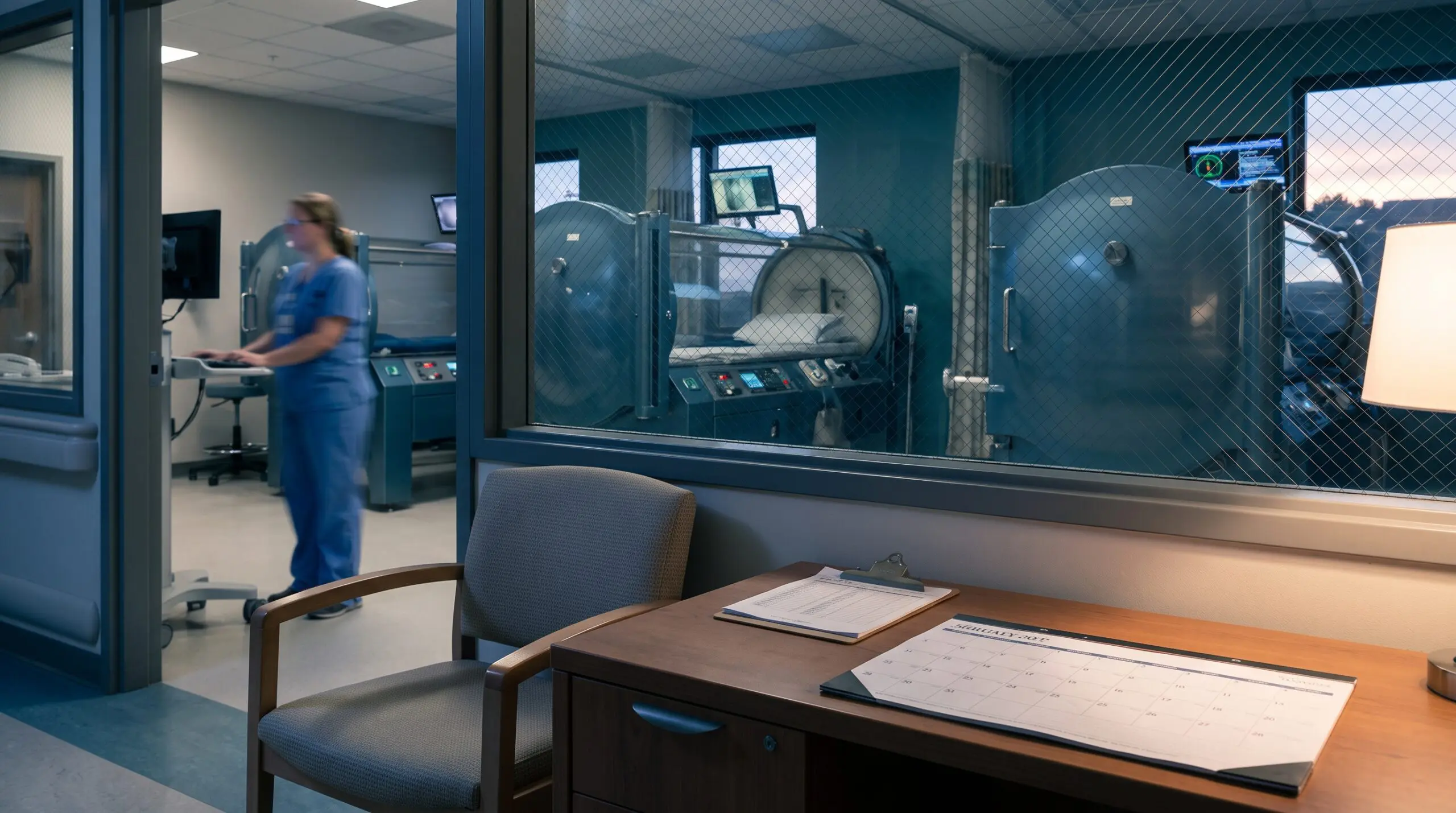
TL;DR: The hyperbaric chamber shortage in Winnipeg has stretched booking timelines for patients seeking hyperbaric oxygen therapy (HBOT) in the region. This short update looks at why local capacity is tight, what it means for referring clinicians and patients, and how clinic operators can plan around it using accredited regional facilities and clear referral pathways.
The hyperbaric chamber shortage in Winnipeg is a capacity problem, not a treatment problem. It refers to a mismatch between the number of monoplace and multiplace chambers available in and around the city and the volume of patients whose clinicians want to book them. For clinic operators and referring physicians, that mismatch shows up as longer wait times, more phone calls to coordinate bookings, and a bigger role for regional or out-of-province facilities in day-to-day scheduling.
This post is a short operational update, not a clinical review. It does not evaluate what hyperbaric oxygen therapy does or does not do for any condition. Instead, it focuses on what a local capacity crunch means for how clinics book, refer, and communicate with patients. Canada Hyperbarics tracks hospital and regulated facility capacity across the country as part of our ongoing reference work, and this update reflects that broader pattern playing out in Manitoba.
What Is Driving the Hyperbaric Chamber Shortage in Winnipeg?
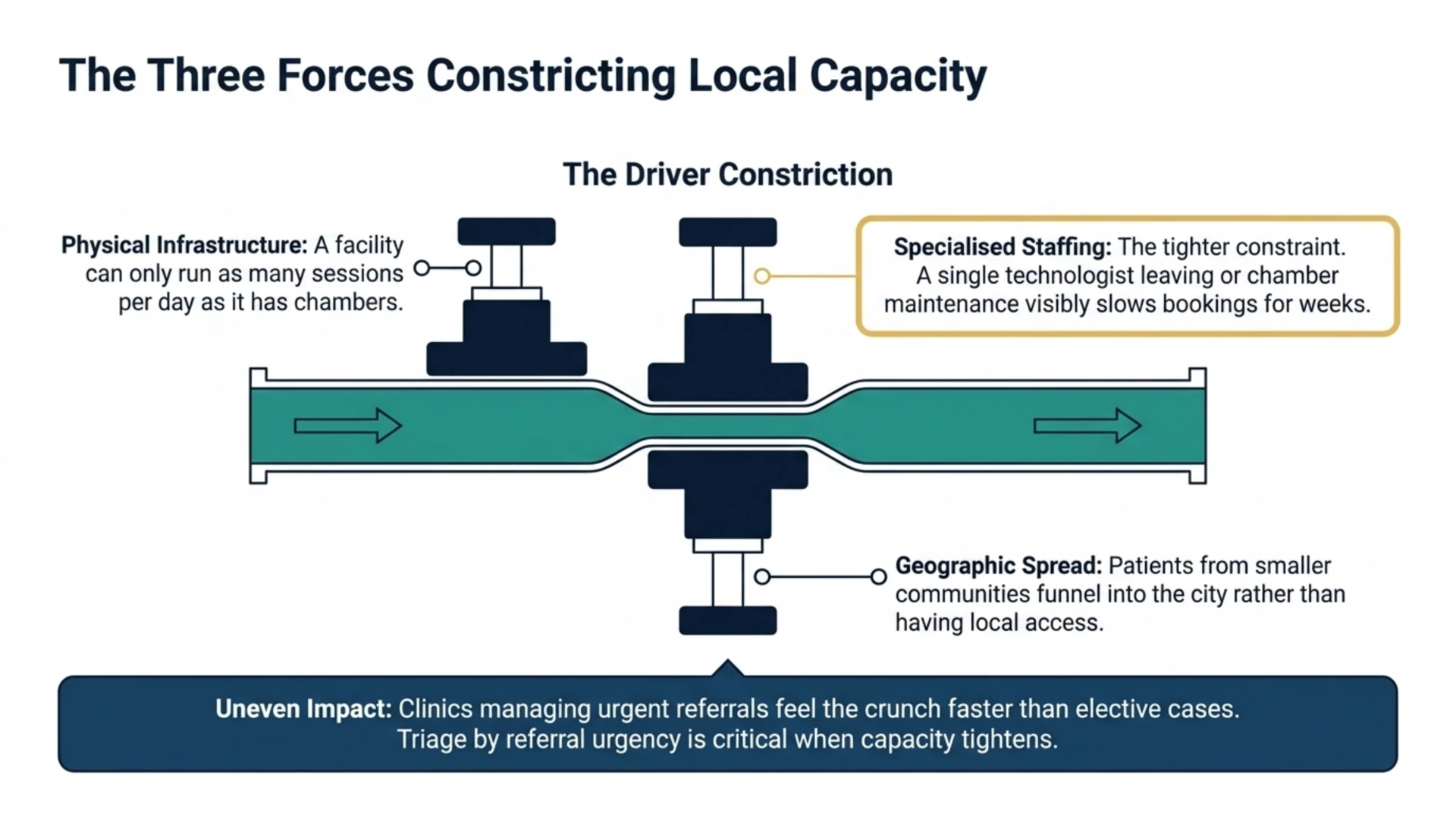
Several factors tend to compound in mid-sized regional markets like Winnipeg. Chamber availability is limited by physical infrastructure: a facility can only run as many sessions per day as it has chambers and trained technicians to staff them. When referral volume rises faster than that fixed capacity, a backlog builds.
Staffing is often the tighter constraint, not the chamber itself. Hyperbaric medicine requires technologists and supervising physicians with specific training, and that talent pool is smaller than the pool of general clinical staff. A single technologist leaving a program, or a chamber going offline for scheduled maintenance, can visibly slow bookings for weeks.
Geography plays a role too. Manitoba’s population outside Winnipeg is spread across a large area, and patients from smaller communities are often referred into the city’s existing programs rather than having local access. That concentrates demand on a small number of chambers.
Why This Matters More for Some Referral Categories
Some referral categories carry tighter clinical timelines than others, which means scheduling delays are felt unevenly. Clinics that manage urgent or time-sensitive referral categories will notice a capacity crunch faster than clinics referring for elective or longer-planning-horizon cases. The practical takeaway is that not all delayed bookings carry the same operational risk, so triage by referral urgency becomes more important when local capacity tightens.
How Does a Local Shortage Change the Referral Process?
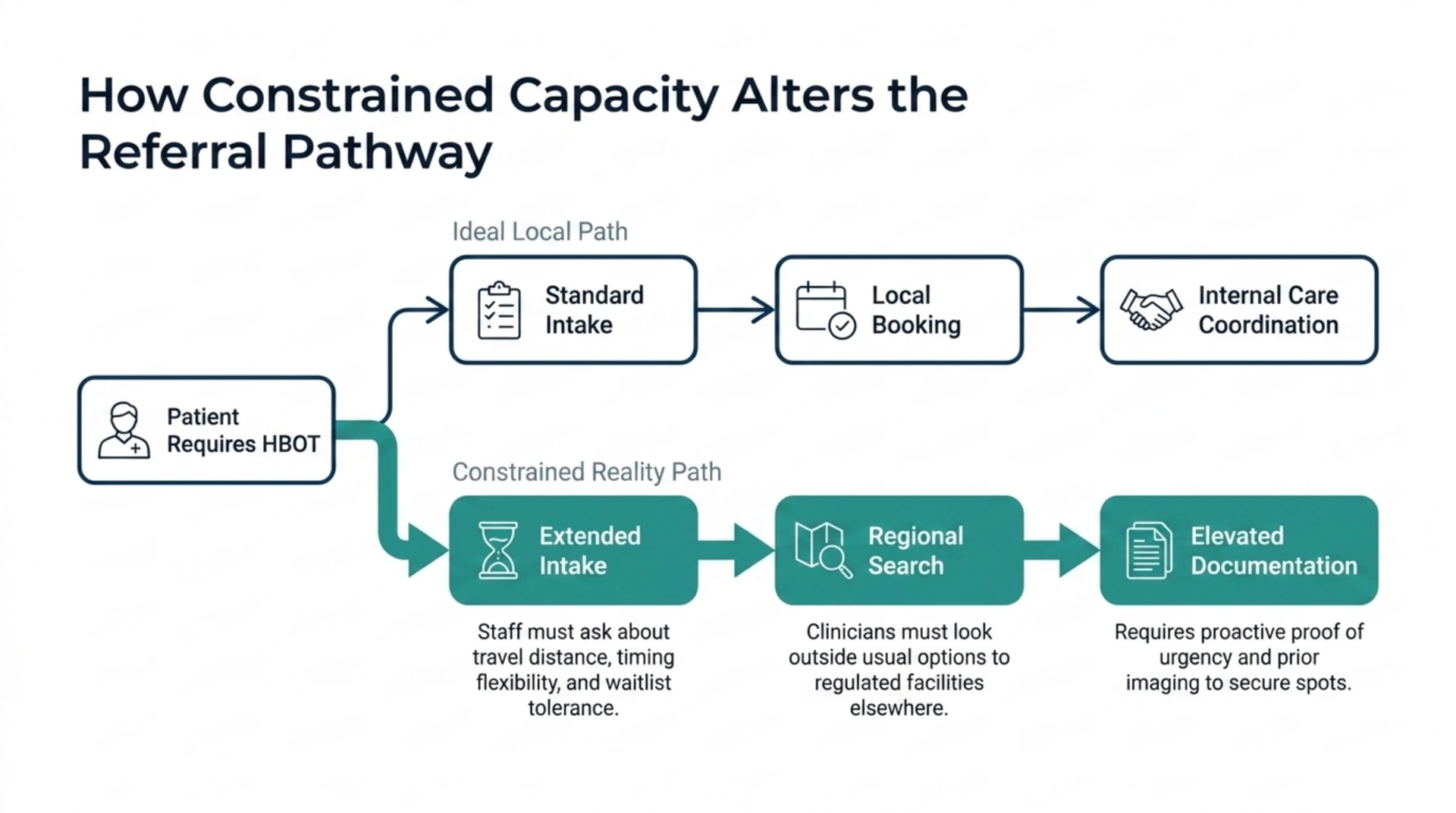
When a nearby hyperbaric program is at or near capacity, the referral process usually shifts in three visible ways.
First, intake conversations get longer. Front-desk and referral coordination staff need to ask about acceptable travel distance, flexibility on session timing, and whether the patient can be added to a waitlist versus needing an immediate alternative.
Second, referring clinicians start looking outside their usual local option. That can mean sending a referral to a regulated facility in another city or province, which introduces new steps: verifying accreditation, confirming intake requirements, and coordinating travel logistics for the patient.
Third, documentation becomes more important. A referral that clearly states urgency, prior imaging or assessment context, and scheduling flexibility moves faster through an intake queue than one that leaves those details for a follow-up call.
Bold takeaway: a well-documented referral is the single fastest lever a clinic has when local chamber capacity is constrained, because it removes back-and-forth clarification from the intake process at the receiving facility.
What Should Clinic Operators Do When Local Capacity Is Tight?
Build a Short List of Regional Alternatives
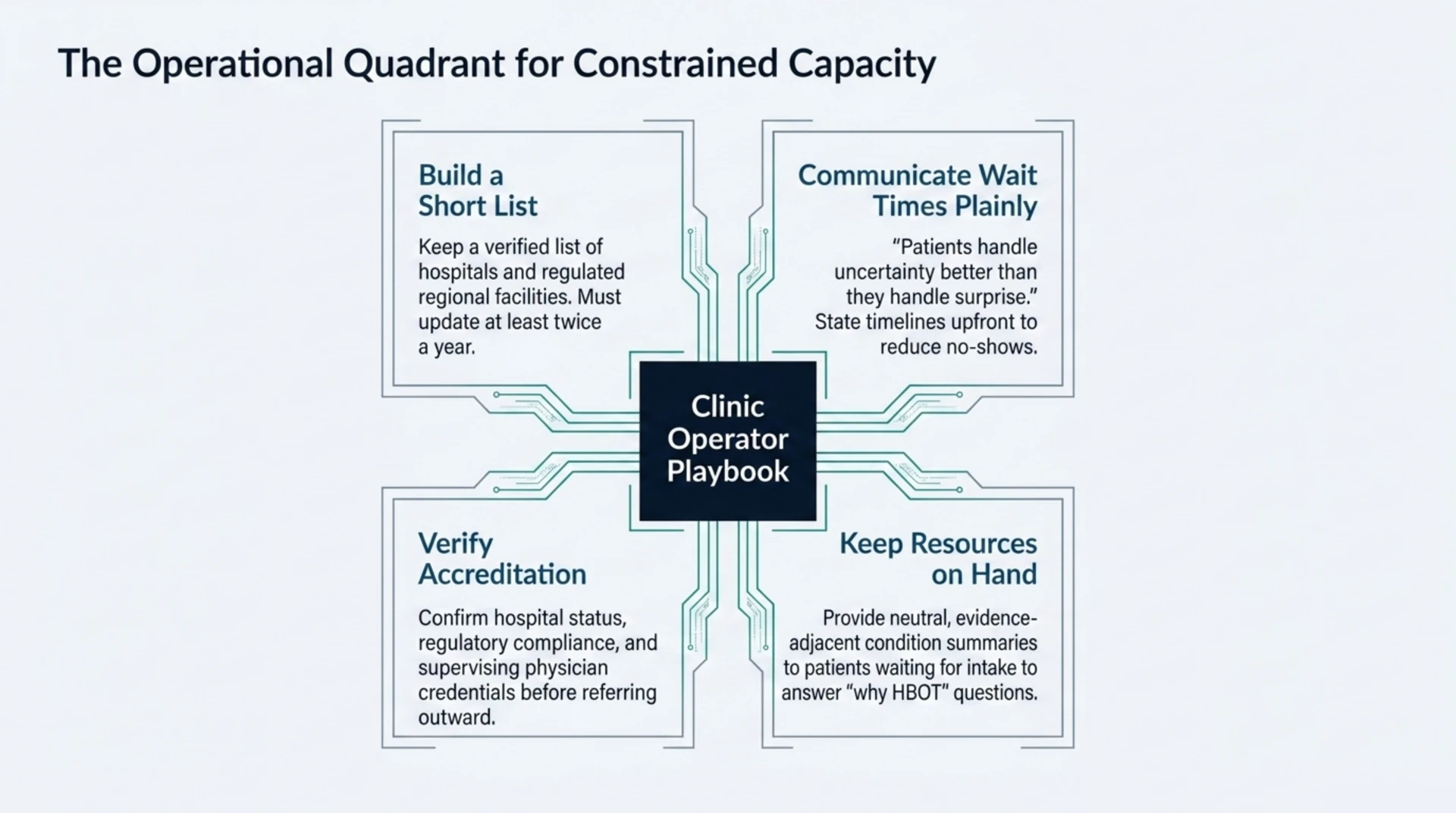
Clinic operators benefit from keeping a current, verified list of hospital and regulated hyperbaric facilities within a reasonable travel radius, updated at least twice a year. Our facilities directory is one place to start that research, since it lists hospitals and regulated facilities rather than unregulated or wellness-only chambers.
Communicate Wait Times in Plain Language
Patients handle uncertainty better than they handle surprise. A clinic that tells a patient upfront “the current wait is approximately X weeks, and we will call if an earlier slot opens” reduces repeat calls and no-shows more than one that stays vague until pressed. This is purely a scheduling communication practice, not a clinical judgment.
Verify Accreditation Before Referring Outward
Not every facility advertising hyperbaric services is a hospital or a regulated program. Before sending a referral to an unfamiliar facility, confirm its accreditation status and supervising physician credentials. Our regulatory overview explains what accreditation looks like in the Canadian context, and is a useful checklist for any clinic vetting a new referral partner during a capacity crunch.
Keep a Condition-Specific Resource on Hand
When a patient or family asks why HBOT is even being considered for their situation, it helps to have a neutral, evidence-adjacent resource ready rather than answering from memory during a busy intake call. Our conditions overview summarizes the range of conditions clinicians may consider HBOT for, without making treatment claims, and can be shared directly with patients who want more background while they wait.
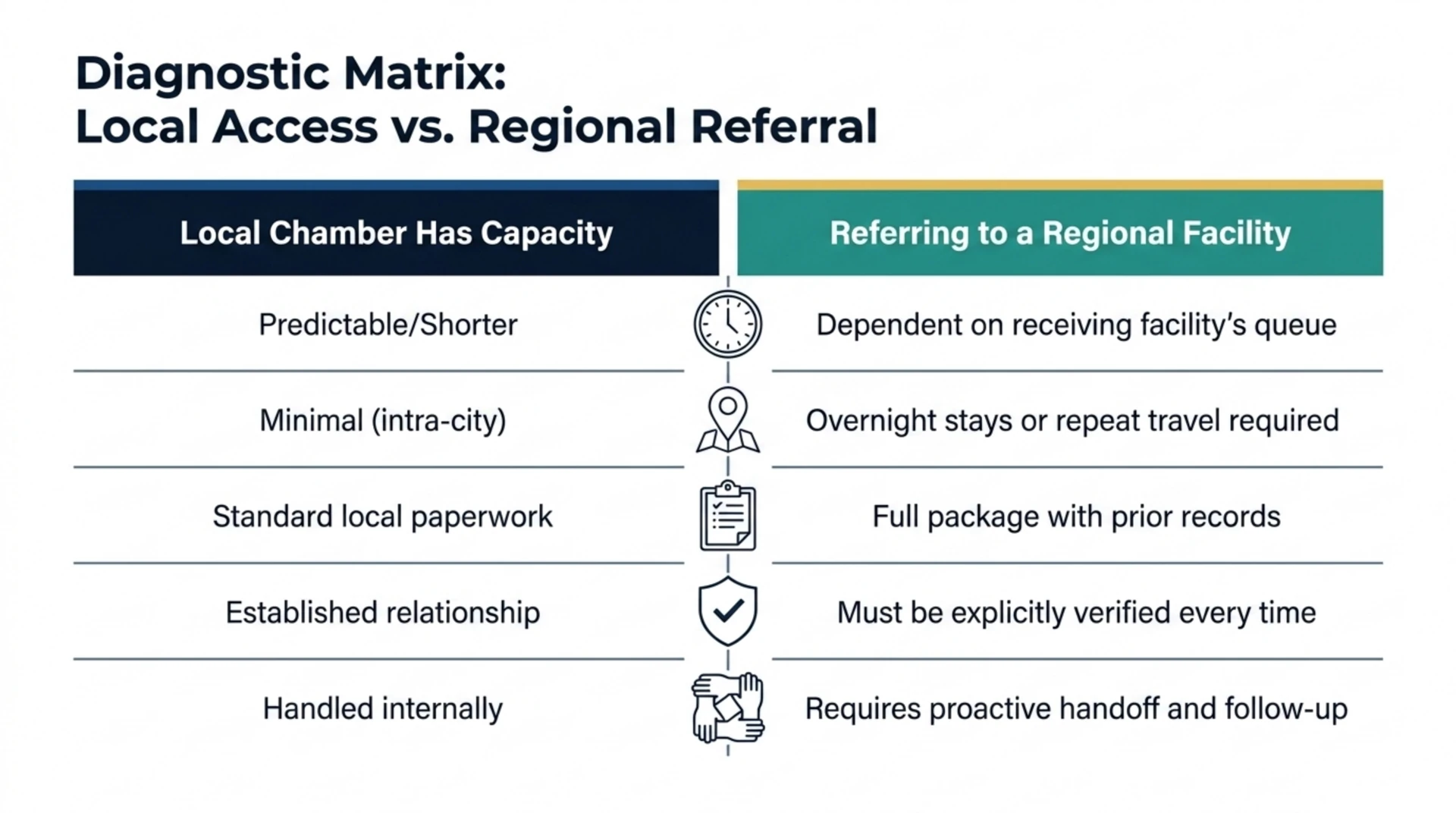
Local Chamber Access vs. Regional Referral: A Quick Comparison
The table below summarizes what changes operationally when a clinic shifts from booking a local chamber to referring a patient to a regional or out-of-province facility.
| Consideration | Local Chamber Has Capacity | Referring to a Regional Facility |
|---|---|---|
| Booking lead time | Typically shorter and more predictable | Depends on the receiving facility’s own queue |
| Travel burden on patient | Minimal, usually within the city | May require overnight stays or repeat travel |
| Documentation needs | Standard local intake paperwork | Fuller referral package, often including prior records |
| Accreditation verification | Already established relationship | Should be confirmed before referring, every time |
| Continuity of care coordination | Handled internally | Requires explicit handoff and follow-up communication |
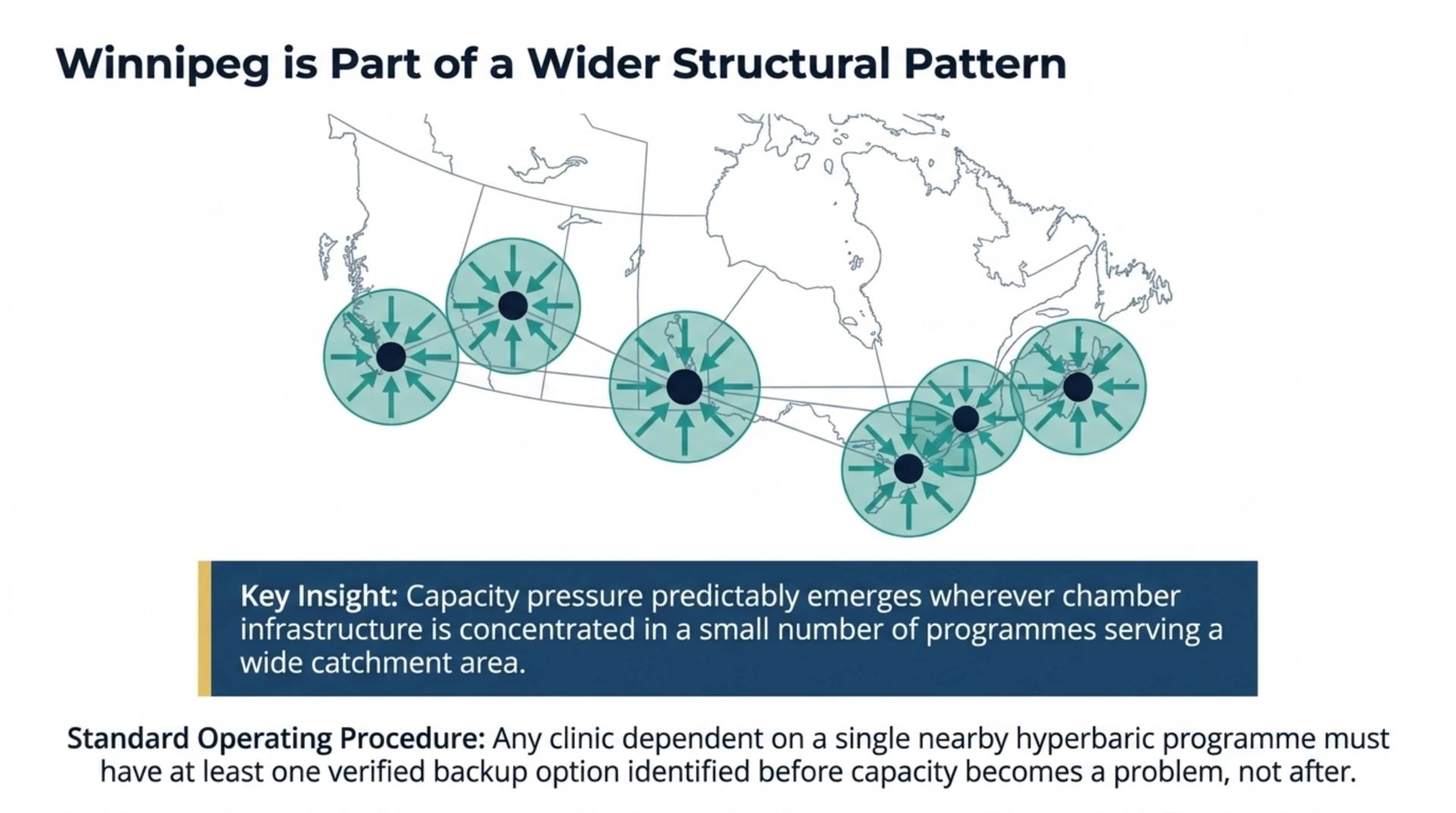
Is the Winnipeg Situation Unique, or Part of a Wider Pattern?
Winnipeg is not an isolated case. Capacity pressure on hyperbaric programs tends to appear wherever chamber infrastructure is concentrated in a small number of hospital-based or regulated programs serving a wide catchment area. Clinic operators in other mid-sized Canadian cities have described similar patterns: a handful of programs serving both the metro area and a large surrounding region, with staffing turnover or equipment downtime quickly translating into visible wait-time changes.
The operational lesson generalizes beyond Winnipeg: any clinic that depends on a single nearby hyperbaric program for referrals should have at least one verified backup option identified before capacity becomes a problem, not after.
For clinics without any local chamber at all, the coordination challenge is even more structural. Our related post on the HBOT referral pathway for patients without a local chamber walks through that process in more detail and is worth reviewing alongside this update.
Frequently Asked Questions
Why is there a hyperbaric chamber shortage in Winnipeg specifically?
The shortage reflects a combination of limited chamber infrastructure, a small pool of trained hyperbaric staff, and a wide catchment area that concentrates referral demand on a small number of programs. It is a regional capacity issue rather than a policy change or a shift in clinical guidance.
How long are current wait times for hyperbaric oxygen therapy in Winnipeg?
Wait times vary by facility, referral urgency, and time of year, and change frequently enough that we do not publish a fixed number here. Clinic staff should confirm current timelines directly with the receiving facility’s intake team before quoting a wait time to a patient.
Should a clinic refer patients out of province if the local wait is too long?
That is a case-by-case decision that depends on urgency, patient ability to travel, and the availability of a verified, accredited program elsewhere. Our regulatory overview and FAQ pages are useful starting points when evaluating an unfamiliar out-of-province facility.
How can a clinic confirm a hyperbaric facility is accredited before referring a patient?
Ask the receiving facility directly for its accreditation status and supervising physician credentials, and cross-check against our facilities directory, which lists hospitals and regulated facilities rather than unregulated operators.
Does a chamber shortage affect which patients get prioritized?
Prioritization decisions are made by treating physicians based on clinical urgency, not by administrative staff managing the booking calendar. A clinic’s operational role is to document referral urgency clearly and communicate realistic timelines, not to make triage decisions itself.
Where can patients learn more while they wait for a booking?
Patients can review our FAQ section and our conditions overview for general background while their referral is pending. Neither page replaces a conversation with their treating clinician.
Related Reading
- HBOT Referral Pathway for Patients Without a Local Chamber
- How to Find a Hyperbaric Oxygen Therapy Clinic Near Me
- Hyperbaric Clinic Accreditation Pathways in Canada
Canada Hyperbarics maintains a directory of hospital and regulated facilities across Canada specifically so that referring clinicians and patients can find verified capacity, even when a local program is stretched thin. If your clinic is navigating the Winnipeg shortage or a similar squeeze elsewhere, start with our list of hospitals and regulated facilities.
This content is for informational purposes only and is not medical advice.