
TL;DR: Hyperbaric clinic accreditation pathways in Canada are not one single licence, they are a stack of separate approvals: a Health Canada medical device licence for the chamber itself, provincial pressure vessel and fire code sign-off for the physical installation, and optional voluntary accreditation (such as UHMS facility accreditation) layered on top. No single certificate covers everything, and clinic owners who assume otherwise often discover the gap during an insurance audit or a facility inspection. This post compares the main pathways side by side.
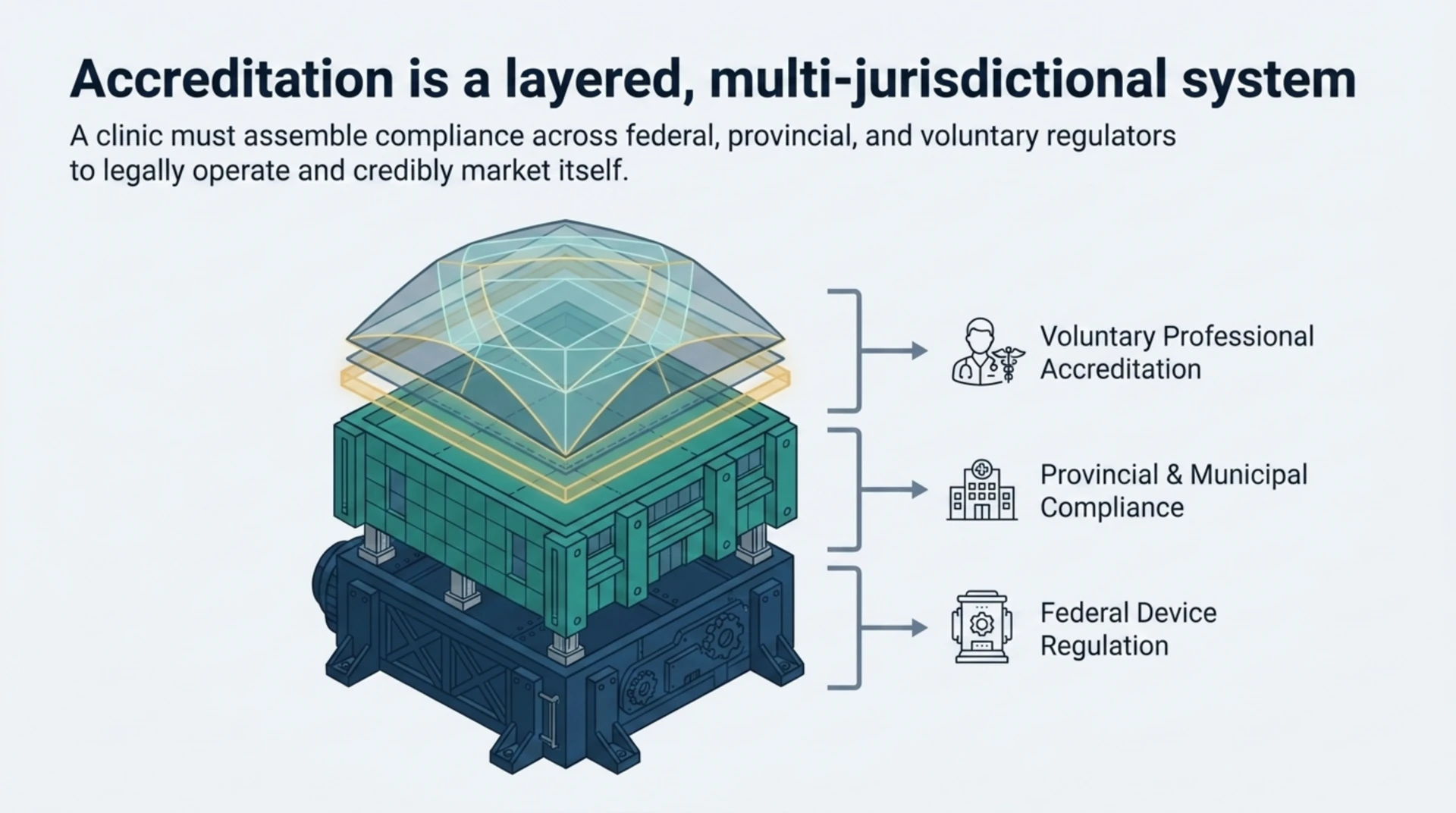
Hyperbaric clinic accreditation pathways in Canada are the combination of federal device regulation, provincial safety compliance, and voluntary professional accreditation that together determine whether a hyperbaric oxygen therapy (HBOT) facility can legally operate and credibly market itself. Unlike a hospital licence, there is no single “hyperbaric clinic licence” issued by one body. Instead, a clinic assembles compliance across several regulators, and the mix depends on whether the facility is hospital-based, a private monoplace clinic, or something in between.
For clinic owners and operators, understanding which pathway applies to which part of the operation is the difference between a defensible compliance file and a patchwork that falls apart under scrutiny. This comparison walks through the federal, provincial, and voluntary layers, and lays out where they overlap and where they do not.
What Are Hyperbaric Clinic Accreditation Pathways in Canada?
In practical terms, “accreditation” for a hyperbaric facility in Canada spans at least three distinct categories of oversight:
- Federal device regulation: Health Canada licenses the hyperbaric chamber itself as a medical device under the Medical Devices Regulations.
- Provincial and municipal compliance: pressure vessel registration, fire code approval, electrical inspection, and (for some facility types) health facility licensing under provincial legislation.
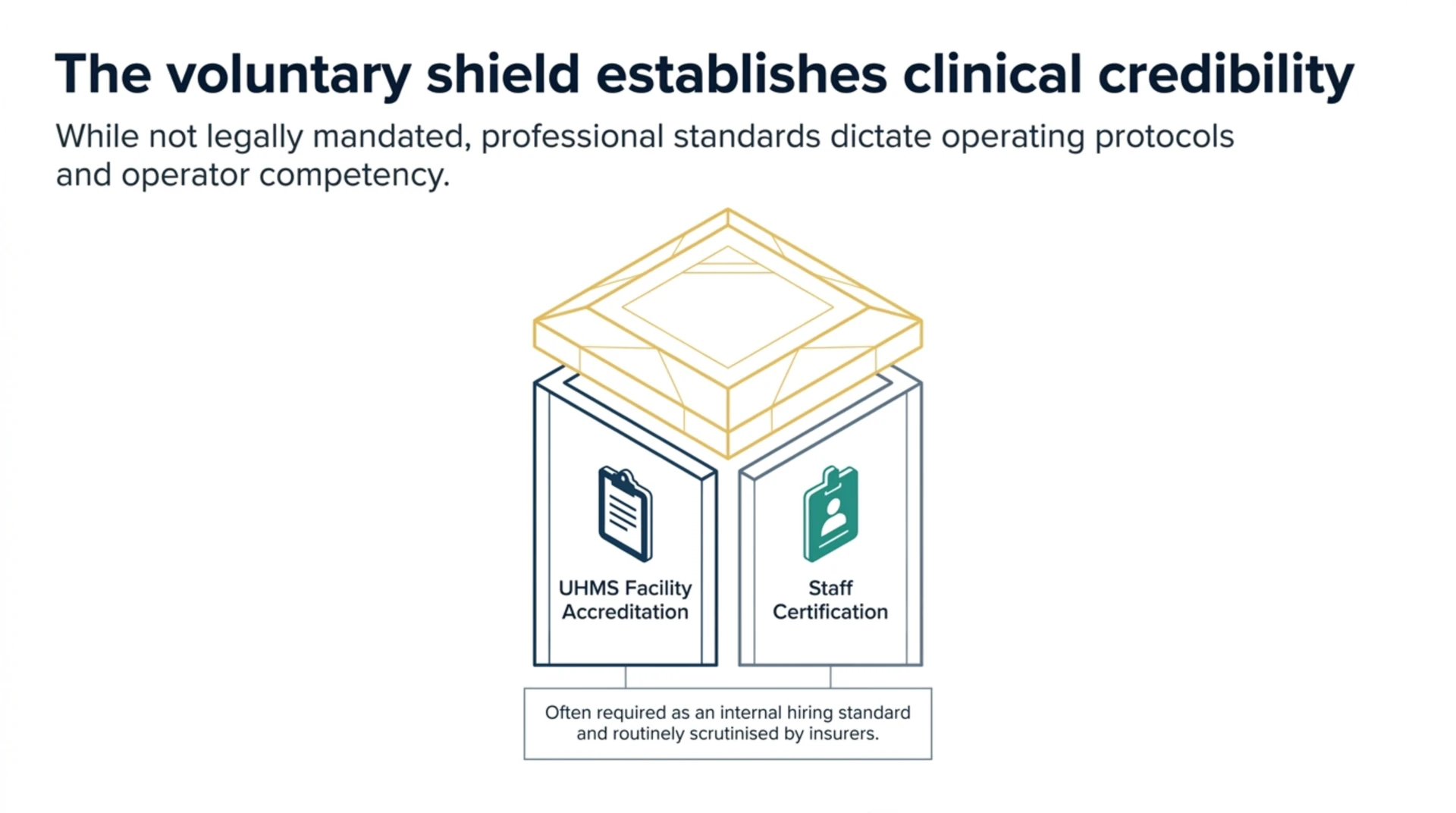
- Voluntary professional accreditation: programs such as the Undersea and Hyperbaric Medical Society’s (UHMS) facility accreditation, which are not legally required but are increasingly used as a credibility signal for referring physicians, insurers, and patients.
These three layers are independent of one another. A clinic can hold a valid Health Canada device licence and still be non-compliant on the pressure vessel side, or vice versa. Treating them as a single bundled “accreditation” is one of the more common planning mistakes new operators make.
Why Does Accreditation Matter for Clinic Owners?
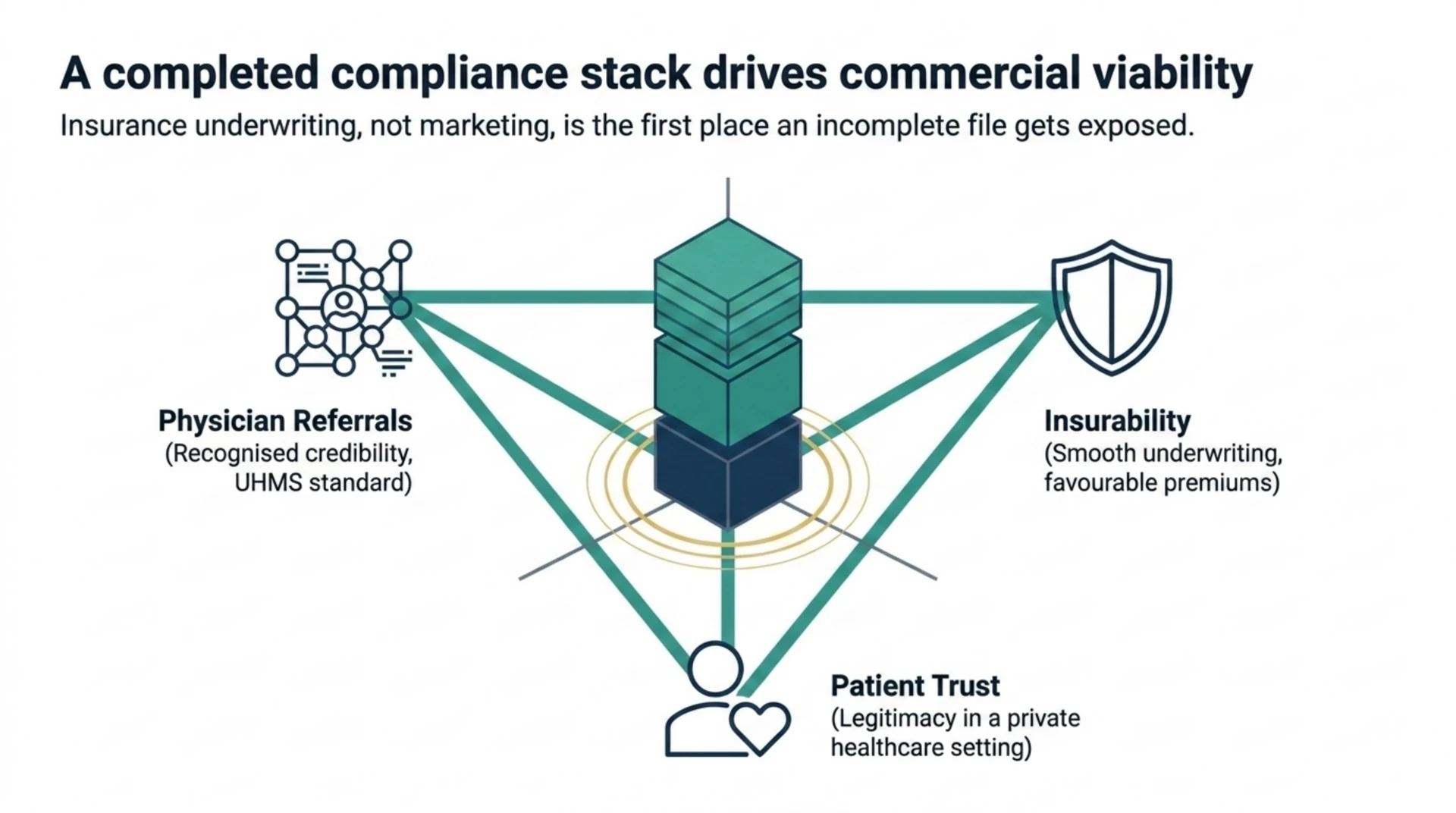
Beyond the legal minimum, accreditation shapes three things that matter commercially: insurability, physician referral confidence, and patient trust.
Insurers underwriting a hyperbaric facility will typically ask for evidence across all three layers described above, not just the device licence. A gap in provincial pressure vessel documentation is a common reason cited for higher premiums or coverage refusal. Insurance underwriting, not marketing, is usually the first place an incomplete accreditation file gets exposed.
Referring physicians and allied health providers also use accreditation status as a proxy for safety and quality, particularly when a patient asks whether a private clinic is “legitimate.” A clinic that can point to a clear, documented compliance stack has an easier time building physician relationships than one that cannot.
How Does Health Canada Regulate Hyperbaric Chambers?
Medical Device Licensing
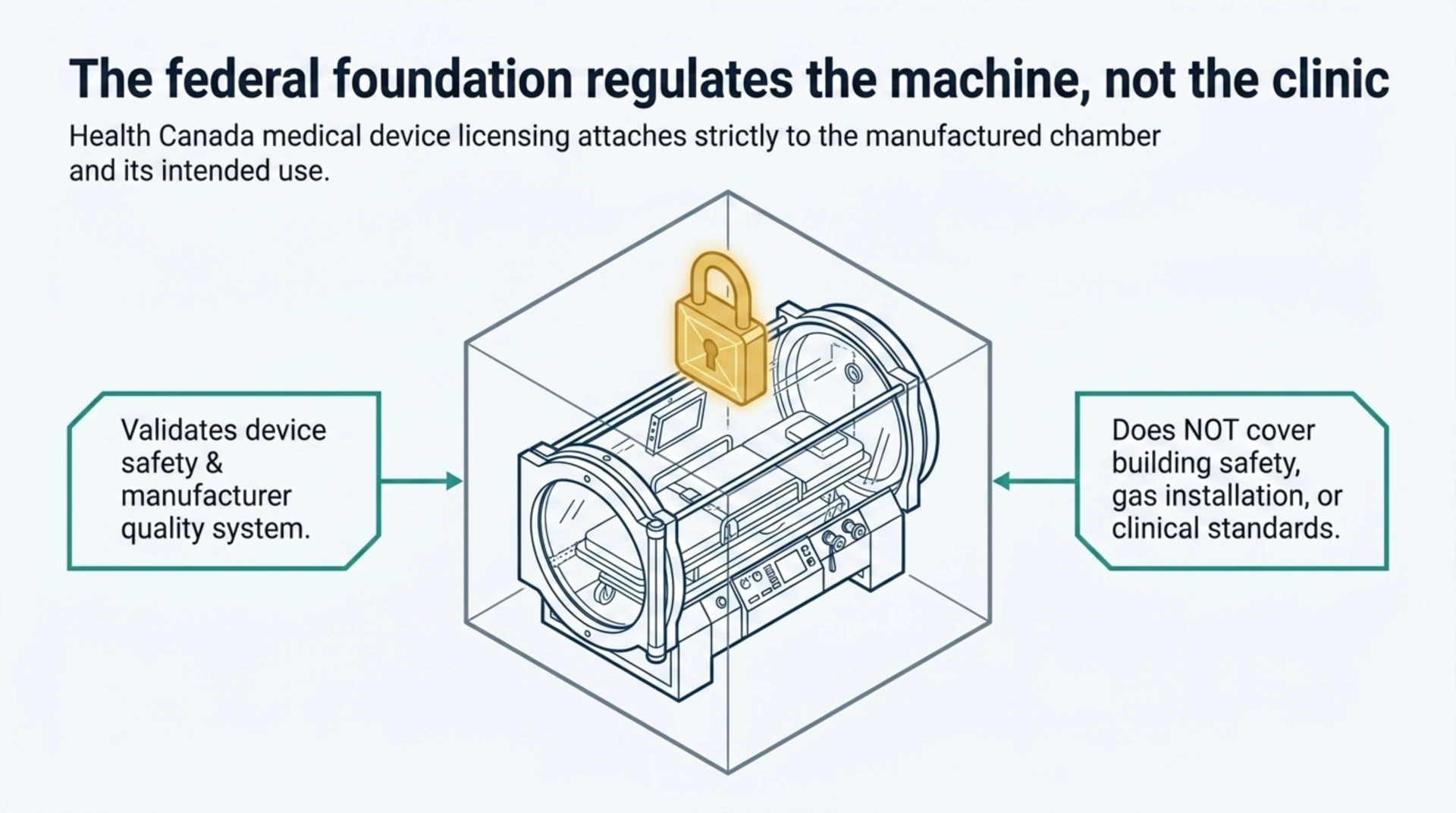
Hyperbaric chambers intended for medical use are regulated by Health Canada as medical devices under the Food and Drugs Act and the Medical Devices Regulations. Depending on the chamber’s design and intended use, it will fall into a device class that determines the rigour of the licensing pathway, including quality system requirements the manufacturer must meet.
This licence attaches to the device and its manufacturer, not to the clinic operating it. A clinic’s job is to confirm the specific chamber it installs carries a valid, current Health Canada licence and to keep that documentation on file, not to apply for the licence itself.
What This Licence Does Not Cover
A Health Canada device licence says nothing about the building the chamber sits in, whether the compressed air or oxygen supply is installed to code, or whether the clinic’s operating protocols meet a clinical standard. Those questions sit entirely with the provincial and voluntary layers described below.
What Provincial Requirements Apply to Hyperbaric Facilities?
Pressure Vessel and Fire Code Inspections
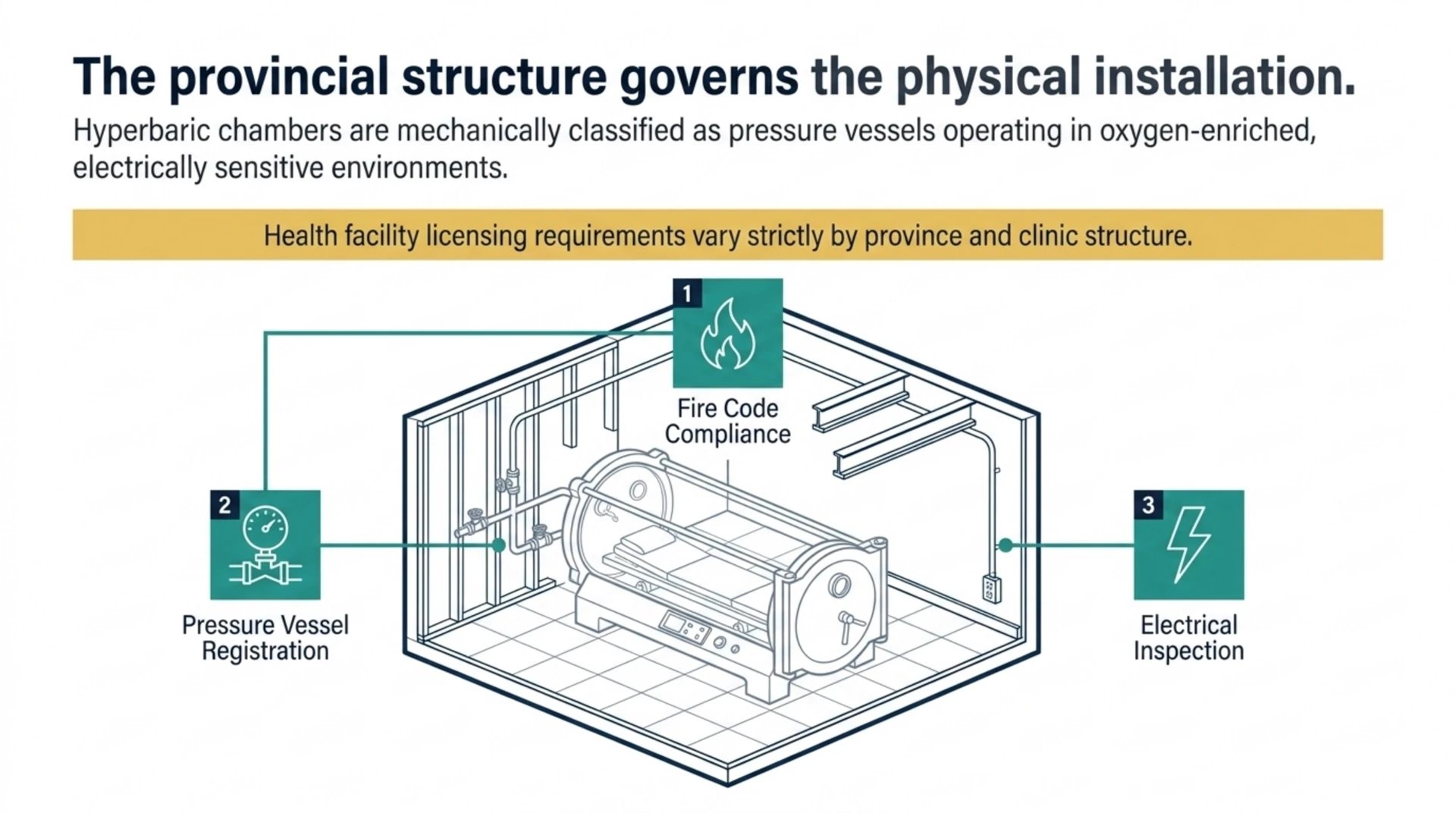
Because a hyperbaric chamber is, mechanically, a pressure vessel, most provinces require registration and periodic inspection through the same regulatory bodies that oversee boilers and pressure equipment. Fire code compliance, particularly around oxygen-enriched environments and hyperbaric-rated electrical systems, is a separate provincial and municipal requirement layered on top. This pressure vessel and fire/electrical layer is covered in Canada by CSA Z275.1, the national standard for hyperbaric facility safety.
These inspections are recurring, not one-time. A clinic’s accreditation file needs a renewal calendar for pressure vessel and fire code sign-off, not just a single certificate from the original installation.
Health Facility Licensing Where It Applies
Whether a hyperbaric clinic needs a provincial health facility licence depends heavily on its legal structure. A hospital-based chamber operates under the hospital’s existing licensing and accreditation umbrella. A freestanding private clinic may fall under a different provincial framework depending on whether it is physician-owned, whether it bills any public plan, and how the province in question defines a “private health facility.”
This is the part of the pathway that varies most by province, and it is worth confirming directly with the relevant provincial ministry rather than assuming a rule from one province applies in another.
Comparing the Main Accreditation and Compliance Pathways
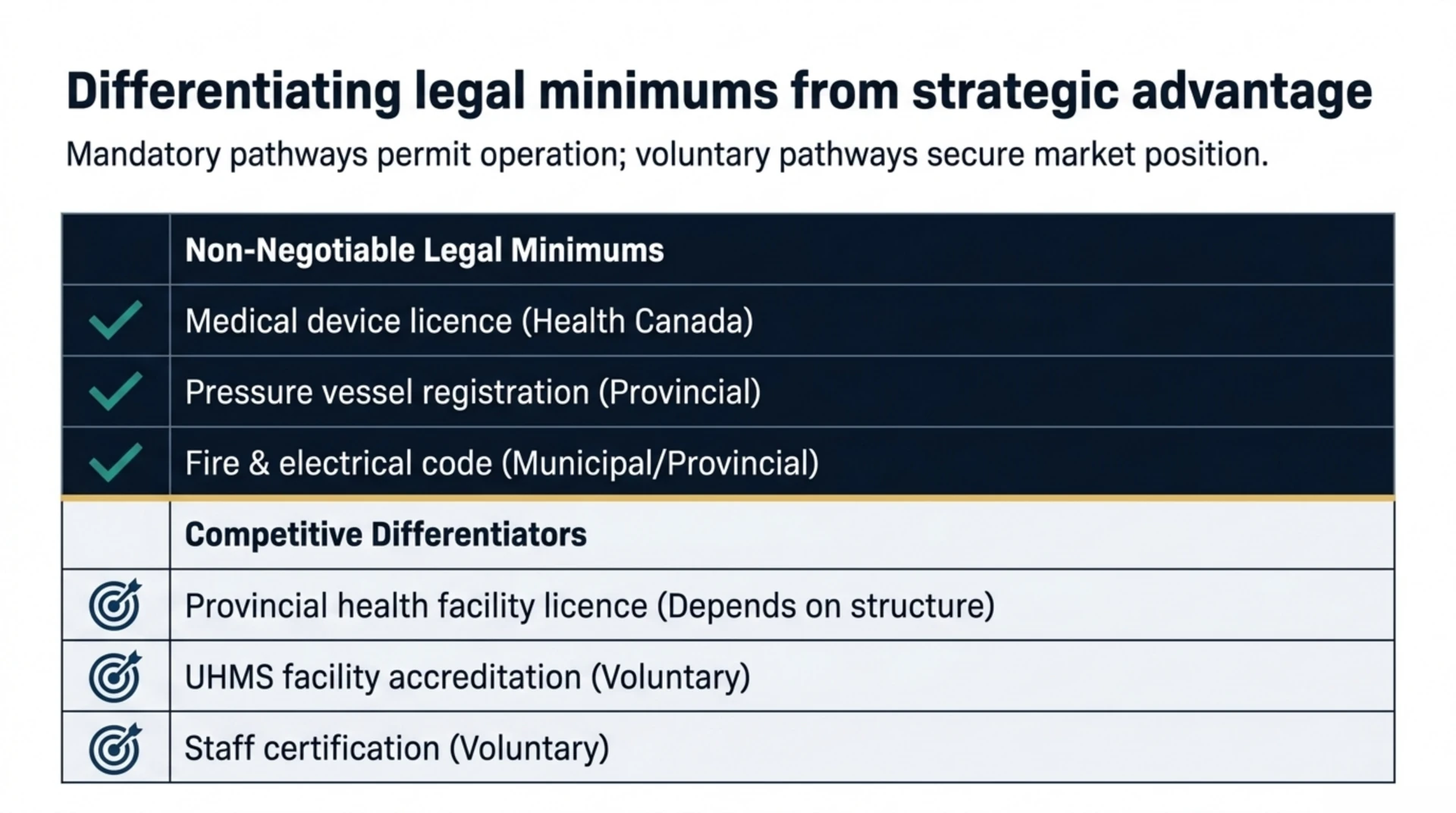
The table below summarizes how the main pathways differ in scope, who administers them, and whether they are mandatory.
| Pathway | Administered By | Mandatory? | What It Covers |
|---|---|---|---|
| Medical device licence | Health Canada | Yes | The chamber as a manufactured device |
| Pressure vessel registration | Provincial safety authority | Yes | Structural and mechanical safety of the installed chamber |
| Fire and electrical code compliance | Provincial/municipal authority | Yes | Building safety in an oxygen-enriched environment |
| Provincial health facility licence | Provincial ministry of health | Depends on structure | Clinical operation of the facility itself |
| UHMS facility accreditation | Undersea and Hyperbaric Medical Society | No (voluntary) | Clinical protocols, staffing and safety practices |
| Staff certification (e.g. CHT) | Professional certifying bodies | No (voluntary, but often expected) | Individual operator competency |
The mandatory rows are non-negotiable; the voluntary rows are where clinics differentiate themselves. A clinic that treats the voluntary layer as optional entirely is not doing anything illegal, but it is leaving a credibility gap that competitors who pursue it will use against it.
Is UHMS Facility Accreditation Worth Pursuing in Canada?
UHMS facility accreditation is a voluntary program that reviews a hyperbaric facility’s clinical protocols, safety practices, staffing, and quality assurance processes against a published standard. It is not a Canadian regulatory requirement, but a number of Canadian clinics pursue it because referring physicians recognize the designation.
For clinics that rely heavily on physician referrals rather than direct patient marketing, this accreditation often pays for itself in referral confidence. For clinics operating primarily on direct-to-consumer wellness demand, the return on the accreditation effort is less clear cut and should be weighed against the administrative cost of preparing for review.
What About Staff Certification Requirements?
Beyond facility-level accreditation, individual hyperbaric technologists and safety directors can pursue certification such as Certified Hyperbaric Technologist (CHT) credentials through recognised certifying bodies. These are not government-mandated in most provinces, but many facilities require them internally as a condition of employment, and some insurers ask about staff certification levels during underwriting.
Staff certification is the layer most often underfunded in a new clinic’s first year, simply because it is not legally required up front. Building it into the initial staffing budget avoids a scramble later when a referral partner or insurer asks for it.
Hospital-Based vs Private Monoplace Clinics: How Do the Pathways Differ?
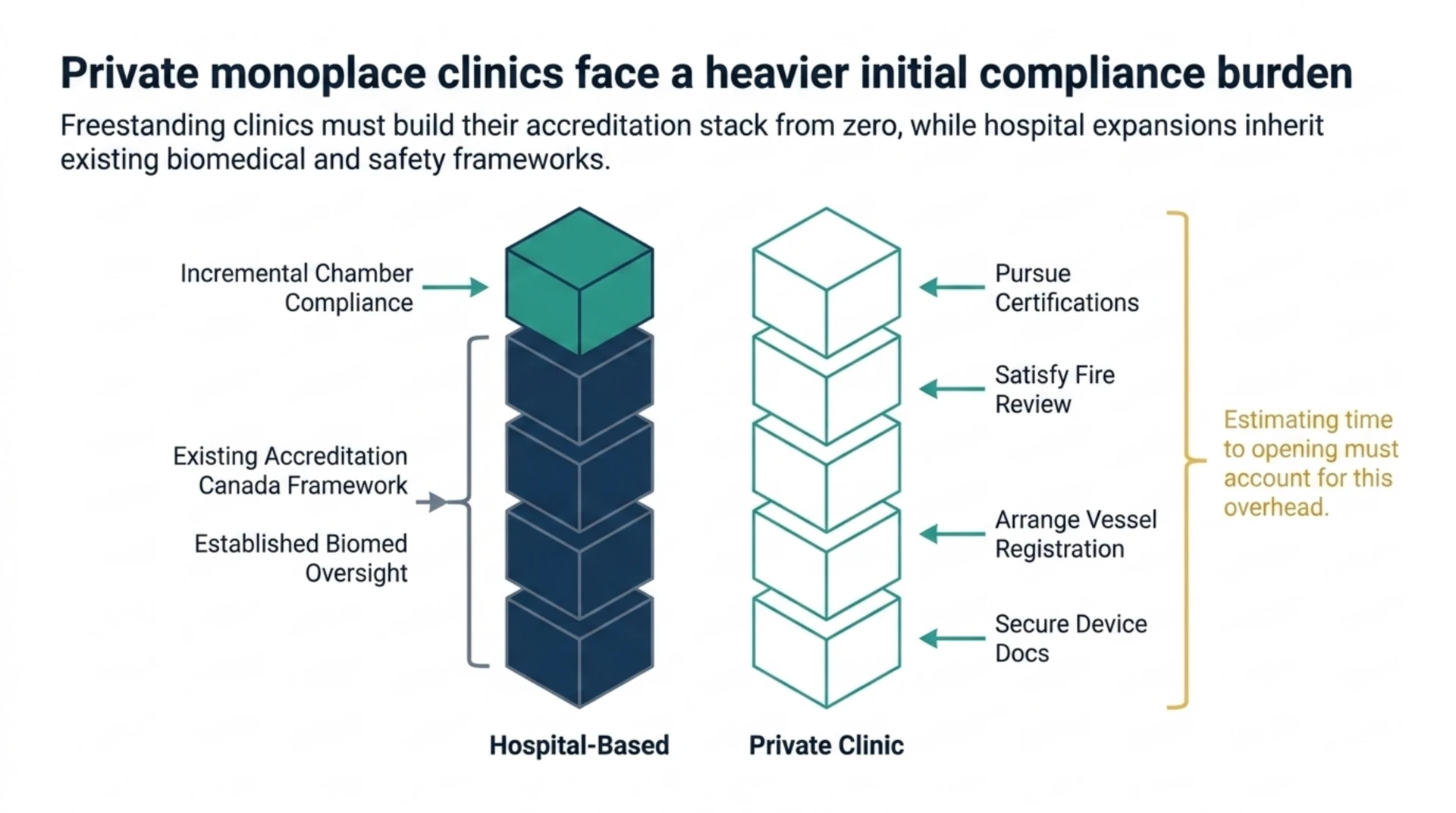
A hospital-based multiplace chamber typically inherits much of its compliance structure from the hospital’s existing accreditation (often through a national hospital accreditation body) and its established biomedical engineering and safety departments. The incremental accreditation burden for adding hyperbaric services to an already-accredited hospital is comparatively lower.
A freestanding private monoplace clinic starts from zero on nearly every layer: it must independently secure the device licence documentation, arrange its own pressure vessel registration, satisfy its own fire code review, and decide separately whether to pursue voluntary accreditation and staff certification. This is why private clinic launches take longer to reach full compliance than hospital-based expansions, even though the chamber technology itself may be identical.
Clinic owners comparing a hospital partnership model against an independent buildout should weigh this compliance overhead as a real cost, not just a formality, when estimating time to opening.
Frequently Asked Questions
Does Health Canada license hyperbaric clinics directly?
No. Health Canada licenses the hyperbaric chamber as a medical device. The clinic itself is regulated through provincial and, where applicable, voluntary accreditation channels, not through a separate Health Canada clinic licence.
Is UHMS accreditation required to operate a hyperbaric clinic in Canada?
No, it is voluntary. It is not a legal requirement anywhere in Canada, though some referring physicians and insurers treat it as a meaningful credibility signal.
Do all provinces require a health facility licence for a private hyperbaric clinic?
Requirements vary by province and depend on the clinic’s legal structure and whether it bills any public health plan. Owners should confirm directly with their provincial ministry of health rather than assuming a rule from another province applies.
How often does pressure vessel registration need to be renewed?
Pressure vessel inspection and registration is a recurring requirement, not a one-time approval, and the interval is set by the provincial safety authority responsible for pressure equipment.
Does a hospital-based hyperbaric unit need separate accreditation from the hospital?
Typically the unit operates under the hospital’s existing accreditation and biomedical safety oversight, though the device-level Health Canada licence and provincial pressure vessel registration still apply to the specific chamber.
What happens if a clinic operates with an expired pressure vessel registration?
This creates both a safety and a liability exposure and can affect insurance coverage. It should be treated as an operational priority, not an administrative afterthought, and tracked on a renewal calendar.
Are staff certifications like CHT legally mandatory in Canada?
In most provinces they are not legally mandatory, but many facilities require them as an internal hiring standard, and some insurers and referral partners ask about staff certification levels.
Owners weighing a private buildout against a hospital-affiliated model should also look at where the clinical evidence for their intended indications currently stands. Canada Hyperbarics maintains condition-specific overviews at /conditions/ that are worth reviewing alongside the compliance pathway, since the strength of evidence for a given indication often shapes what an accreditation reviewer or referring physician will expect to see documented.
For a province-by-province regulatory overview, see the /regulatory/ section, and for common operator questions the /faq/ page covers several accreditation and licensing basics not repeated here.
Related Reading
- HBOT Indications in Canada: A 2026 Referral Guide to the Health Canada and UHMS Lists for Physicians
- Which HBOT Service Lines Have the Strongest 2026 Evidence? An Industry Briefing for Canadian Clinic Owners
- Traveling for Hyperbaric Oxygen Therapy in Canada: FAQ
Canada Hyperbarics tracks these pathways as part of an independent, educational resource on HBOT regulation in Canada, not as an accreditation body itself. For a directory of hospitals and regulated facilities offering hyperbaric oxygen therapy, visit /facilities/.
This content is for informational purposes only and is not medical advice.