
TL;DR: A hyperbaric medical director is the physician who holds legal and clinical oversight responsibility for a Canadian hyperbaric facility’s chamber operations, patient safety protocols, and staff training. Provincial medical colleges, Health Canada device rules, and voluntary accreditation standards all shape who can fill this role and what records they must keep. This guide walks clinic owner-operators through the hyperbaric medical director requirements in Canada, from credentials to day-to-day oversight duties.
If you are planning to open or formalize a hyperbaric oxygen therapy (HBOT) program in Canada, one of your first staffing questions will be hyperbaric medical director requirements in Canada: who qualifies, what they are responsible for, and how that role fits into the province’s licensing framework. This post breaks the question into practical steps so an owner-operator can budget time and money for recruiting, vetting, and supporting this position correctly.
Canada Hyperbarics compiles this kind of practitioner resource so that facility owners, administrators, and newly recruited medical directors have a shared starting point. Nothing here replaces advice from your provincial college or your own health law counsel; it is a map of the terrain, not a legal opinion.
What Is a Hyperbaric Medical Director?
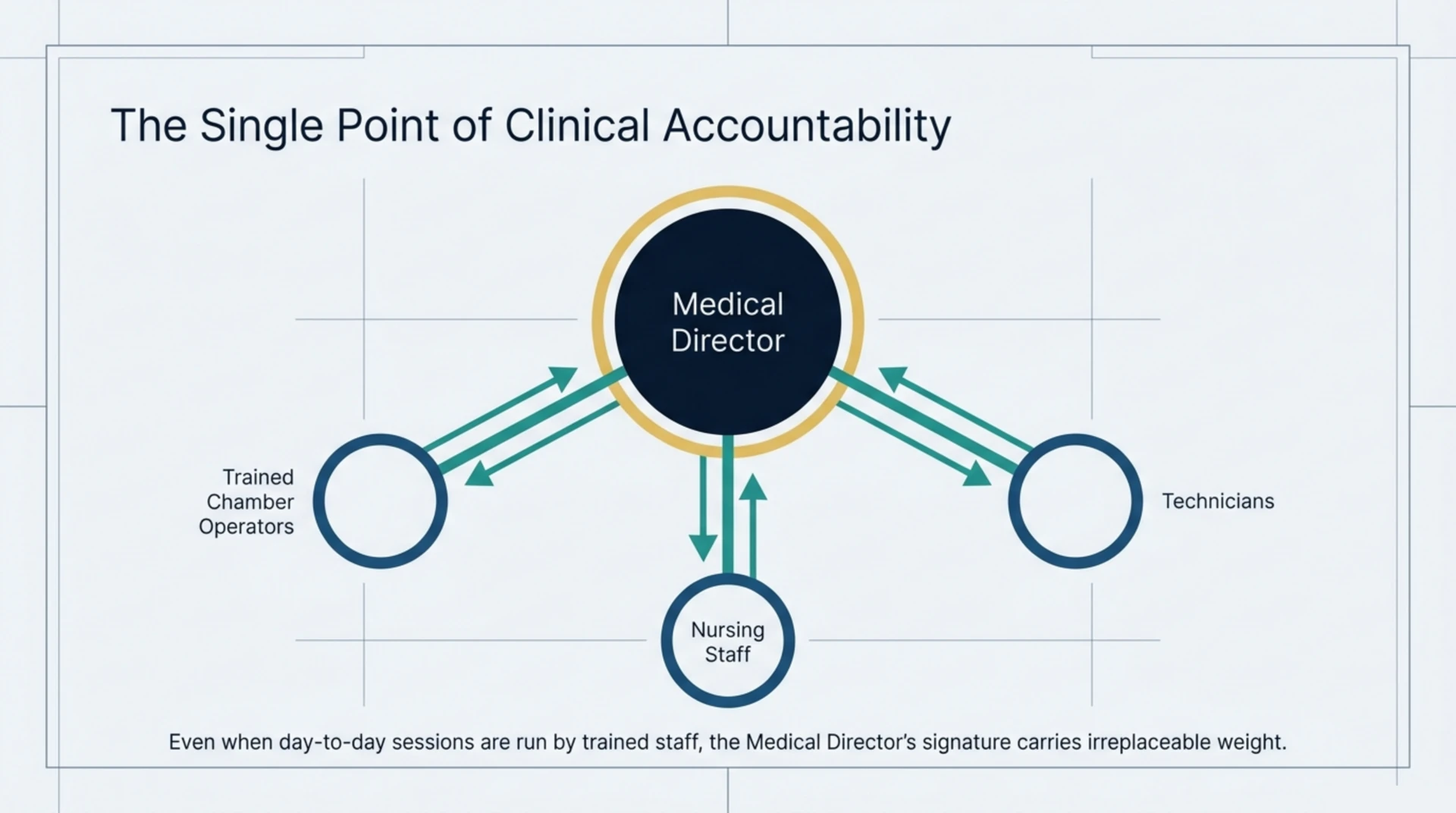
A hyperbaric medical director is the licensed physician named as clinically and legally accountable for a facility’s HBOT program. The title is not symbolic. In most Canadian jurisdictions, any clinic operating a hyperbaric chamber for medical treatment needs a physician of record who signs off on treatment protocols, approves which patients are suitable candidates, and takes responsibility if something goes wrong during a session.
The medical director is the single point of clinical accountability for the program, even when day-to-day sessions are run by trained chamber operators and nursing staff. That distinction matters for owner-operators building out a staffing plan, because it means the director’s signature carries weight that no other role on the team can substitute for.
What Are Hyperbaric Medical Director Requirements in Canada?
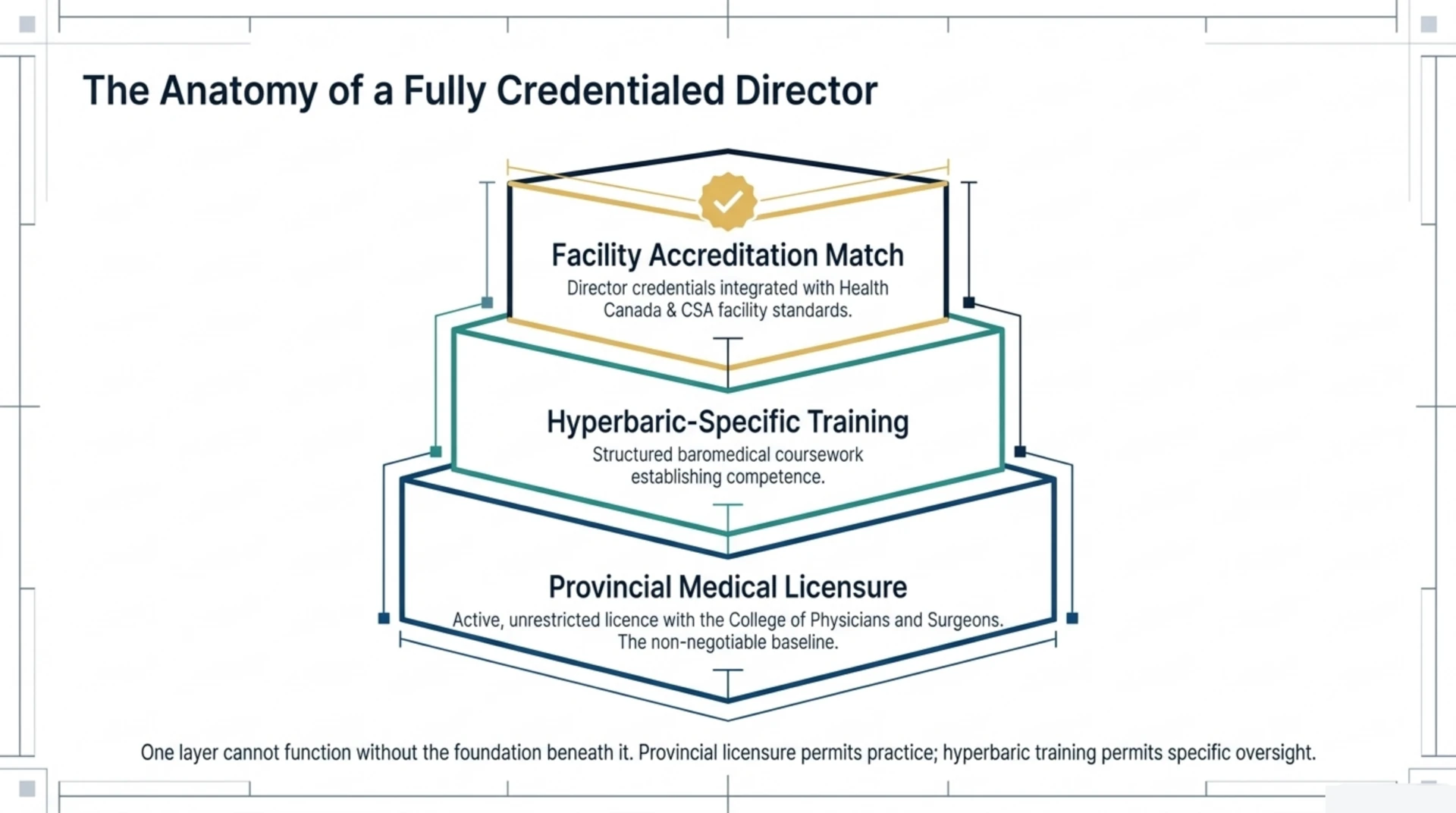
There is no single federal “hyperbaric medical director licence” in Canada. Instead, the requirements are assembled from three layers: general medical licensure, hyperbaric-specific training, and facility-level accreditation expectations. Owner-operators need to satisfy all three before the program can be considered properly staffed.
Medical Licensure and Provincial College Registration
First, the candidate must hold an active, unrestricted licence to practise medicine with the College of Physicians and Surgeons (or equivalent regulatory college) in the province where the facility operates. This is non-negotiable and is usually the easiest box to check, since most candidates come from emergency medicine, family medicine, anesthesia, or occupational medicine backgrounds.
Licensure confirms the physician can practise medicine in that province, but it does not by itself confirm hyperbaric competence. That is the second layer.
Hyperbaric-Specific Training and Certification
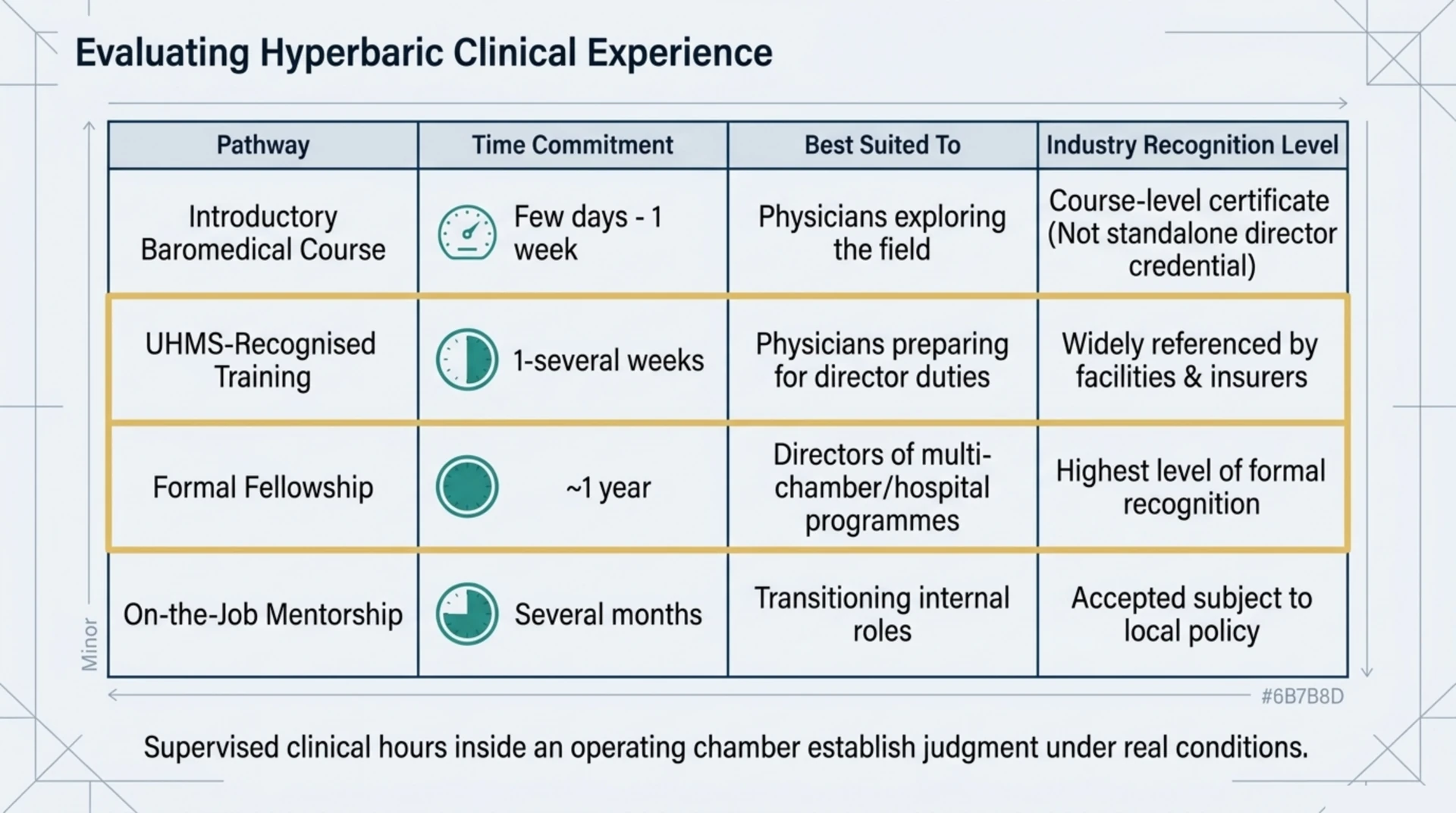
Beyond general licensure, a medical director should complete structured hyperbaric medicine training. In practice this usually means a baromedical or undersea and hyperbaric medicine course recognised by a body such as the Undersea and Hyperbaric Medical Society (UHMS), often delivered through a university-affiliated program. Some directors go further and complete a formal fellowship in undersea and hyperbaric medicine.
The depth of training a facility should expect often depends on the complexity of the patient population being considered, including whether the clinic plans to treat only conditions within a narrow, well-defined scope or a broader range of indications. For background on the kinds of conditions clinicians may consider HBOT for, see our conditions overview rather than treating any single condition as a training benchmark here.
Clinical Experience Expectations
Most credentialing bodies and liability insurers also look for supervised clinical hours inside an operating chamber before a physician takes on an unsupervised director role. This mirrors how other procedural specialties build competence: classroom training establishes the knowledge base, and supervised hours establish judgment under real operating conditions.
| Pathway | Typical time commitment | Best suited to | Recognition |
|---|---|---|---|
| Introductory baromedical course | A few days to one week | Physicians new to hyperbaric medicine exploring the field | Course-level certificate, not a standalone director credential |
| UHMS-recognised physician training | One to several weeks, often module-based | Physicians preparing to take on director duties | Widely referenced by Canadian facilities and insurers |
| Formal fellowship in undersea and hyperbaric medicine | Roughly one year | Physicians directing larger, multi-chamber or hospital-based programs | Highest level of formal recognition |
| On-the-job mentorship under an existing director | Variable, often several months | Transitioning director roles within the same facility | Accepted by some facilities, subject to local policy |
What Does a Medical Director Actually Oversee?
Once in place, the medical director’s job is ongoing, not a one-time credential check. Owner-operators should expect the role to include the following areas.
Patient Selection and Referral Oversight
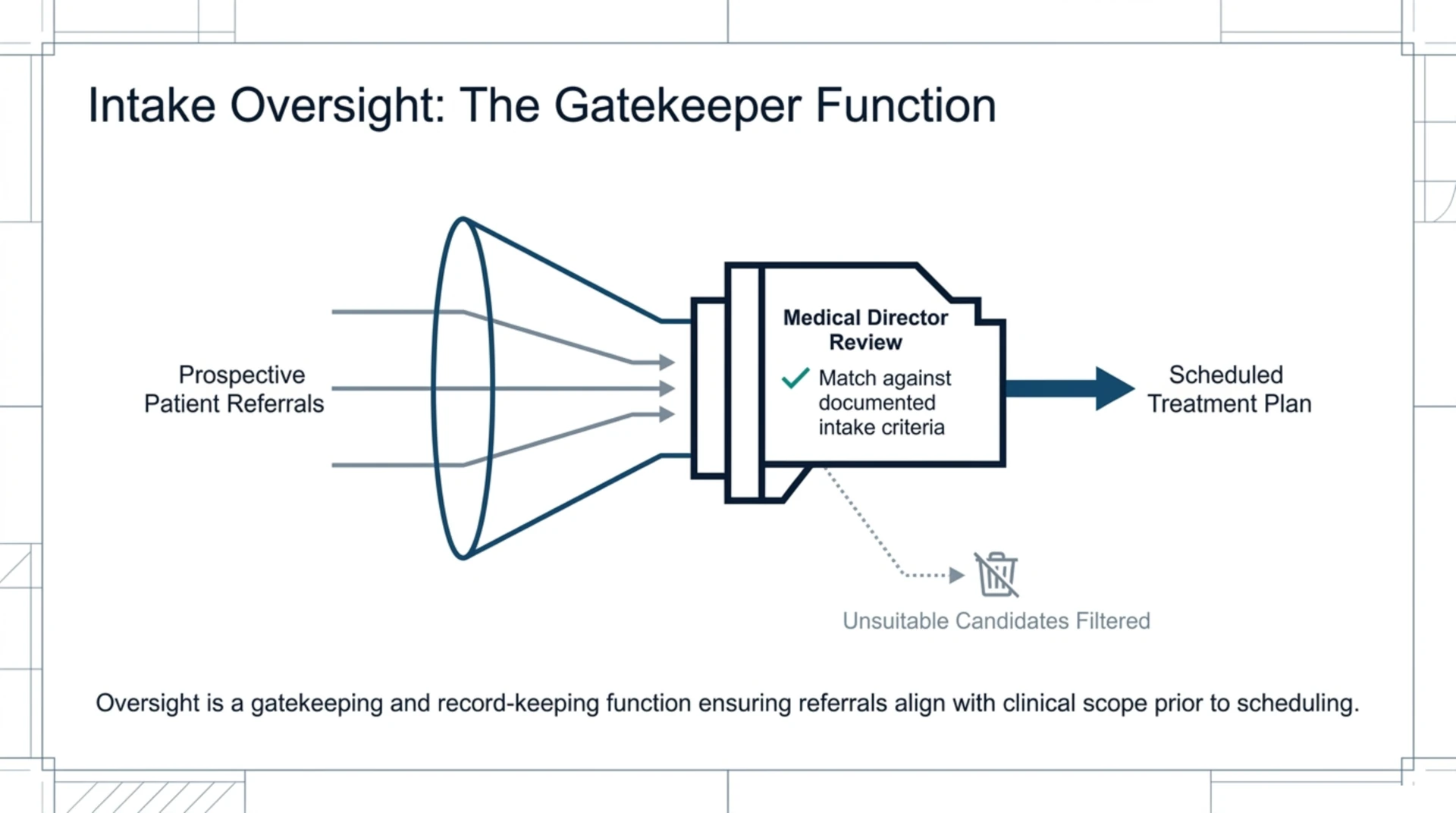
The medical director reviews referrals and confirms that each prospective patient fits the facility’s documented intake criteria before a treatment plan is scheduled. This oversight step is about appropriate screening and documentation, not a clinical outcome; it is a gatekeeping and record-keeping function. For an overview of the categories of conditions clinicians may consider referring for HBOT, visit our conditions page.
Chamber Safety and Operations
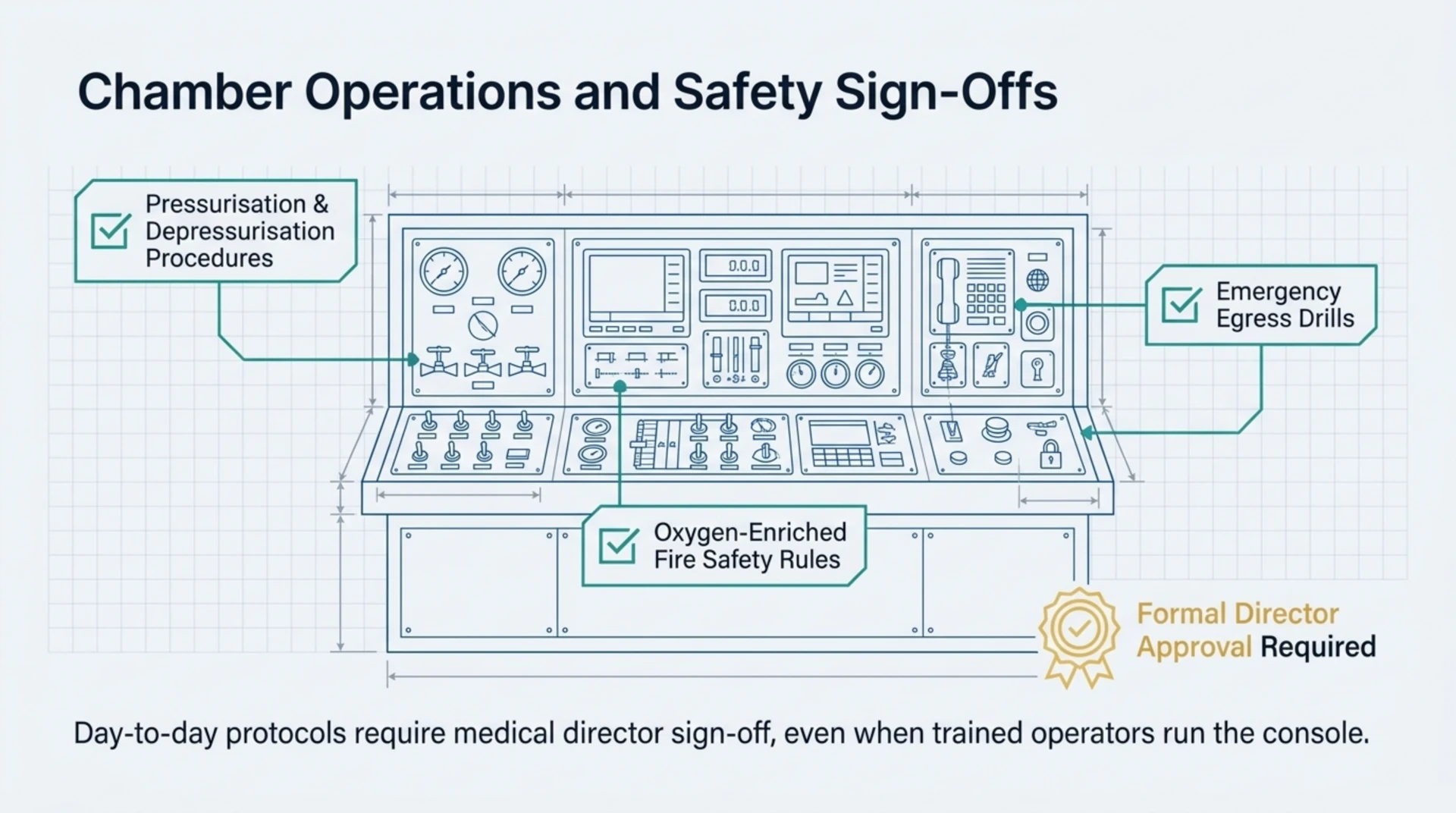
Day-to-day chamber safety protocols, emergency procedures, and equipment maintenance schedules all require medical director sign-off, even when a trained operator runs the console. This includes setting pressurization and depressurization procedures, fire safety rules specific to oxygen-enriched environments, and emergency egress drills.
Staff Training and Credentialing
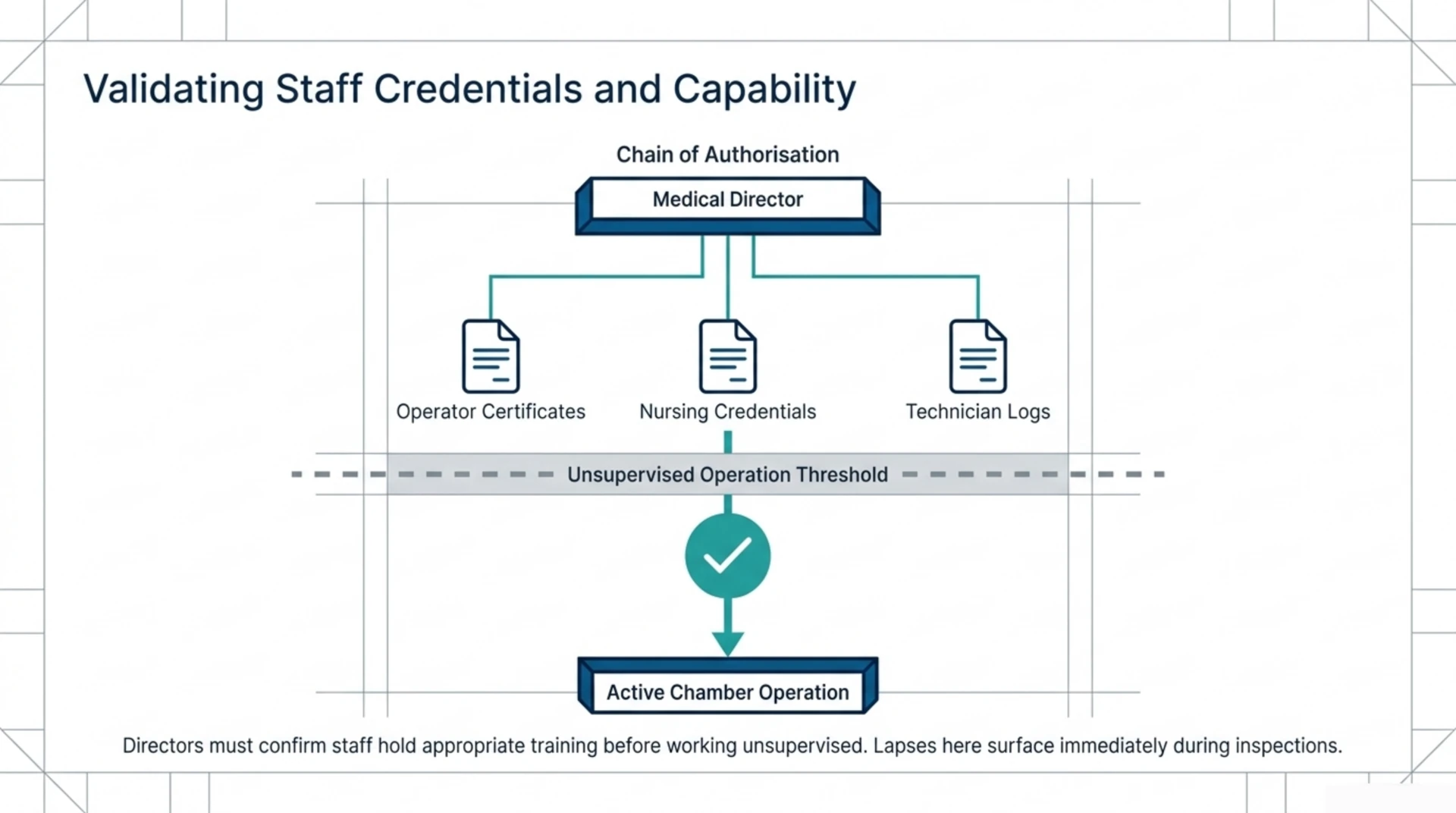
The director is typically responsible for confirming that chamber operators, nurses, and technicians hold appropriate training before they work unsupervised, and for keeping those training records current. Clinics that skip this step tend to run into trouble during inspections or insurance renewals.
How Do Canadian Facilities Credential a Medical Director?
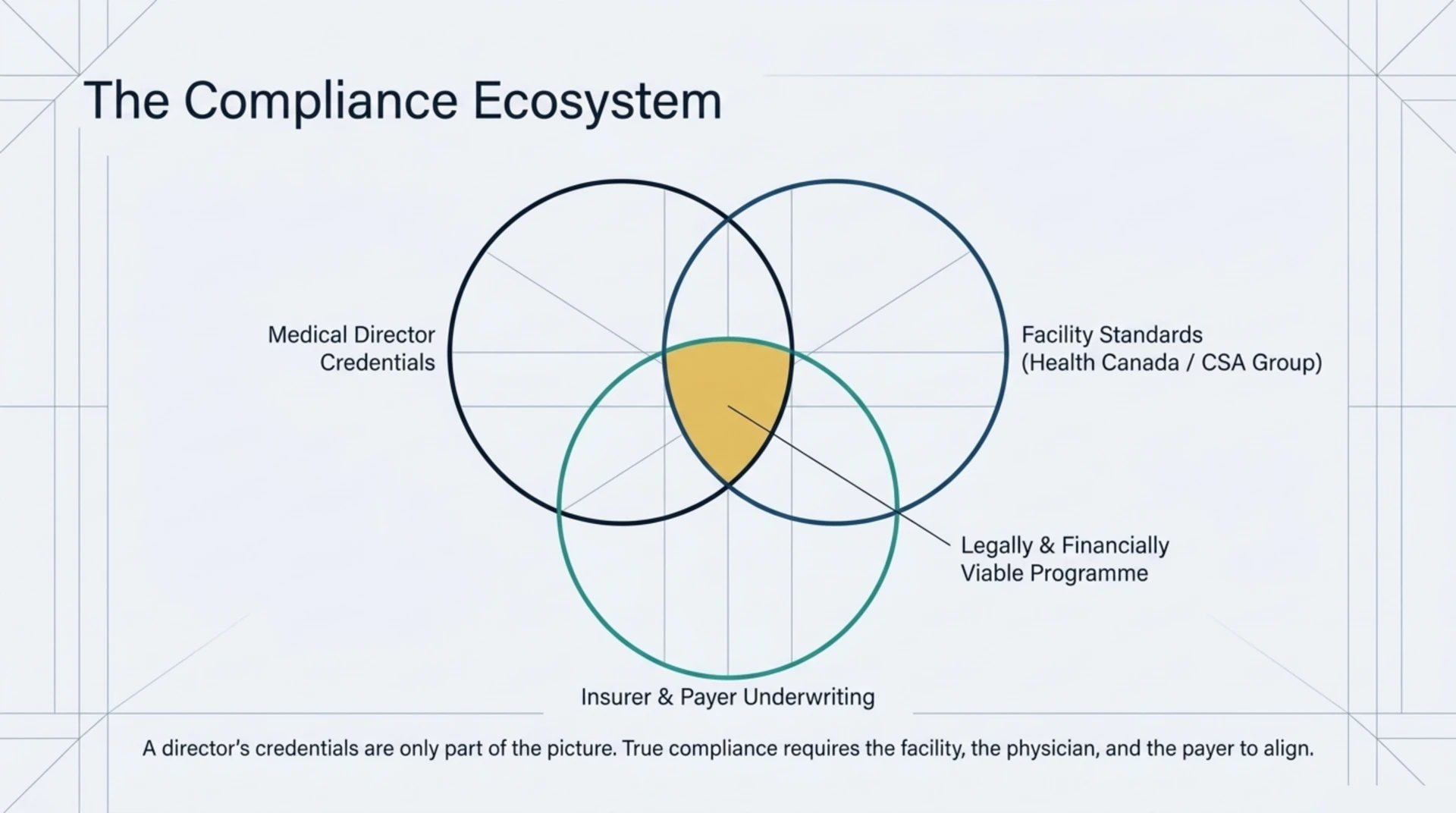
Facility-level accreditation and standards also shape what owner-operators need to document. Chambers themselves fall under Health Canada’s medical device framework, and facility design and operating procedures are commonly benchmarked against CSA Group hyperbaric facility standards. Our regulatory page walks through how these pieces fit together for Canadian clinics.
A medical director’s credentials are only part of the compliance picture; the facility itself must also meet device, construction, and operating standards. Owner-operators who treat the director hire as the entire compliance project often discover gaps during their first external audit.
How Does Medical Director Oversight Affect Facility Coverage?
Insurance underwriters and, in some cases, extended health or workers’ compensation payers ask for documentation of medical director credentials before they will set coverage terms for a hyperbaric program. A facility that cannot produce a current director credential file, training records, and sign-off logs may face delayed approvals or higher premiums. Our coverage page outlines how documentation like this typically factors into payer conversations in Canada.
What Ongoing Compliance Does the Role Require?
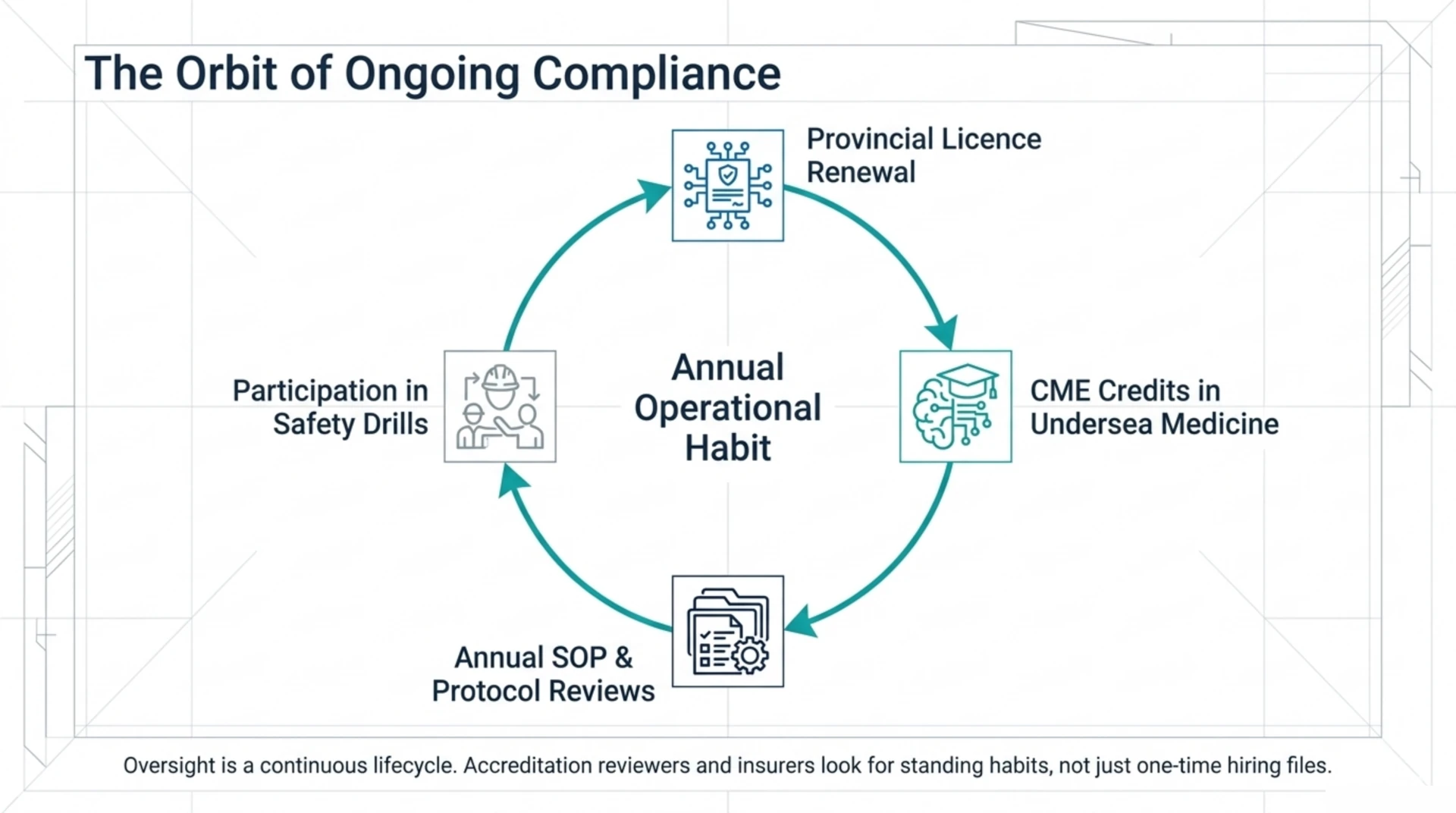
Most provinces expect ongoing proof that the director’s training stays current, not just a one-time credential on file. Continuing medical education in hyperbaric and undersea medicine, periodic review of the facility’s standard operating procedures, and documented participation in safety drills are common renewal expectations. Owner-operators should build a simple annual checklist, for example confirming licence renewal with the provincial college, logging any new hyperbaric-specific coursework the director has completed, and archiving updated sign-offs on protocols and emergency procedures. A renewal checklist like this turns medical director oversight from a hiring-day task into a standing operational habit, which is usually what accreditation reviewers and insurers actually want to see when they ask for documentation.
How Can a Clinic Find or Vet a Qualified Medical Director?
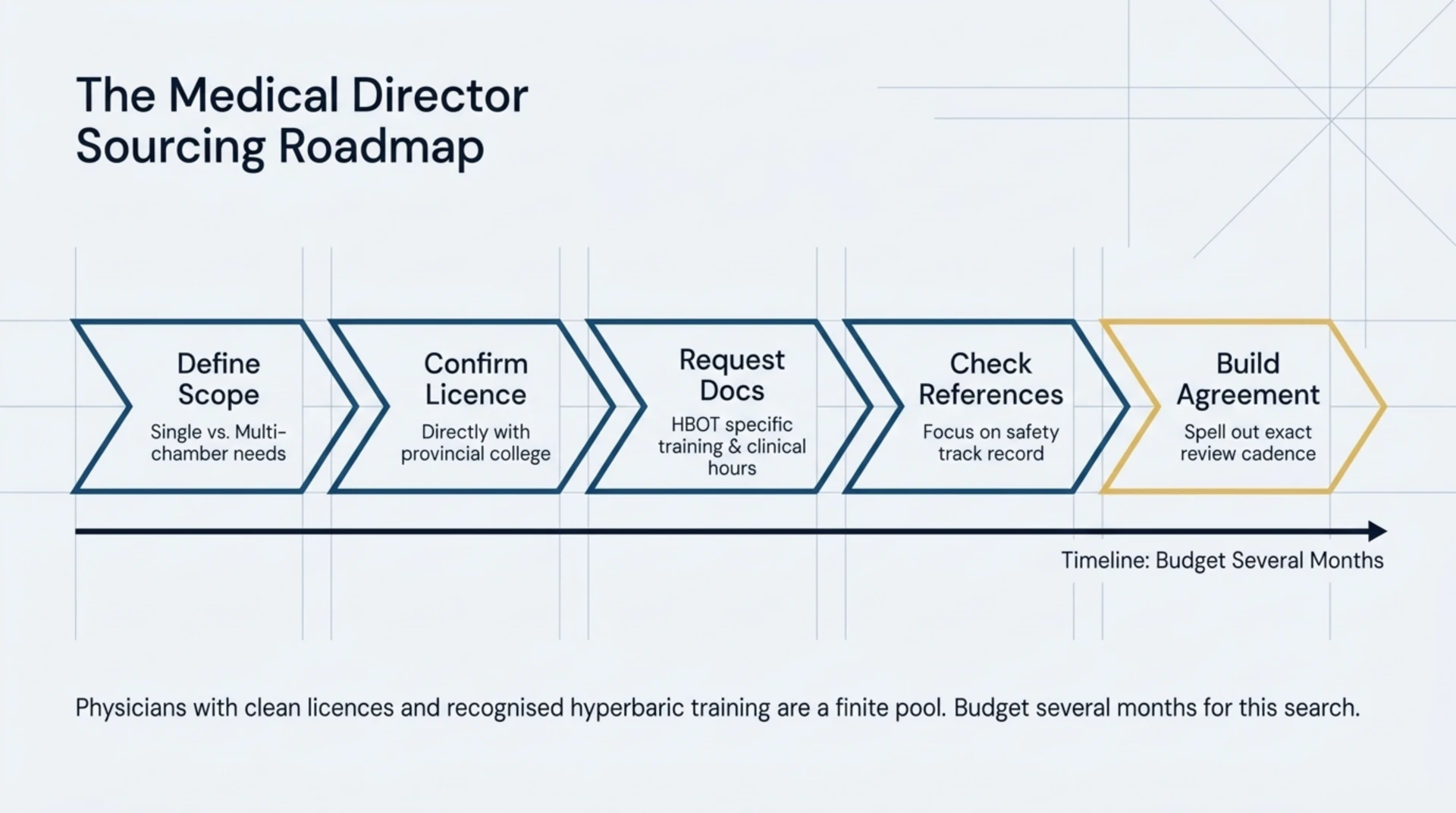
Clinics that are just starting out often underestimate how long recruitment takes. Physicians with both a clean provincial licence and completed hyperbaric-specific training are not a large pool in Canada, and many already hold director or consulting roles elsewhere. Building in a recruitment timeline of several months, rather than assuming a director can be found and onboarded within weeks, tends to save owner-operators from rushed decisions on a role this central to the program.
For owner-operators starting this search, a practical sequence helps:
First, define the scope of the program. A single-chamber clinic treating a narrow set of referrals has different staffing needs than a multi-chamber facility working alongside a hospital network.
Second, confirm provincial licensure status directly with the relevant college before any formal offer. This step is quick and prevents a costly mismatch later.
Third, request documentation of hyperbaric-specific training and any supervised clinical hours, rather than relying on a verbal summary of experience.
Fourth, check references from prior facilities, specifically asking about the candidate’s track record on safety protocol development and staff training follow-through.
Fifth, build a written agreement that spells out review cadence, for example how often the director will review protocols, sign off on new patient intakes, and audit chamber logs, so the oversight relationship does not quietly lapse into a name-only arrangement.
Frequently Asked Questions
Does every hyperbaric facility in Canada need a medical director?
Any facility operating a hyperbaric chamber for medical treatment should have a named physician accountable for clinical oversight. Requirements and terminology can vary by province, so confirm specifics with your provincial college.
Can a general practitioner serve as a hyperbaric medical director?
Yes, provided they complete recognised hyperbaric-specific training and, typically, supervised clinical hours. A general medical licence alone is usually not considered sufficient on its own.
How long does it take to become qualified as a hyperbaric medical director?
It depends on the pathway chosen. An introductory course can take about a week, while a formal fellowship runs roughly a year. Many practising directors complete a UHMS-recognised course plus a period of supervised hours.
Do medical directors need to be on-site for every session?
Not necessarily. Many facilities operate with trained chamber operators running sessions under documented protocols the director has approved, with the director available for consultation and periodic in-person review. Specific on-site requirements can vary by province and facility policy.
What happens if a facility operates without a qualified medical director?
This creates regulatory, insurance, and liability exposure. Payers and accreditation bodies generally expect documented director credentials, and a gap here can affect coverage decisions and inspection outcomes.
Where can clinic owners find a directory of regulated hyperbaric facilities in Canada?
Canada Hyperbarics maintains a list of hospitals and regulated facilities that can serve as a reference point for how established programs structure their oversight.
Related Reading
- Hyperbaric Chamber Decommissioning and End of Life
- Medications to Hold Before Hyperbaric Oxygen Therapy
- Hyperbaric Clinic Data Breach Incident Response
For more background on how Canada Hyperbarics approaches practitioner resources generally, visit our about page, or browse our FAQ for other common operator questions.
This content is for informational purposes only and is not medical advice.
Ready to see how established programs structure medical director oversight? Visit our directory of hospitals and regulated facilities to compare how Canadian hyperbaric programs are staffed and governed.