
TL;DR: Hyperbaric oxygen therapy (HBOT) is a treatment that delivers 100% oxygen at greater than normal atmospheric pressure to raise dissolved oxygen in blood and tissue. A clear, universal list of medications to hold before hyperbaric oxygen therapy is not well supported by the current evidence base, which is drawn mostly from diving medicine, a small number of case reports, and one randomised trial of an adjunctive drug given during recompression, so referring physicians should treat pre-session medication review as an individualized risk discussion rather than a fixed checklist.
Physicians referring a patient for hyperbaric oxygen therapy are often asked, directly or indirectly, which medications to hold before hyperbaric oxygen therapy. It is a reasonable question. Pressure and high oxygen concentrations change how some drugs behave, and hyperbaric medicine has a handful of well-known cautions, such as concerns around certain chemotherapy agents and pulmonary oxygen sensitivity. What is less well appreciated is how thin the direct clinical trial evidence actually is for a standardised hold list. This review, compiled from the Canada Hyperbarics research library, looks honestly at what the available studies do and do not support, and where the gaps are large enough that clinical judgement, not a checklist, has to fill them.
What Does “Holding a Medication” Mean Before Hyperbaric Oxygen Therapy?
Holding a medication before a hyperbaric session means pausing a scheduled dose, typically for one dosing interval, because of a theoretical or observed interaction with increased pressure, elevated oxygen tension, or the physiologic stress of compression and decompression. The concept is borrowed largely from diving medicine, where “fitness to dive” assessments have existed for decades and where medicated divers are a well-recognised population.
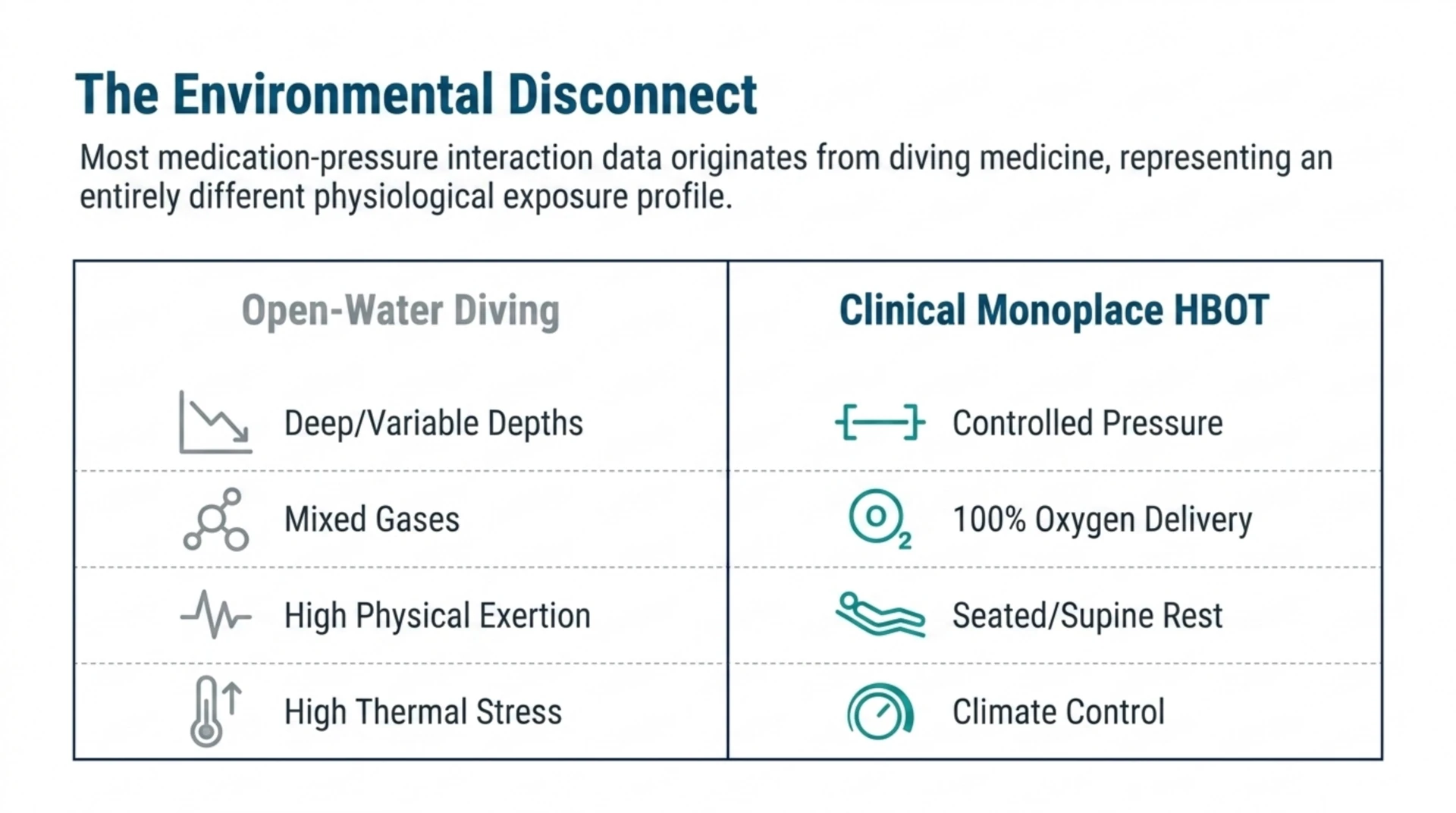
Clinical, monoplace-chamber HBOT is a different exposure profile than open-water diving: dive depths, gas mixtures, exertion levels, and thermal stress all differ from a seated or supine chamber session breathing 100% oxygen. That difference matters, because much of the published data on medications under hyperbaric conditions comes from the diving literature, not from clinical HBOT patients, and translating diving findings directly into a hospital or outpatient chamber protocol is an extrapolation, not a direct replication.
What Does the Direct Evidence on Medications and Hyperbaric Conditions Show?
The most directly relevant source in the Canada Hyperbarics research library is a systematic review of 44 human and animal studies (PubMed | Our Assessment). It was designed to guide fitness-to-dive decisions for medicated divers by pulling together what is known about how various drugs interact with hyperbaric conditions. A review of this design tells you where interaction signals exist across the literature, but it cannot tell you the size or clinical significance of any single interaction, because it is synthesizing studies of very different quality, drug classes, and exposure settings.
Why a Diving-Focused Review Only Partly Answers the Clinical HBOT Question
Because this review’s underlying purpose was diving fitness rather than clinical hyperbaric oxygen therapy protocols, its findings are best read as a starting map of where medication-pressure interactions have been studied at all, not as a ready-made hold list for a wound care or radiation injury clinic. A referring physician can reasonably use it to flag which drug classes warrant a closer look, while recognizing that the underlying studies were not designed around a therapeutic HBOT population.
Is There a Randomised Trial on Medication Use During Hyperbaric Treatment?
Yes, though it addresses adding a drug during hyperbaric treatment rather than holding one beforehand. A randomised controlled trial in 180 divers with decompression illness (PubMed | Our Assessment) found that adding the NSAID tenoxicam to standard recompression therapy reduced the number of compressions required compared with placebo, within that specific trial.
This is one of the few pieces of controlled, prospective evidence anywhere in the hyperbaric medicine literature that directly examines a medication given around the time of hyperbaric treatment. It is worth noting for two reasons: it shows a drug can be studied rigorously in this setting, and it demonstrates that the existing rigorous evidence points toward giving a medication adjunctively, not toward withholding one. It does not generalize to other drug classes or to non-diving HBOT indications.
What Can Case Reports Teach Physicians About Medication and HBOT Timing?
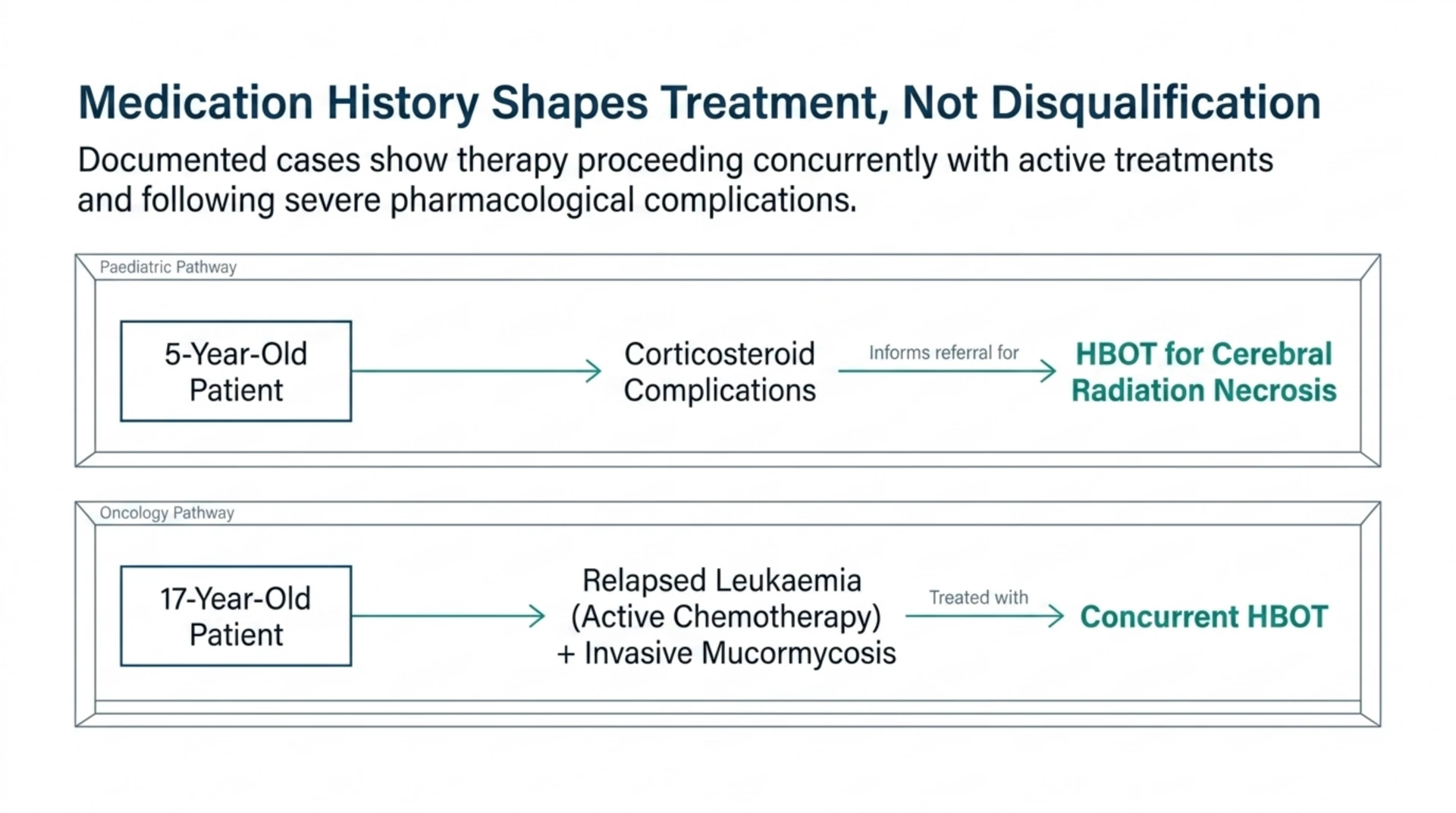
Two case reports in the pool illustrate how medication history can shape a hyperbaric referral in practice, even without trial-level evidence behind the interaction itself.
A Pediatric Case Involving Steroid Complications
A published case report describes a 5-year-old boy with cerebral radiation necrosis who was treated with hyperbaric oxygen therapy after experiencing complications from previous steroid treatment (PubMed | Our Assessment). This is a single case, so it cannot establish how often steroid-related complications should prompt a shift toward HBOT, but it is a concrete example of a medication history (corticosteroid use and its side effects) directly influencing the treatment pathway a referring team chose.
A Case Involving Ongoing Chemotherapy
Similarly, a case report describes a 17-year-old girl with relapsed pre-B acute lymphoblastic leukaemia who developed invasive rhinocerebral mucormycosis and received a multimodal treatment approach that included hyperbaric oxygen therapy alongside her cancer treatment (PubMed | Our Assessment). Here, HBOT was used concurrently with, not instead of, active leukaemia treatment, which is a useful illustration for referring physicians who assume any active systemic medication automatically rules out hyperbaric therapy. Neither case report supports a general rule; both simply show that medication status was one factor weighed alongside the specific clinical picture.
Why Does Gas Embolism Risk Matter for Medication Planning?
A review of the pathophysiology and treatment of gas embolism (PubMed | Our Assessment) outlines how venous and arterial gas embolism is diagnosed and managed, an underlying safety concern across hyperbaric and diving medicine. This source is not about routine pre-session medication holds, but it is relevant background for referring physicians because acute hyperbaric complications, when they occur, are managed with their own emergency protocols and medications inside the chamber setting. Understanding this baseline is part of why hyperbaric teams, not the referring office alone, are usually best placed to make final same-day medication timing decisions.
Should Physicians Use a Standard Hold List Before Referring for HBOT?
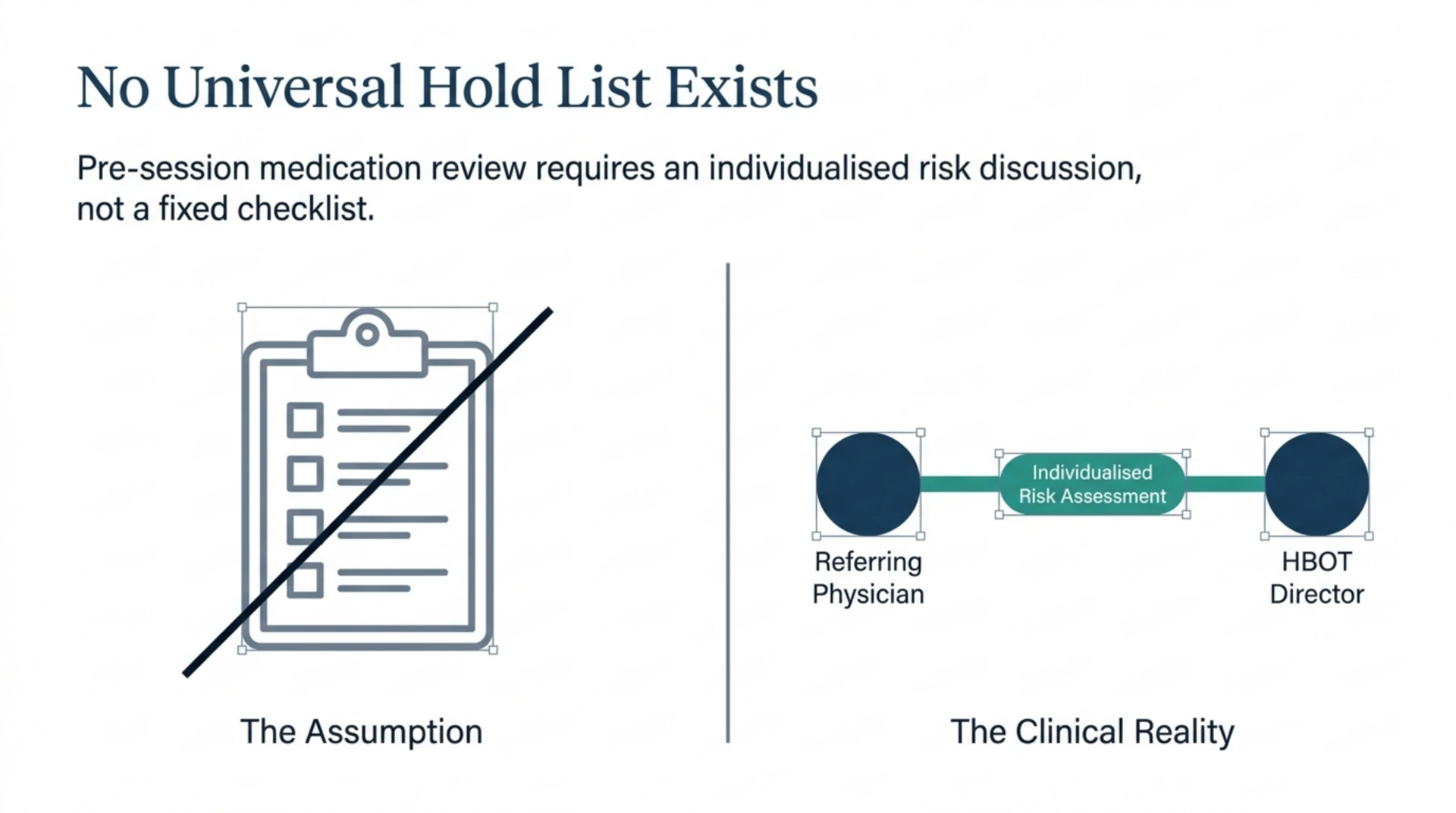
Based on this evidence base, no single validated hold list can be recommended with confidence. The strongest study design available, the tenoxicam trial, actually supports adjunctive drug use rather than withholding a drug. The broadest source, the 44-study systematic review, is a useful map of where interactions have been studied but was built for diving fitness decisions, not clinical HBOT dosing protocols. The remaining sources are single-patient case reports that show medication history mattered to a treatment decision without establishing a generalizable rule.
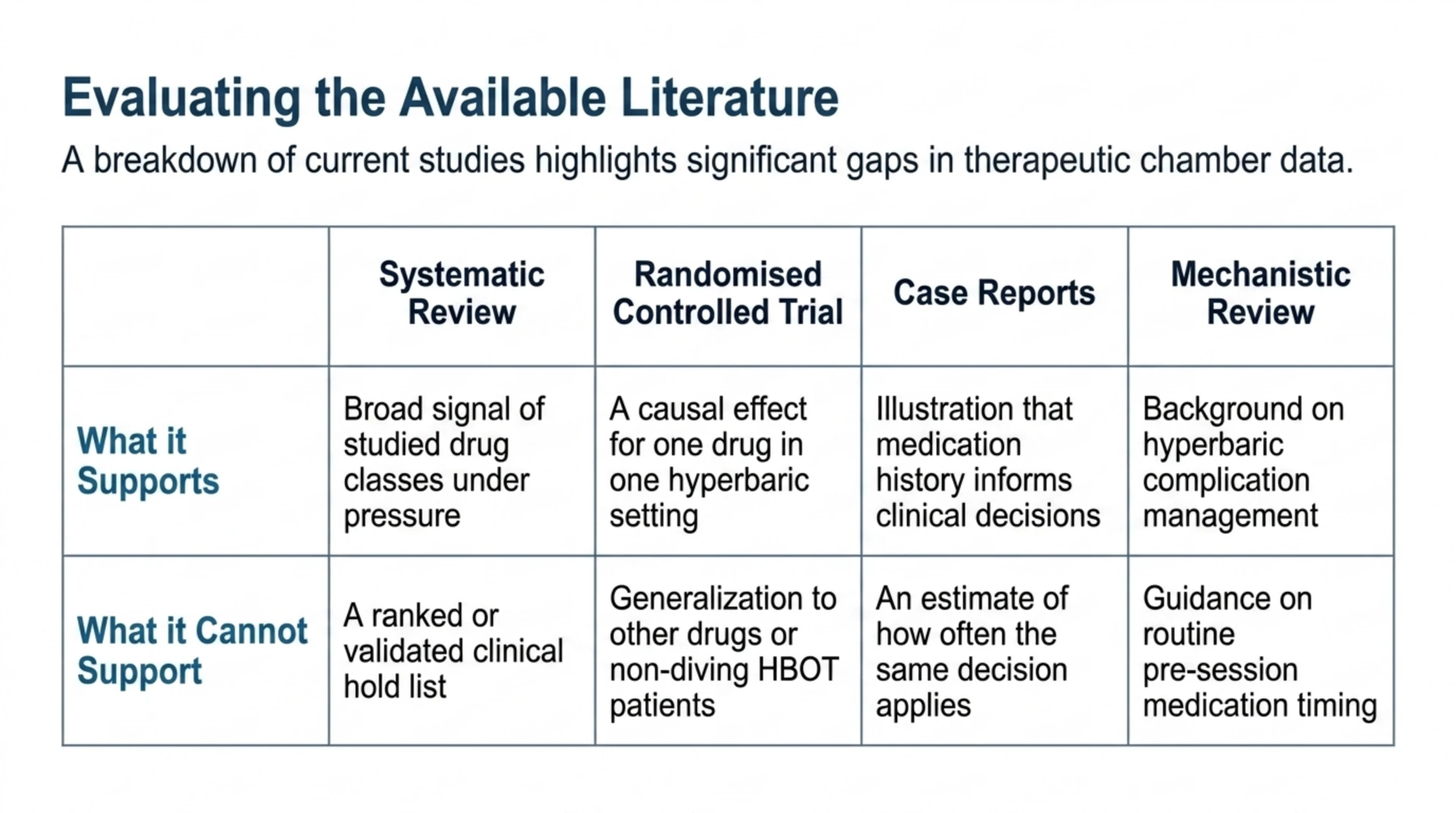
The table below summarizes what each type of evidence in this review can and cannot support.
| Evidence type | Example in this review | What it supports | What it cannot support |
|---|---|---|---|
| Systematic review | 44-study review of medication under hyperbaric conditions | Broad signal of which drug classes have been studied under pressure | A ranked or validated clinical hold list |
| Randomised controlled trial | Tenoxicam adjunct in decompression illness | A causal effect for one drug, one indication, one hyperbaric setting | Generalization to other drugs or to non-diving HBOT patients |
| Case report | Steroid complications preceding HBOT; concurrent chemotherapy during HBOT | An illustration that medication history informed one team’s decision | An estimate of how often, or in whom, the same decision applies |
| Mechanistic/narrative review | Gas embolism pathophysiology and treatment | Background on hyperbaric complication management | Guidance on routine pre-session medication timing |
Given this, the most defensible clinical approach is a case-by-case pharmacology review, done in coordination with the hyperbaric facility’s medical director, rather than applying a generic list drawn from diving medicine to every referred patient. For context on which HBOT indications are publicly funded for Canadian patients, see the overview of HBOT coverage in Canada.
Frequently Asked Questions About Medications and Hyperbaric Oxygen Therapy
Is there an official list of medications to hold before hyperbaric oxygen therapy?
No validated, universally adopted list is supported by the evidence reviewed here. Most of the underlying data comes from diving medicine fitness assessments rather than clinical HBOT trials, so individual chamber facilities typically apply their own conservative protocols pending a case discussion.
Does the evidence on medications and hyperbaric conditions come from hospital HBOT patients?
Largely, no. The main systematic review in this area was built to inform diving fitness decisions in 44 human and animal studies, not clinical hyperbaric oxygen therapy patients specifically, which limits how directly its findings translate to a wound care or radiation injury clinic.
Should chemotherapy be stopped before hyperbaric oxygen therapy?
The evidence in this review does not answer that question generally. One case report describes hyperbaric oxygen therapy used concurrently with ongoing leukaemia treatment for a serious fungal infection, which shows continuation is sometimes clinically appropriate, but this single case cannot be extended into a rule for other chemotherapy agents or indications.
Is there a randomised trial supporting any medication decision around hyperbaric treatment?
Yes. A randomised controlled trial found that adding the NSAID tenoxicam to recompression therapy reduced the compressions needed in divers with decompression illness. This is one of the few controlled trials of a medication given around hyperbaric treatment, and it supports adjunctive use in that specific trial rather than withholding a drug.
Who should make the final call on same-day medication timing before a hyperbaric session?
Given the limited and mostly indirect evidence base, the hyperbaric facility’s medical director, working with the referring physician and the patient’s other treating specialists, is best positioned to weigh the individual medication history against the specific indication for HBOT.
Why does most of the published evidence come from diving medicine rather than clinical chambers?
Diving medicine has a longer history of formal fitness-to-dive assessment and a larger population of medicated individuals undergoing hyperbaric exposure recreationally or occupationally, which has produced more systematic data collection than exists for clinical monoplace-chamber HBOT populations.
A Note on the Limits of This Review
This is an honest account of a narrow evidence base. The Canada Hyperbarics research library holds more than 14,000 peer-reviewed studies across hyperbaric medicine, and only a small subset directly addresses medication interactions with hyperbaric conditions. Where direct clinical HBOT trial data does not exist, that gap should be stated plainly rather than papered over with confident-sounding guidance. Canada Hyperbarics reviewed the sources available and found the evidence sufficient to describe the landscape, but not sufficient to publish a definitive hold list.
Related Reading
- Hyperbaric Oxygen Therapy Pregnancy Safety: FAQ
- Publication Bias in HBOT Meta-Analyses: Funnel Plots
- Hyperbaric Oxygen for Radiation Enteritis: Evidence Review
Referring physicians and patients considering hyperbaric oxygen therapy should discuss the patient’s full medication list with the hyperbaric treatment team well before the first scheduled session, so that any necessary timing decisions can be made individually rather than by default. This content is for informational purposes only and is not medical advice.