TL;DR Hyperbaric oxygen therapy (HBOT) is a treatment in which a person breathes oxygen at a pressure higher than normal atmospheric pressure inside a chamber. For prosthetic joint infection, the direct evidence in our pool is limited to a single case report, and the rest is indirect, drawn from bone and joint infection generally. Surgery and antibiotics remain the keystones of management in the reviews we examined.
Hyperbaric oxygen therapy (HBOT) is a treatment in which a patient breathes oxygen at higher than normal atmospheric pressure. Researchers have asked whether it could help in hard-to-treat infections of bone and joints. This review looks at hyperbaric oxygen prosthetic joint infection (PJI) evidence in the Canada Hyperbarics research library, which holds over 14,000 studies.
The honest answer is that the evidence base for this specific question is thin. We have reframed the post around what the pool actually supports: one directly relevant case report, several related bone and joint infection studies, and some background reviews.
What is prosthetic joint infection, and why is it hard to treat?
A prosthetic joint infection is an infection around an artificial joint, such as a knee replacement. The abstracts in our pool describe the wider problem rather than PJI alone.
One review of bone and joint infection (PubMed | Our Assessment) by García-Lechuz J et al. notes that these infections are of rising concern. It links this partly to the widespread use of prosthetic devices and to new patterns of antimicrobial resistance.
The same review reports that surgery and antibiotic therapy are the keystones of management. It also says that knowledge of the bacterial biofilm status helps guide decisions. It advises a multidisciplinary team of surgeons, pathologists, microbiologists and clinicians.
The abstract of that review does not mention HBOT. That matters. In the review, HBOT is not presented as part of the core approach to bone and joint infection.
What does the direct evidence on hyperbaric oxygen and PJI show?
Only one study in the pool involves a periprosthetic joint infection and HBOT together. It is a single case report (PubMed | Our Assessment) by Talanker M et al.
The case in brief
The report describes a 66-year-old woman with rheumatoid arthritis and PAPA syndrome, a rare inflammatory condition. She developed wound breakdown, exposed hardware and a periprosthetic joint infection after a left total knee arthroplasty.
After multidisciplinary optimization, she had a single-stage procedure. It included irrigation and debridement, hardware removal, revision knee arthroplasty with patellar tendon reconstruction, and coverage with a free latissimus dorsi muscle flap. A staged skin graft followed one week later, with adjunctive postoperative HBOT.
Initial healing was uncomplicated. Four months later, however, she developed chronic sinus tracts and a recurrent periprosthetic infection. This required flap re-elevation, debridement and hardware exchange. At one year, all wounds had healed, and she was last seen infection-free and full-weightbearing four months after that.
What this case can and cannot tell us
The authors conclude that microvascular limb salvage is feasible in PAPA syndrome when guided by multidisciplinary planning and strategic flap design. Their stated conclusion is about the surgical strategy, not about HBOT.
The patient had many simultaneous interventions. A case report cannot separate the effect of HBOT from the surgery, the flap and the antibiotics. This case does not show that HBOT contributed to the outcome. It also, importantly, records a recurrence despite adjunctive HBOT.
Does HBOT help chronic osteomyelitis? The closest controlled data
Osteomyelitis is bone infection, and it shares features with periprosthetic infection. The closest comparative data in the pool come from two reports by Esterhai JL et al. Both describe 28 patients with chronic refractory osteomyelitis treated between January 1980 and December 1985.
In the first report (PubMed | Our Assessment), patients were assigned to HBOT or control status after initial debridement. Fourteen of the 28 received HBOT at 2 atmospheres for 2 hours, once daily, six days per week.
The principal result was null. Hyperbaric oxygen had no effect on length of hospitalization, rapidity of wound repair, initial clinical outcome, or recurrence of infection noted to date. A companion report with the same enrolment dates and sample size (PubMed | Our Assessment) reached the same conclusion.
There is a key caveat for this topic. Both abstracts state that patients with total joint arthroplasty were excluded. These data therefore do not address prosthetic joints at all. They are indirect evidence from a small, older cohort, and the abstracts do not name the design as randomised.
What do larger case series say about HBOT in bone and joint infection?
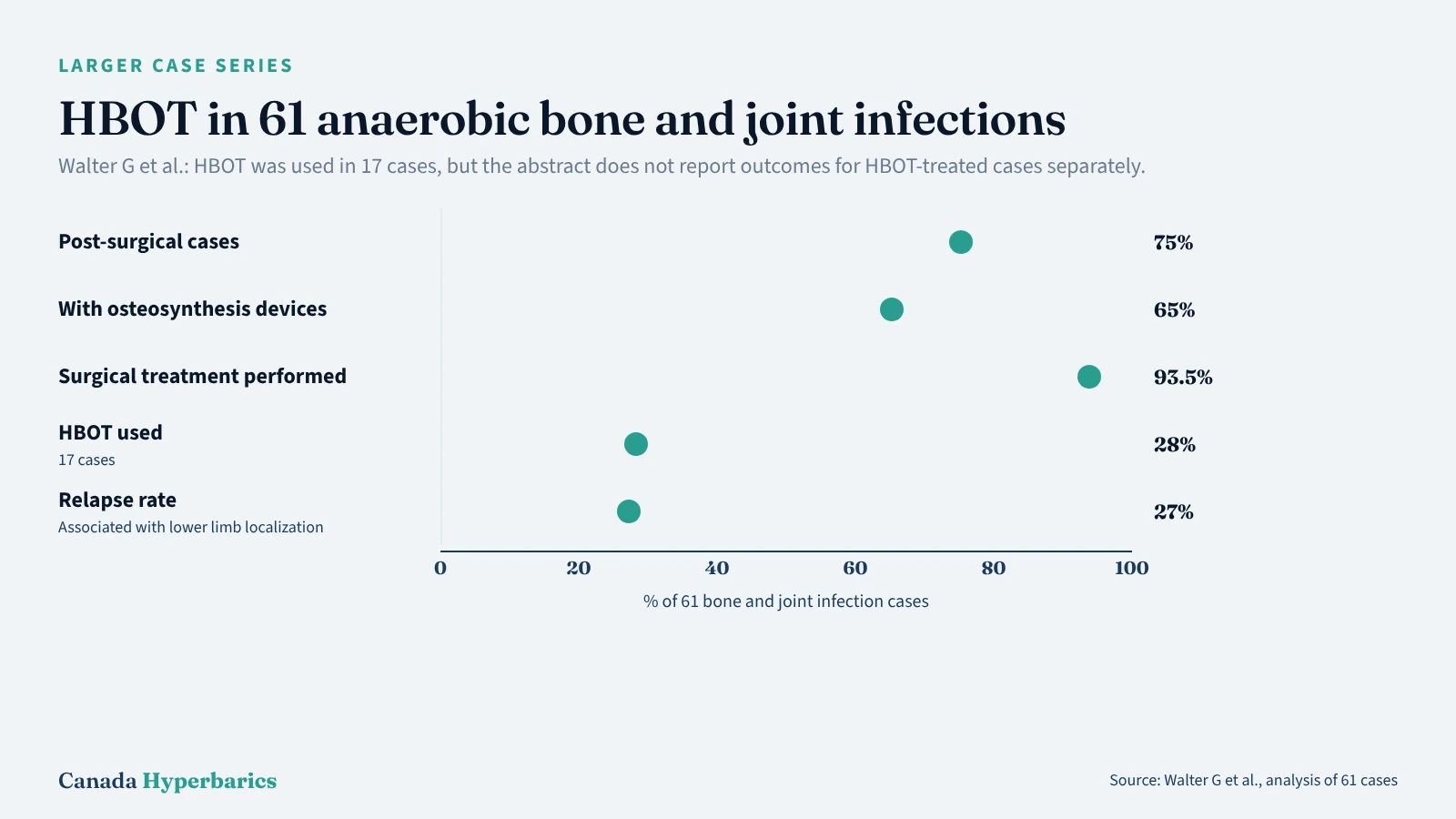
An analysis of 61 anaerobic bone and joint infections (PubMed | Our Assessment) by Walter G et al. offers context. The abstract reports that 75% of cases were post-surgical, and 65% were associated with osteosynthesis devices. Polymicrobial infections occurred in 50 cases.
Surgical treatment was performed in 93.5% of cases. HBOT was used in 17 cases (28%), alongside antibiotics such as amoxicillin, metronidazole and clindamycin. The relapse rate was 27%, and it was associated with lower limb localization.
The abstract does not report outcomes for the HBOT-treated cases separately. We therefore cannot say whether HBOT changed relapse in this series. What the study does show is that hardware-related infection is often polymicrobial and surgically managed.
What do the reviews say about HBOT as an adjunct?
A literature review by a multiprofessional team on osteomyelitis (PubMed | Our Assessment) by Lima A et al. discusses guidelines for surgical and antimicrobial treatment. It also covers “the role of hyperbaric oxygen as adjuvant therapy.”
The abstract does not state what the team concluded about that role. We therefore cannot report a recommendation for or against it from this source alone.
Are there individual case reports of HBOT in joint infections?
Yes, though they involve native joints rather than prostheses, and they are anecdotal by design.
- A case report of hip septic arthritis due to Bacteroides fragilis (PubMed | Our Assessment) by Merle-Melet M et al. described a 53-year-old man. Recovery followed 4 months of antimicrobial therapy, surgical debridement and four sessions of hyperbaric oxygen.
- A case report of sternoclavicular joint septic arthritis with a chest wall abscess (PubMed | Our Assessment) by Tanaka Y et al. described a 68-year-old man. He had surgery, negative pressure wound therapy and HBOT, and was free of relapse for 3 years.
In both reports, HBOT was one of several concurrent treatments. Neither case can isolate an HBOT effect.
Is there any signal of harm or limited benefit?
A case report by Williams ST et al. (PubMed | Our Assessment) describes a 48-year-old diabetic patient. After subtalar arthrodesis, he developed a wound infection treated with two returns to theatre and then 19 HBOT sessions at 2.2 ATA.
His wounds had virtually healed by 7 weeks, and a scan at 5.5 months showed satisfactory fusion with no evidence of infection. He nonetheless developed chronic regional pain syndrome. The authors report that early HBOT for another indication did not prevent it. This is one patient, and it does not establish that HBOT caused or failed to prevent anything in general.
How do the studies compare?
| Study | Design as the abstract names it | Involves a prosthetic joint? | What the abstract reports about HBOT |
|---|---|---|---|
| Talanker M et al. | Case report | Yes (periprosthetic infection after knee arthroplasty) | Adjunctive HBOT given; infection recurred at 4 months, then resolved |
| Esterhai JL et al. | Patients assigned to HBOT or control after debridement | No (total joint arthroplasty excluded) | No effect on hospital stay, wound repair, outcome or recurrence |
| Walter G et al. | Analysis of 61 cases with literature review | Not stated | Used in 17 cases; outcomes not reported separately |
| Merle-Melet M et al. | Case description | No (native hip) | Four sessions among several treatments; recovery |
| Tanaka Y et al. | Case report | No (native joint) | Used with surgery and wound therapy; no relapse at 3 years |
Frequently Asked Questions
Is hyperbaric oxygen an established treatment for prosthetic joint infection?
Not on the evidence in our pool. The single directly relevant study is a case report, and the reviews we examined name surgery and antibiotics as the keystones of management.
Did the one PJI case report show HBOT worked?
No. The patient received many interventions at once, and the authors’ conclusion concerns surgical feasibility. A recurrent periprosthetic infection occurred four months after surgery.
Has any controlled study tested HBOT in joint-related infection?
The closest is the Esterhai osteomyelitis work, which found no effect on hospitalization, wound repair, initial outcome or recurrence. It excluded patients with total joint arthroplasty, so it is indirect evidence.
Why do bacterial biofilms matter here?
The bone and joint infection review notes that knowledge of biofilm status helps in choosing therapy. Its abstract does not link biofilm to HBOT.
What kind of research would answer the question?
The studies here suggest a need for comparative studies that include patients with prosthetic joints and report outcomes separately for those who receive HBOT. Such data are absent from this pool.
Is this a health recommendation?
No. This is a summary of published abstracts for researchers. It does not recommend any treatment.
Related Reading
- Hyperbaric Oxygen Response Biomarkers: Evidence Review
- Hyperbaric Oxygen for Radiation Brachial Plexopathy
- Hyperbaric Oxygen Chemical Burns Referral: Evidence Review
Next step
Anyone dealing with a joint infection should talk to their physician about whether HBOT is appropriate for them. For context on approved uses, see HBOT coverage in Canada. Canada Hyperbarics publishes this review as educational reference material only.
This content is for informational purposes only and is not medical advice.