TL;DR: Hyperbaric recompression table selection is the process of choosing a pre-defined pressure, oxygen and time schedule for treating decompression illness in a diver or compressed-air worker. The published evidence is mostly small, observational and single-centre, so no single table is proven best for every patient. This guide, from the Canada Hyperbarics research library, walks clinic operators through a structured way to think about the choice and flags where the evidence is limited.
Hyperbaric recompression table selection is a decision about which treatment schedule to run when a patient presents with decompression sickness (DCS) or related gas-bubble injury. The U.S. Navy (USN) tables, such as Table 5 and Table 6, are the most commonly cited schedules in the studies we reviewed. Shorter custom tables, helium-oxygen tables and extended tables also appear in the literature.
This post is an evidence review for clinic owners and operators. It is not a protocol. Table choice belongs to the treating hyperbaric physician and your facility’s written procedures. What follows is a framework for asking better questions, grounded only in the studies in our pool.
What is a recompression treatment table?
A recompression table is a written schedule that sets the depth (pressure), the breathing gas, and the timing of each stage of a chamber treatment. Tables exist so that every team treats a given presentation the same way and can document deviations.
One review of the development of these protocols noted that the U.S. Navy tables were based on limited data. That review also offered an alternative shorter table for monoplace chambers (PubMed | Our Assessment). That is a useful starting caution: a standard table is a convention with a limited trial base, not a settled optimum.
How do you choose a recompression table, step by step?
Step 1: Classify the presentation and the delay
Start with what the patient actually has. Mild limb pain, spinal symptoms, cerebral symptoms and pulmonary barotrauma are not the same problem, and the studies in this pool treat them differently. Record the time from surfacing to chamber, because several studies examine delay.
A retrospective analysis from Israel compared 76 divers treated 48 hours or more after surfacing with 128 treated earlier (PubMed | Our Assessment). Complete recovery was reported in 76% of the delayed group and 78% of the early group. The authors concluded that late recompression has clinical value. A long delay alone did not appear to rule out treatment in that study.
Step 2: Know what the standard table has and has not been shown to do
The Hadanny analysis also looked at protocol. Delayed treatment with the USN Table 6 protocol trended toward a better outcome than a standard 90 minute session at 2 ATA, but the difference was not statistically significant (p=0.07). The authors suggested the preferred protocol should be based on Table 6. A trend that did not reach significance is a prompt for caution, not proof.
Another assessment of 169 cases treated in Italian hyperbaric centres reported full recovery in 78.2% of type I and 61.9% of type II sickness (PubMed | Our Assessment). Results were not significantly related to the speed of intervention in that series. Outcomes were significantly better with USN tables 2-2A, 3-3A, 4, 5 and 6 and the 2 + 6 protocol than with tables 5A and 6A. That comparison is historical and observational, so it describes association, not cause.
Step 3: Consider whether a shorter table fits mild presentations
This is where the strongest design in the pool sits. A prospective, single-blind randomised clinical trial at a hospital hyperbaric unit in Fremantle compared a modified USN Table 6 (TT6m) with a shorter custom table (FH01) in mild DCS, using a monoplace chamber (PubMed | Our Assessment). Banham N et al. enrolled 41 cases, 21 on TT6m and 20 on FH01.
The primary outcome was the number of treatments until resolution or plateau. The median was 1 for FH01 and 2 for TT6m (P = 0.01). In the FH01 arm, 17 of 20 patients (85%) had complete resolution after the first treatment, versus 8 of 21 (38%) on TT6m. Final outcomes were similar: 19 of 20 and 20 of 21 were asymptomatic at the end of their last treatment (P = 0.97). Two FH01 patients were moved to TT6m mid-treatment for failing to improve, as the protocol required, and two TT6m patients needed extensions.
The authors concluded FH01 appears superior for mild DCS. For an operator, the careful reading is narrower: in this small single-centre trial, the shorter table needed fewer treatments, and end results were similar. It does not tell you the shorter table is safe for moderate or severe presentations.
Step 4: Check your chamber type against the table’s oxygen exposure
Table 6 uses high oxygen partial pressures, and oxygen toxicity seizures are the classic concern in monoplace chambers. A retrospective review of 1000 USN Table 6 treatments over 30 years (331 monoplace, 669 multiplace) found four seizures in total and none in the monoplace chamber (PubMed | Our Assessment). Bonnington S et al. found no statistically significant difference between chamber types (P = 0.31) and concluded the risk was acceptably low in selected patients.
Note the phrase “selected patients.” Patient selection, seizure-management readiness and written contingency steps remain operator responsibilities. A retrospective review from one hyperbaric unit’s records cannot tell you your own seizure rate.
Step 5: Weigh extended tables against pulmonary risk
Extended tables exist for patients who respond poorly to standard ones, but longer oxygen exposure carries its own risk. A case report described a 42-year-old with severe decompression illness who developed acute respiratory distress syndrome after a very long treatment on USN Table 7; the patient developed pulmonary fibrosis and died (PubMed | Our Assessment). The authors advised that pulmonary oxygen toxicity must be considered when using a prolonged table.
A single case cannot show how often this happens. It does show why extended tables should have documented decision points and monitoring, not default use.
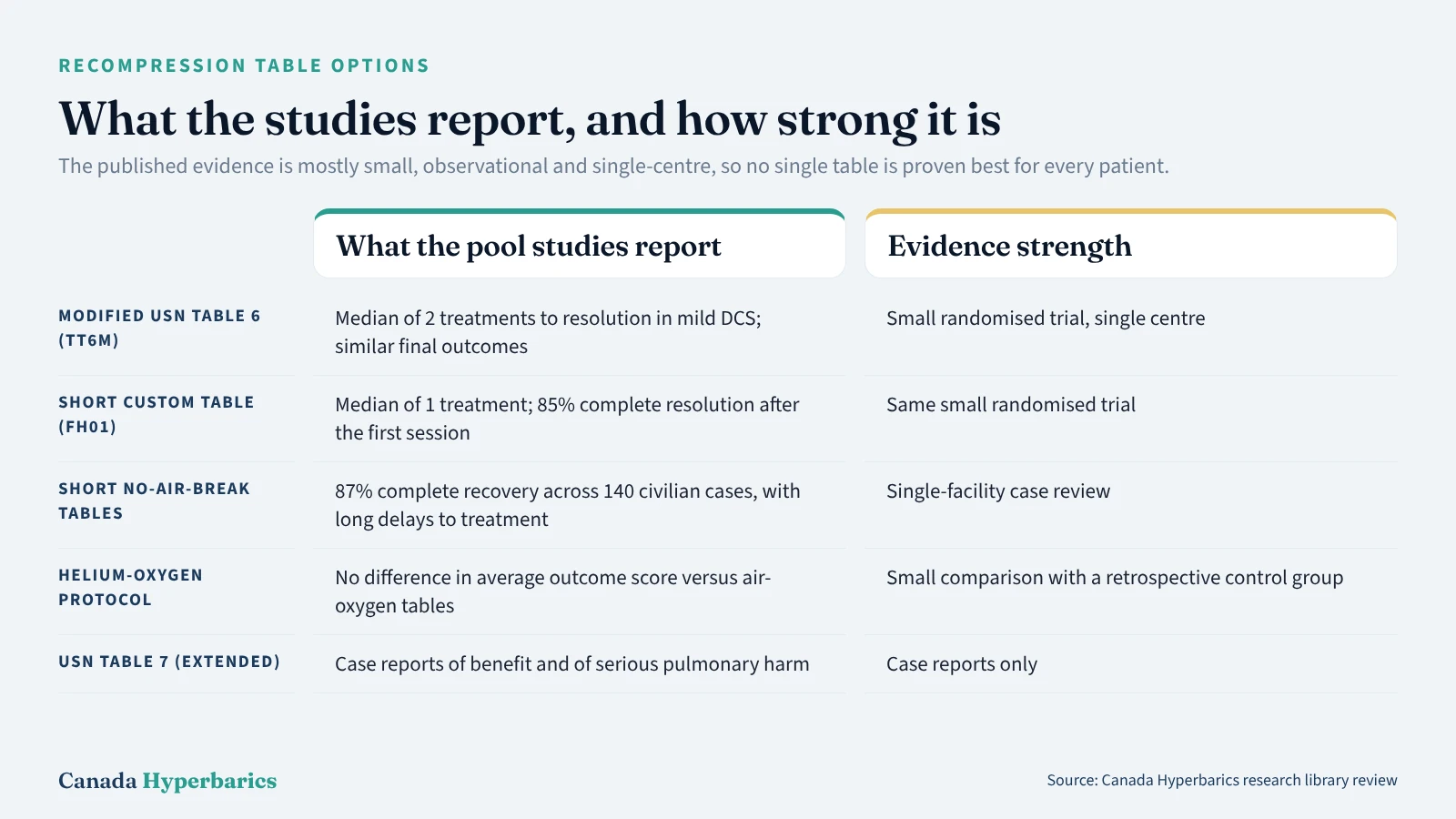
How do the main table options compare?
| Table type | What the pool studies report | Evidence strength |
|---|---|---|
| Modified USN Table 6 (TT6m) | Median of 2 treatments to resolution in mild DCS; similar final outcomes to a shorter table | Small randomised trial, single centre |
| Short custom table (FH01) | Median of 1 treatment; 85% complete resolution after the first session | Same small randomised trial |
| Short no-air-break tables | 87% complete recovery across 140 civilian cases, with long delays to treatment | Single-facility case review |
| USN Table 6 for delayed presentations | Trend toward better outcome versus a 90 minute session at 2 ATA, not significant | Retrospective analysis |
| Helium-oxygen protocol | No difference in average outcome score versus air-oxygen tables | Small comparison with a retrospective control group |
| USN Table 7 (extended) | Case reports of benefit and of serious pulmonary harm | Case reports only |
What about helium-oxygen tables?
Helium-oxygen protocols have theoretical appeal for severe neurological DCS. An Israeli study compared 16 divers treated with a helium-oxygen protocol against 17 retrospective controls treated on USN Table 6 or 6A (PubMed | Our Assessment). Shupak A et al. found clinical scores improved in both groups, and no difference was found between the groups’ average outcome scores. Presentation scores were lower in the helium-oxygen group.
Five patients in the air-oxygen group deteriorated after recompression, and none did in the helium-oxygen group. The authors read this as suggesting an advantage for helium-oxygen. Given the small groups, the retrospective control and the null primary comparison, that is a hypothesis worth testing, not a basis for a purchasing decision.
How well do the tables work in real-world cohorts?
A single-centre retrospective review of 103 recreational divers treated on USN Tables 5, 6, 6A and 9 reported complete relief in 53, partial relief in 45 and no relief in five (PubMed | Our Assessment). Among those with complete relief, 28 (53%) needed only one treatment. Chin W et al. also reported that the depth of the first dive and symptom change in the first 20 minutes of the first recompression were explanatory variables for outcome.
For operators, the second finding is practical. How a patient responds early in the first treatment may inform whether to continue, extend or change course. Your protocol should say who makes that call and when.
Does table selection matter for your own staff?
Yes, because chamber attendants are exposed too. A case report described a hyperbaric physician who developed spinal DCS within 10 minutes of finishing a standard session as an inside attendant in a multiplace chamber (PubMed | Our Assessment). Kot J et al. reported that symptoms resolved on 100% oxygen at 283.6 kPa and that a standard USN Table 6 was completed. The authors described any hyperbaric exposure as an occupational DCS risk for inside attendants.
That is one case, but it belongs in your safety plan: a recompression table should be available for staff as well as patients, and attendant exposure should be tracked.
Is in-water recompression an alternative to a chamber table?
A review of in-water recompression stated that no data establish its benefits compared with conventional first aid with surface oxygen and transport to the nearest chamber (PubMed | Our Assessment). Doolette D et al. noted a major risk is an oxygen convulsion leading to drowning, and that no experimentation with initial treatment at pressures below 285 kPa has occurred since the original table development. This is relevant context for clinics: it underlines that the evidence base behind current tables is old and thin.
What should a clinic’s table selection procedure include?
- A named decision-maker: the treating hyperbaric physician selects the table, and the choice and any deviation are documented.
- Presentation and delay fields: record symptom class, time from surfacing and response in the first treatment.
- Chamber-specific rules: state which tables are permitted in monoplace and multiplace chambers and why.
- Escalation and stop criteria: define when to extend, switch tables, or stop, including pulmonary oxygen toxicity monitoring for long tables.
- Attendant protocol: track inside-attendant exposures and have a plan for staff DCS.
- A review cycle: audit your own outcomes against the literature, since published series come from other units.
Frequently Asked Questions
Is USN Table 6 always the right table for decompression sickness?
No single table is shown to be right for every case. Table 6 is widely used and appears throughout the studies reviewed, but the Fremantle randomised trial found a shorter table needed fewer treatments in mild DCS, with similar final outcomes.
Can a monoplace chamber run Table 6?
One 30-year retrospective review from a single hyperbaric service reported no oxygen toxicity seizures among 331 monoplace Table 6 treatments and concluded the risk was acceptably low in selected patients. Your own chamber, staff and patient selection still govern the decision.
Does a long delay to treatment mean recompression is pointless?
Not in the studies reviewed. The Israeli retrospective analysis reported 76% complete recovery in divers treated 48 hours or more after surfacing, close to the 78% in earlier-treated divers. Individual outcomes will vary.
Are helium-oxygen tables better than air-oxygen tables?
The evidence in this pool does not show it. The one comparison found no difference in average outcome scores between groups, though the authors noted fewer deteriorations on helium-oxygen. The groups were small and the control group was retrospective.
What are the risks of extended tables?
A published case report linked a very long Table 7 treatment to fatal ARDS, and a three-case series using Table 7 noted mild lung function impairment in one patient, probably due to pulmonary oxygen toxicity. These are case-level reports and cannot give a rate.
How strong is the evidence overall?
Limited. Apart from one small randomised trial, most of the pool is retrospective series, single-centre reviews and case reports. Canada Hyperbarics tracks more than 14,000 studies across hyperbaric medicine, and direct comparisons of recompression tables remain scarce within them.
Next step
If you are a patient or clinic owner trying to understand where hyperbaric treatment fits, talk to your physician about whether HBOT is appropriate for the situation in question. For approved uses and funding context, see the HBOT coverage in Canada overview.
Related Reading
- Hub and Spoke Hyperbaric Chamber Networks in Canada
- Hyperbaric Medical Director Requirements in Canada
- Hyperbaric Oxygen Response Biomarkers: Evidence Review
This content is for informational purposes only and is not medical advice.