
TL;DR: Opening a hyperbaric oxygen therapy clinic in Canada is a regulated, multi-step project. You need a chamber that meets Health Canada medical device requirements, a facility built to recognised engineering standards (CSA Z275.1 and ASME PVHO-1), trained and certified staff under qualified medical supervision, and a clear plan for referrals and provincial coverage. Voluntary UHMS accreditation is the recognised quality benchmark. Build the business case on recognised indications, where the evidence is strongest, and never overstate results for investigational uses.
A hyperbaric oxygen therapy clinic is a regulated medical facility where patients breathe 100 percent oxygen inside a pressurised chamber to treat specific conditions. Opening one in Canada is less like starting a typical wellness business and more like commissioning a small medical-device operation. The chamber is a regulated medical device, the room around it must meet engineering and fire-safety standards, and the people running it need recognised training. This guide from Canada Hyperbarics walks clinic owners and operators through the main steps, in the order they usually happen, so you can plan a realistic timeline and budget.
What is a hyperbaric oxygen therapy clinic, and what does it actually treat?
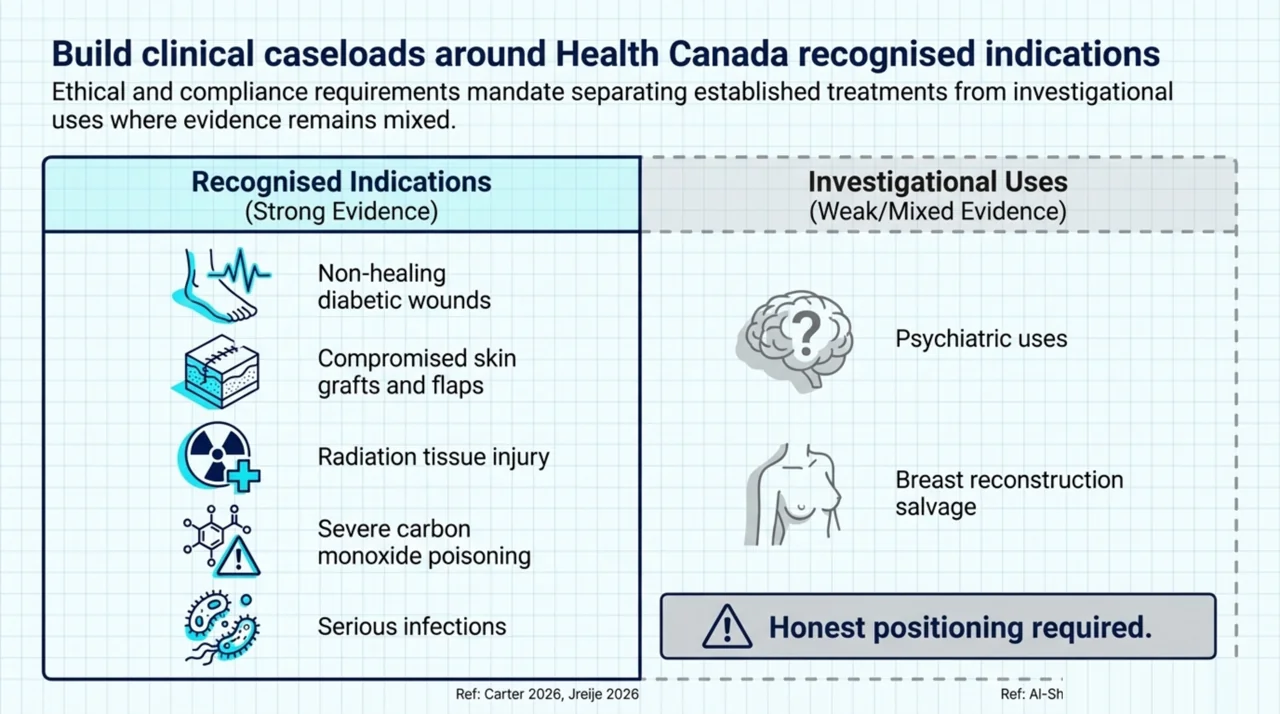
Hyperbaric oxygen therapy (HBOT) delivers oxygen at a pressure higher than normal atmospheric pressure, which raises the amount of oxygen dissolved in the blood and tissues. The strongest evidence sits behind a defined list of conditions publicly funded in Canada, including non-healing diabetic wounds, compromised skin grafts and flaps, radiation tissue injury, severe carbon monoxide poisoning, and certain serious infections. A successful clinic builds its caseload around these recognised indications first.
The evidence base for these core uses continues to mature. A 2026 systematic review of comparative studies (Carter et al., PubMed | Our Assessment) pooled 24 studies and 2,246 patients, including 13 randomised controlled trials, and issued a strong recommendation to use HBOT to help heal flaps and grafts in soft-tissue and trauma wounds. For diabetic wounds, a 2026 review (Jreije et al., PubMed | Our Assessment) lists hyperbaric oxygen among the interventions used for refractory diabetic ulcers, while stressing that no single therapy fully addresses these complex wounds.
Many other uses remain investigational, and honest positioning is both an ethical and a compliance requirement. A 2026 systematic review and meta-analysis of psychiatric uses (Al-Shamali et al., PubMed | Our Assessment) reviewed 17 studies and 920 participants, including nine randomised trials, and reported that HBOT was associated with a large pooled improvement in depressive symptoms, with benefit at 2.0 ATA but none at the low 1.2 ATA dose. Results like these are promising but not a basis for marketing claims. Where evidence is weak or mixed, say so: a separate 2026 review of breast reconstruction salvage (Machado et al., PubMed | Our Assessment) found that across seven non-randomised studies, HBOT did not significantly reduce major complications such as skin necrosis or the need for repeat surgery.
What are the steps to open a hyperbaric oxygen therapy clinic in Canada?
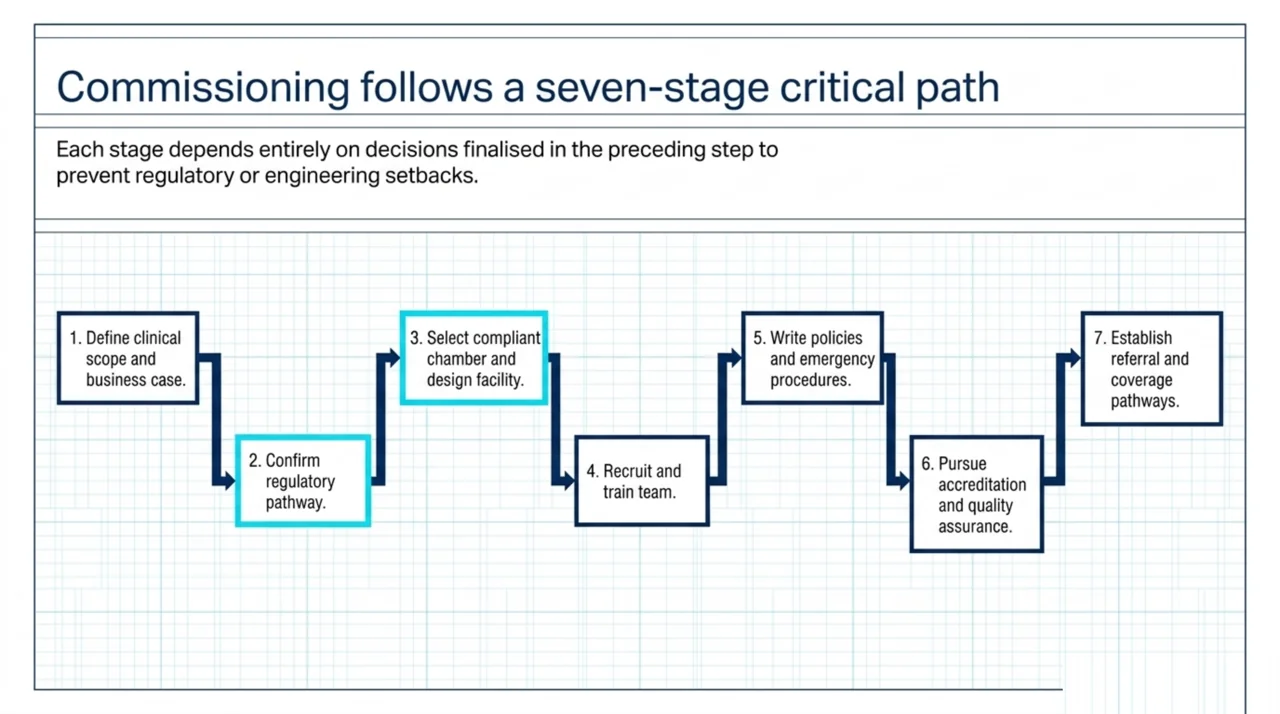
Most successful Canadian hyperbaric projects move through the same seven stages. The order matters, because each stage depends on decisions made in the one before it.
- Define your clinical scope and business case. Decide which recognised indications you will serve and confirm there is genuine referral demand in your region.
- Confirm the regulatory pathway. Understand how Health Canada treats the chamber as a medical device and what licensing your activities require.
- Select a compliant chamber and design the facility. Choose a chamber that meets CSA and ASME standards and plan the room, fire safety, and oxygen handling around it.
- Recruit and train the team. Secure a qualified supervising physician and certified hyperbaric staff before you treat anyone.
- Write your policies and emergency procedures. Build documented protocols for screening, treatment, adverse events, and equipment maintenance.
- Pursue accreditation and quality assurance. Prepare for voluntary UHMS accreditation as your independent quality benchmark.
- Establish referral and coverage pathways. Connect with referring physicians and clarify how patients will access and pay for treatment.
How do you license the hyperbaric chamber with Health Canada?
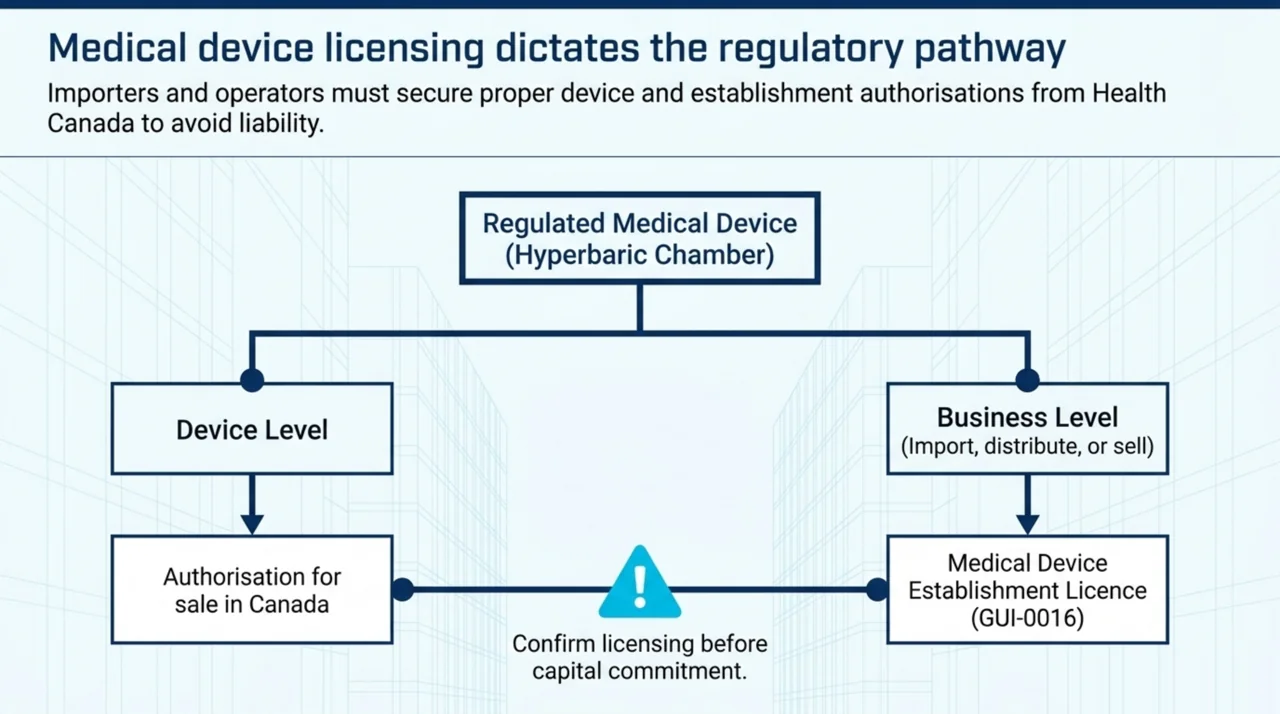
In Canada, a medical hyperbaric chamber is a regulated medical device, not ordinary equipment. That single fact shapes much of your startup work. The device itself must be authorised for sale in Canada, and the business that imports, distributes, or sells it generally needs a Medical Device Establishment Licence. Health Canada explains who needs this licence and how to apply in its guidance document GUI-0016 on medical device establishment licensing, part of its broader framework on establishment licences.
Practically, this means you should confirm in writing that any chamber you are considering is appropriately licensed for the Canadian market before you commit capital. Ask the manufacturer for its device licence details and confirm that the model is intended for clinical medical use. A chamber marketed only for fitness or recreational use does not belong in a medical clinic and can create serious regulatory and liability problems. To understand how these rules fit into the wider Canadian picture, see our overview of HBOT regulation in Canada.
Which chamber safety standards apply to a Canadian hyperbaric clinic?
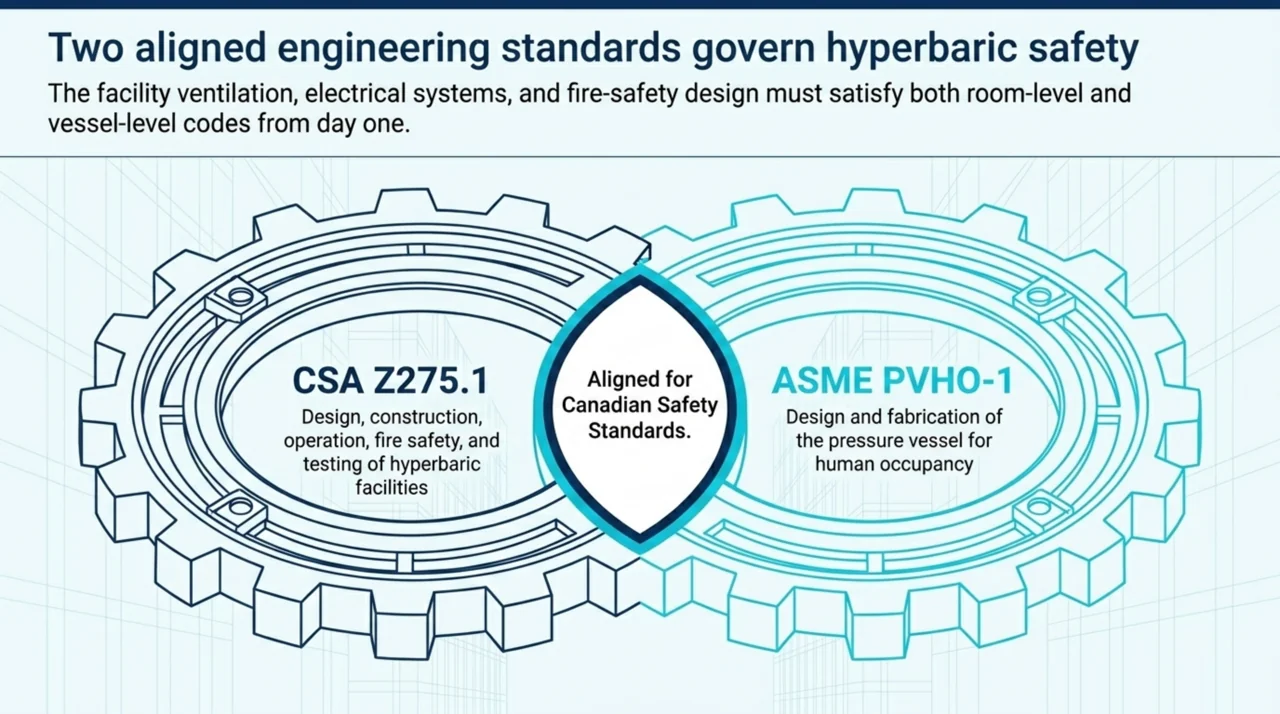
Two engineering standards do most of the heavy lifting for hyperbaric safety in Canada. CSA Z275.1 sets minimum requirements for the design, construction, operation, maintenance, and testing of hyperbaric chambers, and ASME PVHO-1 governs the design and fabrication of the pressure vessel itself. Facility design should account for both standards together, since each covers a different scope. Your facility, ventilation, electrical systems, and fire-safety design should all be planned to satisfy these standards from day one, because retrofitting a finished room is expensive.
| Standard | Issuing body | What it covers |
|---|---|---|
| CSA Z275.1 | CSA Group | Design, construction, operation, maintenance, and testing of hyperbaric facilities |
| ASME PVHO-1 | ASME | Design and fabrication of the pressure vessel for human occupancy |
| UHMS accreditation | UHMS | Voluntary, independent review of clinical quality, safety, and staffing |
Fire safety deserves special attention. An oxygen-enriched environment increases fire risk, so chamber rooms have strict requirements for materials, grounding, prohibited items, and staff training. These details are not optional extras; they are central to how a hyperbaric facility is judged safe to operate.
What staffing and accreditation does a hyperbaric clinic need?
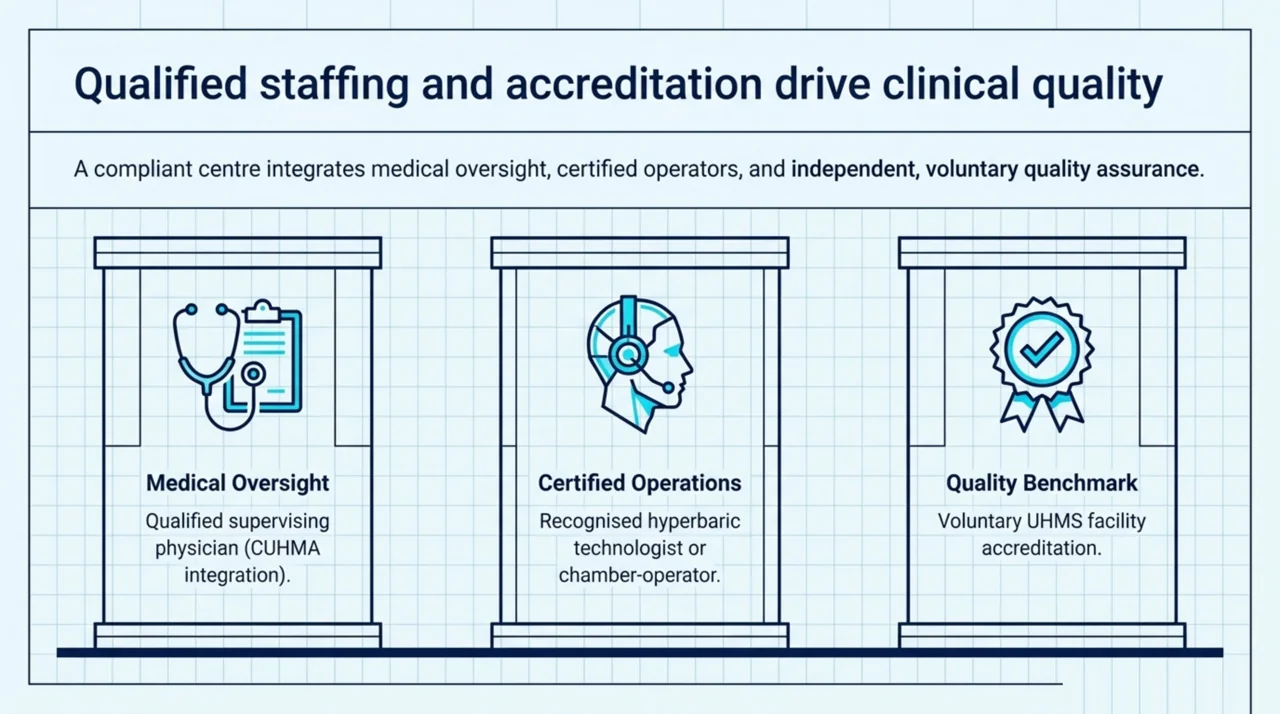
A hyperbaric clinic cannot run on equipment alone. You need a qualified physician to provide medical oversight and certified hyperbaric staff to operate the chamber and monitor patients. In Canada, hyperbaric medicine is recognised as a focused area of practice, and clinicians can pursue training and credentials in the field. Operators and attendants typically complete recognised hyperbaric technologist or chamber-operator training and maintain that certification over time.
Two organisations are central here. The Canadian Undersea and Hyperbaric Medical Association (CUHMA) promotes education and best practice for hyperbaric and diving medicine in Canada and is a natural professional home for your clinical team. The Undersea and Hyperbaric Medical Society (UHMS) runs a voluntary clinical hyperbaric facility accreditation program that independently reviews safety, staffing, and quality. UHMS accreditation is voluntary, but it is widely regarded as the benchmark of a well-run hyperbaric facility and is worth planning toward from the start, even if you apply once operations are stable.
How do patients access and pay for treatment at a new clinic?
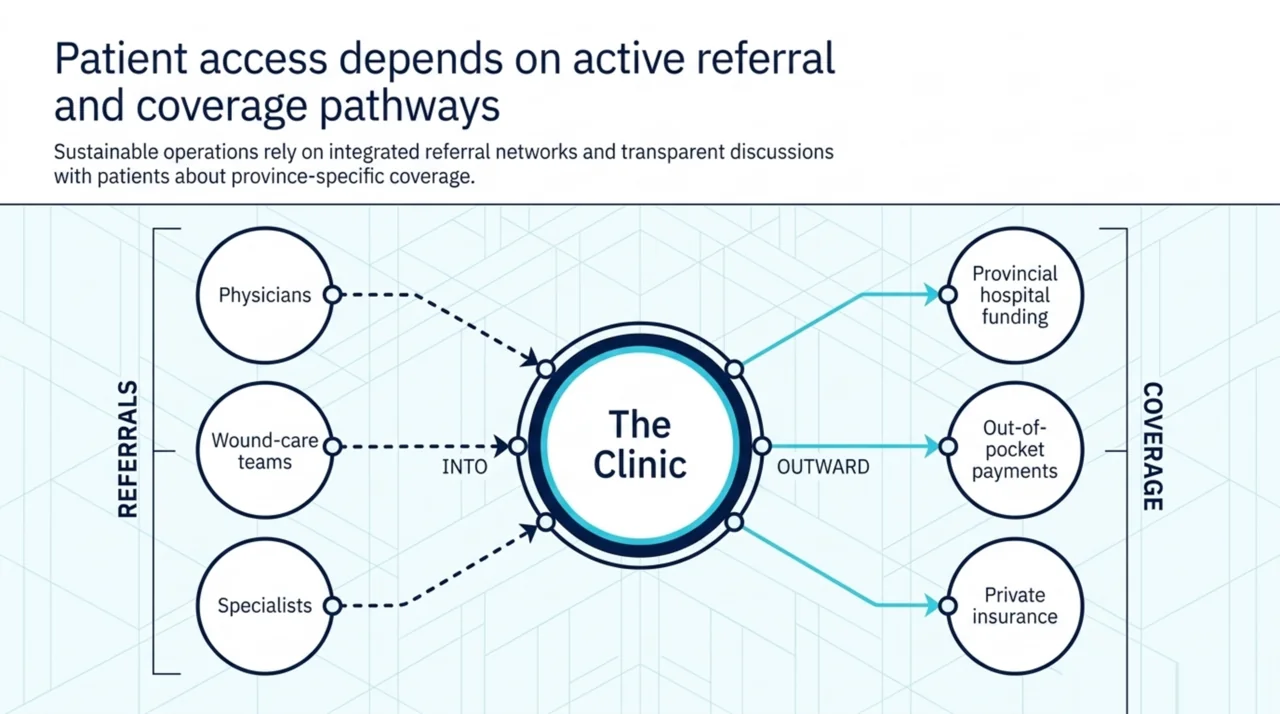
Your clinic will only succeed if patients can actually reach it through a credible pathway. Most hyperbaric care begins with a referral from a physician who has identified a recognised indication. Building relationships with local referring physicians, wound-care teams, and specialists is therefore a core part of opening, not an afterthought. It helps to understand where your clinic fits among Canada’s existing hospitals and regulated facilities, which you can explore in the Canada Hyperbarics directory of hospitals and regulated facilities.
Coverage is the other half of access, and it varies widely by province. Some provincial plans fund HBOT for recognised indications at hospital programmes, while private clinics are often paid out of pocket or through private insurance. Be transparent with patients about what is and is not covered where you operate. Our province-by-province guide to HBOT coverage in Canada is a useful reference to share, and it helps you set realistic expectations before a patient books a course of treatment.
Frequently asked questions about opening a hyperbaric clinic in Canada
How long does it take to open a hyperbaric oxygen therapy clinic in Canada?
There is no fixed timeline, but most projects take many months to well over a year. The longest stages are usually facility design and construction to meet CSA and ASME standards, sourcing a licensed chamber, and recruiting qualified medical and technical staff. Planning these in parallel, rather than one after another, is the main way to shorten the path.
Do I need Health Canada approval to run a hyperbaric clinic?
The chamber itself is regulated as a medical device, and the business that imports, distributes, or sells it generally needs a Medical Device Establishment Licence. Always confirm a chamber is licensed for the Canadian market before purchase, and review Health Canada’s establishment licensing guidance for the activities that apply to your operation.
Is UHMS accreditation mandatory in Canada?
No. UHMS clinical hyperbaric facility accreditation is voluntary. However, it is widely recognised as a marker of quality and safety, and pursuing it encourages strong protocols, documentation, and staff training. Many operators treat it as a goal to work toward once their clinic is running smoothly.
What conditions can a new hyperbaric clinic treat?
Build your caseload around the conditions publicly funded in Canada, where the evidence is strongest, such as non-healing diabetic wounds, compromised grafts and flaps, radiation injury, severe carbon monoxide poisoning, and certain serious infections. Many other uses are still investigational, and you should describe them honestly and avoid unsupported therapeutic claims.
What kind of chamber should a clinic buy?
Choose a clinical-grade chamber that meets ASME PVHO-1 and CSA Z275.1 and is licensed for medical use in Canada. Clinics generally choose between single-occupancy (monoplace) and multi-occupancy (multiplace) chambers based on patient volume, staffing, and budget. Avoid chambers marketed only for fitness or recreation, which are not appropriate for medical treatment.
How do patients get referred to a hyperbaric clinic?
Most patients are referred by a physician after a recognised indication is identified. Strong relationships with local referring physicians, wound-care clinics, and specialists are essential. Clear, accurate information about your services and the conditions you treat makes it easier for referrers to send appropriate patients your way.
Planning your hyperbaric clinic the right way
Opening a hyperbaric oxygen therapy clinic in Canada rewards careful sequencing: confirm the regulatory pathway, choose a compliant and licensed chamber, build the facility to recognised standards, staff it with qualified people, document your protocols, and pursue voluntary accreditation. Ground your clinical scope and your marketing in the indications where the evidence is strongest, and you protect both your patients and your business. To see where your clinic would fit in the national landscape, explore the Canada Hyperbarics directory of hospitals and regulated facilities across the country.
This content is for informational purposes only and does not constitute medical advice, nor legal or regulatory guidance. Requirements for opening and operating a hyperbaric facility vary by jurisdiction and change over time. Confirm current obligations with Health Canada, your provincial regulators, and qualified legal and clinical advisors before acting.