
TL;DR: Hyperbaric oxygen therapy (HBOT) is a treatment that delivers 100% oxygen at increased atmospheric pressure to raise oxygen delivery to swollen or injured nerve tissue. For Bell’s palsy, the facial nerve palsy most primary care physicians and ENTs will encounter, the referral evidence is mixed: an older comparative trial and recent case reports describe good outcomes when HBOT is added to standard care, while systematic reviews have called for more randomised trial data before HBOT can be considered a routine adjunct.
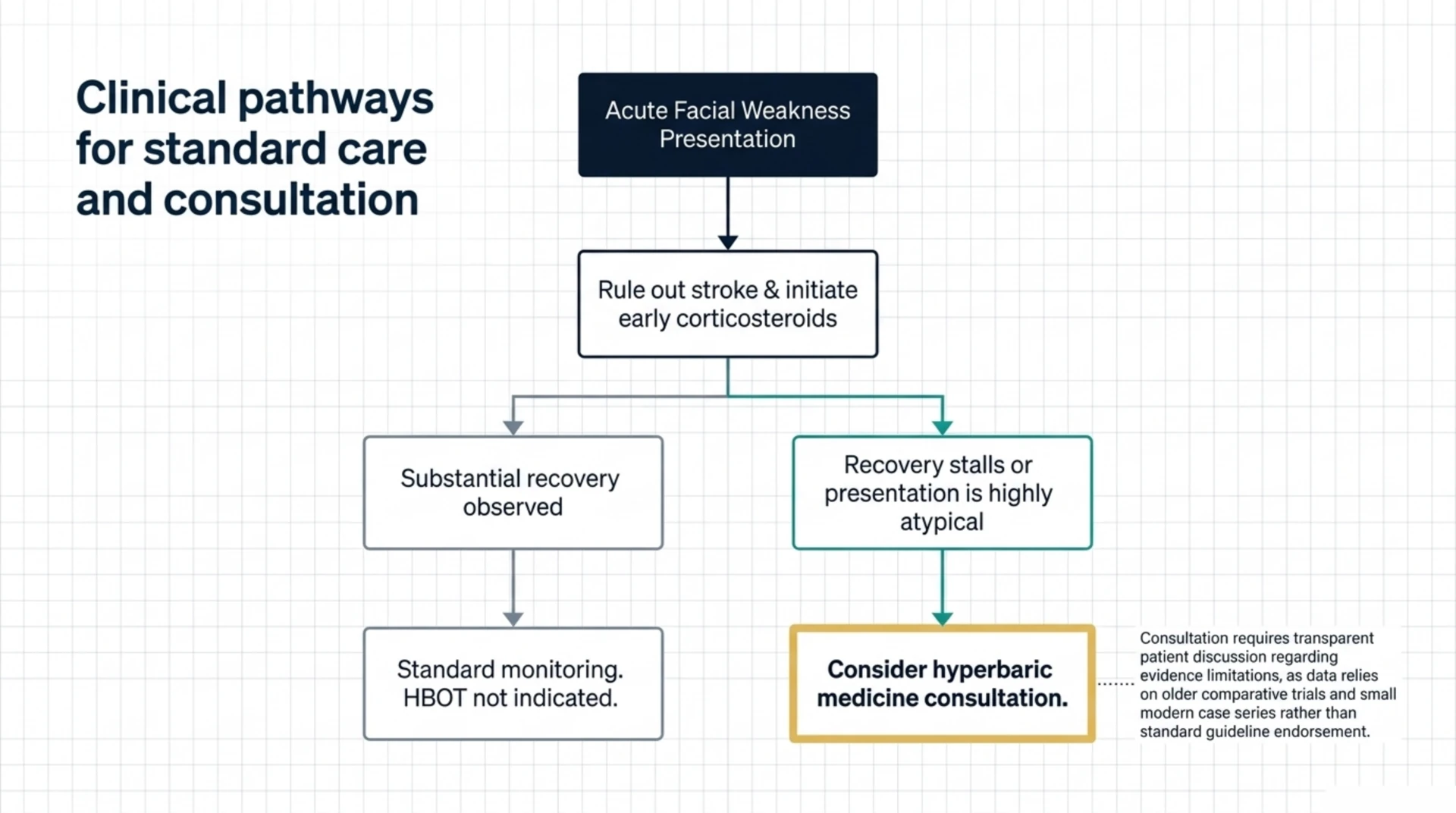
When a patient presents with sudden facial weakness, most physicians move quickly through the standard pathway: rule out stroke, start corticosteroids early, consider antivirals, and refer to ENT or neurology if recovery stalls. Hyperbaric oxygen therapy Bell’s palsy facial nerve referral questions come up less often, usually when a patient has not fully recovered on standard therapy and is asking what else exists. This article reviews the actual published evidence, drawn entirely from the Canada Hyperbarics research library, so referring physicians can weigh it accurately rather than relying on marketing claims from either side.
The short version: the evidence base for HBOT in Bell’s palsy is older, smaller, and less standardised than physicians may expect for a treatment that has been studied since the 1980s. That does not mean the question is settled. It means the honest answer is more nuanced than a simple yes or no.
What Is Bell’s Palsy and Why Does the Facial Nerve Matter?
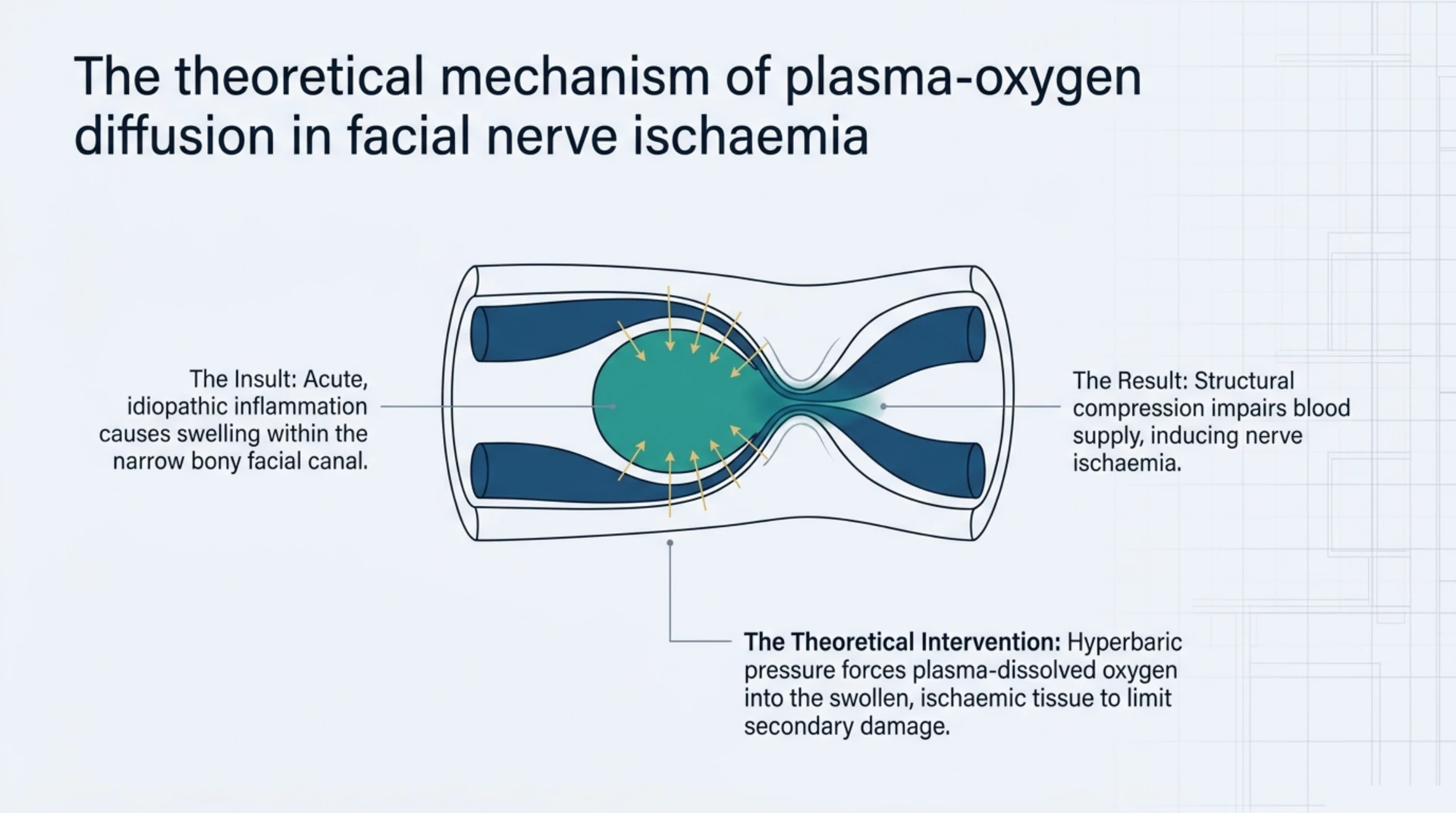
Bell’s palsy is an acute, usually idiopathic, unilateral weakness of the facial nerve (cranial nerve VII) that develops over hours to a few days. It is the most common cause of acute facial paralysis seen in primary care and emergency settings. The leading pathophysiological theory involves inflammation and swelling of the facial nerve as it passes through the narrow bony facial canal, which compresses the nerve and impairs its blood supply.
Most patients recover substantially within three to six months with corticosteroids started early, but a meaningful minority are left with residual weakness, synkinesis, or incomplete recovery. It is this residual group, and occasionally patients with unusual precipitating conditions, where HBOT referral questions most often arise.
Hyperbaric Oxygen Therapy for Bell’s Palsy: What Does Facial Nerve Referral Evidence Show?
The proposed rationale for HBOT in facial nerve injury is straightforward: if nerve compression within the facial canal reduces local blood flow and oxygen delivery, then increasing plasma-dissolved oxygen under pressure could theoretically support the nerve through the ischaemic, swollen phase of injury and reduce secondary damage. That is a plausible mechanism, but plausibility is not the same as proof, and referring physicians should treat the two separately.
Early Comparative Data
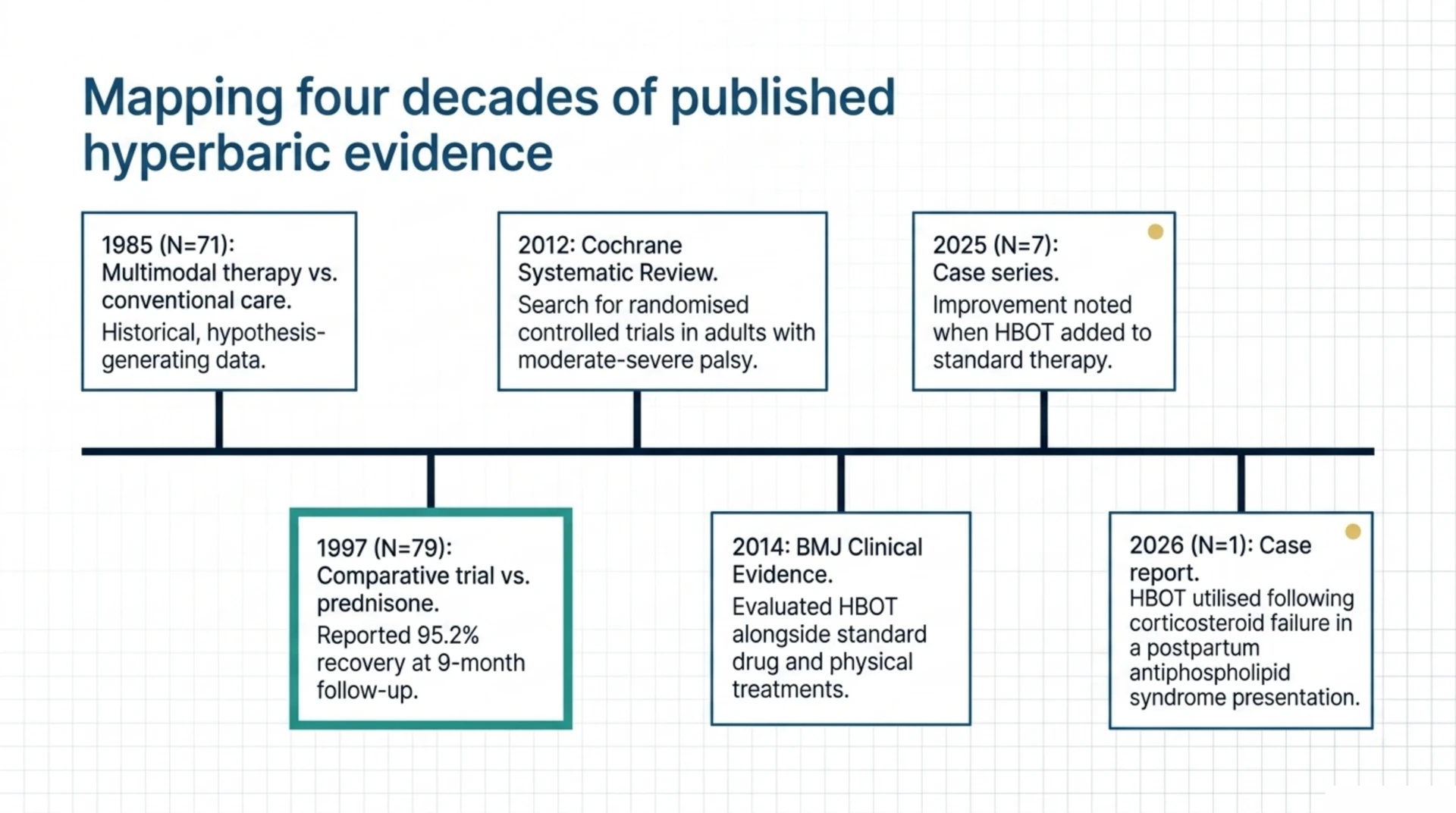
The oldest and most frequently cited HBOT data for Bell’s palsy comes from a 1997 study (Undersea & Hyperbaric Medicine, PubMed | Our Assessment) that compared hyperbaric oxygen therapy against prednisone in 79 subjects with Bell’s palsy. At nine month follow-up, the study reported that 95.2% of subjects treated had recovered. That figure is notable, but it comes from a single trial published nearly three decades ago, and it should be weighed against the far more cautious conclusions of the systematic reviews discussed below rather than treated as a standalone endorsement.
A related and older dataset comes from a 1985 study (Zhurnal Nevropatologii i Psikhiatrii, PubMed | Our Assessment) that evaluated hyperbaric oxygenation as part of a multiple modality therapy against conventional treatment in 71 patients with facial neuritis. Because this study predates modern trial reporting standards and used a multimodal treatment package rather than isolating HBOT alone, its findings are best read as historical, hypothesis-generating evidence rather than a modern efficacy benchmark.
Systematic Reviews Urge Caution
The strongest and most recent systematic evidence has not endorsed HBOT as a standard therapy for Bell’s palsy. A 2012 Cochrane systematic review (PubMed | Our Assessment) set out to evaluate hyperbaric oxygen therapy specifically in adults with moderate to severe Bell’s palsy, systematically searching multiple databases for qualifying randomised controlled trials. Cochrane reviews of this design exist precisely to surface how much, or how little, trial-level evidence supports a given intervention, and referring physicians who want the full picture should read that review directly rather than rely on any single earlier trial.
A separate 2014 systematic review in BMJ Clinical Evidence (PubMed | Our Assessment) took a broader look, evaluating multiple drug and physical treatments, including HBOT, for Bell’s palsy in both adults and children. This kind of comparative review is useful context for referring physicians because it situates HBOT alongside corticosteroids, antivirals, and physical therapy rather than assessing it in isolation.
Recent Case Reports and Case Series
More recent literature has moved away from large comparative trials and toward smaller case-level reports, usually describing HBOT as an add-on therapy in patients who did not fully respond to standard care. A 2025 case series in the Journal of Family Medicine and Primary Care (PubMed | Our Assessment) followed seven individuals with Bell’s palsy treated with a combination of standard therapy and HBOT, and the authors reported improvement in facial nerve function among the group. As a case series without a control arm, this is descriptive evidence, useful for generating referral questions but not for establishing that HBOT caused the improvement.
A 2026 case report (Frontiers in Rehabilitation Sciences, PubMed | Our Assessment) described a 37-year-old woman with antiphospholipid syndrome who developed postpartum Bell’s palsy and was given HBOT after corticosteroids failed to resolve her symptoms. Cases like this illustrate the population where HBOT referral questions actually surface in practice: patients with an atypical or refractory presentation, not patients on the standard steroid-responsive pathway.
A Related Diagnostic Consideration: Facial Baroparesis
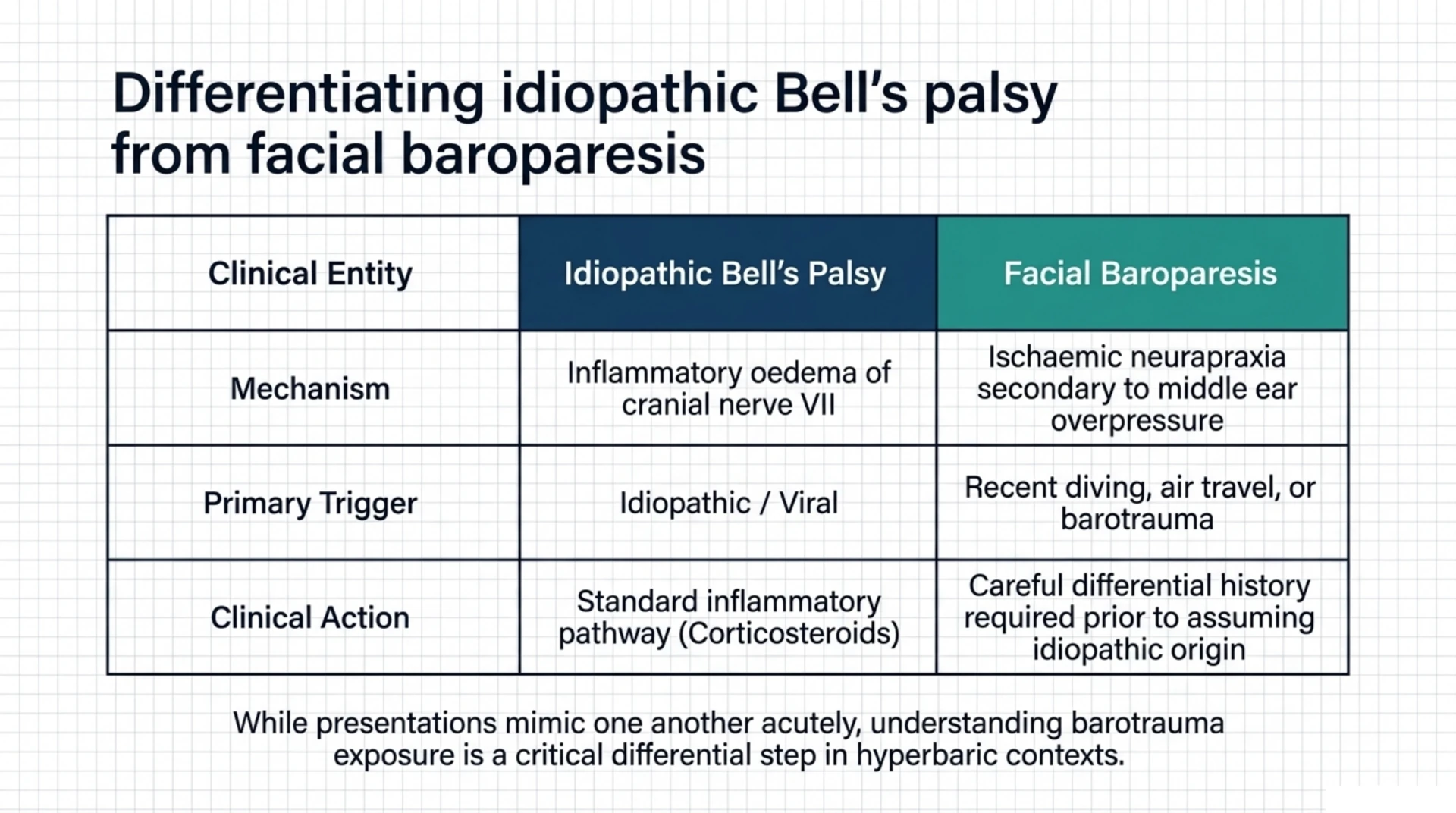
Referring physicians should also be aware of a distinct entity relevant to hyperbaric contexts. A 2008 paper in Presse Medicale (PubMed | Our Assessment) characterized facial baroparesis, an ischaemic neurapraxia of the facial nerve caused by middle ear overpressure, most often seen in divers or air travellers. This is not Bell’s palsy and does not share its idiopathic, inflammatory mechanism, but the two can look clinically similar at first presentation. A careful history of recent diving, flying, or barotrauma is a useful differential step before assuming any acute facial palsy is idiopathic Bell’s palsy.
How Does the Evidence Compare at a Glance?
| Study (Year) | Design | Participants | Key Finding |
|---|---|---|---|
| Undersea & Hyperbaric Medicine (1997) | Comparative trial vs. prednisone | 79 | 95.2% recovery reported at 9 month follow-up |
| Zhurnal Nevropatologii i Psikhiatrii (1985) | Multimodality vs. conventional care | 71 | Hyperbaric oxygenation evaluated as part of a combined treatment package |
| Cochrane Database of Systematic Reviews (2012) | Systematic review of RCTs | Adults, moderate-severe Bell’s palsy | Systematically searched for qualifying randomised trial evidence |
| BMJ Clinical Evidence (2014) | Systematic review | Adults and children | Evaluated HBOT alongside other drug and physical treatments |
| Journal of Family Medicine and Primary Care (2025) | Case series | 7 | Improvement reported with standard therapy plus HBOT |
| Frontiers in Rehabilitation Sciences (2026) | Case report | 1 | HBOT added after corticosteroid failure in a complex postpartum case |
When Might a Referring Physician Consider an HBOT Consultation?
Based on what the literature actually supports, the most defensible referral scenarios are narrow, not broad. HBOT has not been established as a first-line or routine addition to standard Bell’s palsy care, and the systematic review evidence has not moved past a call for more randomised data. Where HBOT questions have realistically arisen in the published cases reviewed here, it has been in patients with incomplete recovery on corticosteroids, or an atypical or complicated presentation, such as an underlying autoimmune condition.
For patients on the standard, steroid-responsive recovery curve, there is no evidence reviewed here to suggest HBOT referral changes that trajectory. For patients who plateau early or have an unusual clinical picture, a hyperbaric medicine consultation may be a reasonable discussion to have, with the patient informed that the supporting evidence is limited to older comparative data, small case series, and individual case reports rather than a modern, adequately powered randomised trial.
Physicians managing patients on Ontario’s HBOT-covered indication list may also want to review how coverage decisions are made more broadly; the HBOT coverage in Canada overview outlines which indications currently qualify and how that differs from an off-label or evidence-limited referral like Bell’s palsy.
Frequently Asked Questions
Is hyperbaric oxygen therapy an approved standard treatment for Bell’s palsy in Canada?
No. HBOT is not a standard, guideline-endorsed first-line treatment for Bell’s palsy. Corticosteroids, started early, remain the evidence-based standard of care.
What does the Cochrane review say about HBOT for Bell’s palsy?
The 2012 Cochrane systematic review searched for randomised controlled trial evidence on HBOT specifically for adults with moderate to severe Bell’s palsy. Referring physicians should consult the full review directly, since systematic reviews are the most reliable single source for judging how much quality trial evidence actually exists.
How might hyperbaric oxygen theoretically help facial nerve recovery?
The proposed mechanism is that increased plasma oxygen delivery under pressure may support nerve tissue compressed and made ischaemic by swelling within the narrow facial canal. This is a plausible biological rationale, not a proven clinical benefit.
Which patients with facial palsy have actually received HBOT in the published literature?
The case reports and case series reviewed here generally describe HBOT used as an add-on after incomplete recovery on standard therapy, or in patients with an atypical presentation, rather than as routine first-line care.
Are HBOT and Bell’s palsy always the right diagnosis to consider together?
Not necessarily. Facial baroparesis, caused by middle ear overpressure from diving or flying, can mimic Bell’s palsy but has a different mechanism. A history of recent barotrauma exposure is a useful differential step.
How many hyperbaric oxygen sessions are typically involved when HBOT is used for facial nerve conditions?
The studies reviewed here do not report a single standardised protocol, and session counts varied by case and setting. This is one of the gaps that more rigorous trial data would need to resolve.
Related Reading
- HBOT for Sickle Cell Crisis: What the Evidence Shows
- HBOT for Pyoderma Gangrenosum: What the Evidence Shows
- Hyperbaric Oxygen for Calciphylaxis: What Evidence Shows
The Canada Hyperbarics research library tracks more than 14,000 peer-reviewed HBOT studies, and this review reflects only the subset directly relevant to Bell’s palsy and facial nerve referral. As with any evidence-limited indication, the Canada Hyperbarics team’s role is to summarize what has actually been published, not to recommend for or against a specific referral.
If you are a physician weighing an HBOT referral for a patient with Bell’s palsy or another facial nerve condition, the next step is a direct conversation with the patient about what the evidence does and does not show, and whether hyperbaric oxygen therapy is appropriate for their specific clinical picture.
This content is for informational purposes only and is not medical advice.