
TL;DR: Hyperbaric oxygen therapy (HBOT) is a treatment that delivers 100% oxygen at greater-than-atmospheric pressure to raise the amount of oxygen dissolved directly in blood plasma, independent of haemoglobin. For sickle cell disease vaso-occlusive crisis specifically, the direct clinical evidence is limited to one small retrospective case series of nine patients. A wider, but still preliminary, evidence base exists for related sickle cell complications, avascular necrosis, chronic leg ulcers, and vaso-occlusive eye disease, built mostly from single case reports rather than controlled trials.
Sickle cell disease (SCD) is a genetic blood disorder in which abnormally shaped red blood cells can block small blood vessels, causing episodes of severe pain and tissue damage known as vaso-occlusive crises. Researchers have long been interested in whether hyperbaric oxygen sickle cell disease crisis evidence supports using pressurized oxygen to interrupt this blockage and protect tissue during an acute episode. This review, compiled from the Canada Hyperbarics research library, walks through what the available studies actually show, and where the evidence stops short of proof.
What Is Hyperbaric Oxygen Therapy and Why Consider It for Sickle Cell Disease?
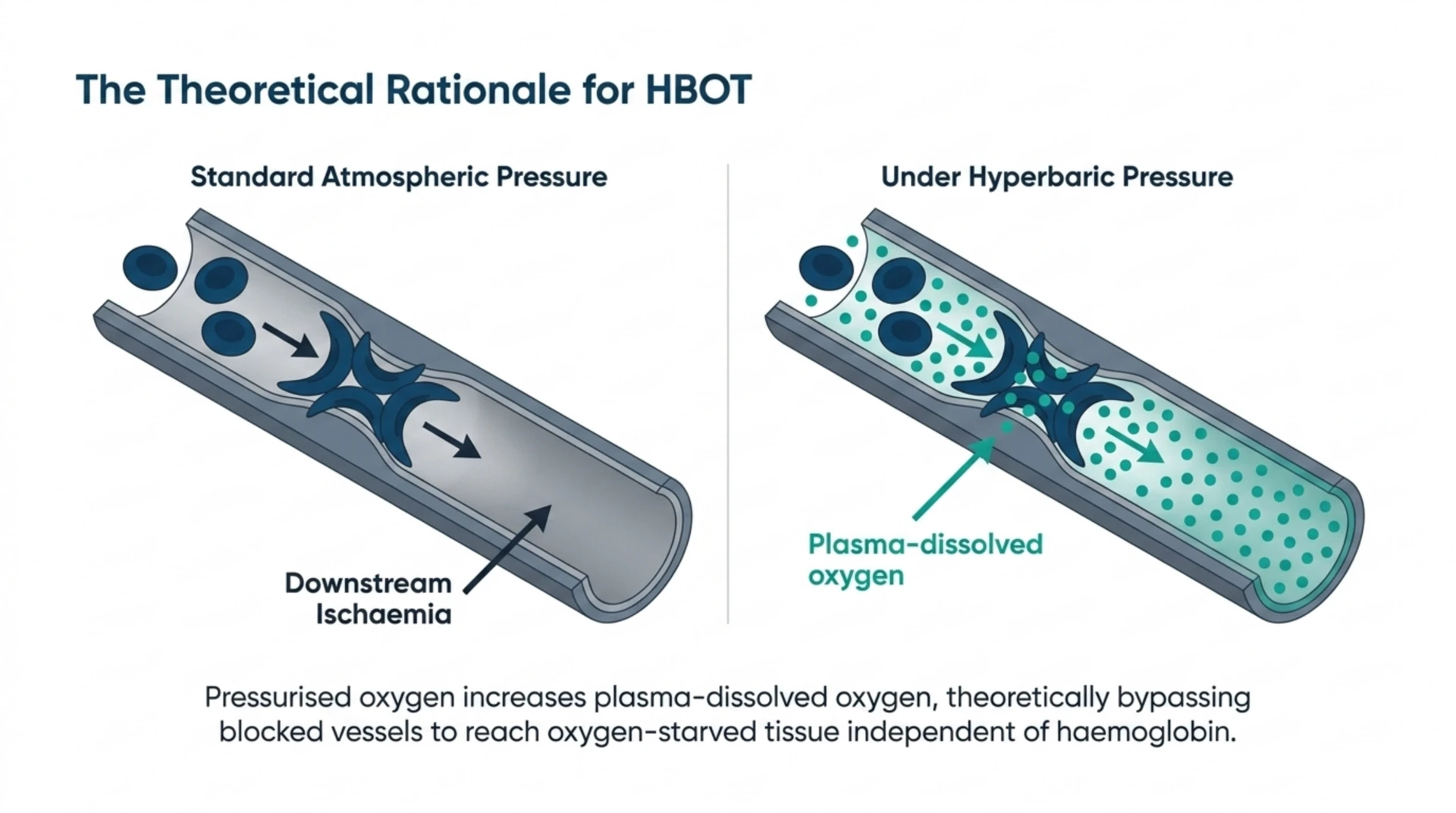
During a vaso-occlusive crisis, sickled red blood cells obstruct capillaries and small vessels, starving downstream tissue of oxygen. The theoretical rationale for HBOT is straightforward: breathing 100% oxygen at pressure dramatically increases plasma-dissolved oxygen, which in principle can reach tissue even when haemoglobin-carried oxygen delivery is blocked.
A 2026 narrative review (Author et al., PubMed | Our Assessment) synthesized the proposed mechanisms and existing clinical reports for HBOT across sickle cell disease complications. Importantly, this is a review of prior literature, not a new clinical trial, and its authors describe the field as early-stage with a clear need for prospective controlled research.
What Does the Direct Evidence on HBOT for Sickle Cell Crisis Show?
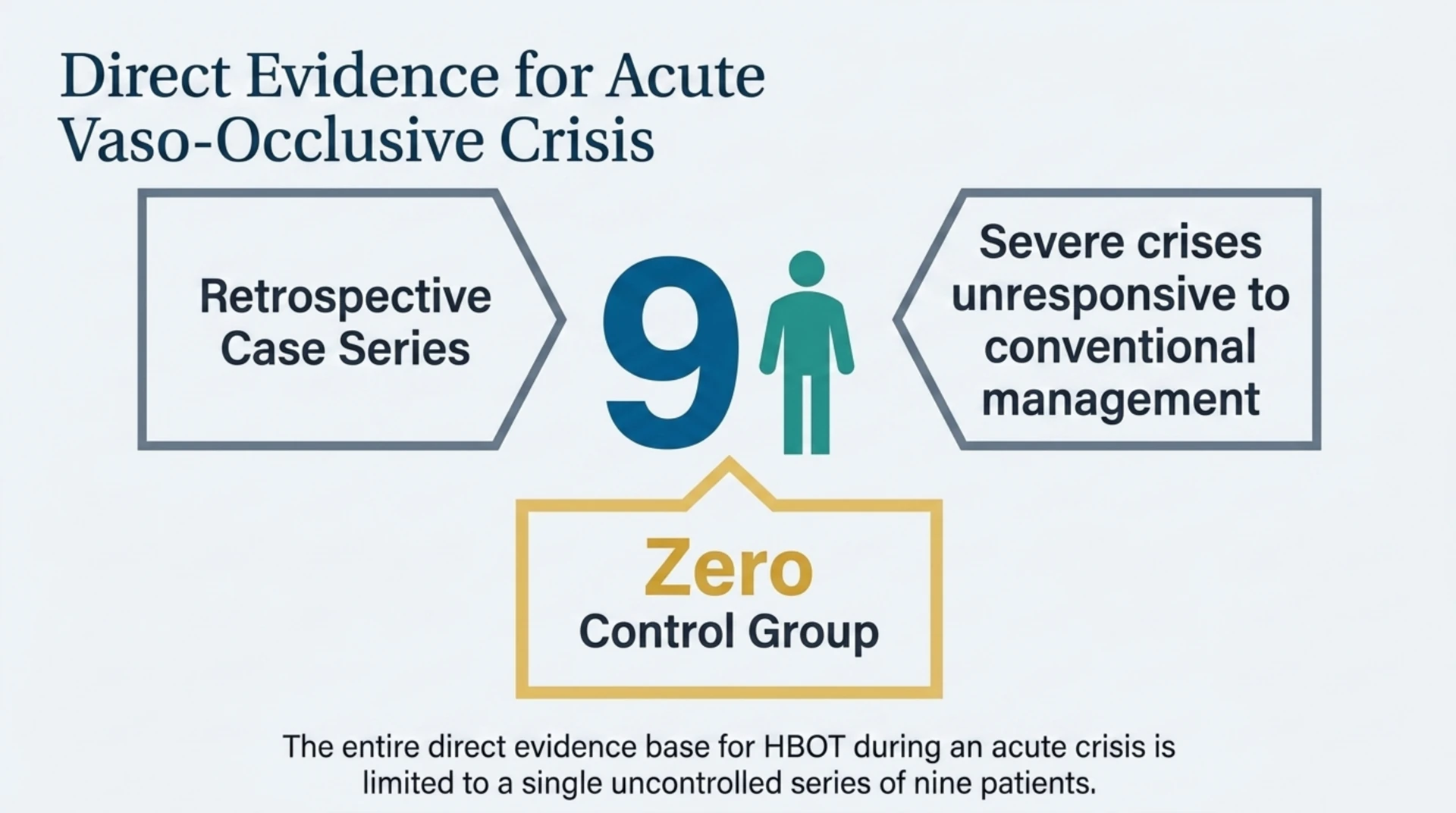
The most directly relevant study for hyperbaric oxygen sickle cell disease crisis evidence is a retrospective case series (Author et al., PubMed | Our Assessment) that evaluated HBOT in nine sickle cell disease patients experiencing severe vaso-occlusive crises who had not responded to conventional management.
This is the only study in the current evidence base that directly examines HBOT during an acute crisis episode, and it involved just nine patients with no control group. The retrospective, uncontrolled design means the reported clinical improvement cannot be separated from the effect of concurrent standard care, or from natural crisis resolution over time. It is a signal worth further study, not proof of benefit.
Outside this single series, no randomised controlled trial testing HBOT specifically for acute vaso-occlusive crisis appears in this pool. Readers searching for crisis-specific evidence should understand that the literature here is thin, and largely limited to this one uncontrolled series plus the mechanistic discussion in the 2026 narrative review above.
Beyond Acute Crisis: What Do Related Sickle Cell Complications Show?
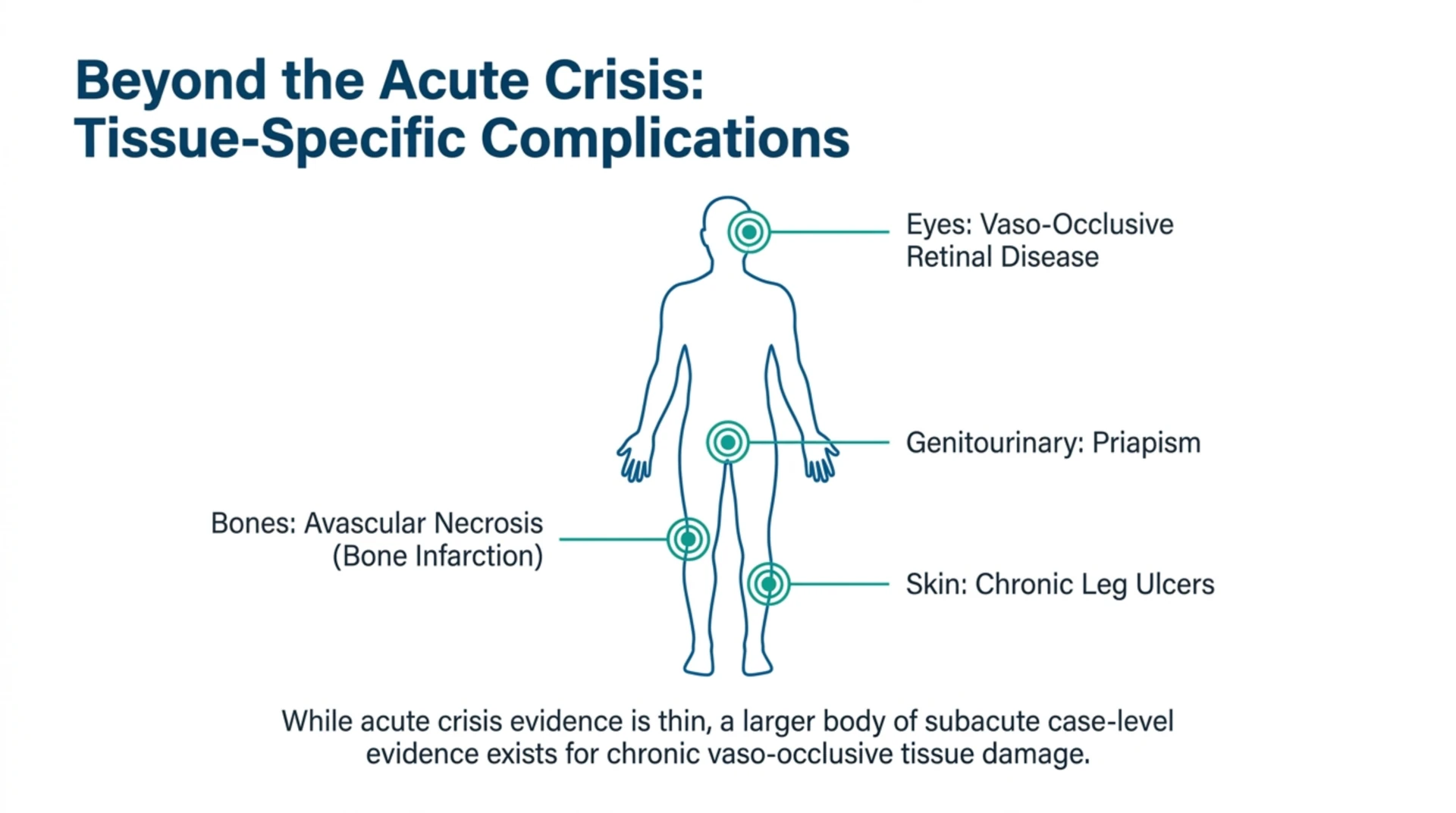
Because vaso-occlusion underlies many sickle cell disease complications beyond the acute pain crisis, part of the HBOT literature has instead focused on chronic or subacute vaso-occlusive tissue damage. This body of case-level evidence is larger, though it addresses a different clinical question than crisis treatment itself.
Avascular Necrosis (Bone Infarction)
Avascular necrosis, death of bone tissue from interrupted blood supply, is a recognised and common complication of sickle cell disease. A cross-sectional study conducted in Qatar (Author et al., PubMed | Our Assessment) documented the clinical and epidemiological burden of AVN across 49 adult SCD patients, underscoring how frequently this vaso-occlusive complication occurs.
Against that backdrop, a case report (Author et al., PubMed | Our Assessment) described a 15-year-old boy whose stage II avascular necrosis across three joints resolved following hyperbaric oxygen treatment. A separate preliminary case series (Author et al., PubMed | Our Assessment) reported short-term MRI changes in three adult SCD patients with aseptic osteonecrosis after HBOT.
These are individual case reports describing outcomes in specific patients, not evidence that HBOT reliably resolves avascular necrosis in the broader sickle cell population. Each case may have involved other concurrent treatments not fully separable from the HBOT effect.
Chronic Leg Ulcers
Chronic leg ulcers are another vaso-occlusive complication of sickle cell disease, and wound healing is one of the better-established general indications for HBOT. A case report (Author et al., PubMed | Our Assessment) described a 34-year-old man whose chronic sickle cell leg ulcer was successfully managed with HBOT. A more recent case report (Author et al., PubMed | Our Assessment) described complete coverage of a chronic sickle cell leg ulcer in a 35-year-old man using HBOT combined with skin grafting.
Both are single-patient outcomes where HBOT was paired with other standard wound care measures, so the individual contribution of oxygen therapy is difficult to isolate from the case description alone.
Vaso-Occlusive Eye Disease
Sickle cell disease can also cause vaso-occlusive events in the retina. A case report (Author et al., PubMed | Our Assessment) described a young man with sickle cell disease who developed central retinal artery occlusion and was treated with HBOT alongside exchange transfusion. Because the two treatments were given together, the case cannot show which one drove the outcome.
Priapism
Priapism, a prolonged and painful erection caused by vaso-occlusion, is a recognised sickle cell complication in males. A case report (Author et al., PubMed | Our Assessment) described an 11-year-old with sickle cell disease and priapism successfully treated with automated red cell exchange combined with hyperbaric oxygen after other interventions had failed.
How Strong Is This Evidence, Really?
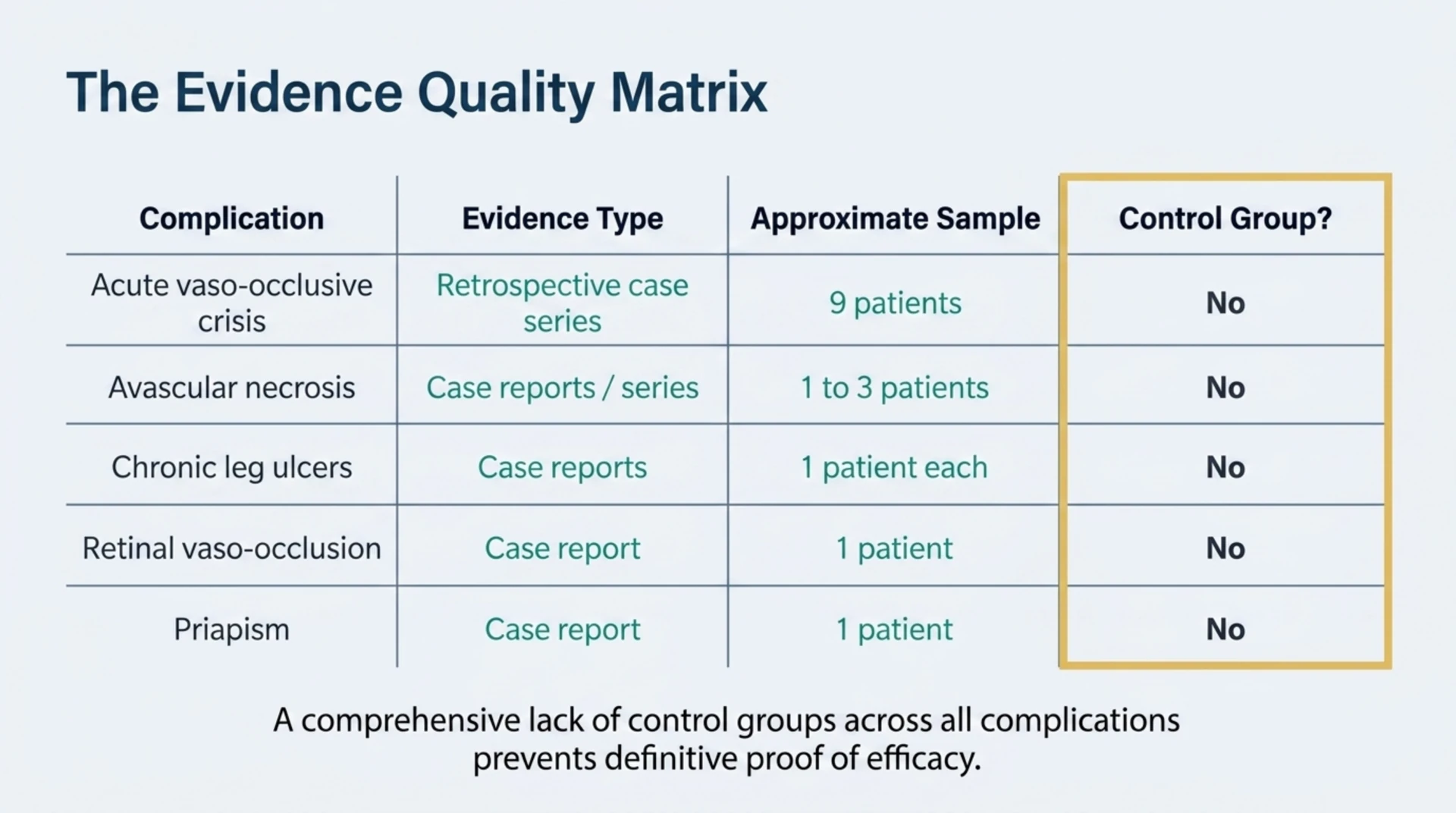
Taken as a whole, the hyperbaric oxygen sickle cell disease crisis evidence base is dominated by case reports and one small retrospective case series. No randomised controlled trial in this pool tests HBOT against a control condition for either acute crisis or its related complications. Case reports are useful for generating hypotheses and documenting that a treatment was tolerated and followed by improvement, but they cannot establish that HBOT caused the outcome rather than coincided with it.
The table below summarizes what type of evidence exists for each sickle cell complication discussed here.
| Sickle Cell Complication | Evidence Type | Approximate Sample | Control Group? |
|---|---|---|---|
| Acute vaso-occlusive crisis | Retrospective case series | 9 patients | No |
| Avascular necrosis | Case reports / small case series | 1 to 3 patients each | No |
| Chronic leg ulcers | Case reports | 1 patient each | No |
| Retinal vaso-occlusion | Case report (combined with exchange transfusion) | 1 patient | No |
| Priapism | Case report (combined with red cell exchange) | 1 patient | No |
For context, the Canada Hyperbarics research library tracks more than 14,000 peer-reviewed hyperbaric medicine studies overall, and sickle cell disease represents a small, still-developing corner of that literature. The narrative review discussed above explicitly calls for prospective, controlled studies before firmer conclusions can be drawn.
Frequently Asked Questions
Is HBOT an approved treatment for sickle cell crisis?
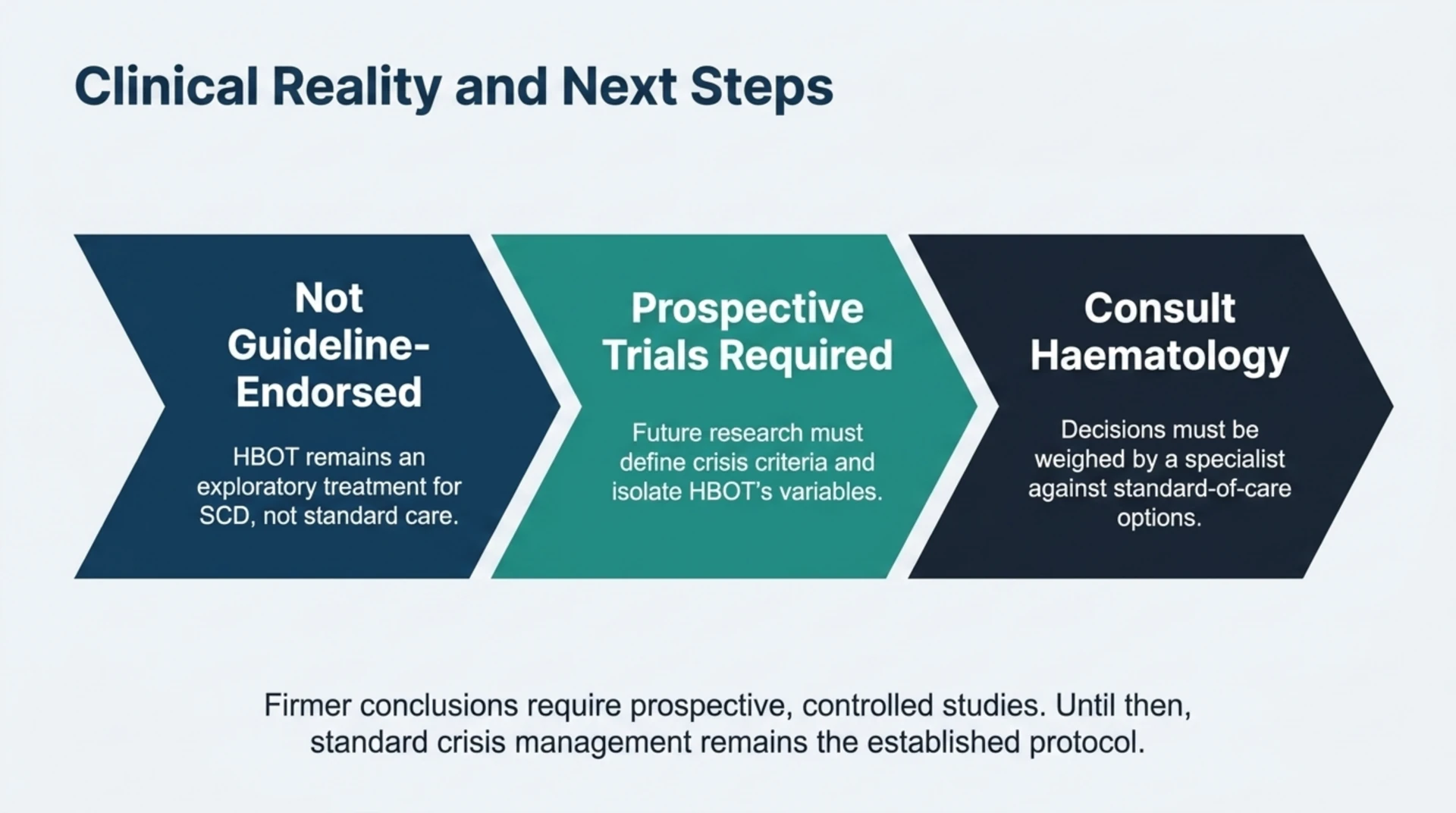
HBOT is not a standard, guideline-endorsed treatment for acute vaso-occlusive crisis. The evidence supporting its use is limited to a single small case series, and standard crisis management (fluids, analgesia, oxygen supplementation, and transfusion when indicated) remains the established approach.
How does HBOT theoretically help in vaso-occlusive crisis?
The proposed mechanism is that pressurized oxygen increases plasma-dissolved oxygen enough to bypass blocked vessels and reach oxygen-starved tissue. This is a physiological rationale described in the 2026 narrative review, not a proven clinical mechanism confirmed by controlled trials.
What sickle cell complications have the most case-based evidence for HBOT?
Chronic leg ulcers and avascular necrosis have the most case reports in this pool, reflecting HBOT’s broader established role in wound healing and its exploratory use in bone infarction. Acute crisis itself has the least direct evidence.
Are there risks associated with HBOT for people with sickle cell disease?
The case reports summarized here did not describe serious adverse events, but they are not designed to systematically capture safety data across a larger population. Anyone considering HBOT should discuss individual risk factors with their treating physician.
Does HBOT replace standard treatments like exchange transfusion?
No. In the case reports reviewed here, HBOT was consistently used alongside standard treatments such as red cell exchange or transfusion, never in place of them.
What research is still needed?
Prospective, controlled studies with clearly defined crisis criteria and outcome measures are needed to determine whether HBOT provides benefit beyond standard crisis management. The current literature cannot answer that question.
Related Reading
- HBOT for Diabetic Foot Ulcers: Cost-Effectiveness Evidence
- HBOT for Pyoderma Gangrenosum: What the Evidence Shows
- Hyperbaric Oxygen for Calciphylaxis: What Evidence Shows
For context on where HBOT is a recognised, funded treatment in Canada, see HBOT coverage in Canada. Sickle cell vaso-occlusive crisis is not among those recognised indications based on the current evidence reviewed here.
Anyone living with sickle cell disease who is curious about hyperbaric oxygen therapy should raise the question directly with their haematologist or treating physician, who can weigh it against their individual history and current standard-of-care options.
This content is for informational purposes only and is not medical advice.