
TL;DR: Hyperbaric oxygen therapy informed consent documentation is the clinic paperwork that records a patient’s understanding of, and agreement to, HBOT sessions before treatment begins. A solid documentation system covers the consent form itself, the intake conversation that supports it, storage and retrieval, staff training, and a process for updates. This guide walks clinic owners and operators through building that system from the ground up.
Hyperbaric oxygen therapy informed consent documentation is one of the most overlooked parts of running a compliant hyperbaric clinic. It is easy to focus on chamber logistics, scheduling, and staffing, and treat the consent form as an afterthought signed at the front desk. But a clinic’s documentation practices are often the first thing a regulator, insurer, or legal reviewer will ask to see. This guide covers what belongs in your consent documentation, how to build a workflow around it, and where clinics commonly fall short.
What Is Informed Consent Documentation in a Hyperbaric Oxygen Therapy Clinic?
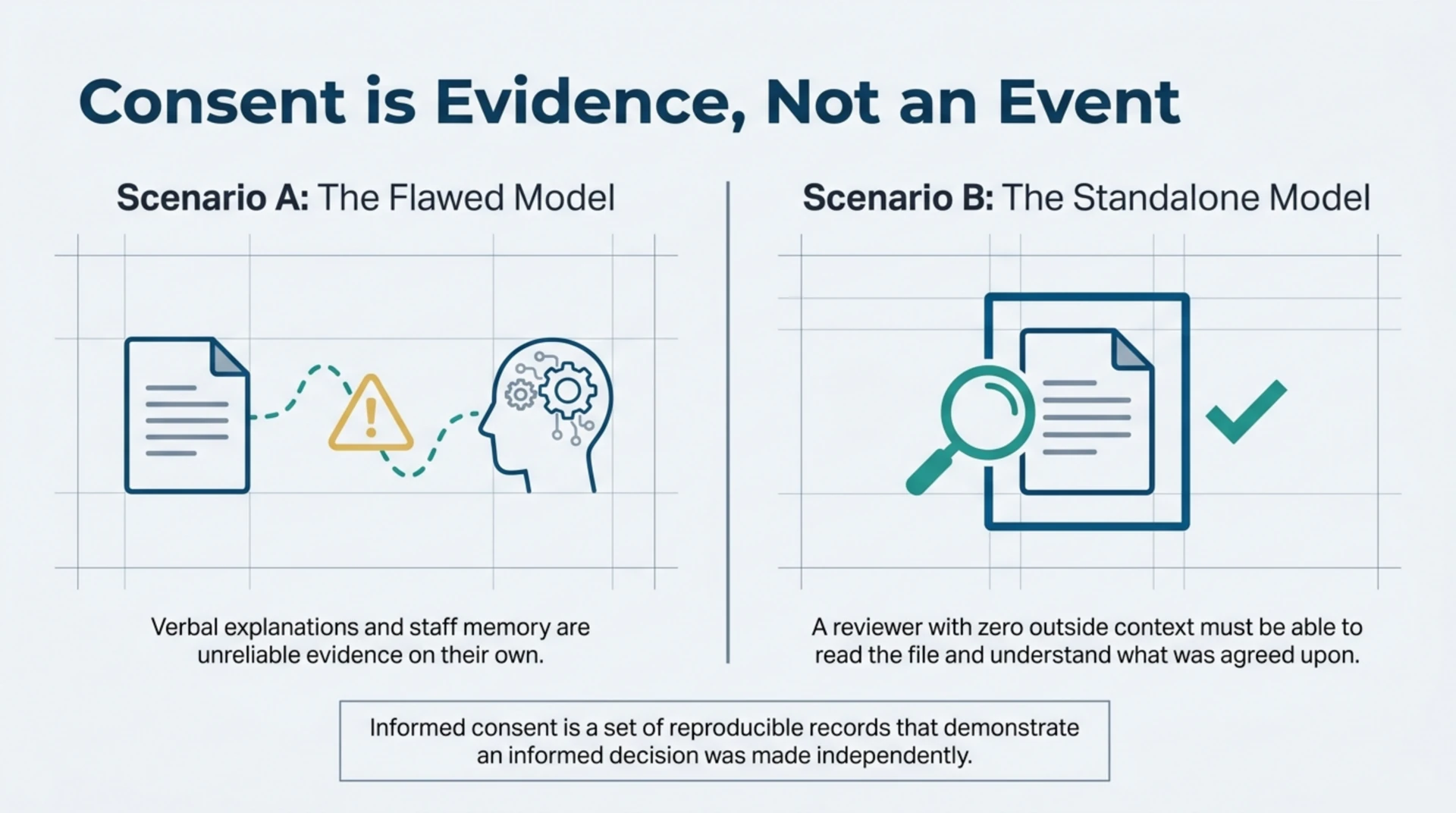
Informed consent documentation is the written record showing that a patient was told what to expect from hyperbaric oxygen therapy sessions, understood the process, and agreed to proceed of their own free will. It is not a single form. It is a set of records that, taken together, demonstrate an informed decision was made and can be reproduced later if questioned.
The documentation should stand on its own, meaning a reviewer with no other context could read the file and understand what the patient was told, when, and by whom. This matters because staff turnover, memory, and verbal explanations are not reliable evidence on their own.
Why Consent Documentation Matters for Clinic Operators
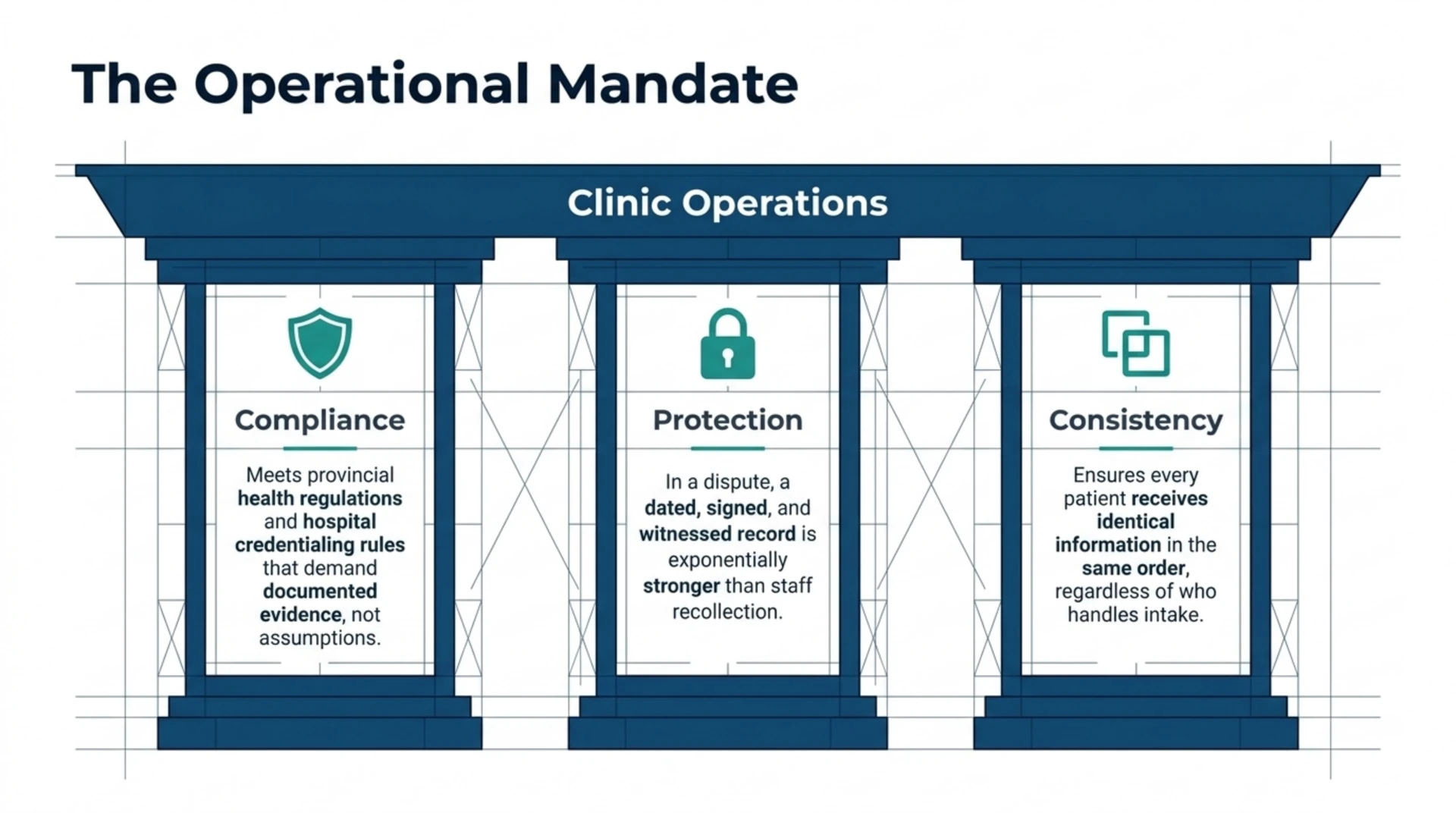
For a clinic owner, consent documentation serves three practical purposes beyond the ethical obligation to the patient.
First, it is a compliance record. Facilities operating under provincial health regulations or hospital credentialing rules are typically required to keep evidence that consent was obtained and documented, not just assumed. Details on how Canada Hyperbarics addresses regulatory expectations are outlined on our regulatory information page.
Second, it protects the clinic in the event of a dispute. A dated, signed, and witnessed consent record is far stronger evidence than staff recollection.
Third, it supports operational consistency. A standardised consent process means every patient, regardless of which staff member handles intake, receives the same information in the same order.
What Should a Hyperbaric Oxygen Therapy Consent Form Include?
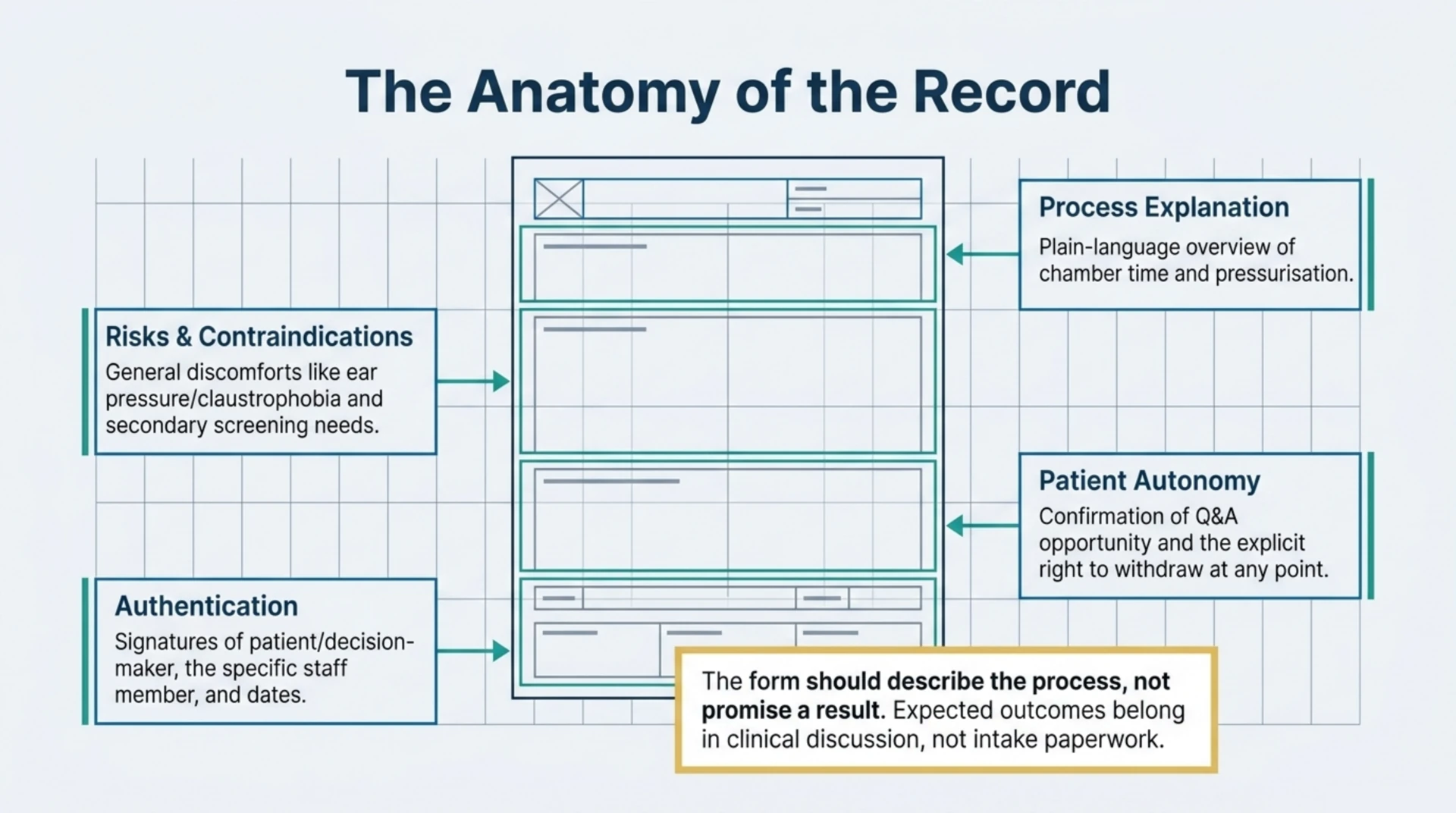
A hyperbaric oxygen therapy consent form does not need to be lengthy, but it does need to cover a defined set of elements consistently. At minimum, most clinic consent forms should include:
- A plain-language explanation of what a hyperbaric session involves, including time in the chamber and pressurization
- A description of general risks and discomforts, such as ear pressure sensations or mild claustrophobia, and how staff will address them during a session
- A note on contraindications or conditions that require additional screening before a patient begins sessions
- Confirmation that the patient has had the opportunity to ask questions
- A statement that the patient may withdraw consent and stop treatment at any point
- Signature lines for the patient (or substitute decision-maker), the staff member obtaining consent, and a date
The form should describe the process, not promise a result. Consent documentation explains what will happen in a session and what risks exist. It is not the place to describe expected outcomes, since those belong in a clinical discussion with the referring or treating physician, not in the intake paperwork.
Building a Consent Workflow for Your Clinic
A form alone is not a system. The workflow around it determines whether documentation is complete, consistent, and retrievable when needed.
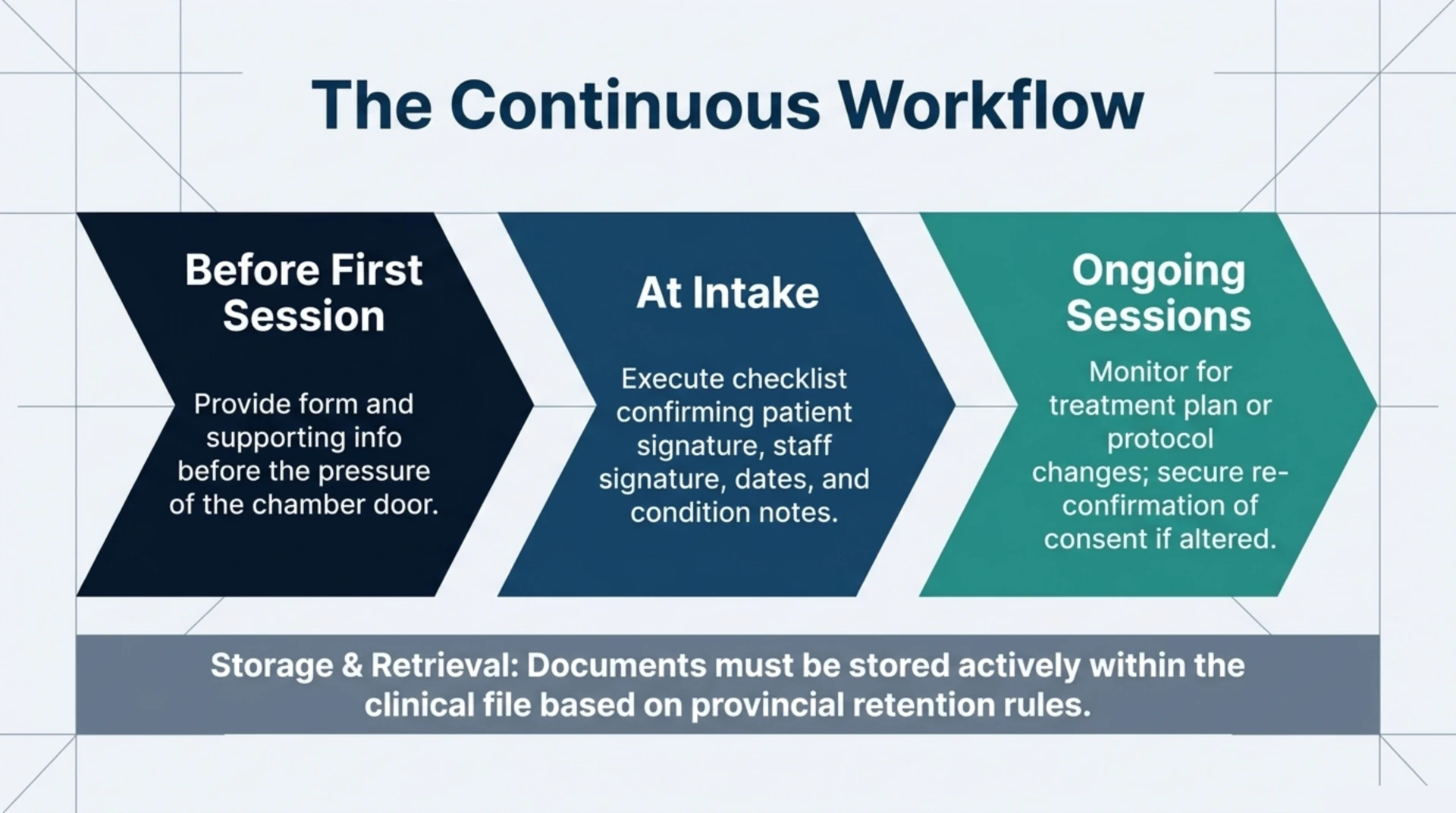
Before the First Session
Give the patient the consent form and any supporting information before the day of their first session, when possible. Reading and signing under time pressure at the chamber door is a common source of incomplete documentation.
At Intake
Use a checklist at intake that confirms every required field is complete: patient signature, staff signature, date, and any condition-specific notes. If your clinic sees patients for a range of reasons, our conditions overview can help intake staff understand the general categories of conditions clinicians may consider HBOT for, so the conversation stays consistent.
During Ongoing Sessions
If a patient’s treatment plan changes materially, for example a change in protocol or pressure schedule ordered by their physician, document that the patient was informed of the change and consented to it.
Storage and Retrieval
Store consent documentation with the patient’s clinical file, not separately, and make sure it can be retrieved quickly if a regulator, insurer, or patient requests a copy. Set a retention period consistent with your provincial health record requirements and your clinic’s own policy.
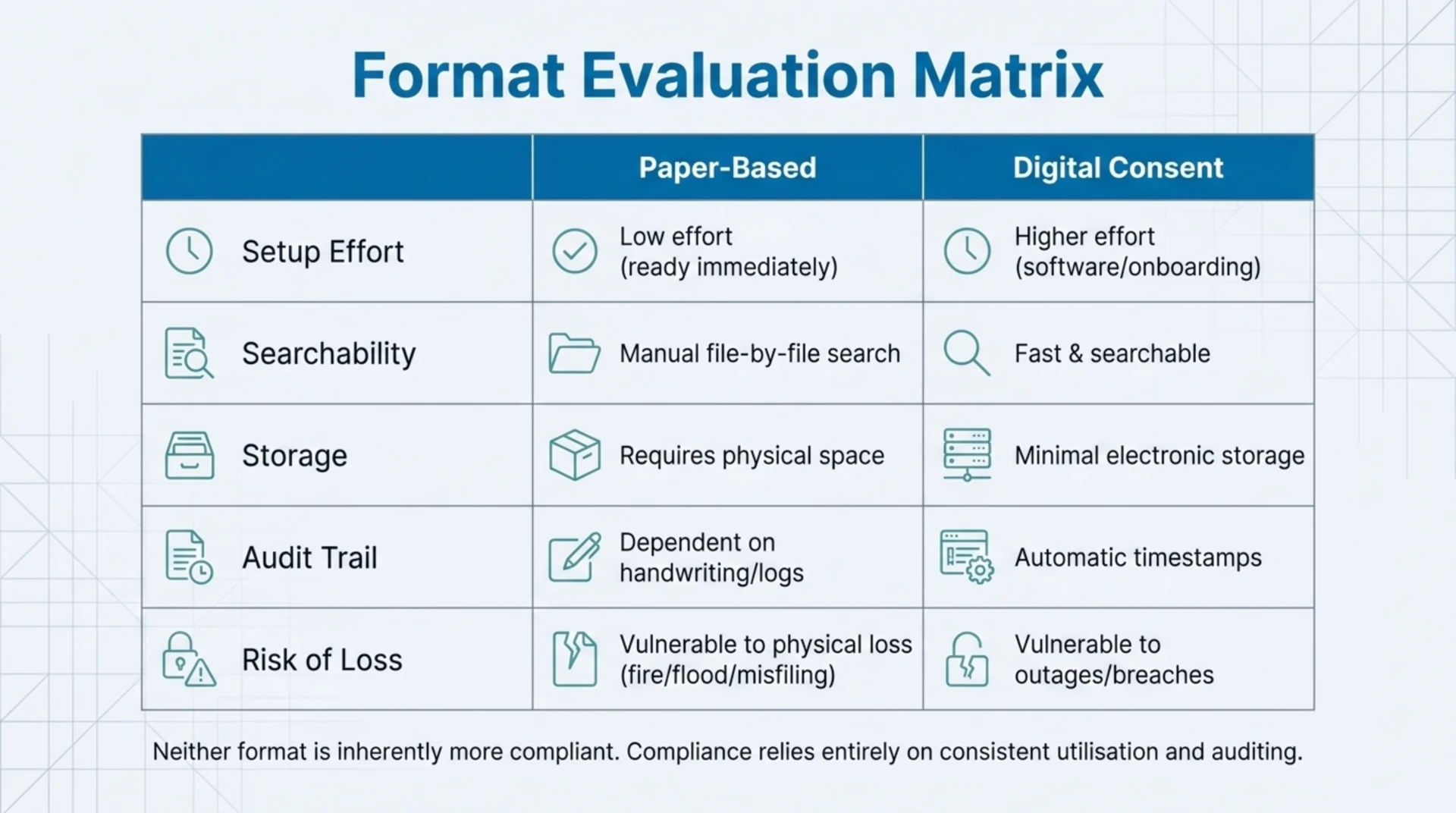
Paper Versus Digital Consent Documentation
Many clinics start with paper forms and later move to a digital intake system. Both approaches can be fully compliant, but they carry different operational tradeoffs.
| Factor | Paper-Based Consent | Digital Consent |
|---|---|---|
| Setup effort | Low, ready to use immediately | Higher, requires software setup and staff onboarding |
| Searchability | Manual, file by file | Fast, searchable by patient name or date |
| Storage space | Requires physical filing space | Minimal, stored electronically |
| Audit trail | Depends on handwriting and manual logs | Often includes automatic timestamps |
| Risk of loss | Vulnerable to fire, flood, or misfiling | Vulnerable to system outages or data breaches |
Neither format is inherently more compliant than the other. What matters is that whichever system you choose is used consistently, backed up, and reviewed periodically for gaps.
Common Documentation Mistakes to Avoid
A few recurring problems show up in clinic audits and reviews.
- Missing signatures or dates on an otherwise complete form
- Consent forms signed well after the first session already took place
- No record of who obtained consent from the patient
- Forms that describe outdated protocols after a clinic updates its procedures
- No process for re-confirming consent when a patient’s treatment plan changes
Most of these are workflow failures, not form design failures. A clear intake checklist prevents the majority of them.
Training Staff on Consent Documentation
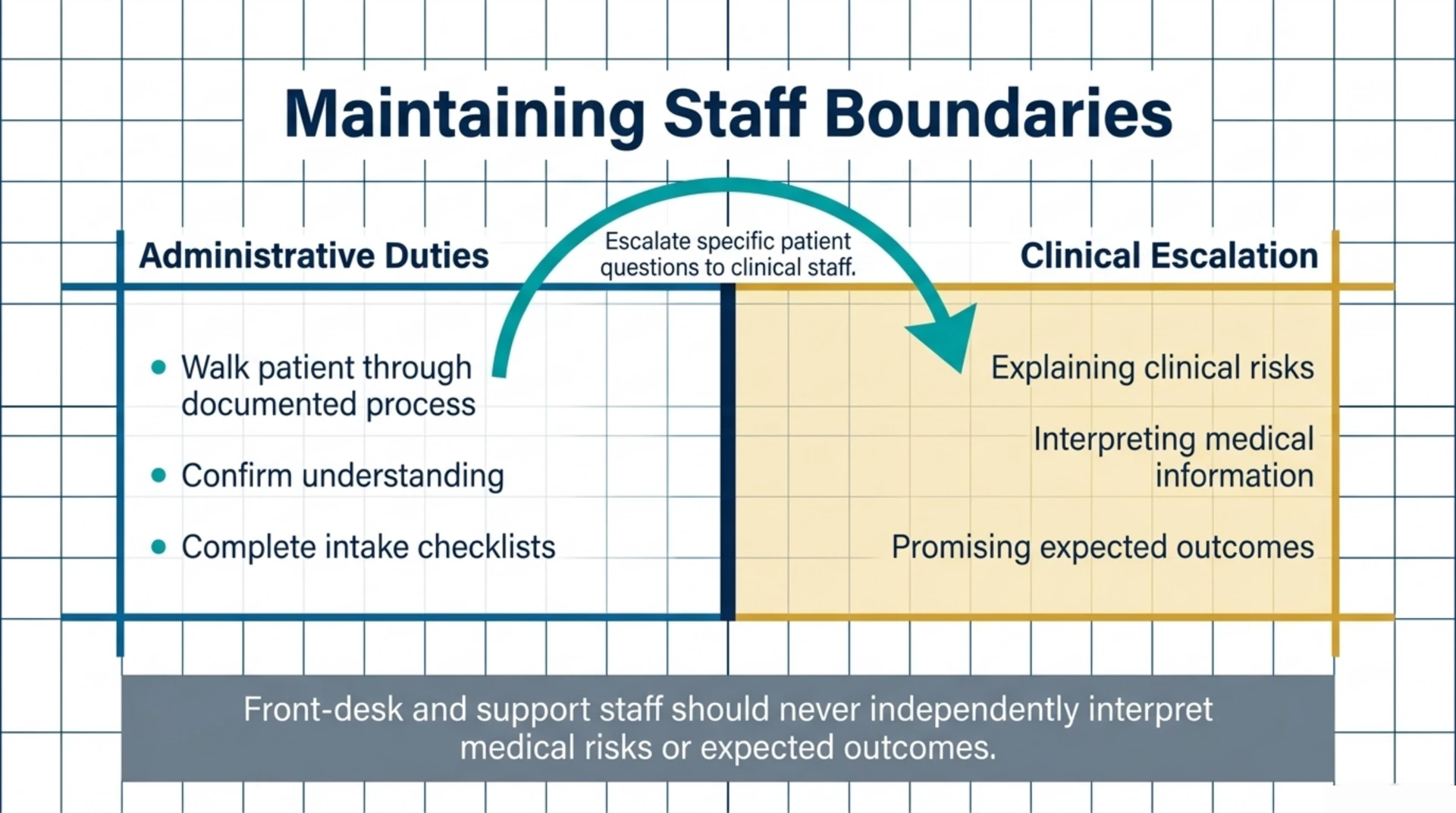
Consent documentation is only as strong as the staff member completing it. New staff should be trained on exactly what to say during the consent conversation, what questions patients commonly ask, and when to escalate a question to clinical staff rather than answer it themselves.
Front-desk and support staff should never be put in a position of explaining clinical risks or outcomes on their own. Their role is to walk the patient through the documented process and confirm understanding, not to interpret medical information.
Refresh training whenever your consent form changes, and periodically audit a sample of completed forms to check for gaps.
Regulatory and Facility Considerations
Consent documentation requirements can vary depending on whether treatment is delivered in a hospital-based unit or a private facility. Canada Hyperbarics maintains information on how regulated facilities across the country approach oversight on our regulatory page, and a directory of where sessions are delivered under medical supervision on our facilities page. Clinic operators should confirm their documentation practices align with the specific requirements of their province and facility type.
Frequently Asked Questions
Who needs to sign an HBOT informed consent form?
The patient signs, or a substitute decision-maker if the patient cannot consent on their own behalf. The staff member who conducts the consent conversation should also sign and date the form.
How long should a clinic keep consent documentation on file?
Retention periods depend on provincial health record regulations and your facility’s own policy. Check with your regulatory body or legal counsel to confirm the minimum retention period that applies to your clinic.
Can a patient withdraw consent after starting a treatment course?
Yes. Patients can withdraw consent and stop sessions at any point. Clinics should document when a patient withdraws consent, along with the date and any follow-up steps taken.
Does informed consent documentation replace a medical intake assessment?
No. Consent documentation and clinical intake assessment serve different purposes. Consent confirms the patient understands and agrees to the process. A medical intake assessment evaluates whether the patient is an appropriate candidate for treatment.
Should consent forms be updated for each new treatment protocol?
If a protocol change is significant enough that it changes what the patient experiences during a session, the clinic should document that the patient was informed of the change and re-confirm consent.
What happens if consent documentation is incomplete?
Incomplete documentation creates compliance and legal exposure for the clinic. Any gaps found during an internal audit should be corrected going forward, and the clinic’s intake workflow should be reviewed to prevent recurrence.
Related Reading
- Telehealth Pre-Screening for HBOT Candidacy Workflow
- Hyperbaric Oxygen Dose, Pressure and Protocol Optimization
- Hyperbaric Oxygen Therapy Trial Methodology: Sham Control
Strong hyperbaric oxygen therapy informed consent documentation protects patients and clinics alike, and it starts with a consistent, well-trained workflow rather than a form alone. Canada Hyperbarics encourages clinic operators to review their consent process regularly as protocols and regulatory expectations evolve. To see where HBOT is delivered under medical oversight in Canada, visit our directory of hospitals and regulated facilities.
This content is for informational purposes only and is not medical advice.