
TL;DR: Hyperbaric oxygen therapy (HBOT) trial methodology is the study design work that determines whether a trial’s result can be trusted, and a sham control is a fake treatment session used to hide who received real pressurized oxygen. Sham control is unusually hard to build for HBOT because patients can feel the chamber pressurize. Only a handful of studies in the current evidence base are meta-analyses of randomised controlled trials (RCTs); most are narrative reviews, mixed-design systematic reviews, or reviews where HBOT is one option among several. Researchers should weigh each citation by its design, not just its conclusion.
Hyperbaric oxygen therapy trial methodology refers to how researchers design, blind, and control studies that test HBOT, and a sham control is the comparison arm meant to look and feel like real treatment without delivering it. Getting this right matters because a poorly controlled trial can produce a result that looks like a treatment effect but is really a placebo response, an expectation effect, or noise. This matters especially for HBOT, where the physical sensations of pressurization make a convincing sham genuinely difficult to build.
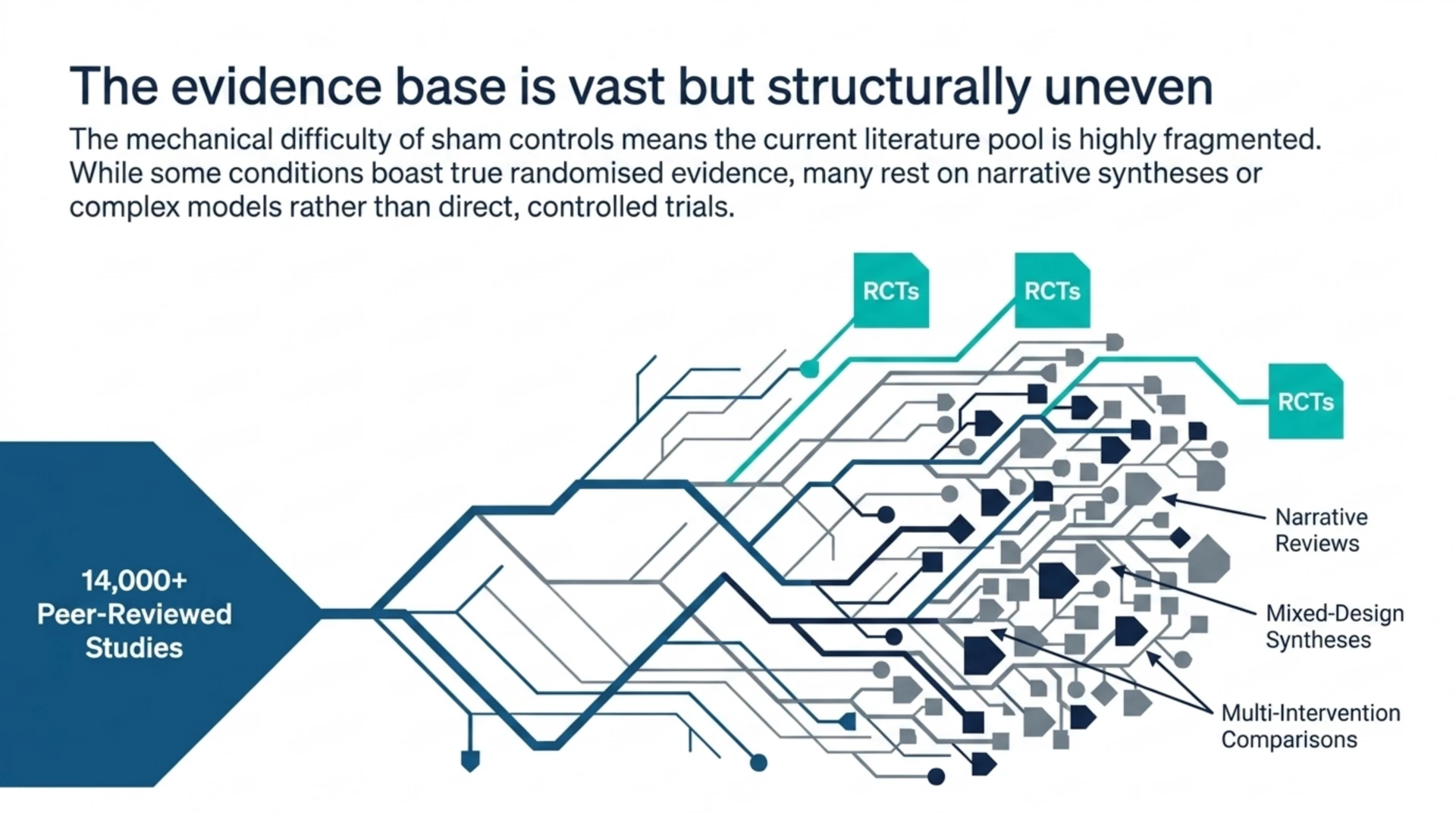
This article looks at what the current evidence base actually contains: how many studies are randomised trials, how many are reviews of reviews, and where HBOT is a small piece of a much larger, multi-intervention comparison. Canada Hyperbarics draws on a research library of over 14,000 peer-reviewed studies, and the picture across that library is uneven. Some conditions have real randomised evidence behind them. Many others rest on narrative synthesis rather than controlled trials.
What Does “Trial Methodology” Mean in Hyperbaric Oxygen Therapy Research?
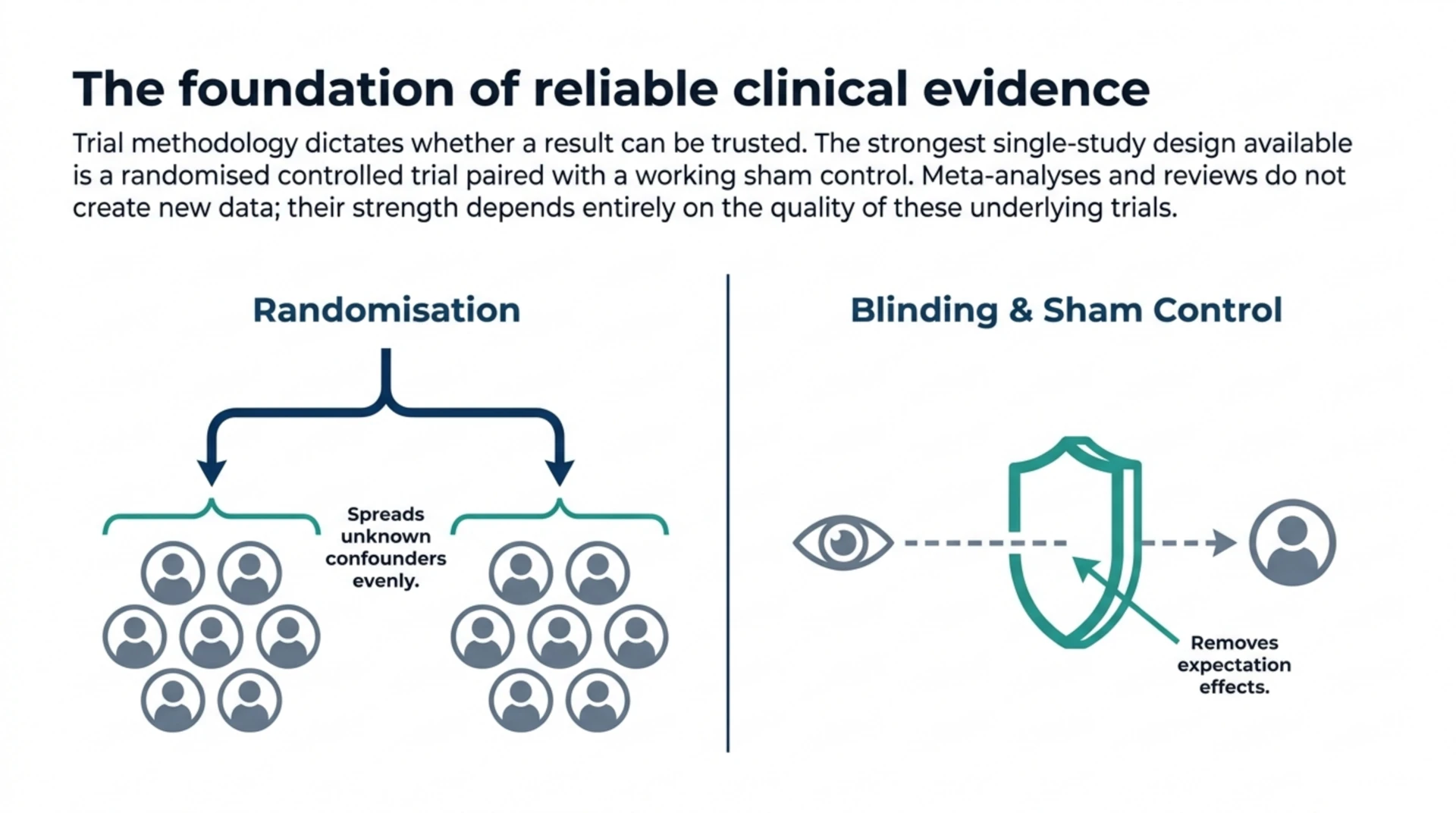
Trial methodology covers the decisions that shape whether a study’s result is reliable: how participants are assigned to groups, whether anyone is blinded to group assignment, how outcomes are measured, and how the analysis is planned in advance. For HBOT specifically, the two hardest decisions are how to build a believable sham exposure and how to measure outcomes without the assessor knowing who received real treatment.
A randomised controlled trial with a working sham control is the strongest single-study design available, because randomization spreads unknown confounders evenly across groups and blinding removes expectation effects. Systematic reviews and meta-analyses do not create new trial data; they pool and weigh existing trials, so their strength depends entirely on the quality of what went into them.
Why Is a Sham Control So Hard to Build for HBOT?
A sham HBOT session usually means running the chamber at a much lower pressure, or using room air instead of oxygen, while keeping the session length and setting identical to a real treatment. The problem is that patients often notice the difference. Ear popping, the sensation of pressure change, and the sound of the compression cycle are all physical cues that a real session produces and a shallow sham may not fully replicate.
This does not mean sham-controlled HBOT trials are impossible. It means that blinding quality varies a great deal between trials, and a review or meta-analysis that does not report on blinding success cannot tell a reader how much of an observed effect might be attributable to expectation rather than oxygen exposure. This is a design detail worth checking before treating any single HBOT trial result as definitive.
What Do the Randomised Trials in the Current Evidence Base Actually Show?
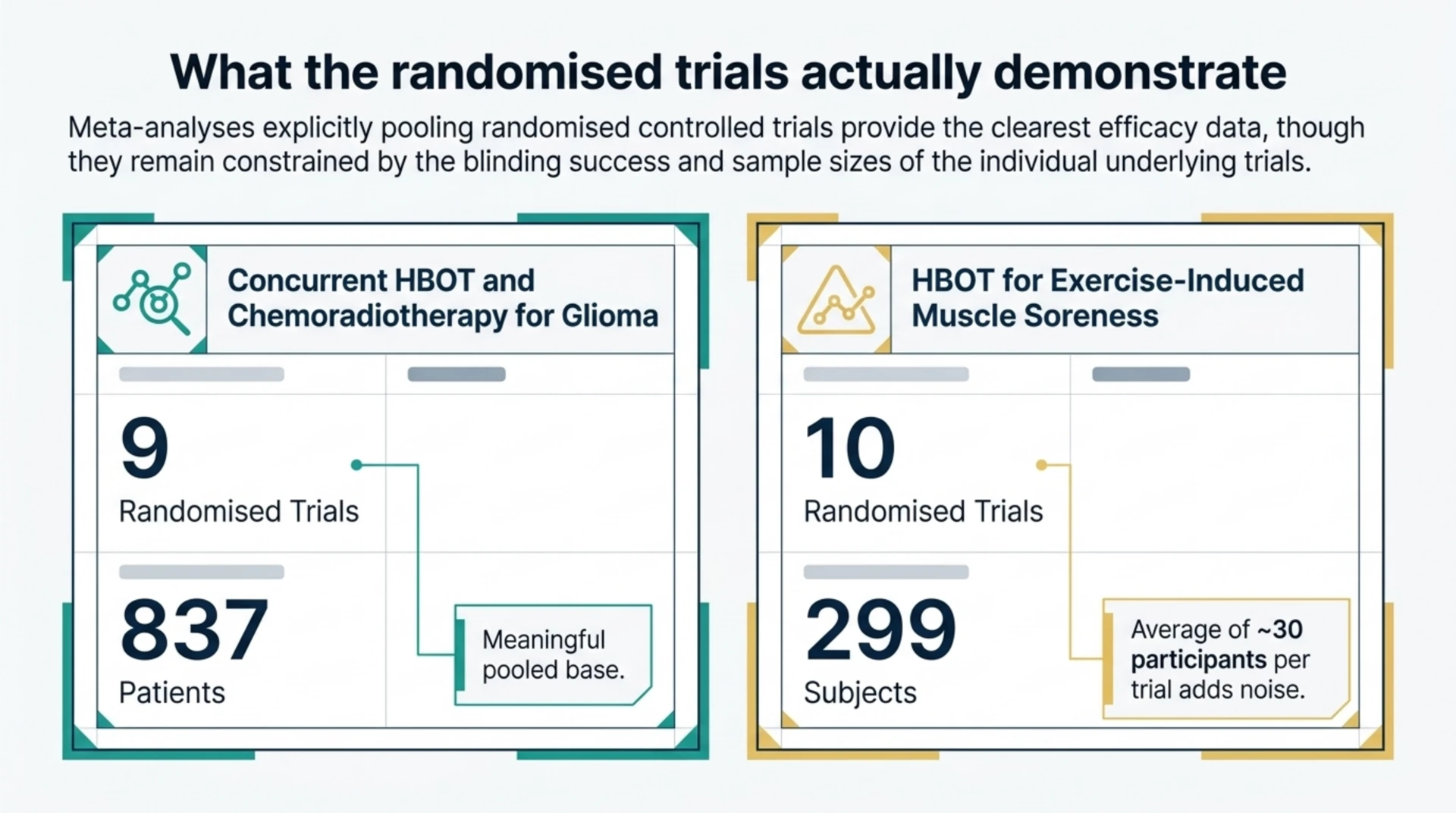
Two entries in the current pool are meta-analyses that explicitly pooled randomised controlled trials, which makes them useful worked examples of what RCT-level HBOT evidence looks like in practice.
Concurrent HBOT and Chemoradiotherapy for Glioma
A 2026 meta-analysis (PubMed | Our Assessment) pooled nine randomised controlled trials involving 837 patients to evaluate the efficacy and safety of concurrent HBOT with chemoradiotherapy for glioma. Nine trials pooled together is a meaningful base for a meta-analysis, though it still depends on how consistently each individual trial handled blinding and sham exposure, details a pooled analysis does not always resolve.
HBOT for Exercise-Induced Muscle Soreness
A 2025 systematic review and meta-analysis (PubMed | Our Assessment) combined results from 10 randomised controlled trials, 299 subjects in total, to determine whether HBOT reduces exercise-induced muscle injury and soreness in athletes and college populations. An average of roughly 30 participants per trial is small by RCT standards, which is a methodological limitation worth naming even when the trials themselves were randomised.
When the Evidence Is a Review, Not a Trial
Most of the current HBOT-related literature is not a randomised trial at all. It is a narrative or systematic review that synthesizes existing work, sometimes with HBOT as the central subject and sometimes as one therapy among many being compared.
Narrative and Mechanistic Reviews
A 2026 narrative review (PubMed | Our Assessment) examined the mechanisms and clinical rationale for HBOT in sickle cell disease complications by reviewing existing studies rather than running a new trial. Similarly, a 2026 review (PubMed | Our Assessment) reviewed how HBOT and N-acetylcysteine interact with the body’s oxidative stress systems. Neither of these is a trial and neither can establish a sham-controlled effect size; both are useful for generating hypotheses, not for confirming them.
Multi-Intervention Reviews Where HBOT Is One Option Among Several
Some reviews compare HBOT against other treatments rather than against a placebo. A 2026 systematic review and Bayesian network meta-analysis (PubMed | Our Assessment) compared several treatments for medication-related osteonecrosis of the jaw, including surgical approaches and HBOT, and ranked them for effectiveness. A network meta-analysis is a different methodological tool than a standard sham-controlled trial: it ranks active treatments against each other using statistical modelling, not against a placebo arm, so it answers a different question than “does this beat a sham.”
A similarly broad 2025 systematic review of 127 studies (PubMed | Our Assessment) looked at how personalized distraction rates and physical therapies, including HBOT, affect bone regeneration in mandibular distraction osteogenesis. With 127 studies covering multiple interventions, any single therapy’s specific contribution is harder to isolate than in a trial designed around that one therapy.
Meta-Analyses That Do Not Specify Trial Design
A 2025 systematic review and meta-analysis of ten studies (PubMed | Our Assessment) assessed how HBOT performs in treating osteonecrosis of the femoral head. The label “systematic review and meta-analysis” does not by itself guarantee the pooled studies were randomised or sham-controlled, so this kind of citation is worth checking at the source before treating it as RCT-grade evidence.
Reviews That Include Animal Data Alongside Human Trials
A 2026 systematic review of 38 studies (PubMed | Our Assessment) covered both animal and human research to examine the mechanisms, effectiveness, and safety of hyperbaric and normobaric oxygen for intracranial hemorrhage. Mixing animal and human data is common in mechanism-focused reviews, but it means the human-relevant trial evidence is only a portion of what the review covers, not the whole of it.
Safety and Adverse-Effect Reviews
Trial methodology also includes how adverse events are tracked, which is its own evidence category. A 2026 review (PubMed | Our Assessment) examined how hyperbaric oxygen and other mechanical factors can cause acute lung injury. Safety literature like this is a reminder that trial design work extends beyond efficacy outcomes into monitoring for harm, which any well-run RCT protocol should specify in advance.
Comparing Evidence Tiers in the Current HBOT Literature
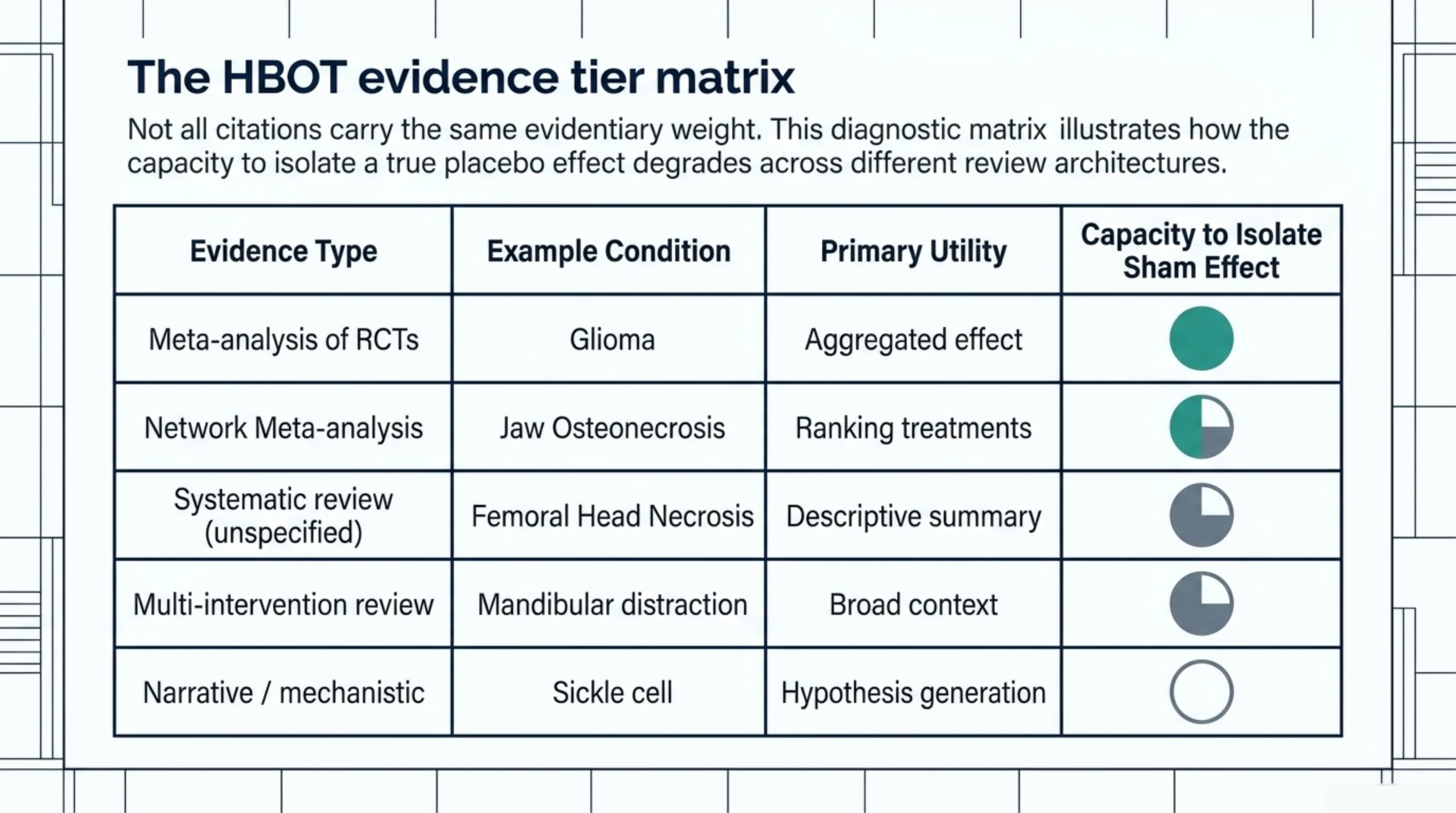
| Evidence type | Example from this review | Can it isolate a placebo/sham effect? | What it is best used for |
|---|---|---|---|
| Meta-analysis of RCTs | Glioma + chemoradiotherapy (9 RCTs, 837 patients) | Only as well as the underlying trials blinded participants | Aggregated effect estimate across pooled trials |
| Meta-analysis of RCTs | Exercise-induced muscle soreness (10 RCTs, 299 subjects) | Same caveat; small per-trial sample sizes add noise | Aggregated effect estimate, interpreted cautiously |
| Network meta-analysis | Medication-related osteonecrosis of the jaw treatments | Not designed to answer this; compares active treatments | Ranking treatment options against each other |
| Systematic review, design unspecified | Femoral head necrosis (10 studies) | Unknown without checking source studies | Descriptive summary, hypothesis generation |
| Multi-intervention systematic review | Mandibular distraction osteogenesis (127 studies) | Not isolated to HBOT specifically | Broad context, not HBOT-specific inference |
| Mixed animal/human review | Intracranial hemorrhage (38 studies) | Human trial evidence is only part of the total | Mechanism understanding, translational context |
| Narrative/mechanistic review | Sickle cell disease; HBOT and N-acetylcysteine | No; not a controlled comparison | Generating hypotheses for future trials |
What Does This Mean for Researchers Evaluating HBOT Claims?
The practical takeaway is that not all citations carry the same evidentiary weight, even within a single research library. A claim backed by a meta-analysis of randomised trials is on firmer ground than one backed by a narrative review, and a claim backed by a network meta-analysis is answering a different question than a claim backed by a sham-controlled RCT.
Before relying on any single HBOT citation, it is worth checking three things: whether the underlying studies were randomised, whether blinding or sham control was attempted and how well it worked, and whether HBOT was the primary intervention studied or one option among several. This is slower than accepting a headline finding at face value, but it is the difference between reading the evidence and reading a summary of the evidence.
For background on how HBOT is currently funded and delivered in Canada, see our HBOT coverage overview.
Frequently Asked Questions
What is a sham control in an HBOT trial?
A sham control is a comparison session designed to feel similar to real hyperbaric treatment, typically using a much lower pressure or room air instead of oxygen, without delivering the treatment being tested. Its purpose is to let researchers separate a true treatment effect from a placebo or expectation effect.
Why is blinding difficult in hyperbaric oxygen therapy research?
Patients can often sense chamber pressurization through ear popping and other physical cues, which makes it hard to fully disguise whether they received a real or sham session. This is a known, well-recognised challenge in pressurized-environment trial design generally, not specific to any single condition studied.
How many randomised controlled trials support HBOT with chemoradiotherapy for glioma?
A 2026 meta-analysis pooled nine randomised controlled trials covering 837 patients on this specific question. That is a reasonably sized pooled sample for a meta-analysis, though the quality of blinding in each contributing trial still shapes how much weight the pooled result deserves.
Does a systematic review always include randomised controlled trials?
No. A systematic review can synthesize any combination of randomised trials, observational studies, case series, or narrative literature, depending on what is available and what the reviewers chose to include. The label alone does not tell a reader the design of the underlying studies.
What is a network meta-analysis and how does it differ from a standard meta-analysis?
A network meta-analysis compares several treatments against each other using statistical modelling, even when those treatments were never tested head-to-head in the same trial. A standard meta-analysis typically pools trials that tested the same intervention against the same type of comparator, such as a sham or placebo.
Should researchers treat all HBOT-related reviews as equally strong evidence?
No. Reviews vary widely in design, from meta-analyses of randomised trials to narrative syntheses with no controlled comparison at all. Weighing a claim requires checking what kind of study actually sits behind the citation.
Related Reading
- Hyperbaric Oxygen Dose, Pressure and Protocol Optimization
- HBOT for Complex Regional Pain Syndrome: The Evidence Gap
- HBOT and Invasive Fungal Sinusitis: The Evidence
This is a research-methodology overview, not treatment guidance. Anyone considering HBOT for a specific condition should talk to their physician about whether it is appropriate for them.
This content is for informational purposes only and is not medical advice.