
TL;DR: Publication bias is the tendency for studies with positive or statistically significant results to reach print more often than studies with null or disappointing findings, which can make a treatment look more effective on paper than it is in practice. A funnel plot is a scatter chart that plots each study’s effect size against its precision to check visually for this pattern, but the statistical tests built on top of funnel plots only become dependable once a meta-analysis has pooled roughly ten or more studies. Most hyperbaric oxygen therapy (HBOT) meta-analyses in the Canada Hyperbarics research library sit at or below that line, which means publication bias in this field is a real, largely untested methodological question rather than one that has been ruled out.
Publication bias funnel plot analysis is a standard part of how researchers judge whether a body of evidence can be trusted, and it matters as much for hyperbaric oxygen therapy meta-analyses as for any other field of medicine. When a treatment area is built mostly from small trials and small pooled reviews, the tools researchers normally use to check for missing negative studies stop working reliably. That is the situation across much of the current HBOT literature, and it is worth understanding before treating any single pooled result as the final word.
This review does not claim to have re-run funnel plot statistics on every study below. Instead, it looks honestly at what the Canada Hyperbarics research library actually contains: how many trials feed into each published HBOT meta-analysis, and what that trial count means for how confidently a reader can trust the pooled result.
What Is Publication Bias, and Why Does It Matter for HBOT Research?
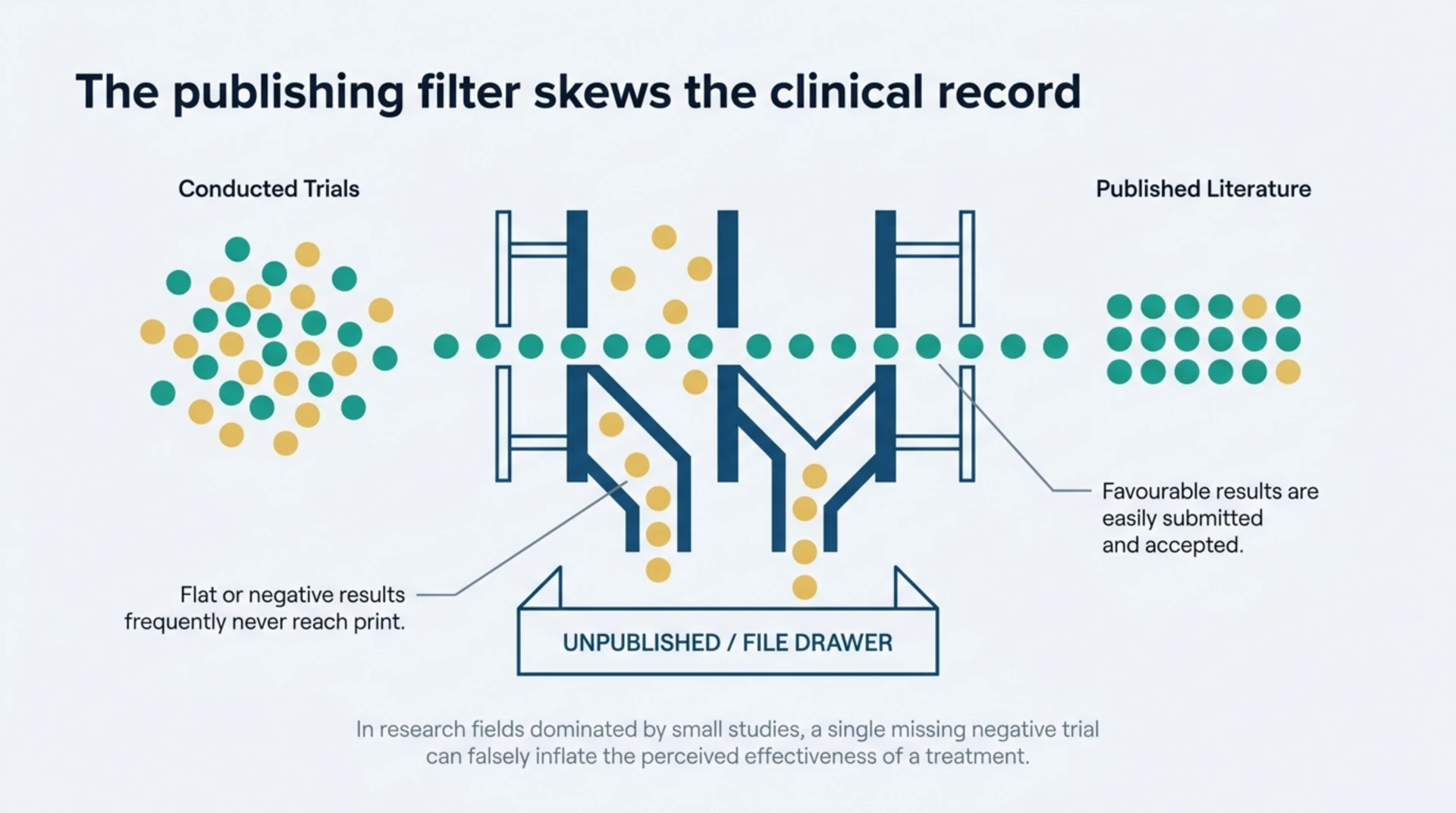
Publication bias happens when studies with striking or favourable results are more likely to be submitted, accepted, and published than studies with flat or negative results. Over time this skews the published literature toward positive findings, even if the true effect of a treatment is smaller or absent. Journals, sponsors, and researchers themselves can all contribute to this pattern, often without intending to.
A research field dominated by small studies is more vulnerable to publication bias because a single unpublished negative trial can meaningfully change the pooled result. In a field with dozens of large trials, one missing study barely moves the average. In a field with seven or ten trials, it can flip the conclusion.
What Is a Funnel Plot, and What Does It Actually Show?
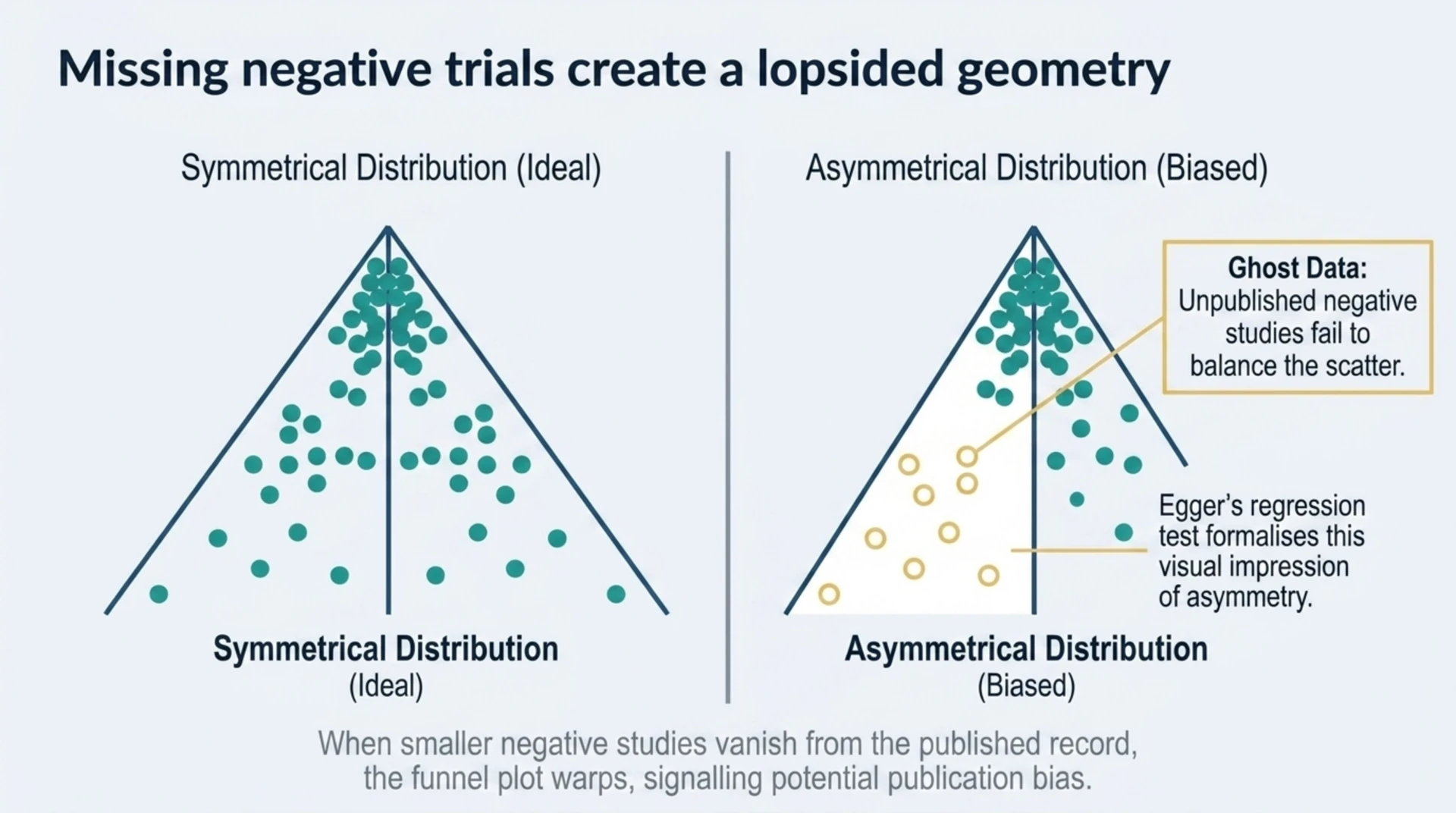
A funnel plot is a scatter plot that places each included study’s effect size on one axis and a measure of its precision, usually sample size or standard error, on the other. In a body of literature free from publication bias, the plot should look like a symmetrical inverted funnel: small, imprecise studies scatter widely around the pooled effect, while larger, more precise studies cluster tightly near it.
When smaller negative studies are missing from the published record, the funnel becomes lopsided. Statisticians can formalise that visual impression with tests such as Egger’s regression test, but these tests carry an important caveat that is easy to miss in a headline summary.
How Many Trials Does It Take to Test for Publication Bias Reliably?
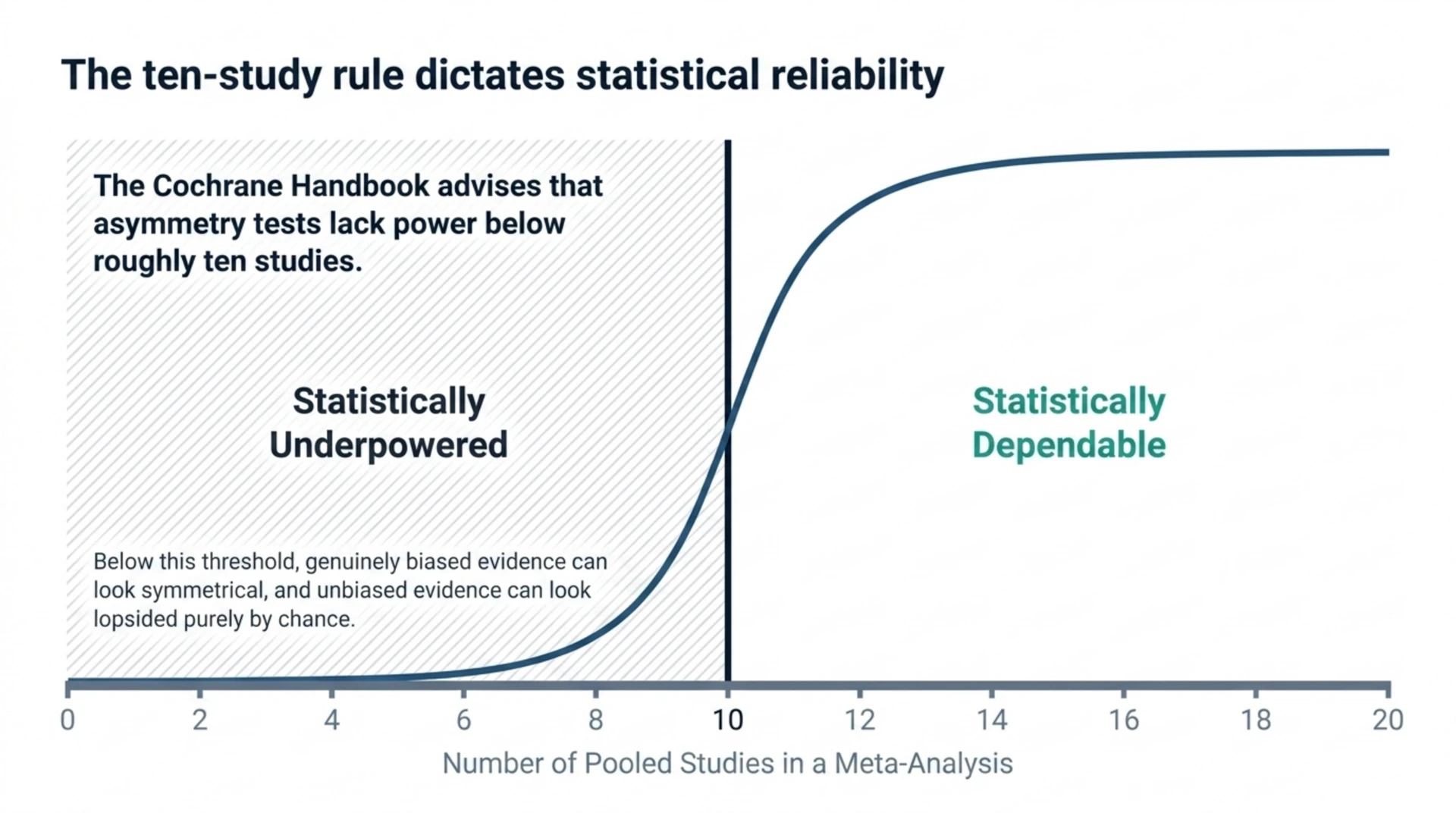
The Cochrane Handbook, the standard methodological reference for systematic reviews, recommends against interpreting funnel plot asymmetry tests when a meta-analysis includes fewer than roughly ten studies. Below that threshold, the tests are statistically underpowered: a genuinely biased body of evidence can look symmetrical, and a genuinely unbiased one can look asymmetrical, purely by chance.
This is the central issue for HBOT research: a large share of the published meta-analyses on hyperbaric oxygen sit right around, or below, that ten-study line. That does not mean their results are wrong. It means the field mostly lacks the statistical power to formally rule publication bias in or out, which is a meaningfully different, more cautious conclusion than either “the evidence is biased” or “the evidence is clean.”
Looking at the Trial Counts Across the HBOT Evidence Base
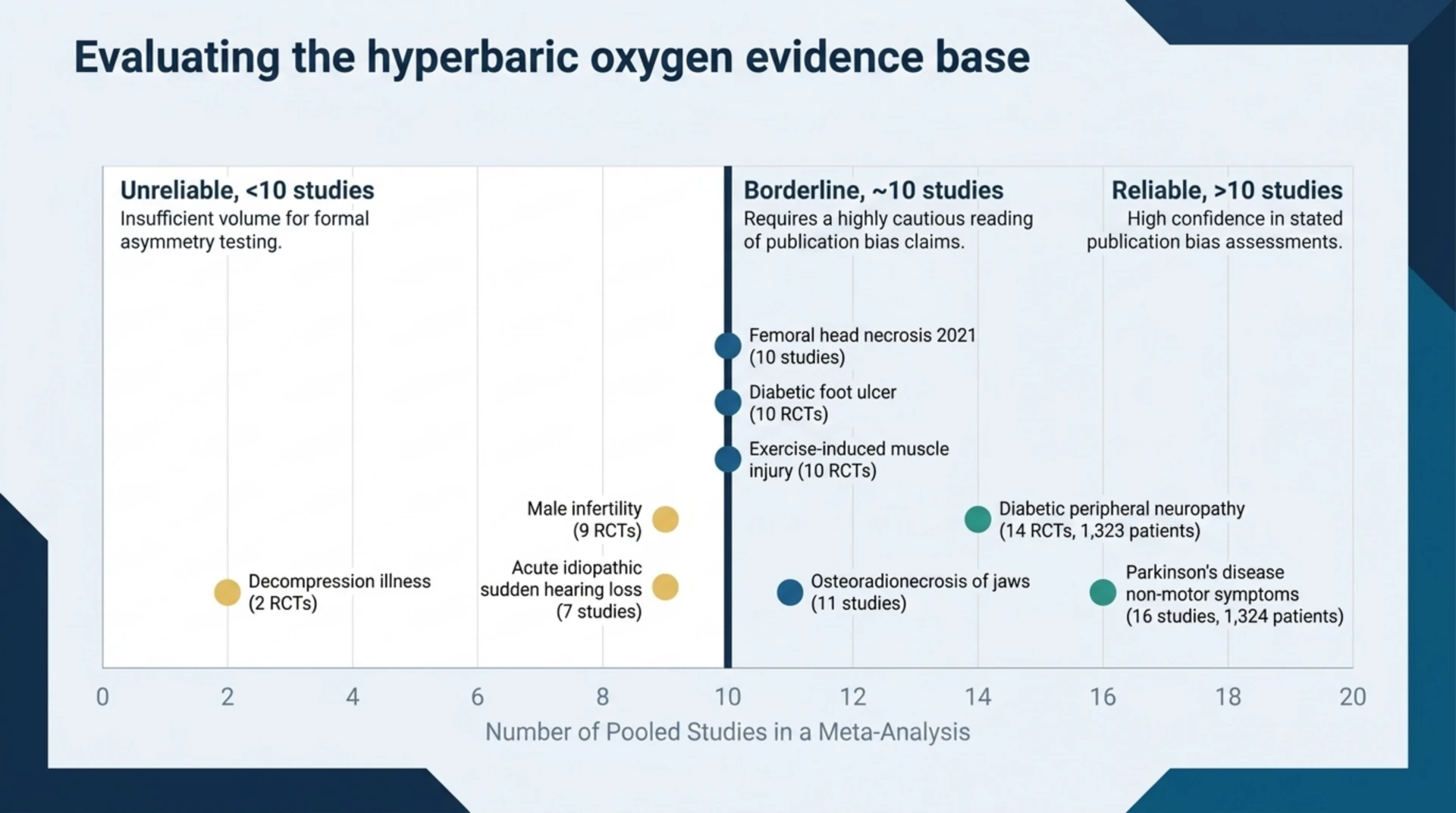
The table below lists several recent HBOT systematic reviews and meta-analyses and the number of studies each one pooled. It is not a ranking of quality, since a well-conducted review of seven trials can still be more trustworthy than a sloppy review of twenty. It is meant only to show how often HBOT meta-analyses land in the range where funnel plot testing is unreliable.
| Condition reviewed | Studies pooled | Meets ~10-study threshold? |
|---|---|---|
| Parkinson’s disease, non-motor symptoms | 16 studies, 1,324 patients | Yes |
| Diabetic peripheral neuropathy | 14 RCTs, 1,323 patients | Yes |
| Osteoradionecrosis of the jaws | 4 RCTs + 7 cohort studies (11 total) | Borderline |
| Exercise-induced muscle injury and soreness | 10 RCTs, 299 subjects | Borderline |
| Diabetic foot ulcer healing | 10 RCTs | Borderline |
| Femoral head necrosis (2021 review) | 10 studies | Borderline |
| Femoral head necrosis (2017 review) | 9 studies, 623 hips | Below |
| Male infertility | 9 RCTs | Below |
| Acute idiopathic sudden hearing loss | 7 studies | Below |
| Decompression illness in divers | 2 RCTs | Well below |
Where the Evidence Base Is Large Enough to Matter
A handful of pooled HBOT reviews clear the threshold comfortably. A 2024 meta-analysis (Weng et al., PubMed | Our Assessment) pooled 14 randomised controlled trials covering 1,323 patients with diabetic peripheral neuropathy, a sample large enough that formal funnel plot testing has real statistical footing. Similarly, a 2025 meta-analysis (PubMed | Our Assessment) pooled 16 studies and 1,324 patients on non-motor Parkinson’s symptoms. These are the reviews where a reader can place the most weight on any stated publication bias assessment, simply because the underlying study count supports the statistics being used.
Where the Evidence Base Is Too Thin to Formally Test
At the other end, a 2025 review of decompression illness management in divers (PubMed | Our Assessment) found only two randomised controlled trials it could include, a study count where a funnel plot has no meaningful shape to assess at all. A 2025 meta-analysis of hyperbaric oxygen for acute idiopathic sudden sensorineural hearing loss (PubMed | Our Assessment) pooled seven studies, and a 2025 meta-analysis on male infertility (PubMed | Our Assessment) pooled nine RCTs. Both sit below the point where asymmetry tests are considered dependable.
The two femoral head necrosis meta-analyses (2021, PubMed | Our Assessment; and 2017, PubMed | Our Assessment), a 2025 diabetic foot ulcer meta-analysis of 10 RCTs (PubMed | Our Assessment), and a 2021 meta-analysis of osteoradionecrosis of the jaws pooling four RCTs and seven cohort studies (PubMed | Our Assessment) all sit right at the borderline, close enough to ten studies that a stated funnel plot result deserves a cautious reading rather than automatic trust.
Other Ways Researchers Are Trying to Guard Against Bias
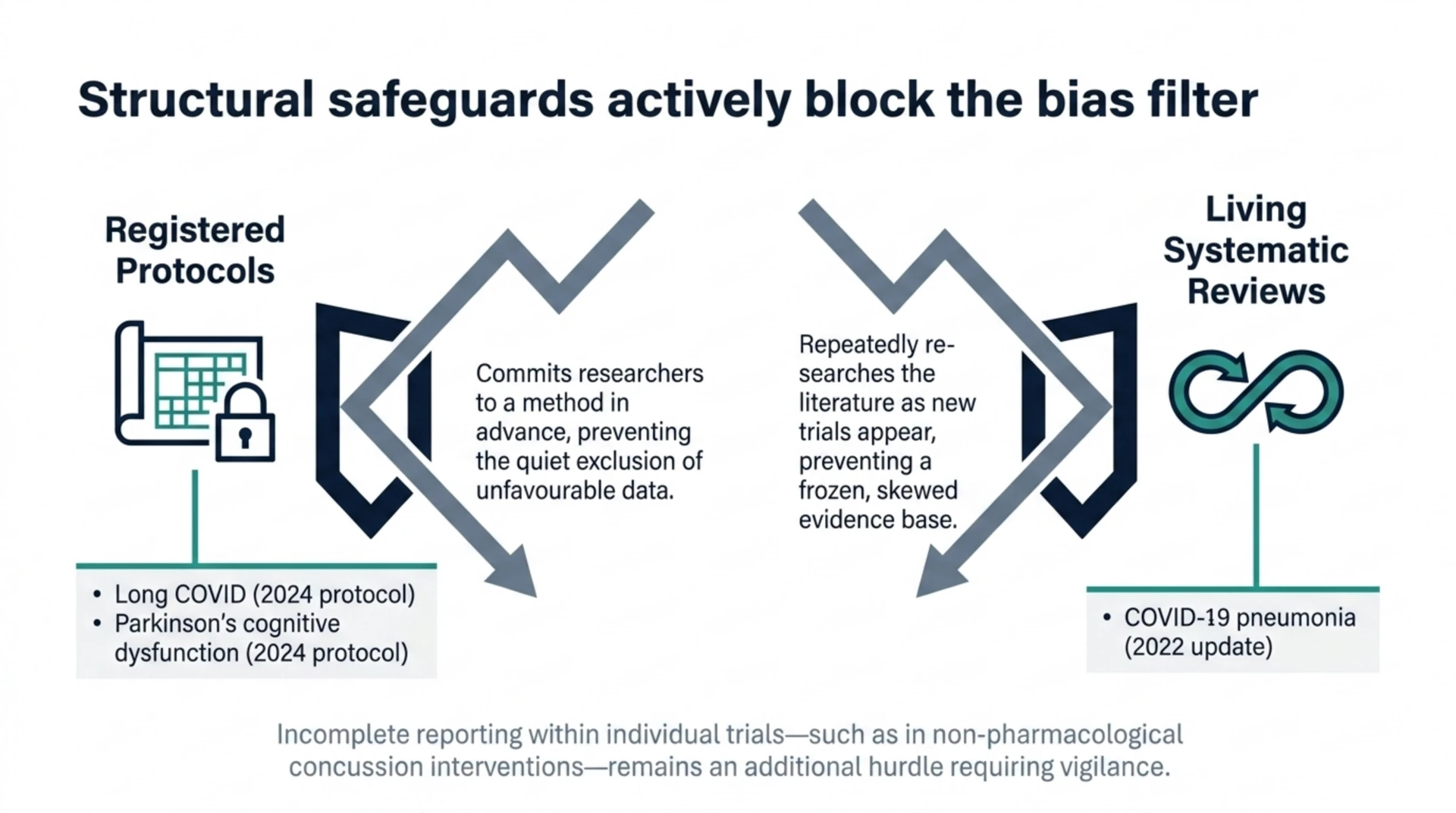
Trial counts are not the only defence against publication bias. Registering a review protocol before the data are gathered is another one, because it commits researchers to a method in advance and makes it harder to quietly drop unfavourable studies after the fact. The Canada Hyperbarics research library includes two such protocols: a 2024 published protocol for a planned systematic review of HBOT for long COVID (PubMed | Our Assessment) and a 2024 protocol for a review of HBOT in Parkinson’s disease with cognitive dysfunction (PubMed | Our Assessment).
A “living” systematic review is a related safeguard, since it commits to repeatedly re-searching the literature as new trials appear rather than freezing the evidence at one point in time. A 2022 living systematic review update on HBOT for COVID-19 pneumonia (PubMed | Our Assessment) is one example in this pool. A closely related issue is how completely individual trials report their own methods and outcomes in the first place; a 2024 review that assessed 89 randomised controlled trials of non-pharmacological interventions after concussion for reporting completeness (PubMed | Our Assessment) illustrates why incomplete reporting, not just missing studies, is a second bias-related problem researchers have to watch for.
Does This Mean HBOT Doesn’t Work?
No. A thin evidence base is not the same as a negative or disproven one. None of this means the pooled results in these reviews are wrong; it means a reader should treat “no evidence of publication bias was detected” with more caution when a meta-analysis includes fewer than ten trials, because the test used to detect it may simply lack the power to find anything either way. The honest reading of the current HBOT literature is that it is promising in several areas and formally under-tested for this specific bias in most of them.
What Should Researchers and Clinicians Take Away?
When reading any hyperbaric oxygen meta-analysis, it is worth checking the number of included studies before weighing a stated funnel plot or Egger’s test result. A funnel plot result from a seven- or nine-study meta-analysis carries far less statistical weight than the same result from a sixteen-study meta-analysis, even if both are reported with equal confidence in the abstract. Prioritising protocol-registered reviews and living systematic reviews, where available, is one practical way to manage this uncertainty until larger trial pools accumulate. The Canada Hyperbarics research library, which tracks more than 14,000 peer-reviewed studies related to hyperbaric oxygen, will continue to update as new trials and pooled reviews are published.
For context on which uses of HBOT are currently covered in Canada, see our overview of HBOT coverage in Canada.
Frequently Asked Questions
What is publication bias?
Publication bias is the tendency for studies with positive or statistically significant results to be published more often than studies with null or negative findings, which can distort the overall picture a field’s literature presents.
What is a funnel plot used for?
A funnel plot is a scatter chart that plots each study’s effect size against its precision. Researchers use it to visually check whether smaller, less precise studies are missing in a lopsided way that would suggest unpublished negative results.
How many studies does a meta-analysis need before a funnel plot test is reliable?
Cochrane guidance generally advises against interpreting formal funnel plot asymmetry tests when a meta-analysis pools fewer than about ten studies, since the tests lack statistical power at that scale.
Does a small number of pooled trials mean HBOT does not work for a condition?
No. It means the statistical tools used to detect publication bias may not be reliable at that trial count, not that the treatment itself has failed to show benefit. Small evidence bases call for caution, not dismissal.
What is a registered review protocol, and why does it matter?
A registered protocol is a publicly posted plan for how a systematic review or meta-analysis will be conducted, published before the results are gathered. It reduces the chance that unfavourable results are quietly excluded after the fact.
What is a living systematic review?
A living systematic review is one that commits to repeatedly re-searching the literature and updating its conclusions as new studies are published, rather than freezing its evidence base at a single point in time.
Related Reading
- HBOT Adverse Event Reporting: What Systematic Reviews Show
- Hyperbaric Oxygen After Cardiac Arrest: Brain Injury
- HBOT for Malignant Otitis Externa: Evidence Review
This content is for informational purposes only and is not medical advice. Anyone considering hyperbaric oxygen therapy should talk to their physician about whether it is appropriate for their specific situation.