
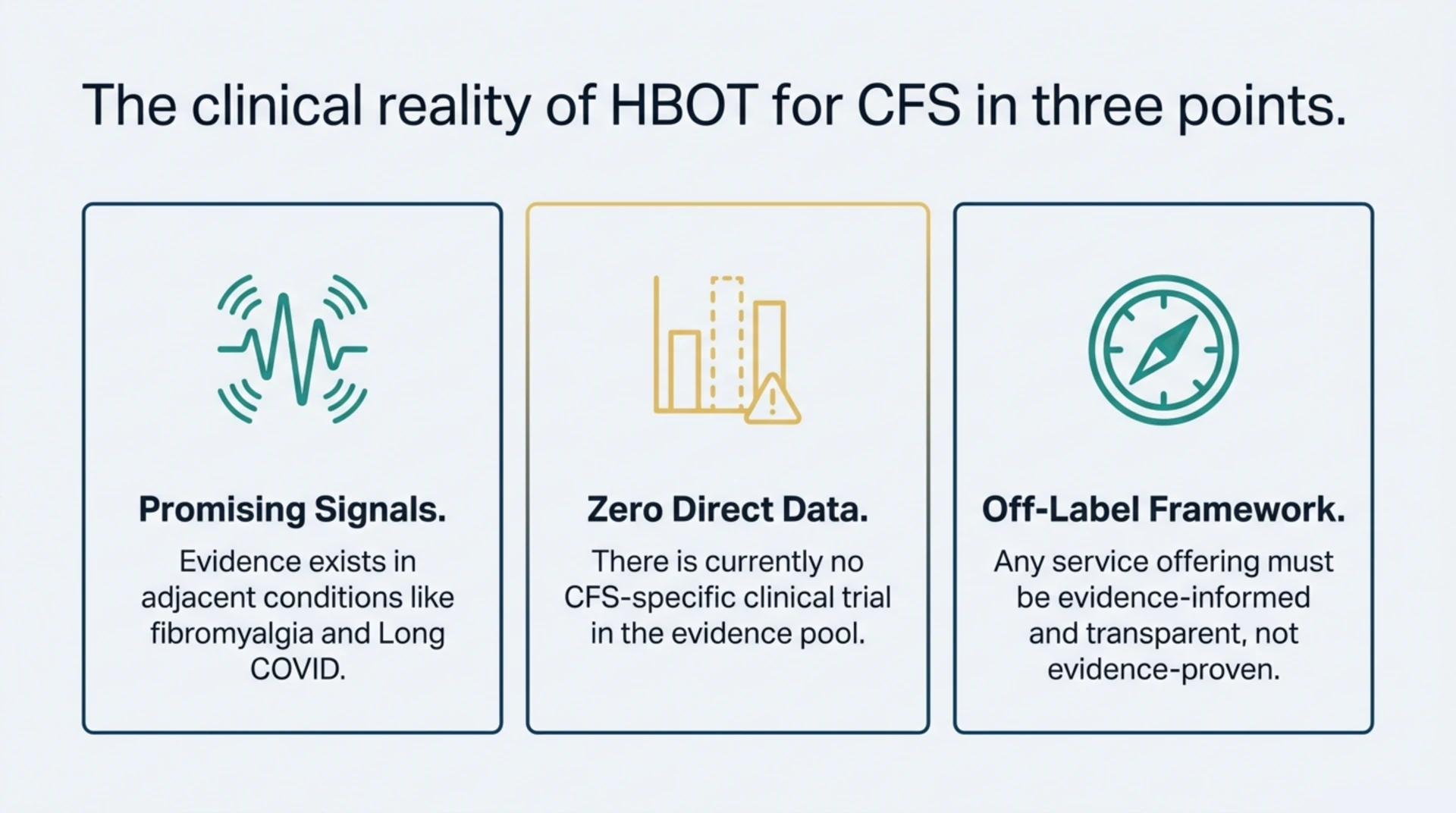
TL;DR: There is no hyperbaric oxygen therapy chronic fatigue syndrome trial in the current research pool. What exists is a smaller set of studies on overlapping-symptom conditions, fibromyalgia, sleep quality in fatigue-heavy populations, and psychiatric symptoms that often co-occur with chronic fatigue syndrome (CFS). The honest evidence briefing for a clinic owner considering this as a service line is: promising signals in adjacent conditions, no direct CFS trial data, and a clear need to frame any offering as evidence-informed rather than evidence-proven.
Chronic fatigue syndrome, also called myalgic encephalomyelitis (ME/CFS), is a long-term illness marked by profound fatigue that does not improve with rest, post-exertional malaise, unrefreshing sleep, and cognitive difficulties. Hyperbaric oxygen therapy (HBOT) delivers 100% oxygen at increased atmospheric pressure and is used off-label by some clinics as a possible option for fatigue-related conditions. This briefing reviews what the current evidence pool actually supports for a hyperbaric oxygen therapy chronic fatigue syndrome service line, and where that support runs out.
For a clinic owner weighing whether to build out this service line, the honest starting point matters more than the sales pitch. The evidence base available today does not include a chronic fatigue syndrome-specific HBOT trial. What it does include is a cluster of studies on conditions that share core CFS features, chronic widespread pain and fatigue (fibromyalgia), disrupted sleep in fatigue-heavy populations, and mood symptoms that frequently accompany chronic fatigue. That overlap is useful, but it is not a substitute for direct evidence.
Why Would a Clinic Consider HBOT for Chronic Fatigue Syndrome?
CFS and fibromyalgia are frequently discussed together in the research literature because they share overlapping features: persistent fatigue, non-restorative sleep, diffuse pain, and cognitive fog often described as “brain fog.” Some clinics reason that if HBOT shows benefit for fibromyalgia symptoms or for fatigue-adjacent sleep disruption, it may plausibly help CFS patients too. That is a reasonable hypothesis to explore, but it is a hypothesis, not a demonstrated finding for CFS itself.
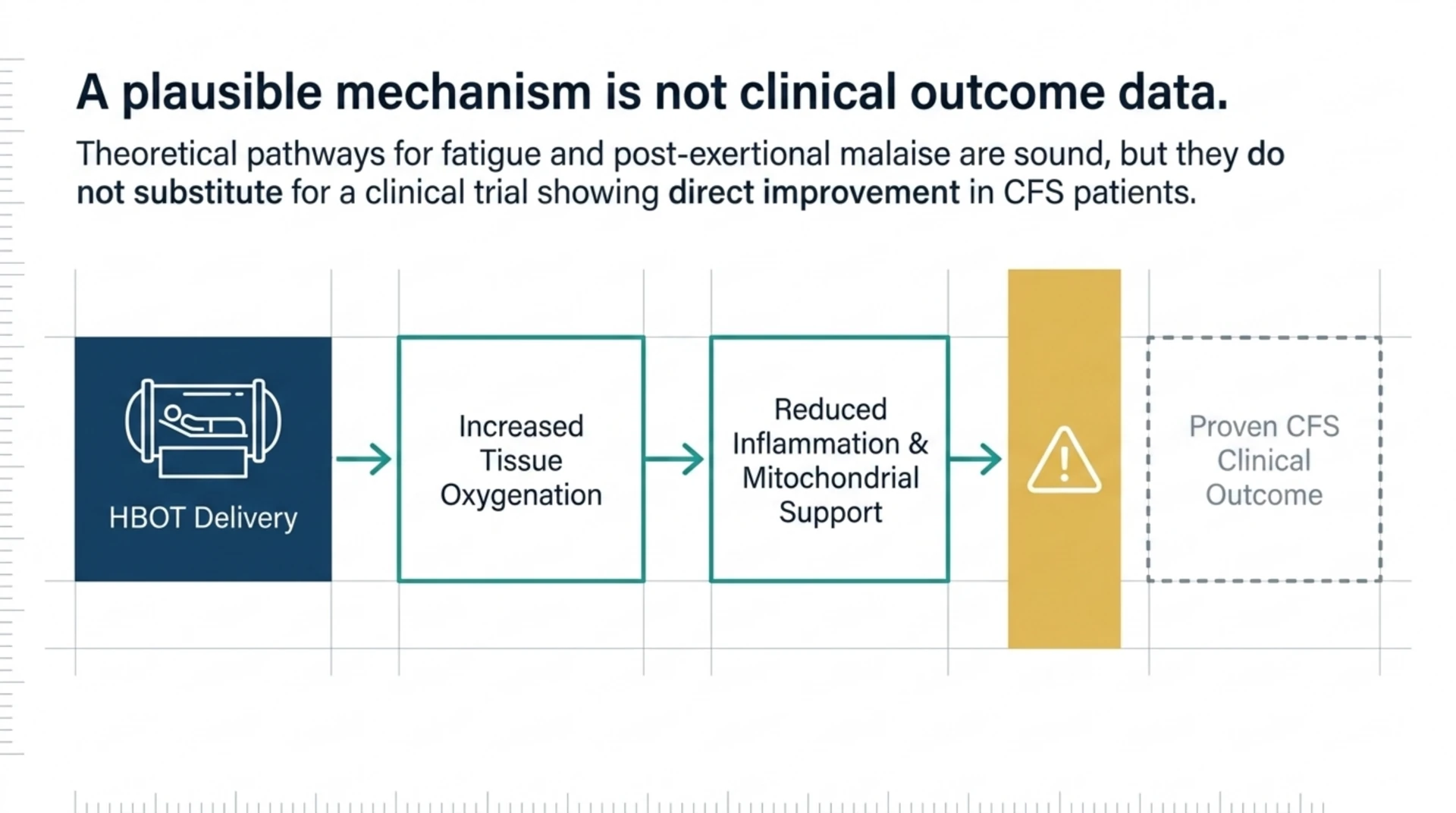
The mechanism argument is mechanism, not outcome data. HBOT is proposed to work through increased tissue oxygenation, reduced inflammation, and mitochondrial support, all pathways of theoretical relevance to fatigue and post-exertional malaise. But a plausible mechanism is not the same as a clinical trial showing improvement in CFS patients specifically.
What the Evidence Pool Actually Supports
A Randomised Trial in Fibromyalgia (HOTFy)
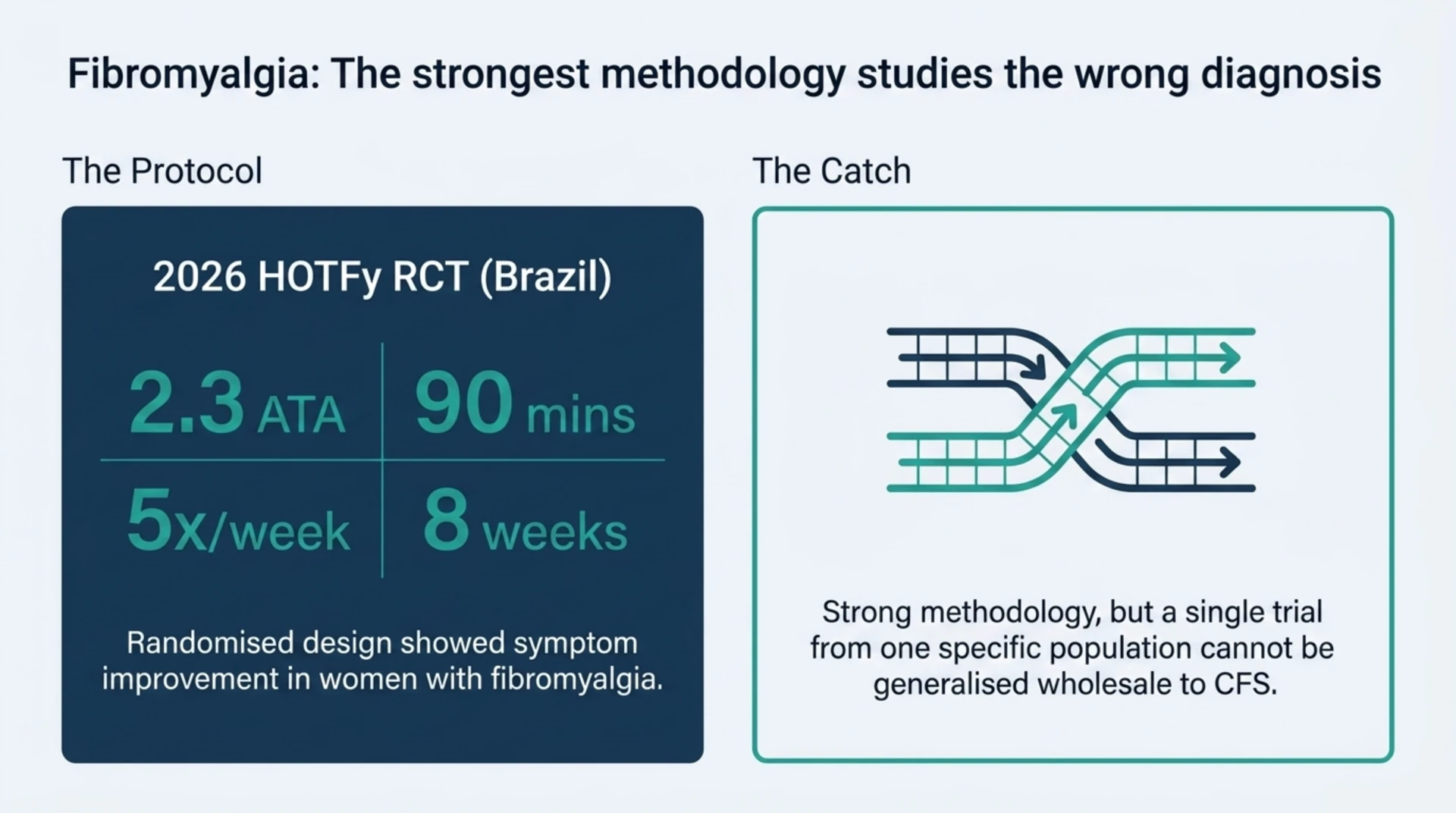
The closest direct-condition evidence in this pool comes from fibromyalgia, a condition that shares fatigue, diffuse pain, and sleep disruption with CFS. A 2026 randomised clinical trial conducted in Brazil (HOTFy, PubMed | Our Assessment) tested an eight-week HBOT protocol, 2.3 atmospheres absolute for 90 minutes, five sessions a week, in women with fibromyalgia. The trial reported symptom improvement following the treatment course. As a randomised design, this is the strongest single piece of methodology in the pool, but it studied fibromyalgia, not CFS, and a single trial from one population should not be generalized wholesale to a different diagnosis.
Sleep Quality in Fatigue-Heavy Populations, Including Long COVID
Sleep disruption is a defining feature of CFS, and it is also where the pool offers a useful, if indirect, signal. A 2026 retrospective study (PubMed | Our Assessment) reviewed sleep quality outcomes in 395 patients drawn from three groups, healthy aging, long COVID, and PTSD, after they completed 60 HBOT sessions at 2.0 ATA. Long COVID is clinically relevant here because its fatigue and post-exertional symptom pattern closely resembles CFS, and many researchers now treat the two conditions as clinically related. Because this was a retrospective, observational study with no control arm, HBOT was associated with improved sleep quality measures in this analysis, it did not prove that HBOT caused the improvement.
Mood and Psychiatric Symptom Overlap
CFS commonly co-occurs with depression, anxiety, and other mood symptoms, whether as a consequence of chronic illness or a contributing factor to symptom burden. A 2026 systematic review and meta-analysis in Psychiatry and Clinical Neurosciences (PubMed | Our Assessment) pooled 17 studies examining HBOT in adults with depression, anxiety, and PTSD. Across the pooled data, HBOT was associated with improvement in mood-related symptoms, though the authors also noted considerable variation in study quality and treatment protocols. Separately, a prospective observational program evaluation of 87 U.S. veterans with PTSD (PubMed | Our Assessment) found that a majority of participants reported symptom improvement after completing an HBOT course. Neither study measured CFS-specific fatigue outcomes, and neither used a control group, so these findings are associational at best.
A Note on Oxygen-Ozone Autohaemotherapy: Not the Same as HBOT
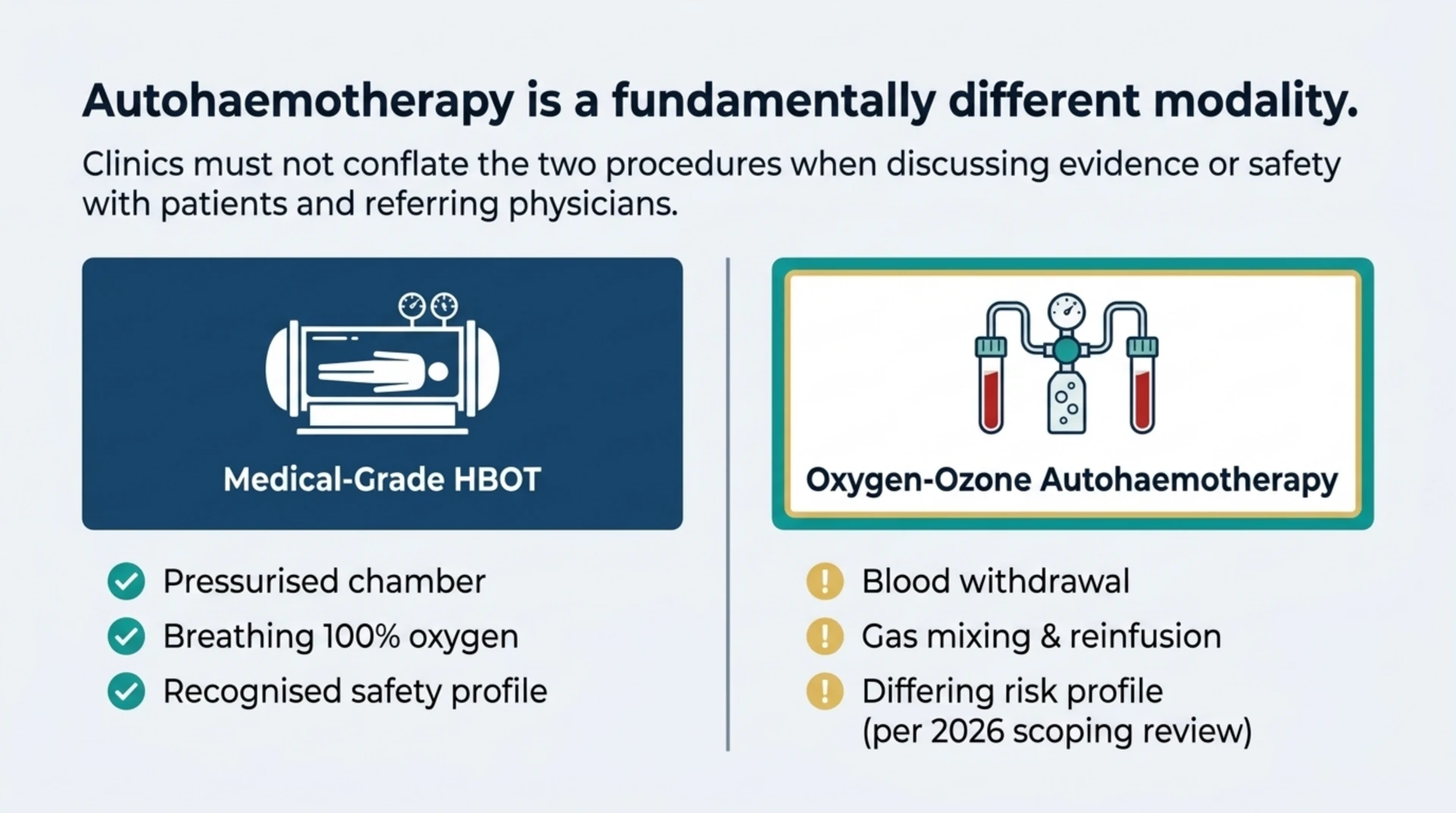
Clinic owners researching this space will also encounter oxygen-ozone autohaemotherapy, sometimes marketed alongside hyperbaric services for fatigue and fibromyalgia. This is a different procedure from medical-grade HBOT, it involves withdrawing a patient’s blood, mixing it with an oxygen-ozone gas mixture, and reinfusing it, rather than breathing pressurized oxygen in a chamber. A 2026 scoping review (PubMed | Our Assessment) examined the documented adverse events and safety profile of this technique in fibromyalgia patients specifically to catalogue its risks. It does not speak to HBOT’s safety or effectiveness, and a clinic should not conflate the two modalities when discussing evidence with patients or referring physicians.
Where the Direct Evidence Is Limited
To be direct about the gap: none of the studies in this pool enrolled patients diagnosed with chronic fatigue syndrome or ME/CFS. The fibromyalgia trial, the sleep quality cohort, and the psychiatric symptom studies all involve related or overlapping symptom domains, not the condition itself. This distinction matters for two practical reasons.
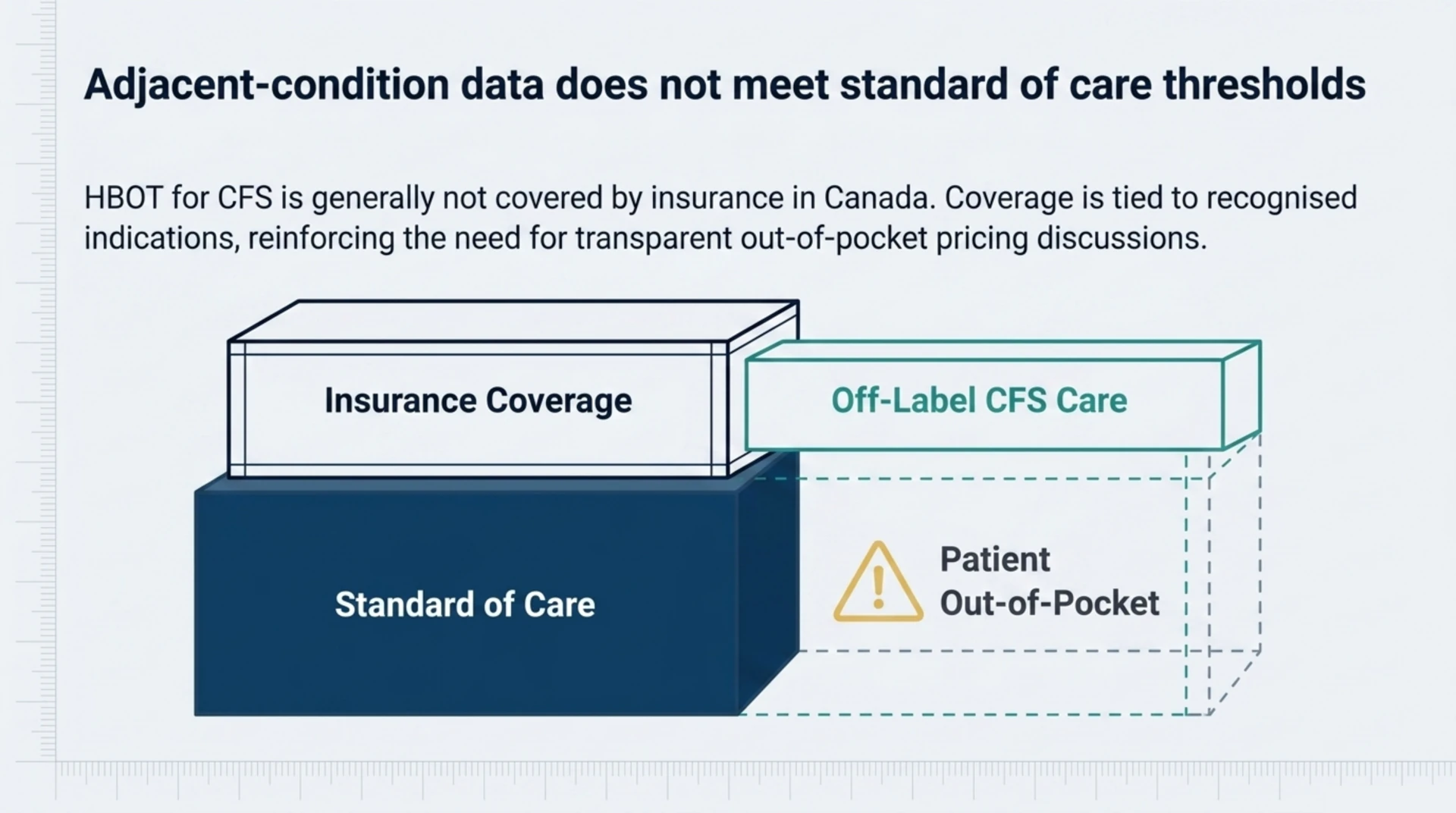
First, CFS has a defining feature, post-exertional malaise, that is not consistently present in fibromyalgia, long COVID, or PTSD populations, and it is not clear from this pool whether HBOT protocols tested elsewhere are safe or effective for patients whose symptoms worsen after physical exertion. Second, regulatory and insurance bodies typically require condition-specific evidence before recognizing a use as standard of care, and adjacent-condition data does not meet that bar.
| Study | Design | Population | Relevance to CFS | Evidence Strength |
|---|---|---|---|---|
| HOTFy fibromyalgia trial | Randomised controlled trial | Women with fibromyalgia (Brazil) | Shared fatigue and pain symptom profile | Moderate (RCT, but different diagnosis) |
| Sleep quality cohort | Retrospective, no control arm | 395 patients: healthy aging, long COVID, PTSD | Long COVID fatigue closely resembles CFS | Low to moderate (observational) |
| Psychiatric disorders meta-analysis | Systematic review and meta-analysis | Adults with depression, anxiety, PTSD (17 pooled studies) | Mood symptoms commonly co-occur with CFS | Moderate (heterogeneous pooled studies) |
| PTSD veterans program evaluation | Prospective observational | 87 U.S. veterans with PTSD | Indirect: fatigue and sleep overlap with PTSD | Low (no control group) |
| Oxygen-ozone autohaemotherapy scoping review | Scoping review of safety data | Fibromyalgia patients | Different modality; not HBOT | Not applicable to HBOT service line |
Should HBOT Be a Service Line for Chronic Fatigue Syndrome?
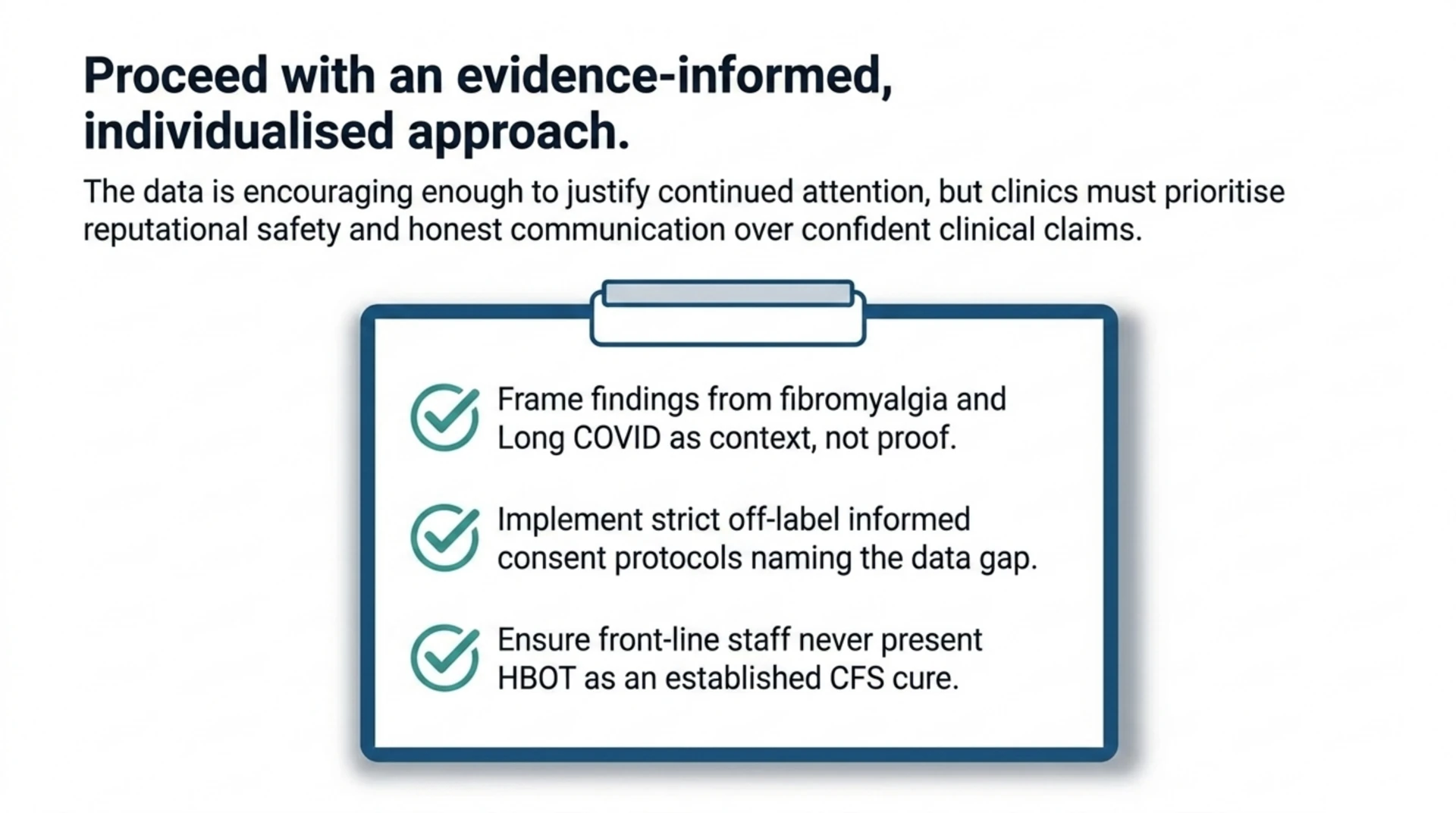
For a clinic owner evaluating a hyperbaric oxygen therapy chronic fatigue syndrome service line, the current pool supports a cautious, evidence-informed position rather than a confident clinical claim. The adjacent-condition data is encouraging enough to justify continued attention, but not strong enough to market HBOT as an established CFS treatment. Clinics that choose to offer HBOT to CFS patients should do so within an off-label, individualized-care framework, with clear informed consent that names the absence of CFS-specific trial data.
Operationally, this also means training front-line staff and referring physicians to be precise in how they describe the evidence: fibromyalgia and long COVID findings are relevant context, not proof of efficacy for CFS. Overstating the evidence to prospective patients creates both a clinical and a reputational risk.
What This Means for Clinic Owners
Building a service line around adjacent-condition evidence is not unusual in a field where trial funding lags clinical interest, but it carries an obligation to communicate uncertainty honestly. Patients with CFS are often symptom-fatigued from unproven treatments and are likely to notice, and appreciate, a clinic that is upfront about what the research does and does not show. A transparent evidence briefing, shared with patients before they commit to a treatment course, is a reasonable middle path between ignoring a plausible therapy and overselling one.
Frequently Asked Questions
Is there a clinical trial of HBOT specifically for chronic fatigue syndrome?
Not in the current evidence pool. The available studies cover overlapping-symptom conditions such as fibromyalgia, long COVID, and PTSD, not CFS or ME/CFS directly.
Why do fibromyalgia and CFS studies get compared so often?
The two conditions share core features, persistent fatigue, diffuse pain, unrefreshing sleep, and cognitive fog, which is why researchers and clinics often look at findings from one when considering the other. Overlap in symptoms is not the same as overlap in diagnosis, however.
Does the HOTFy fibromyalgia trial prove HBOT works for fatigue?
It shows symptom improvement in women with fibromyalgia following an eight-week HBOT protocol in a randomised design, which is methodologically meaningful, but it is one trial in one condition, not proof of effect in CFS patients.
Is oxygen-ozone autohaemotherapy the same as hyperbaric oxygen therapy?
No. Autohaemotherapy involves reinfusing a patient’s own blood after mixing it with an ozone-oxygen gas, a fundamentally different procedure from breathing pressurized oxygen in a hyperbaric chamber. The two should not be presented interchangeably to patients.
What should a clinic tell patients considering HBOT for chronic fatigue syndrome?
That HBOT is being offered off-label based on evidence from related conditions, not from a chronic fatigue syndrome-specific trial, and that they should discuss the decision with their physician given their individual health history.
Is HBOT covered by insurance for chronic fatigue syndrome in Canada?
Generally not, since coverage in Canada is typically tied to recognised indications. Clinic owners and patients researching coverage questions more broadly can review our overview at HBOT coverage in Canada.
Related Reading
- Is Hyperbaric Oxygen Therapy Covered by Insurance?
- CUHMA and the Referral Pathway for Hyperbaric Care
- HBOT for Radiation-Induced Dry Mouth: The Evidence Gap
Our research library currently indexes more than 14,000 peer-reviewed studies on hyperbaric oxygen therapy, and coverage of specific conditions like chronic fatigue syndrome will be updated here as new evidence becomes available.
If you are a clinic owner considering this service line, or a patient wondering whether HBOT is appropriate for your chronic fatigue symptoms, talk to your physician about whether it makes sense given your individual health history and diagnosis.
This content is for informational purposes only and is not medical advice.