TL;DR: Hyperbaric oxygen and intratympanic steroid therapy for sudden sensorineural hearing loss combines pressurized oxygen breathing with steroid injections through the eardrum, on the idea that both boost the inner ear’s oxygen supply during its narrow recovery window. Meta-analyses of randomised trials suggest adding hyperbaric oxygen to corticosteroid treatment is associated with better hearing recovery than steroids alone, but the evidence specifically on the HBOT-plus-intratympanic-steroid combination is thinner, made up mostly of small case series, retrospective cohorts, and case reports rather than large controlled trials. Earlier treatment, milder starting severity, and absence of vestibular involvement all appear linked to better outcomes, but results across individual studies are mixed, not uniform.
Hyperbaric oxygen and intratympanic steroid therapy for sudden sensorineural hearing loss is a combined treatment approach that pairs breathing 100% oxygen inside a pressurized chamber (hyperbaric oxygen therapy, or HBOT) with corticosteroid injections delivered directly through the eardrum into the middle ear (intratympanic steroid therapy, or ITS). Both are used, sometimes together and sometimes as sequential options, to try to improve the odds of hearing recovery after sudden sensorineural hearing loss (SSNHL). Canada Hyperbarics tracks the published research on this combination so clinicians and researchers can see, in plain terms, what the evidence actually supports and where it stops short.
What Is Sudden Sensorineural Hearing Loss?
Sudden sensorineural hearing loss is a rapid drop in hearing, usually in one ear, that develops over hours to a few days and is thought to involve damage to the inner ear’s sensory or neural tissue rather than a blockage in the ear canal. Most cases are labelled idiopathic (ISSNHL) because no single cause is found, though infection, vascular events, and inflammation are all suspected contributors in different patients. Because the inner ear has a limited, largely one-way blood supply, many of the treatments used for SSNHL are built around trying to protect or resupply that tissue before damage becomes permanent.
How Are Hyperbaric Oxygen Therapy and Intratympanic Steroids Used Together for SSNHL?
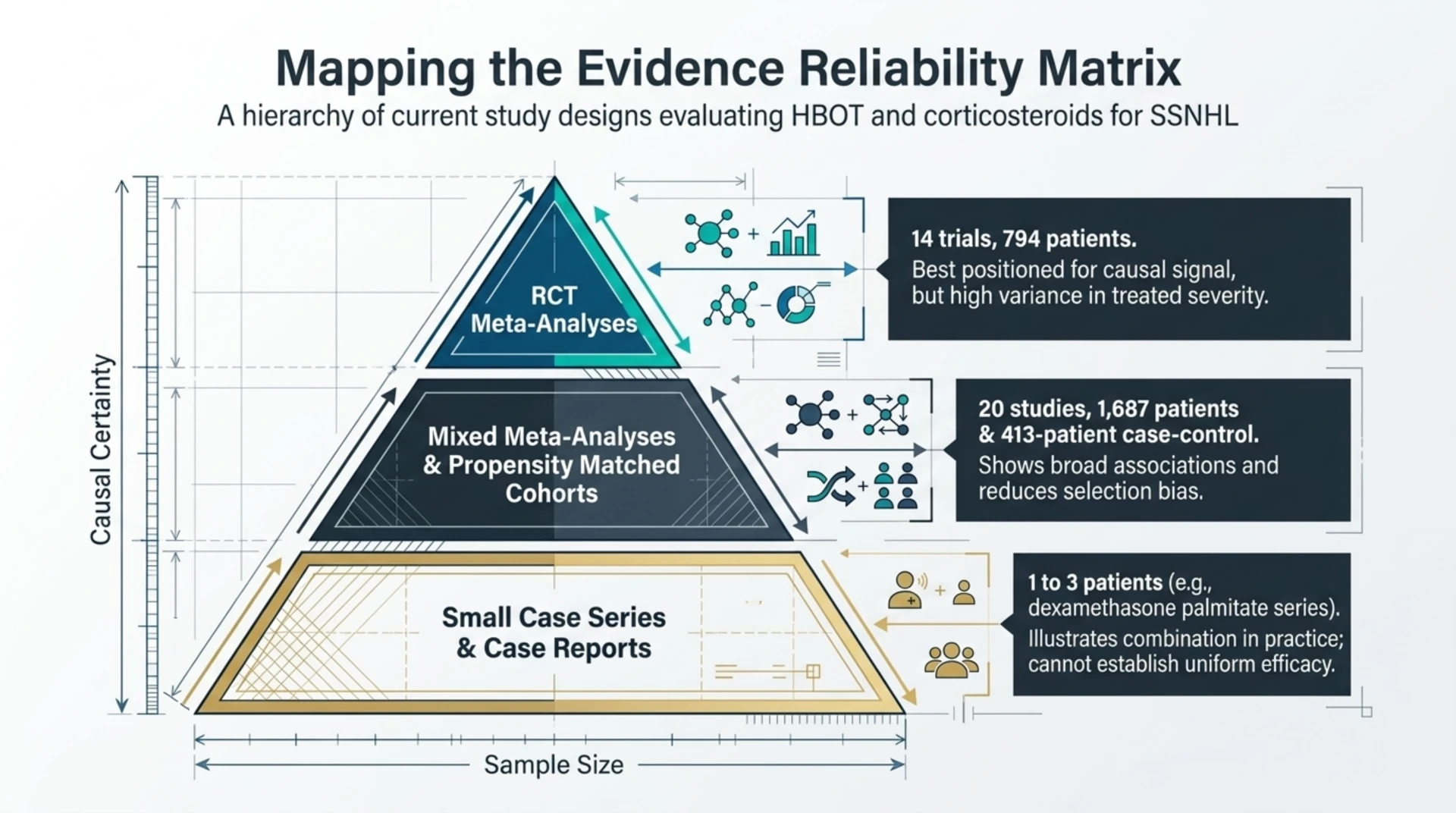
The rationale for combining the two therapies is mechanistic: HBOT dramatically raises the amount of oxygen dissolved in blood plasma, which can reach inner ear tissue even when local blood flow is compromised, while intratympanic steroids deliver a high local corticosteroid dose to reduce inflammation with less systemic exposure than oral steroids. A small case series published in the American Journal of Otolaryngology (PubMed | Our Assessment) treated three patients with severe SSNHL using intratympanic dexamethasone palmitate alongside HBOT, illustrating the combination in practice, though a three-patient series cannot establish how well it works on its own.
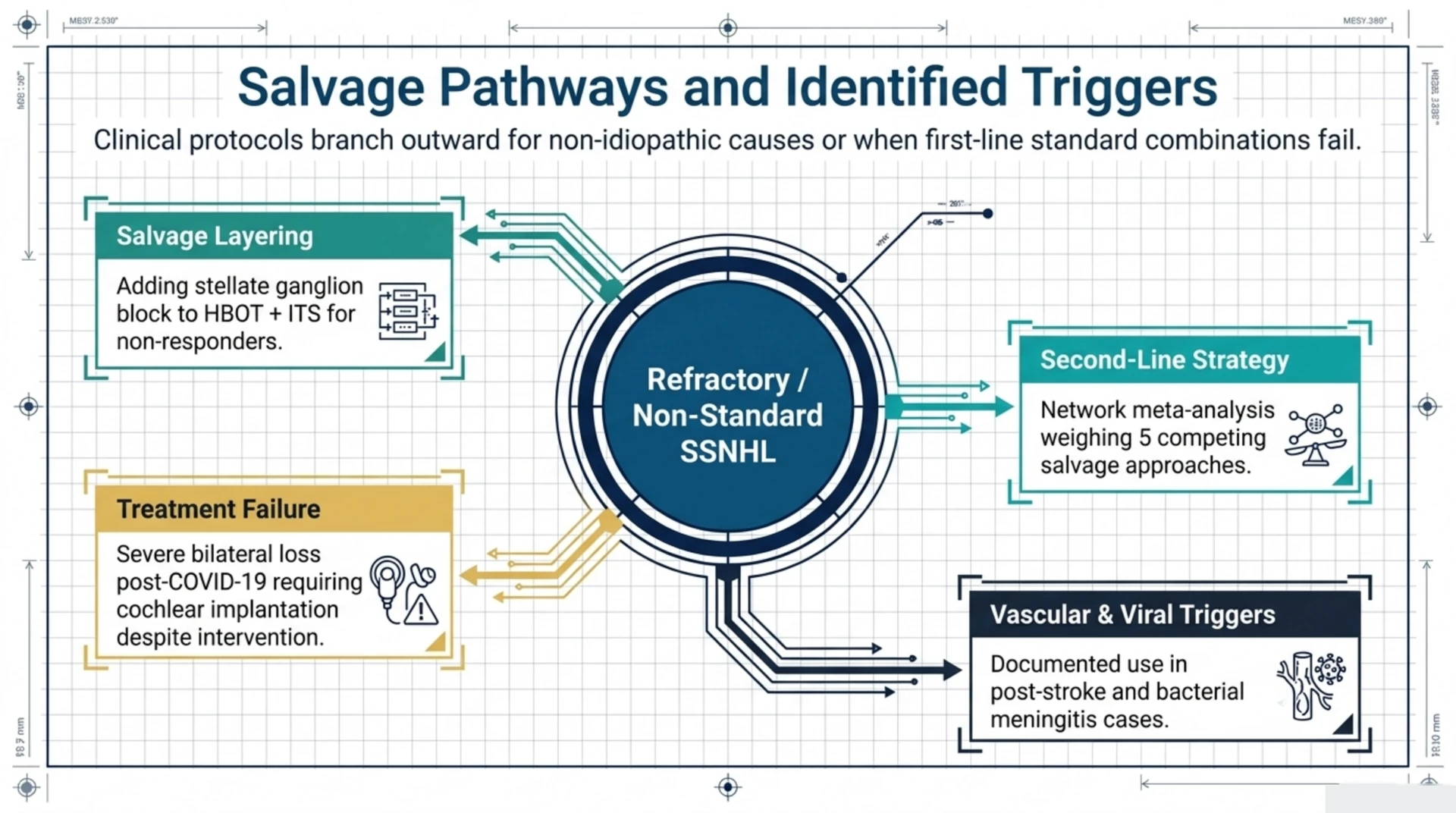
A retrospective study in The Laryngoscope (PubMed | Our Assessment) directly compared the additive effect of HBOT against intratympanic steroid injections, addressing a practical question clinicians actually face: whether to add HBOT, add ITS, or combine both. A separate retrospective study (PubMed | Our Assessment) went a step further, layering a stellate ganglion block onto combined ITS and HBOT for refractory cases, which shows clinicians are actively testing whether stacking interventions helps once the standard combination alone has not worked, though this remains preliminary, exploratory research.
What Does the Broader Research Say About Hyperbaric Oxygen for Sudden Sensorineural Hearing Loss?
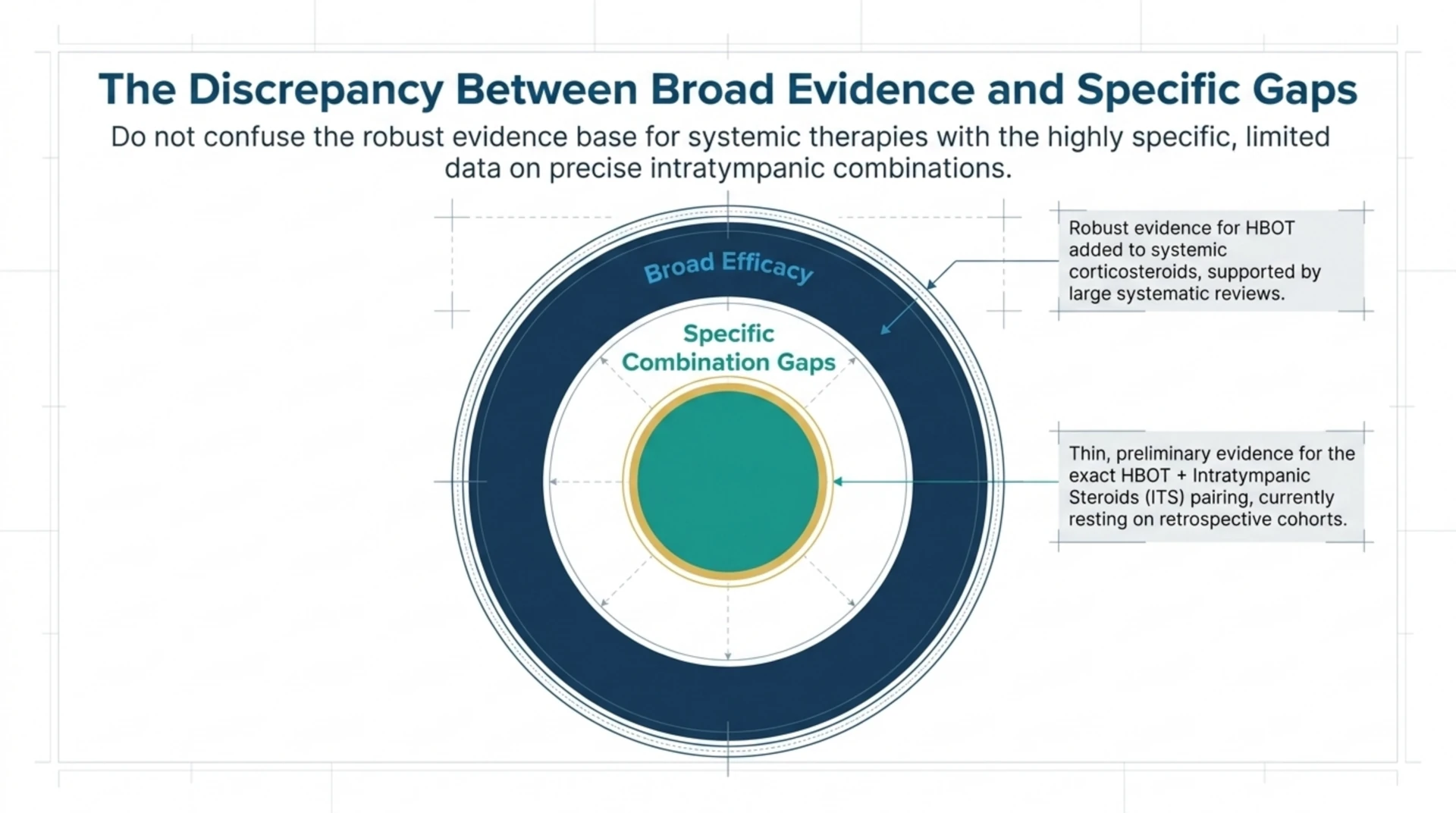
The strongest evidence base is not for the HBOT-plus-ITS combination specifically but for HBOT added to corticosteroid therapy generally. A systematic review and meta-analysis in the European Archives of Oto-Rhino-Laryngology (PubMed | Our Assessment) pooled 14 randomised controlled trials covering 794 participants to test whether HBOT combined with systemic corticosteroids improved outcomes over corticosteroids alone. Because it draws on randomised trials, this is the type of evidence best positioned to support a causal claim, though the authors also flagged meaningful variation across the included trials in dose, timing, and severity of hearing loss treated, which limits how confidently the result generalises to any one patient.
A larger systematic review and meta-analysis in the Laryngoscope (PubMed | Our Assessment) pooled 20 studies and 1,687 patients to ask whether HBOT improves hearing recovery in SSNHL. Because that pool mixed study designs rather than trials alone, its results are best read as an association between HBOT use and hearing recovery rather than a clean causal estimate. A separate case-control analysis in the Brazilian Journal of Otorhinolaryngology (PubMed | Our Assessment) used propensity score matching across 413 patients to examine whether adding HBOT as an initial treatment was associated with a different hearing prognosis than steroid treatment alone, a design meant specifically to reduce the bias that comes from comparing groups that were not randomised.
Does the Timing of Treatment Matter?
A retrospective cohort study of 70 patients with idiopathic SSNHL, published in Diving and Hyperbaric Medicine (PubMed | Our Assessment) evaluated how the timing of HBOT initiation related to treatment success, reflecting the broader clinical rationale that inner ear tissue is thought to be more responsive to oxygen-based therapy before ischaemic damage becomes irreversible. A separate observational study in the Journal of Audiology and Otology (PubMed | Our Assessment) likewise examined how the timing of HBOT administration related to recovery among several treatment approaches used for SSNHL. Both studies frame timing as a variable worth investigating rather than settle a fixed treatment window, so researchers should read them as evidence that timing is plausibly important, not as proof of a specific cutoff.
Who Is Most Likely to Benefit? Prognostic Factors
Not every SSNHL patient responds the same way, and several studies in the pool focus on identifying who is likely to do better or worse before treatment starts. A study of 85 patients with profound SSNHL, published in Scientific Reports (PubMed | Our Assessment) examined how semicircular canal dysfunction related to hearing recovery, aiming to refine which patients are the better candidates for an HBOT referral. A retrospective analysis of 133 patients in Acta Oto-Laryngologica (PubMed | Our Assessment) investigated whether pre-treatment vestibular dysfunction predicted short-term auditory outcomes in severe to profound unilateral SSNHL. Together these point toward vestibular and balance-system involvement as a factor worth screening for, since it may flag patients less likely to recover fully regardless of which treatment combination is chosen.
Hyperbaric Oxygen and Intratympanic Steroids as Salvage Therapy
When first-line treatment fails, clinicians sometimes turn to salvage options. A network meta-analysis in the International Journal of Audiology (PubMed | Our Assessment) compared five different salvage approaches used once initial steroid treatment for refractory SSNHL has failed, underscoring that clinicians weigh several second-line strategies rather than defaulting to a single next step. The stellate ganglion block study referenced above fits this same salvage-therapy pattern: it was conducted specifically in a refractory population that had already not responded fully to combined ITS and HBOT.
What About Hearing Loss From Other Causes, Such as Stroke, Meningitis, or COVID-19?
Several entries in the evidence base are single case reports describing HBOT used for hearing loss with a clear, identified trigger rather than idiopathic SSNHL. One case report in Avicenna Journal of Medicine (PubMed | Our Assessment) described a 57-year-old woman who received HBOT for severe hearing loss caused by bacterial meningitis. Another, in Undersea and Hyperbaric Medicine (PubMed | Our Assessment), documented a 74-year-old man who developed sudden hearing loss after a stroke and was treated with HBOT. Case reports like these show that HBOT is being tried across a range of underlying causes, but a single patient’s outcome cannot establish how well a treatment works in general.
That limitation matters in practice: a case report in Clinical Case Reports (PubMed | Our Assessment) described a 28-year-old woman with severe bilateral hearing loss following a mild COVID-19 infection who ultimately required cochlear implantation, a reminder that even with treatment, severe and bilateral cases do not always recover.
Where the Evidence Is Still Limited
Direct research on hyperbaric oxygen and intratympanic steroid therapy used together, as a specific combination, is limited to small case series and retrospective comparisons rather than large randomised trials. A review in Molecular Medicine Reports (PubMed | Our Assessment) explicitly set out to explore the biological mechanisms, clinical efficacy, and existing controversies of HBOT for SSNHL, a framing that reflects genuine disagreement in the field rather than settled consensus.
That mixed picture also shows up at the multicentre level. A prospective observational study across several tertiary care hospitals, published in Medical Journal, Armed Forces India (PubMed | Our Assessment) evaluated whether adding HBOT to conventional treatment benefited patients with idiopathic SSNHL. Unlike some single-centre reports, results from multicentre observational research in this space have not been uniformly positive, which is one reason HBOT is generally positioned as an adjunct treatment to be considered case by case rather than a guaranteed fix layered onto standard steroid care.
At a Glance: How the Key Study Designs Compare
| Evidence type | Example study | Sample size | What it can and cannot tell us |
|---|---|---|---|
| RCT meta-analysis | HBOT added to corticosteroids (Eur Arch Otorhinolaryngol) | 794 patients, 14 trials | Best-positioned for a causal signal, but trials varied in dose and severity treated |
| Mixed-design meta-analysis | HBOT and SSNHL (Laryngoscope) | 1,687 patients, 20 studies | Shows an association across a broad literature, not a single controlled comparison |
| Case-control (propensity matched) | HBOT as initial treatment (Braz J Otorhinolaryngol) | 413 patients | Reduces some selection bias but is not randomised |
| Multicentre observational | HBOT in ISSNHL management (Med J Armed Forces India) | Multi-hospital cohort | Real-world setting, but results were not uniformly positive |
| Small case series | Intratympanic dexamethasone palmitate + HBOT (Am J Otolaryngol) | 3 patients | Illustrates the ITS+HBOT combination in practice, cannot establish efficacy |
| Case report | COVID-19 related bilateral SSNHL (Clin Case Rep) | 1 patient | Documents a single outcome, including treatment failure requiring cochlear implant |
Frequently Asked Questions
Is hyperbaric oxygen therapy alone effective for sudden hearing loss?
In the studies reviewed here, HBOT is almost always evaluated as an addition to corticosteroid treatment, not as a standalone therapy, so the evidence base does not really speak to HBOT used entirely on its own.
Are intratympanic steroids used instead of or alongside hyperbaric oxygen therapy?
Both patterns appear in the literature. Some studies compare HBOT against intratympanic steroids as competing add-ons, while others, including the dexamethasone palmitate case series, use them together.
How soon after hearing loss should treatment begin?
Several studies specifically investigate how the timing of HBOT relates to recovery, which reflects a broader clinical assumption that earlier treatment is preferable, though the pool here does not establish one fixed cutoff.
Is combining hyperbaric oxygen therapy with steroid injections safe?
Safety was not the primary focus of the studies summarized here. Anyone considering this combination should discuss individual risks, including any prior ear surgery or eardrum condition, with a treating physician.
Does everyone with sudden sensorineural hearing loss recover with treatment?
No. Case reports in this pool, including a bilateral case following COVID-19 that required cochlear implantation, show that severe or bilateral hearing loss does not always fully recover even with treatment.
Where can researchers find the full studies referenced here?
Every citation above links to its original PubMed listing and to a Canada Hyperbarics assessment page summarizing the study’s design and stated aims.
Related Reading
- Hyperbaric Oxygen Therapy for Tinnitus: The SSNHL Evidence
- HBOT Referral Pathway for Patients Without a Local Chamber
- How to Find a Hyperbaric Oxygen Therapy Clinic Near Me
Canada Hyperbarics maintains a database of over 14,000 peer-reviewed studies on hyperbaric oxygen therapy, and the entries summarized above represent only the portion directly relevant to sudden sensorineural hearing loss. Researchers and clinicians weighing this combination for a patient should review treatment through hospitals and regulated facilities; visit our facilities directory to find one.
This content is for informational purposes only and is not medical advice.