
TL;DR: Hyperbaric oxygen therapy (HBOT) is a treatment in which a patient breathes 100% oxygen inside a pressurized chamber, raising the amount of oxygen dissolved in blood plasma well above normal levels. For non-union fractures specifically, the direct evidence is thin: a 2012 Cochrane systematic review found no completed randomised controlled trials on HBOT for fracture healing or non-union, and most of what exists is case reports, one small comparative study, and randomised trials built around broader open-fracture trauma rather than non-union alone. The evidence base is suggestive of a biological rationale, not proof of clinical benefit.
Hyperbaric oxygen therapy (HBOT) is a treatment in which patients breathe 100% oxygen inside a pressurized chamber to raise tissue oxygen levels far above what breathing room air can achieve. This review from the Canada Hyperbarics research library examines the hyperbaric oxygen non-union fracture healing evidence: what has actually been tested, in whom, and how strong that testing is. As with several off-label orthopaedic uses of HBOT, the honest answer is that the evidence is real but limited, and it does not yet support firm conclusions.
What Is a Non-Union Fracture?
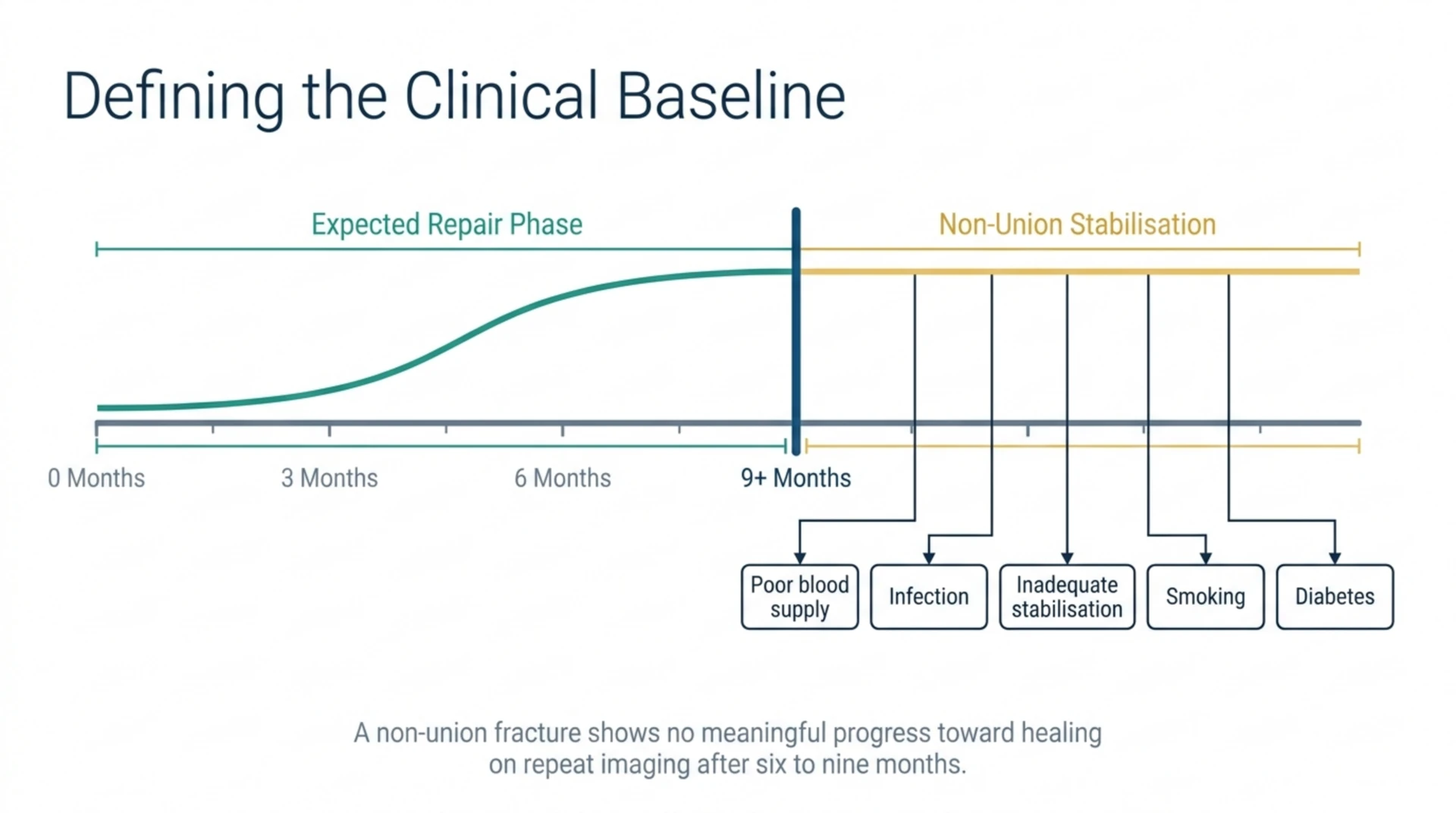
A non-union fracture is a broken bone that has failed to heal within the expected timeframe, typically six to nine months, and shows no meaningful progress toward healing on repeat imaging. Non-union can result from poor blood supply to the fracture site, infection, inadequate stabilization, smoking, diabetes, or prior radiation therapy to the area. Standard treatment usually involves revision surgery, bone grafting, or mechanical stabilization; HBOT has occasionally been proposed as an adjunct in cases where healing has stalled, particularly when blood supply to the area is compromised.
What Does the Hyperbaric Oxygen Non-Union Fracture Healing Evidence Actually Show?
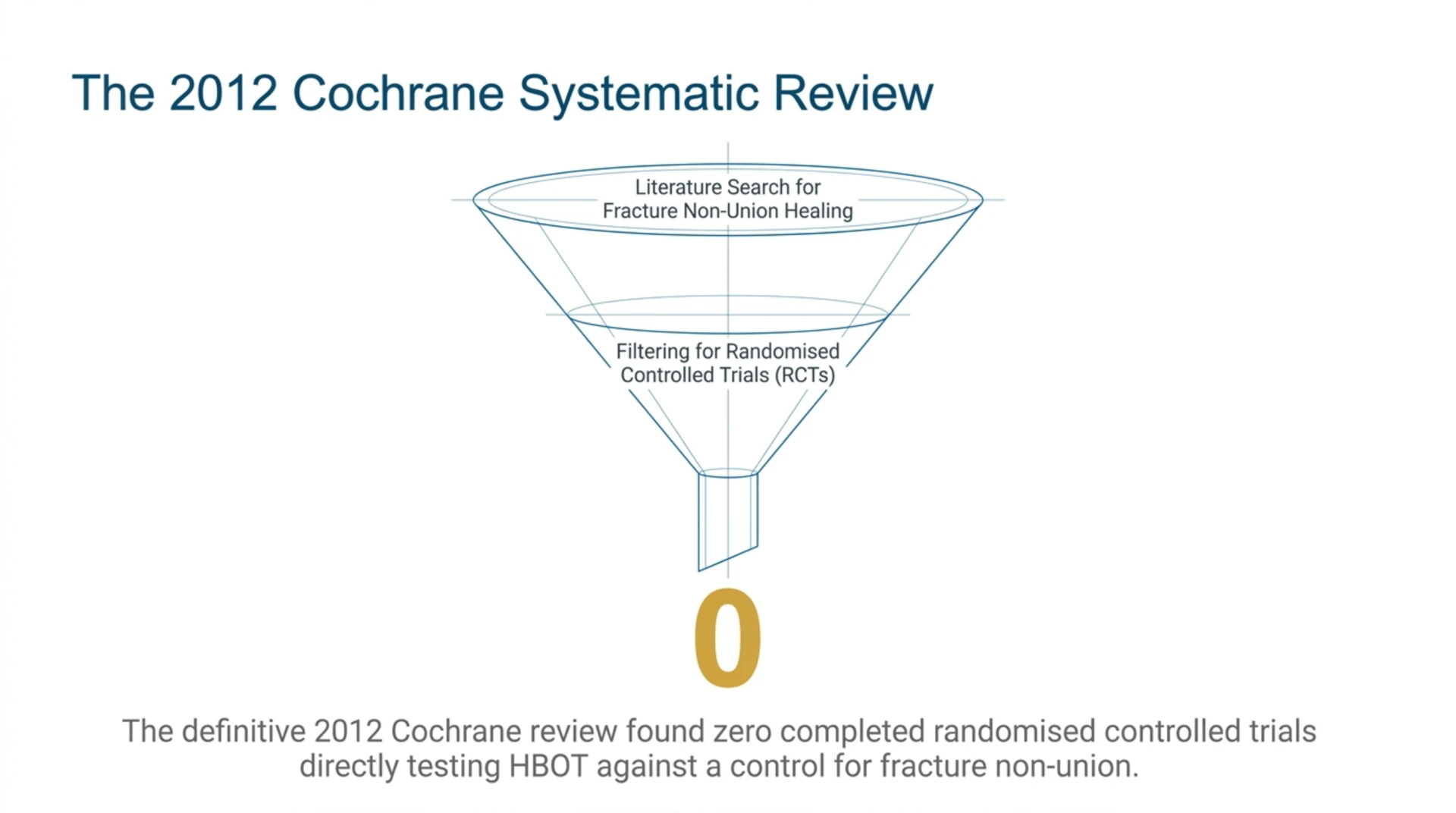
The strongest single statement the evidence base supports is a negative one: there is no completed randomised controlled trial that directly tested HBOT against a control for fracture non-union healing. A 2012 Cochrane systematic review (PubMed | Our Assessment) set out to evaluate whether HBOT helps heal fractures or fracture non-unions, and found no completed randomised trials it could include in a formal analysis. The reviewers concluded the evidence was insufficient to determine whether HBOT has any effect on fracture healing one way or the other.
A Small Comparative Study in Tibial Non-Union
The closest thing to a controlled comparison in this pool is a 2020 study of aseptic tibial non-union (PubMed | Our Assessment). Researchers enrolled a total of 50 patients treated with the Ilizarov external fixation technique, then divided them between two adjunct-therapy groups: one receiving platelet-rich plasma (PRP) and the other receiving hyperbaric oxygen therapy as a callus accelerator. This design compares two active adjuncts against each other rather than against no treatment, so it cannot tell us whether either therapy outperforms natural healing alone. It is a useful data point on feasibility and comparative practice, not proof of effect.
Randomised Trials That Touch Fracture Trauma, But Not Non-Union Directly
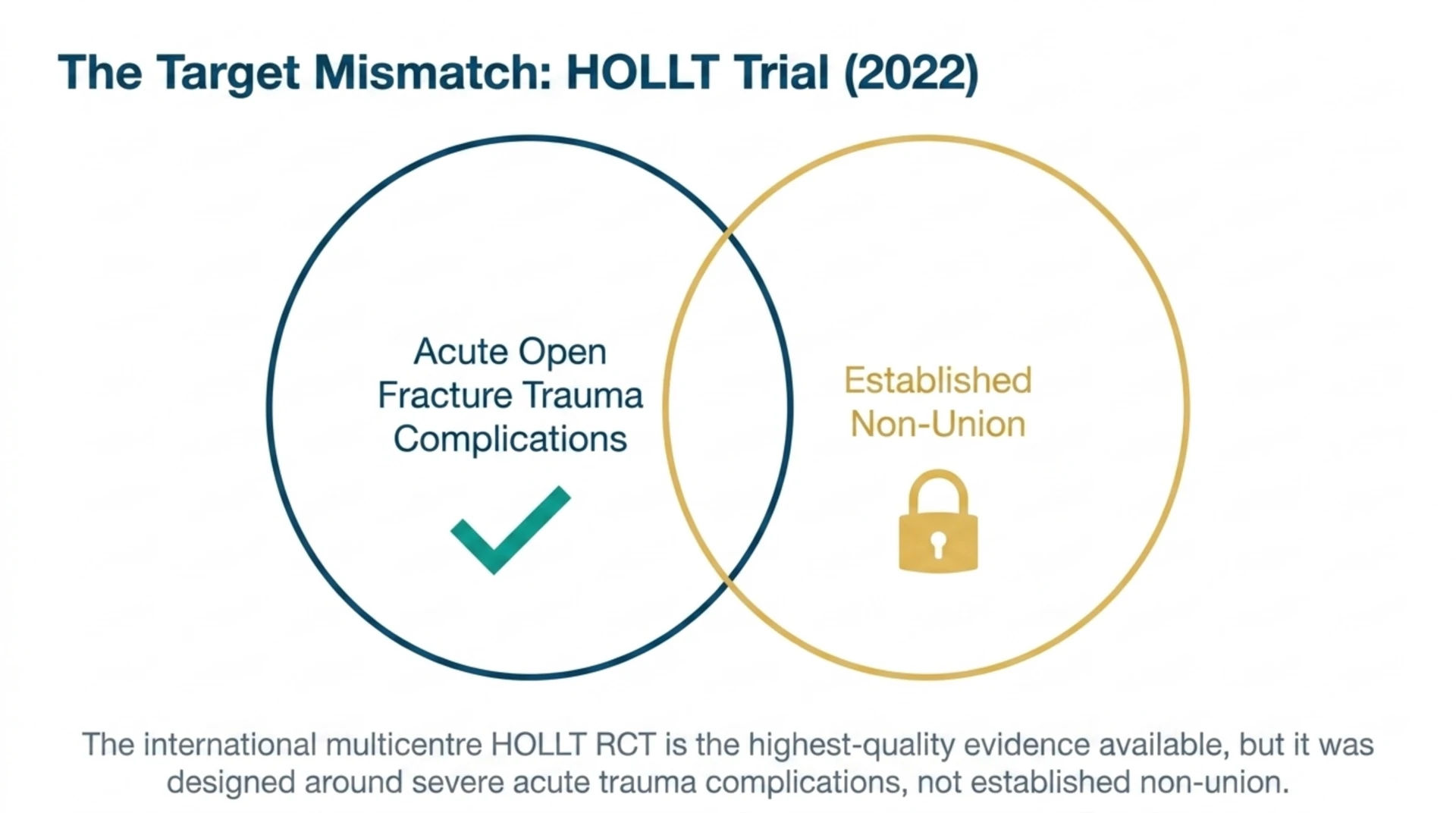
Two linked publications describe the Hyperbaric Oxygen in Lower Limb Trauma (HOLLT) trial: a 2015 protocol paper (PubMed | Our Assessment) and the completed international multicentre randomised trial published in 2022 (PubMed | Our Assessment). HOLLT was designed to test whether adding HBOT to standard care reduces complications after severe open tibial fractures. This is genuine randomised-trial evidence, and it is the highest-quality design in this pool. But it is important to be precise about what it tested: HOLLT was built around acute open fracture trauma and complication rates, not specifically around established non-union. It is relevant background evidence for fracture-related HBOT use, not a direct test of the non-union question.
Case Reports: Individual Patients, Not Population Evidence
Several entries in this pool are single-patient case reports, which is common in a niche adjunct therapy but limits what can be concluded. A 2025 case report (PubMed | Our Assessment) described a 43-year-old woman with pycnodysostosis, a rare bone disease that causes fragile bones through impaired osteoclast function, who had experienced multiple failed surgeries for a femoral fracture before receiving a course of adjunctive hyperbaric oxygen therapy. Separately, a 2018 case report (PubMed | Our Assessment) documented a 25-year-old man with poorly healing bilateral mandibular fractures at risk of developing osteomyelitis, treated with HBOT alongside antibiotics. A single case, however carefully documented, cannot separate the effect of HBOT from the effect of surgery, antibiotics, time, or the natural variability of individual healing.
How Might Hyperbaric Oxygen Help Bone Healing? The Proposed Mechanism
The biological rationale for HBOT in stalled fracture healing rests on oxygen’s role in bone repair. Bone healing depends on adequate blood flow to deliver oxygen to the fracture site, since osteoblast activity, collagen formation, and the growth of new blood vessels (angiogenesis) are all oxygen-dependent processes. In non-union, blood supply to the fracture gap is often compromised, which may starve the healing process of the oxygen it needs. A 2006 review of electric stimulation and hyperbaric oxygen therapy in nonunions (PubMed | Our Assessment) laid out this mechanistic case, summarizing the proposed biological pathways alongside the available experimental and clinical evidence at the time.
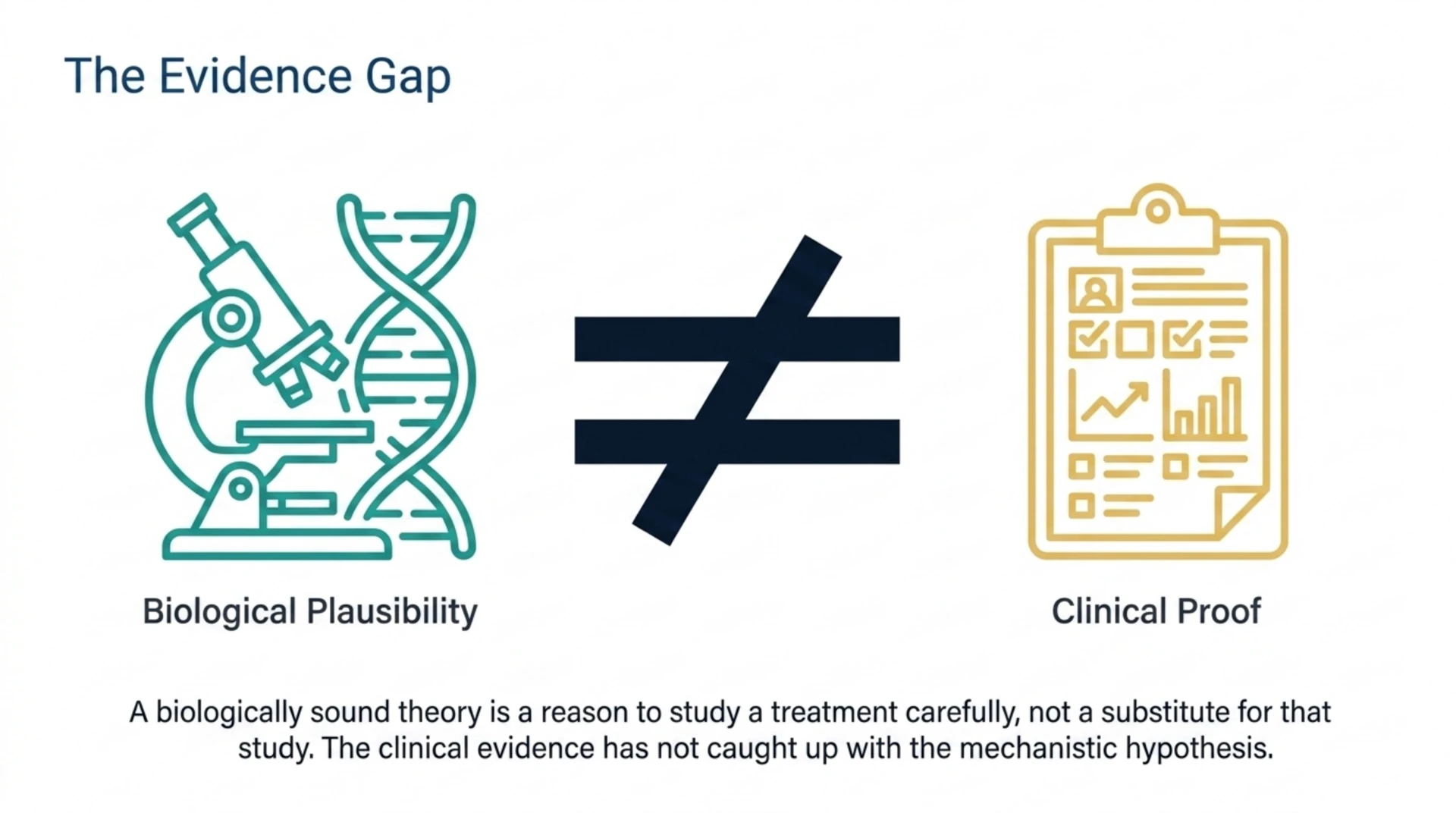
This mechanistic plausibility is a reason to study HBOT for non-union carefully, not a substitute for that study. A biologically sound theory has been wrong before, and the reviews in this pool consistently flag that the clinical evidence has not caught up with the mechanistic hypothesis.
What Do the Broader Orthopedic Reviews Conclude?
Two further reviews reinforce the same pattern. A 2017 review of HBOT in orthopaedic and rheumatological disease (PubMed | Our Assessment) analyzed the efficacy and limitations of HBOT across orthopaedic conditions and found the evidence insufficient to support routine use in most of these indications. An earlier 2002 review covering 43 papers spanning four decades (PubMed | Our Assessment) summarized proposed mechanisms, indications, contraindications, and cost impact for adjunctive HBOT in musculoskeletal disorders, describing a treatment used selectively rather than one backed by a deep trial base.
Comparing the Evidence at a Glance
| Study (year) | Design | What It Actually Tested |
|---|---|---|
| Cochrane review, 2012 | Systematic review | Searched for RCTs of HBOT for fracture healing/non-union; found none completed |
| Tibial non-union study, 2020 | Comparative clinical study (no untreated control) | PRP vs. HBOT as callus accelerators after Ilizarov fixation, 50 patients total |
| HOLLT protocol, 2015 | RCT protocol | Planned design for testing HBOT after severe open tibial fracture |
| HOLLT trial, 2022 | International multicentre RCT | HBOT plus standard care vs. standard care for complications after open tibial fracture |
| Pycnodysostosis case report, 2025 | Single case report | Adjunctive HBOT after repeated failed femoral fracture surgeries |
| Mandibular fracture case report, 2018 | Single case report | Adjunctive HBOT with antibiotics for poorly healing jaw fractures |
| Orthopedic/rheumatologic review, 2017 | Narrative review | Efficacy and limitations of HBOT across orthopaedic conditions |
| Musculoskeletal disorders review, 2002 | Narrative review (43 papers) | Mechanisms, indications, and cost impact of adjunctive HBOT |
What Are the Limitations of the Current Evidence?
Taken together, this pool tells a consistent story: the biological rationale for HBOT in non-union fracture healing is more developed than the clinical trial evidence supporting it. Several honest limitations are worth naming plainly:
- No completed randomised controlled trial has directly tested HBOT against a control specifically for fracture non-union.
- The largest RCT in this pool, HOLLT, was designed around acute open fracture trauma and complications rather than established non-union.
- The one comparative non-union study compared two active adjuncts (PRP vs. HBOT) rather than testing HBOT against no additional treatment.
- Case reports describe individual outcomes and cannot rule out the role of surgery, antibiotics, or natural healing variation.
- Multiple independent reviews, spanning 2002 to 2017, reach the same conclusion: the evidence base is insufficient for firm recommendations.
None of this means HBOT cannot help in select non-union cases, particularly where poor blood supply is a documented factor. It means the current published evidence has not established that it reliably does, which is a different and more limited claim.
Frequently Asked Questions
Is hyperbaric oxygen therapy a proven treatment for non-union fractures?
No. The 2012 Cochrane review found no completed randomised controlled trials on HBOT for fracture healing or non-union, and no study published since has closed that gap for non-union specifically.
What does the strongest available randomised trial actually test?
The HOLLT trial is the highest-quality randomised evidence in this pool, but it evaluated HBOT alongside standard care for complications after severe open tibial fractures, not established non-union.
Did the 2020 tibial non-union study show HBOT works better than no treatment?
It cannot answer that question. The study compared 50 patients split between two active adjunct therapies, PRP and HBOT, both added to the same Ilizarov surgical technique; it did not include a group receiving no adjunct therapy.
Why might oxygen help a fracture that will not heal?
Bone healing depends on oxygen-dependent processes including new blood vessel growth and osteoblast activity. Non-union often involves poor blood supply to the fracture site, so raising tissue oxygen levels is a biologically plausible, though not yet clinically proven, way to support stalled healing.
Is HBOT covered for non-union fractures in Canada?
Non-union fracture treatment is not among the standard funded indications for HBOT in most Canadian provinces. Readers can review general funding context at HBOT Coverage in Canada.
Should someone with a non-union fracture ask their surgeon about hyperbaric oxygen?
That is a reasonable question to raise, particularly if impaired blood supply is a documented factor in the non-union. It is a decision for the treating surgical team, made case by case, not something the current evidence supports as a routine addition.
The Bottom Line
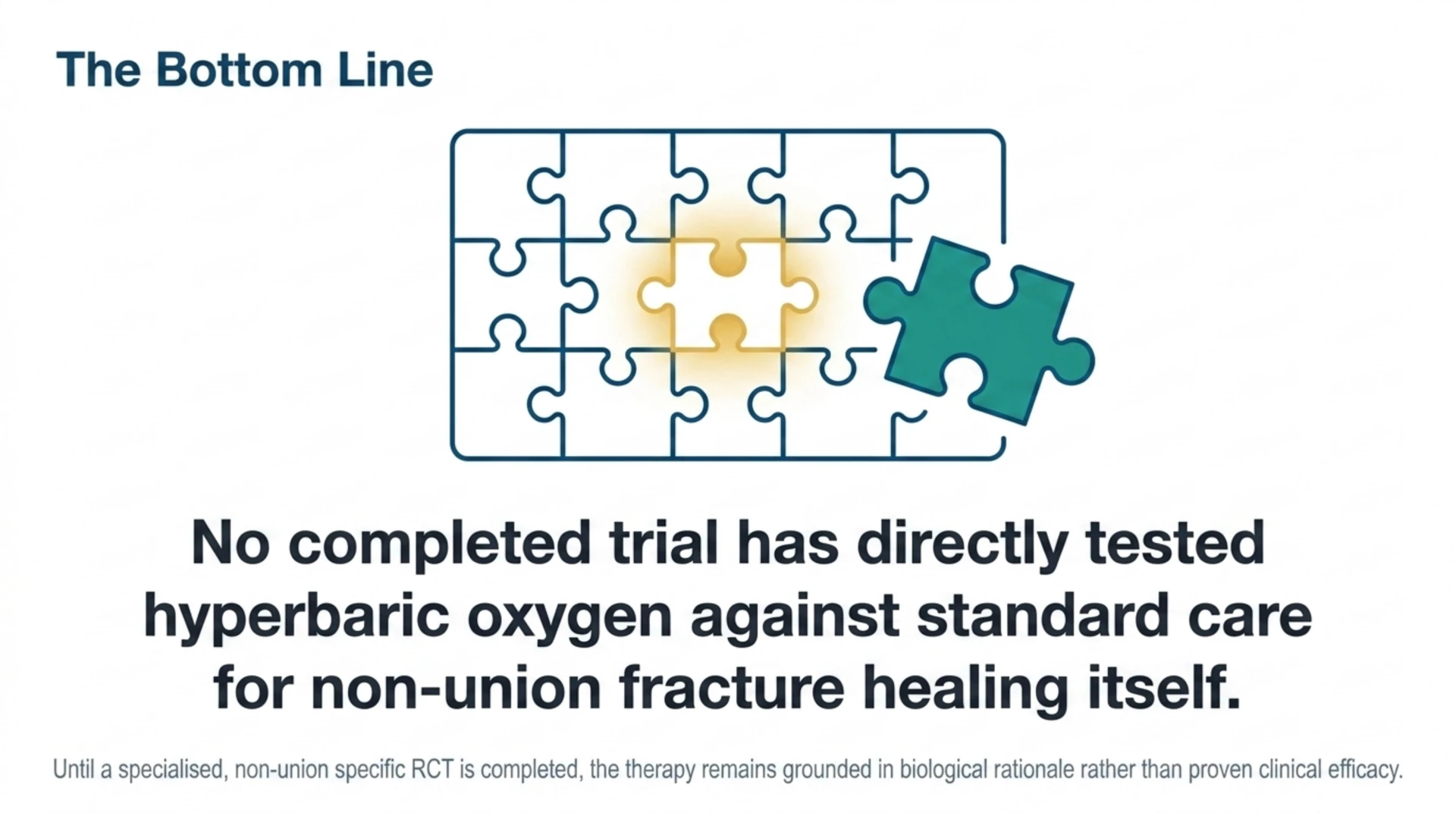
The hyperbaric oxygen non-union fracture healing evidence is real but early-stage. It consists of a mechanistic rationale grounded in how bone repair depends on oxygen, a handful of case reports, one small comparative study between two active adjuncts, and a well-designed randomised trial built around a related but distinct question of open fracture trauma complications. No completed trial has directly tested HBOT against standard care for non-union fracture healing itself. That gap, repeatedly flagged across reviews published fifteen years apart, is the single most important fact for anyone evaluating this therapy.
The Canada Hyperbarics research library will continue tracking new publications in this area as they appear, since a well-designed RCT targeting non-union specifically would meaningfully change this picture.
Related Reading
- HBOT for Diabetic Foot Ulcers: Cost-Effectiveness Evidence
- Hyperbaric Oxygen for Calciphylaxis: What Evidence Shows
- Managing Claustrophobia During Hyperbaric Oxygen Therapy
Anyone considering hyperbaric oxygen therapy for a non-union fracture should discuss it directly with their treating physician or surgeon, who can weigh it against their specific injury, medical history, and treatment plan.
This content is for informational purposes only and is not medical advice.